
A DWI arrest can upend a normal day fast. One moment you're driving home, answering texts from family, or thinking about work the next morning. A few hours later, you're holding bond paperwork, worrying about your license, your job, and what this will do to your record.
That fear is real. It's also not the end of the story.
Lawyers beat DWI cases in Texas by treating the case as a chain of decisions, deadlines, and proof problems. A strong Houston DWI lawyer or Texas DUI attorney doesn't wait for trial and hope for a miracle. The work starts at the stop, moves through the license case, tests the arrest, attacks the evidence, and uses every weakness to protect your future.
You Are Not Alone After a Texas DWI Arrest
Individuals charged with DWI have never been in this position before. They're not thinking like prosecutors or police officers. They're thinking about whether they can still drive to work, whether their family will find out, and whether a first DWI in Texas means their life is about to permanently change.
An arrest is serious, but it is not a conviction. Texas DWI cases can be challenged, and many are.
An analysis of 83,088 DWI charges in Texas found 6,771 dismissals and 3,275 releases, which means a combined 11.4% of those charges ended without a conviction through those outcomes alone, according to Texas DWI outcome statistics discussed by Doug Murphy Law.
That number matters for one reason. It shows that the State doesn't win automatically just because an arrest happened.
What clients usually misunderstand at the start
The biggest mistake is assuming the case turns on one thing, usually a breath result or the officer's opinion. That's not how these cases are fought. A DWI defense usually turns on several questions at once:
- Why were you stopped at all
- What gave the officer grounds to escalate the encounter
- How were the field sobriety tests given
- Whether the chemical evidence is reliable
- Whether the State can prove each step was lawful
A DWI case is often won on procedure and evidence quality, not on the fact that an arrest was made.
What a strategic defense looks like
The practical approach is simple. Preserve your license issues immediately. Lock down the officer's version early. Review every video, report, and test record. Then force the prosecution to defend weak points they often assume no one will challenge.
That's how lawyers beat DWI cases in Texas. Not with one dramatic move, but with disciplined pressure from the first days forward.
The First 15 Days Your DWI License Suspension Hearing
After a Texas DWI arrest, you are dealing with two separate matters. One is the criminal case. The other is the driver's license case, often called the Administrative License Revocation process, or ALR.
Administrative license suspension means the State can try to suspend your driving privileges through this separate civil process, even while the criminal charge is still pending.
Implied consent means that by driving on Texas roads, you are treated as having agreed to provide a breath or blood specimen under the rules that apply after a DWI arrest. That does not mean the State always wins the license case. It means there is a separate process you must answer quickly.
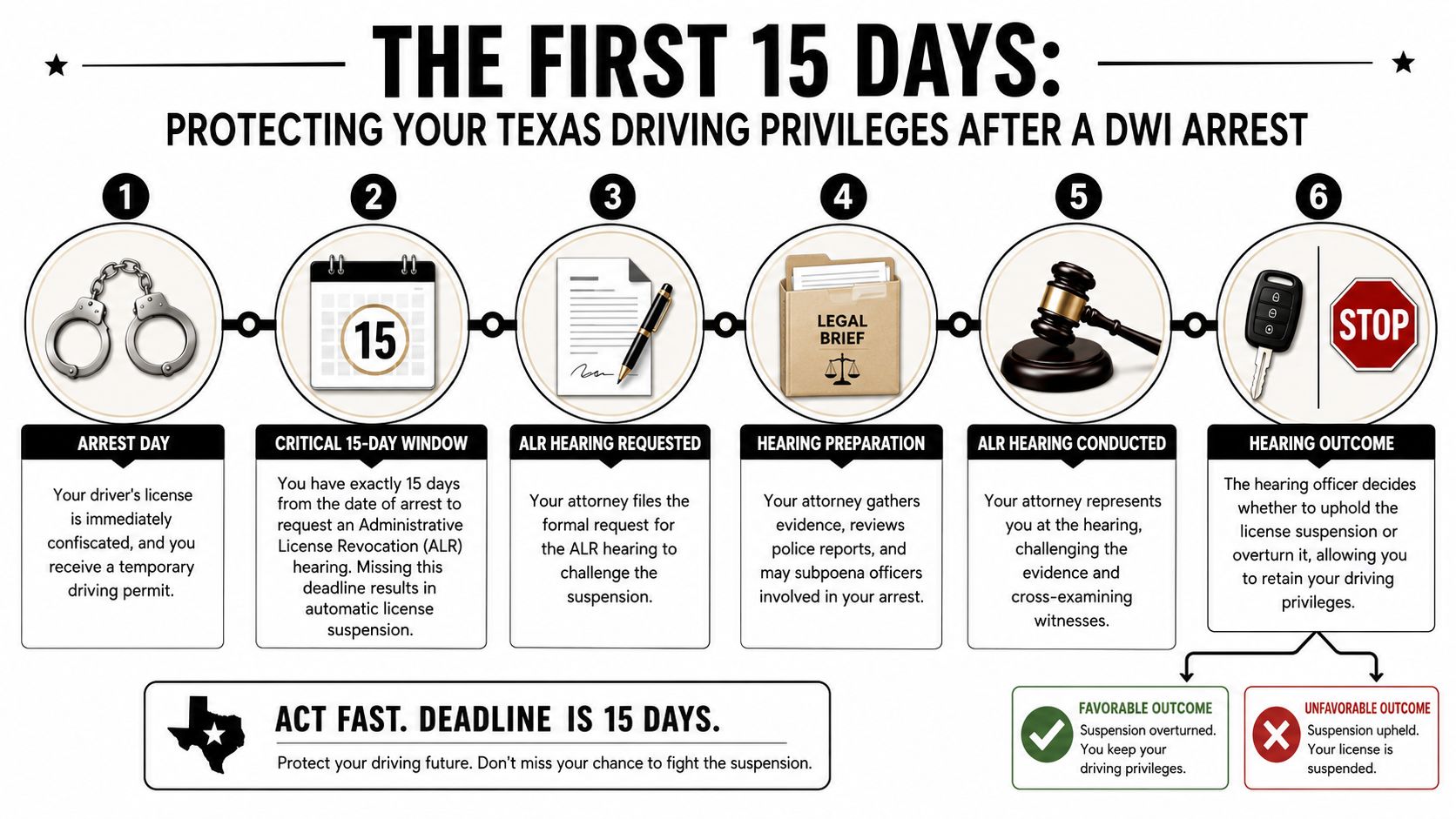
Right after arrest, the deadline becomes urgent. In Texas, you typically have only 15 days from the date of your DWI arrest to request an ALR hearing, and missing that deadline can trigger an automatic license suspension, as explained by Texas DWI lawyers discussing the 15-day ALR deadline.
A timeline helps make the urgency clear.
Why the ALR hearing matters so much
Many people think the ALR hearing is only about driving privileges. It's not. It's also one of the first real opportunities to pressure-test the State's case.
A defense lawyer can use the hearing to examine the officer under oath before the criminal case gets deep into motion practice or trial settings. That early testimony can expose gaps in memory, contradictions with reports, or weak explanations for the stop and arrest. If the officer changes the story later, that matters.
For a working driver, CDL holder, or anyone who needs to stay mobile, this hearing also matters in the obvious way. It can affect whether you keep driving while the criminal case is still unfolding.
The first steps should be immediate
If you've just been arrested, the practical sequence looks like this:
- Protect the deadline by making sure the ALR request is filed on time.
- Secure the paperwork you received after arrest, especially anything tied to your temporary driving status.
- Get counsel involved early so the license case and the criminal case are handled as one strategy, not as separate emergencies.
For a fuller explanation of how this hearing works and how officer testimony can be used, review this guide on ALR hearing cross-examination in Texas.
A short written resource can also help if you're trying to understand the urgency of the deadline itself. The 15-Day ALR Deadline: Save Your License After a DWI Arrest explains why you have only days to request a hearing to stop an automatic license suspension.
Later in the process, many clients want to understand how the hearing looks in practice. This overview is useful:
Practical rule: If you miss the ALR deadline, you don't just lose time. You lose leverage.
Challenging the Traffic Stop and Arrest
Every DWI case starts with a stop. If the stop was unlawful, the rest of the case may be vulnerable from the ground up.
The legal standard for the stop is reasonable suspicion. In plain English, that means the officer must be able to point to specific facts that justified pulling you over. A hunch isn't enough. The legal standard for arrest is probable cause, which is a higher bar. By the time handcuffs go on, the officer must be able to explain why the facts supported a DWI arrest.
That distinction matters because a case can fail at the beginning.
A recognized Texas defense strategy is the traffic-stop suppression theory. If the officer lacked reasonable suspicion for the initial stop, evidence that followed, including field sobriety tests and the arrest itself, can be ruled inadmissible under the Fourth Amendment, as described in this Texas DWI defense strategy discussion.
What lawyers actually examine
A police report may say the vehicle drifted, failed to maintain a lane, or committed some other violation. The video doesn't always match that description. A careful lawyer compares the written report to the dashcam, bodycam, dispatch records, and timing of the encounter.
Look for issues like these:
- Mismatch between report and video. The officer says one thing happened, but the footage doesn't show it clearly.
- Vague driving facts. The report uses general language without identifying a clear traffic violation.
- Escalation without support. The officer moves quickly from a routine stop to a DWI investigation without enough observable facts.
The stop is not the same as the arrest
Clients often ask, “If the officer smelled alcohol, doesn't that make the arrest valid?” Not by itself. The law still requires a lawful stop first, and then enough facts to justify moving from investigation to arrest.
That's why lawyers spend so much time on the first minutes of the encounter. Those minutes shape everything that comes after.
If you want to see how this argument is built in real cases, this article on an illegal traffic stop DWI Texas defense strategy is a useful starting point. So is Was Your DWI Stop Legal? Reasonable Suspicion and Probable Cause, which focuses on how an unlawful stop can undermine an entire DWI case.
When the stop fails, the prosecution can lose the evidence that made the case look strong.
Deconstructing Field Sobriety and Chemical Tests
Police reports often treat test results as if they settle the case. They don't. A defense lawyer's job is to separate what looks official from what is reliable.
Field sobriety tests are roadside exercises officers use to look for signs they associate with impairment. The problem is that these tests are affected by many things that have nothing to do with intoxication, including nerves, fatigue, physical limitations, footwear, lighting, and the surface where the tests were given.
BAC stands for blood alcohol concentration. It refers to the amount of alcohol measured in a person's body through breath or blood testing. That number can become powerful evidence, but only if the State can show the testing was done correctly and the result means what the prosecution says it means.
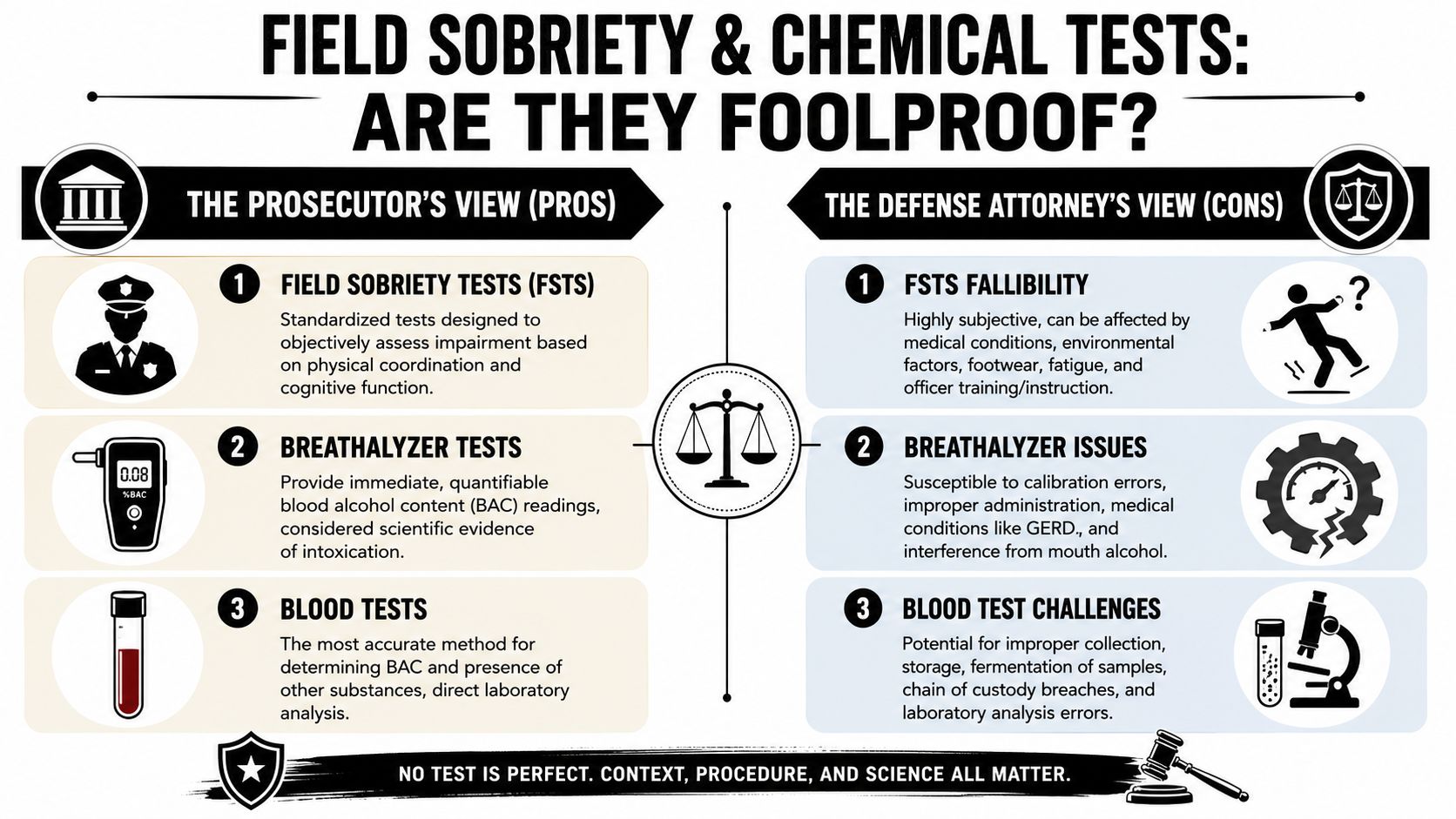
Why field sobriety tests are often overstated
The roadside tests are presented as standardized, but real-world conditions rarely feel standardized to the person taking them. Instructions may be rushed. The shoulder may slope. Traffic may be flying by. The officer may count anything unusual as a clue.
A careful defense doesn't just ask whether you “passed” or “failed.” It asks:
- Were the instructions clear
- Was the environment appropriate
- Did the officer document medical or physical issues
- Does the video support the conclusions in the report
For many jurors, seeing the actual footage is more important than hearing the summary.
Why breath and blood evidence can be challenged
Chemical evidence sounds scientific, but science in court still depends on procedure. Lawyers can beat DWI cases by attacking the reliability of BAC evidence, including problems with breath machine calibration, maintenance, blood sample chain of custody, and the prosecution's use of retrograde extrapolation, as discussed in this guide on beating a DWI in Texas.
Retrograde extrapolation is the prosecution's attempt to work backward from a later test and estimate what your BAC was at the time of driving. That can be a weak point when timing, absorption, or elimination facts are uncertain.
What works and what usually doesn't
Some defenses carry more weight than others. A broad claim that “the machine was wrong” usually doesn't go far by itself. A specific challenge tied to records, procedures, timing, or handling is much stronger.
Disciplined evidence review matters most:
| Issue | Why it matters |
|---|---|
| Breath machine records | They may reveal maintenance or calibration questions |
| Observation period problems | They may affect whether the test was properly administered |
| Blood sample handling | Breaks in chain of custody can weaken reliability |
| Timing gap | It can make later test results harder to connect to driving |
If you want a closer look at one part of that process, this article on how to challenge field sobriety test results in Texas focuses on the roadside portion of the case.
Test results are evidence. They are not the verdict.
Uncovering Flaws in the State's Evidence
By the time a DWI case reaches court, the State usually presents it as a finished story. The primary work is testing whether that story holds up across every document, video clip, timestamp, and witness account. That review starts early, often while the ALR case and the criminal case are both developing, because a weakness found in one track can shape the defense in the other.
Discovery is the process for getting the State's file. In practice, that means more than reading the offense report and watching the patrol video once. A careful defense review compares dispatch logs, body camera footage, intoxilyzer records, lab paperwork, booking records, warrant materials, and officer notes to see whether the sequence fits.
Small inconsistencies matter.
An officer may describe a smooth investigation, but the video shows confusion about instructions or timing. A report may say one thing about when driving was observed, while dispatch records suggest something else. A blood draw packet may look complete at first glance, but signatures, labels, or transfer records may leave room to question reliability. Those are not technicalities. They are proof problems.
Strong DWI defense also means checking whether the people involved did their jobs the way Texas procedure requires. That can include:
- Officer training and certification records tied to the parts of the investigation the State wants to rely on
- Dispatch and timeline records that test whether the sequence of events makes sense
- Video compared against reports and later testimony to catch changes, omissions, or exaggerations
- Warrants, affidavits, and blood draw paperwork for missing details or procedural defects
- Lab and evidence handling records to see whether collection, storage, and transfer were documented correctly
This stage often changes the direction of the case. A file that looked strong at arrest can weaken once the records are lined up side by side. Sometimes the issue is not one dramatic flaw. It is several smaller problems that make the State's version harder to trust.
For some clients, legal representation begins with finding counsel who can address the ALR hearing and the criminal case as one strategy instead of two unrelated fights. The Law Office of Bryan Fagan, PLLC handles Texas DWI defense matters that include ALR hearings, test challenges, and criminal court proceedings.
The State does not win with accusations. It wins with evidence that stays consistent, admissible, and believable under pressure.
Negotiation Plea Bargains and Dismissals
Many people think beating a DWI means only one thing: walking out of trial with a not-guilty verdict. Sometimes that happens. Often, the better result comes earlier.
A prosecutor negotiates differently when the file looks fragile. If the stop may be suppressed, the officer may not present well, or the test evidence has technical problems, the State has to weigh risk. That's where the defense gains an advantage.
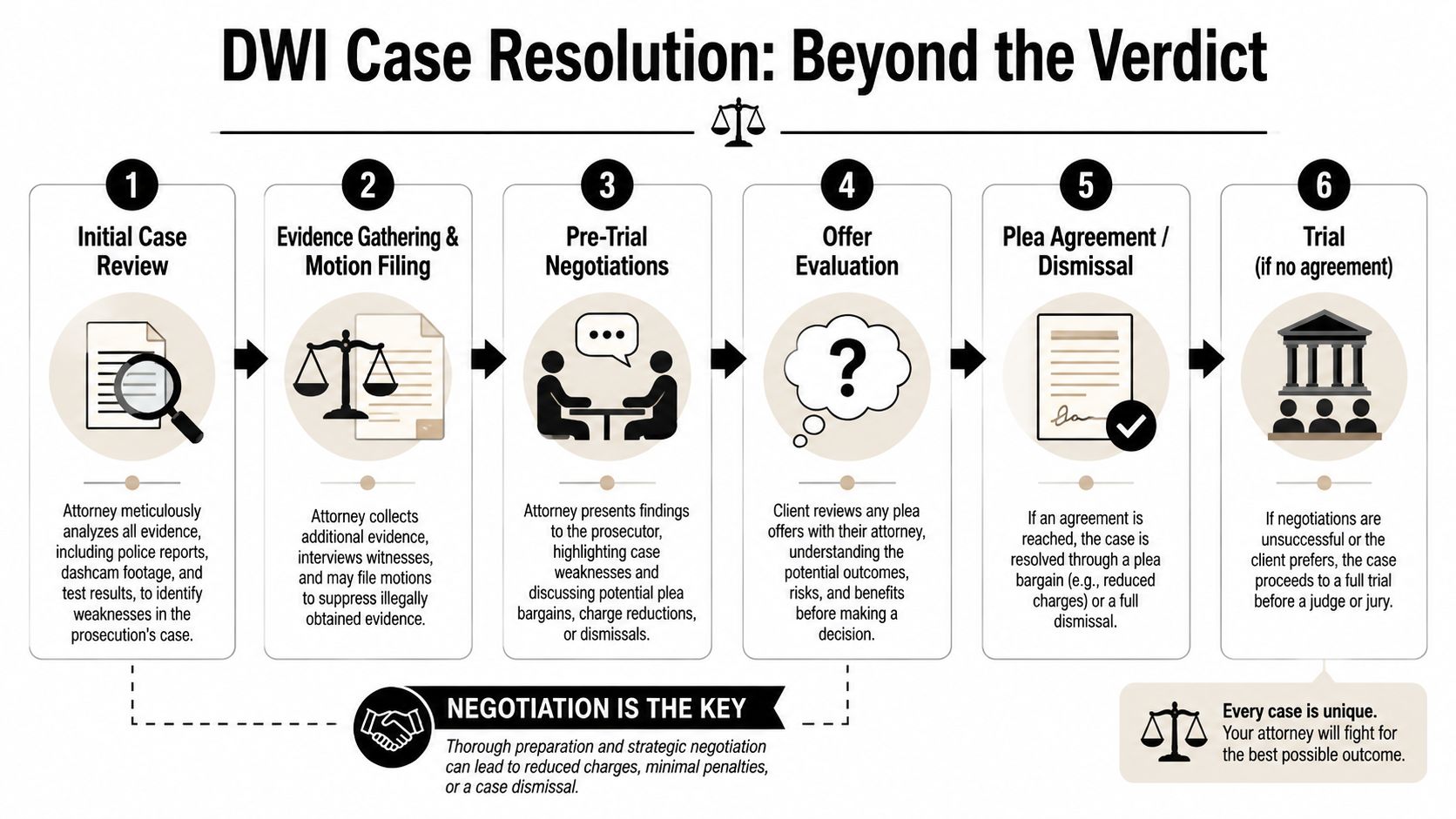
What a good negotiated result can look like
A favorable result is not always the same from case to case. It depends on the evidence, the county, the client's history, and the risks of trial.
Possible outcomes may include:
- Dismissal when the State can't carry its proof
- Reduction to a different offense when the DWI proof is weak
- A negotiated resolution that limits long-term damage and protects future options
- Deferred adjudication in cases where that path is available and strategically wise
For a first DWI in Texas, the right answer is not always “fight to trial” and not always “take the first offer.” The right answer is the one that matches the strength of the evidence and your real-life priorities, including your license, work, immigration concerns, professional licensing, and record consequences.
Trial leverage starts before trial
Strong negotiation comes from preparation. Prosecutors respond when they know the defense has found actual weaknesses and is prepared to litigate them. Empty threats don't move cases. Well-supported motions, disciplined cross-examination, and organized evidence review do.
That's also why felony-level cases demand even more care. If a DWI is charged as a felony, the stakes rise sharply, and every early decision matters more.
A plea bargain is not surrender. Sometimes it is the most strategic way to fight DWI Texas cases because it turns the State's proof problems into a concrete result you can live with.
What to Do After a DWI Arrest A Practical Checklist
When clients ask what to do first, the answer is usually simpler than they expect. Protect your rights. Preserve information. Don't make the State's job easier.
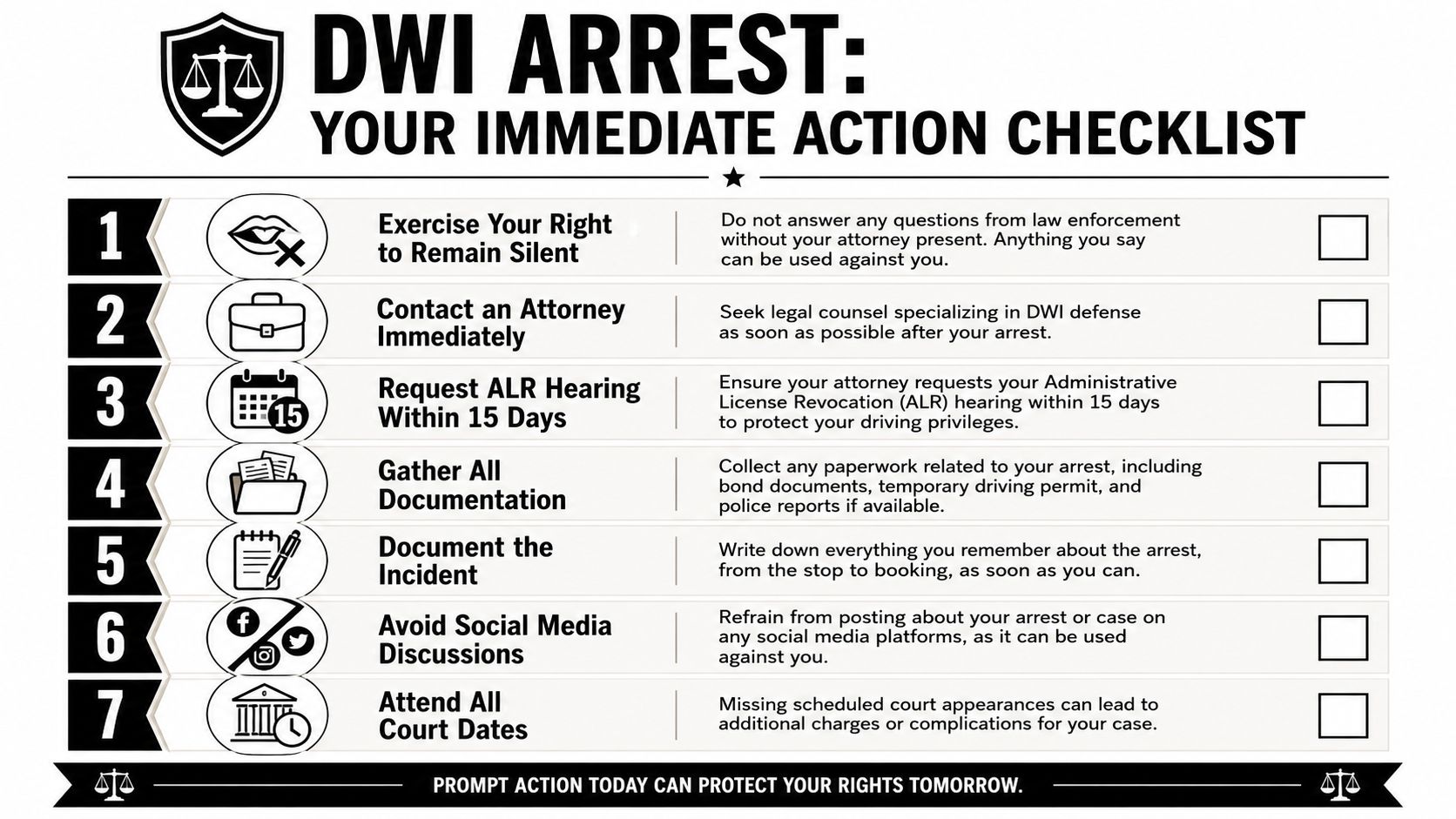
Your immediate next steps
- Stay quiet about the facts of the case. You have the right to remain silent. Use it. Don't try to explain, justify, or talk your way out of what already happened.
- Call a DWI defense lawyer quickly. Early action matters because the case starts moving before many people realize it.
- Make sure the ALR issue is addressed. That deadline comes fast, and your driving privileges may depend on acting in time.
- Save every document. Bond paperwork, the temporary permit, towing paperwork, and any notices you received all matter.
- Write down what you remember. Include the stop, what the officer said, where you were asked to stand, what tests were given, and whether anything felt confusing or rushed.
- Stay off social media. Posts, messages, and jokes about the arrest can become evidence.
- Show up to court and follow instructions. Missed appearances create avoidable problems.
Key terms you should understand
Here are the terms clients ask about most:
- Implied consent means Texas treats driving as carrying certain testing obligations after a DWI arrest.
- BAC means blood alcohol concentration.
- Field sobriety test means a roadside coordination or attention test used during a DWI investigation.
- Administrative license suspension refers to the separate license-related process tied to the arrest, apart from the criminal case.
If you're looking for calm, informed guidance, a Houston DWI lawyer or Texas DUI attorney should be helping you make decisions, not adding panic. The right approach is steady and strategic from day one.
A DWI arrest can feel isolating, but you don't have to sort through it alone. Law Office of Bryan Fagan, PLLC helps Texans defend DWI charges by reviewing the stop, protecting driving privileges, challenging test evidence, and strengthening the case for dismissal, reduction, or trial when necessary. If you need answers about your license, your court dates, or how to fight a DWI in Texas, request a free, confidential consultation and get a clear assessment of your next steps.