
A DWI arrest can be overwhelming, but you don't have to face it alone.
You may be sitting at your kitchen table right now, looking at bond paperwork, worrying about your license, your job, and whether a jury will believe you. That reaction is normal. Individuals charged with DWI have often never been through a criminal trial, and the idea of six or twelve strangers deciding your future feels personal because it is.
A Texas DWI jury trial isn't a mystery once you strip away the courtroom jargon. It's a structured fight over evidence, credibility, and whether the State can prove its case beyond a reasonable doubt. If you want to understand how jury trials work in Texas DWI cases, start with one truth: your case is won or lost by strategy long before the verdict form comes back.
Your DWI Case and the Path to a Jury Trial
A lot of clients come in thinking trial starts on the day everyone walks into court and picks a jury. It doesn't. Trial starts the moment someone decides whether to challenge the stop, the arrest, the testing, and the officer's version of events.
For many people, the first weeks after arrest feel chaotic. You're trying to keep driving, keep working, and keep your family calm. At the same time, the criminal case is moving forward whether you feel ready or not. If you want a broad look at that process, review this Texas DWI case timeline from arrest to trial.
What clients usually want to know first
Most questions fall into the same short list:
- Can I beat this case
- Should I ask for a jury
- Will the breath or blood result decide everything
- What happens if I lose
- Can I clear my record if I win
Those are the right questions. A smart defense doesn't focus only on the trial day. It looks at the entire path, including pretrial motions, the jury selection process, the evidence fight, and what happens after the verdict.
Bottom line: A DWI trial is not about whether you were arrested. It's about whether the State can prove intoxication with reliable, admissible evidence.
Why trial is different from a plea
A plea asks you to accept a result. A trial forces the prosecutor to prove one.
That difference matters because DWI evidence is rarely just one thing. Cases often involve officer testimony, roadside observations, video, field sobriety testing, and chemical testing. When those pieces don't fit together cleanly, a jury trial becomes a real option, not a bluff.
The Pre-Trial Phase Deciding to Face a Jury
The most important work in a DWI case usually happens before the jury ever enters the room. If your lawyer waits until opening statement to start defending you, you're already behind.
Pretrial motions can change the whole case
In Texas DWI cases, constitutional issues matter. An unlawful stop, an improper search, an illegal detention, Miranda problems, or a warrant defect can lead to suppression arguments. Trial evidence often includes officer testimony, dash-camera video, body-camera footage, field sobriety testing, breath or blood results, witness testimony, and lab evidence. That also means the defense has multiple points to challenge reliability and credibility, as discussed in this explanation of what happens during a Texas DWI trial.
A good pretrial attack often focuses on questions like these:
Was the traffic stop legal
If the officer had no lawful basis to stop you, that issue can affect everything that came after.Was the detention too long or too intrusive
Police can't stretch a roadside stop indefinitely just because they want to fish for more evidence.Were the tests administered properly
A field sobriety test is not magic. A breath or blood result is not self-proving. Procedure matters.Does the video match the report
Juries often trust what they can see. If the footage undercuts the officer's written narrative, that's powerful.
If you want to understand how these hearings fit into the case, read about what happens at a pretrial hearing for DWI in Texas.
Jury trial or bench trial
This is one of the most important choices in the case, and too many lawyers treat it like routine paperwork.
A jury trial means jurors decide the facts. A bench trial means the judge decides the facts. That sounds simple, but the strategic difference is serious. One Texas DWI source notes that this bench-versus-jury decision is an underserved issue, especially because clients worry that a judge may be more technical while a jury may react more emotionally to intoxication evidence, and existing guidance doesn't offer data-driven answers for common fact patterns such as borderline test results or shaky stop evidence, as noted in this discussion of the Texas DWI trial process.
Which option is safer
There is no universal answer. Anyone who tells you there is, isn't thinking hard enough.
Here's the practical version:
| Situation | Jury may be stronger | Judge may be stronger |
|---|---|---|
| Weak police video | Jurors may notice the gap between the report and what they actually see | Sometimes |
| Technical lab dispute | Sometimes, if explained clearly | Judges may focus more tightly on legal and technical flaws |
| Officer credibility problem | Jurors can react strongly if an officer seems evasive | Judges may also spot inconsistencies quickly |
| Highly emotional facts | Riskier if the State leans on fear and outrage | A judge may be less reactive to emotional framing |
That's why this decision should be made only after reviewing the evidence, the local court, the judge, the prosecutor, and your personal goals.
Don't choose a jury because it sounds more dramatic. Choose it because it fits the facts of your case.
Terms you need to know now
Before trial, you should understand a few basics:
- BAC means blood alcohol concentration.
- Field sobriety test refers to roadside physical and attention tests officers use to claim impairment.
- Implied consent means Texas drivers are deemed to have consented to certain testing under state law, which can create separate license consequences if a person refuses.
- Administrative license suspension means the civil process that can affect your driving privilege apart from the criminal case. Many people know this as an ALR issue or DWI license suspension problem.
If you're trying to fight DWI Texas charges seriously, pretrial work is where that fight begins.
Building the Jury Understanding Voir Dire
Voir dire is the part of trial where lawyers question potential jurors. Most clients expect it to be dry and procedural. It isn't. It's one of the most important parts of the case.
A DWI jury is not picked by guessing who will “like” you. Instead, the goal is to identify people who cannot be fair, especially in cases involving alcohol, driving, police authority, and scientific testing.
What lawyers are looking for
Some people walk into court already believing three things:
- If you were arrested, you probably did something wrong.
- Police officers are usually right.
- A breath or blood test settles the case.
Those beliefs can wreck a defense if they go unchallenged.
A skilled Texas DUI attorney uses voir dire to test those assumptions in public. That matters because once a juror says, out loud, that they would always believe an officer over a civilian, or that any drinking before driving equals guilt, the court has a basis to deal with that bias.
Two terms that matter
You'll probably hear these during jury selection:
Challenge for cause
This is used when a juror shows a clear inability to be fair or follow the law.Peremptory strike
This allows a lawyer to remove a juror without giving the full factual explanation that a for-cause challenge requires, subject to legal limits.
Your lawyer won't explain every strike decision to you in real time, and that's normal. Jury selection moves fast. What matters is whether the panel that survives can follow the law instead of their assumptions.
Jurors don't need to agree with your life choices. They need to follow the presumption of innocence and hold the State to its burden.
What the questioning sounds like
In a Texas DWI case, common voir dire topics include:
Alcohol use and driving beliefs
Some jurors think any amount of alcohol means automatic intoxication.Trust in police testimony
Others may start with the view that an officer has no reason to exaggerate.Views on chemical testing
Many people assume machines and labs don't make mistakes.Reasonable doubt
This is the core issue. Can the juror acquit if the evidence leaves uncertainty?
Why this stage shapes the whole trial
Voir dire is also where the defense starts teaching, carefully and legally. Jurors hear that the State must prove every required element. They hear that roadside tests are contestable. They hear that people can be accused and still be not guilty.
That matters because jurors don't enter the courtroom as blank slates. They bring habits, fears, and assumptions. Good voir dire doesn't create a favorable jury out of thin air. It removes jurors who can't be fair and frames the case around law instead of emotion.
What you should do during voir dire
Your role is simple but important:
Stay engaged
Jurors notice whether you look bored, angry, or dismissive.Don't react visibly
If someone on the panel says something unfair, let your lawyer handle it.Trust the process
A juror who looks polished and respectful is not always a good defense juror. A juror who asks hard questions is not always bad.
A calm, prepared client helps. Anxious body language can send the wrong message before the evidence even starts.
The DWI Trial Process from Opening to Closing
This is the part people picture when they think about court. Lawyer stands up. Witness takes the stand. Jury watches everything. That's accurate, but the actual trial is more disciplined than dramatic.
Here's the big picture first.
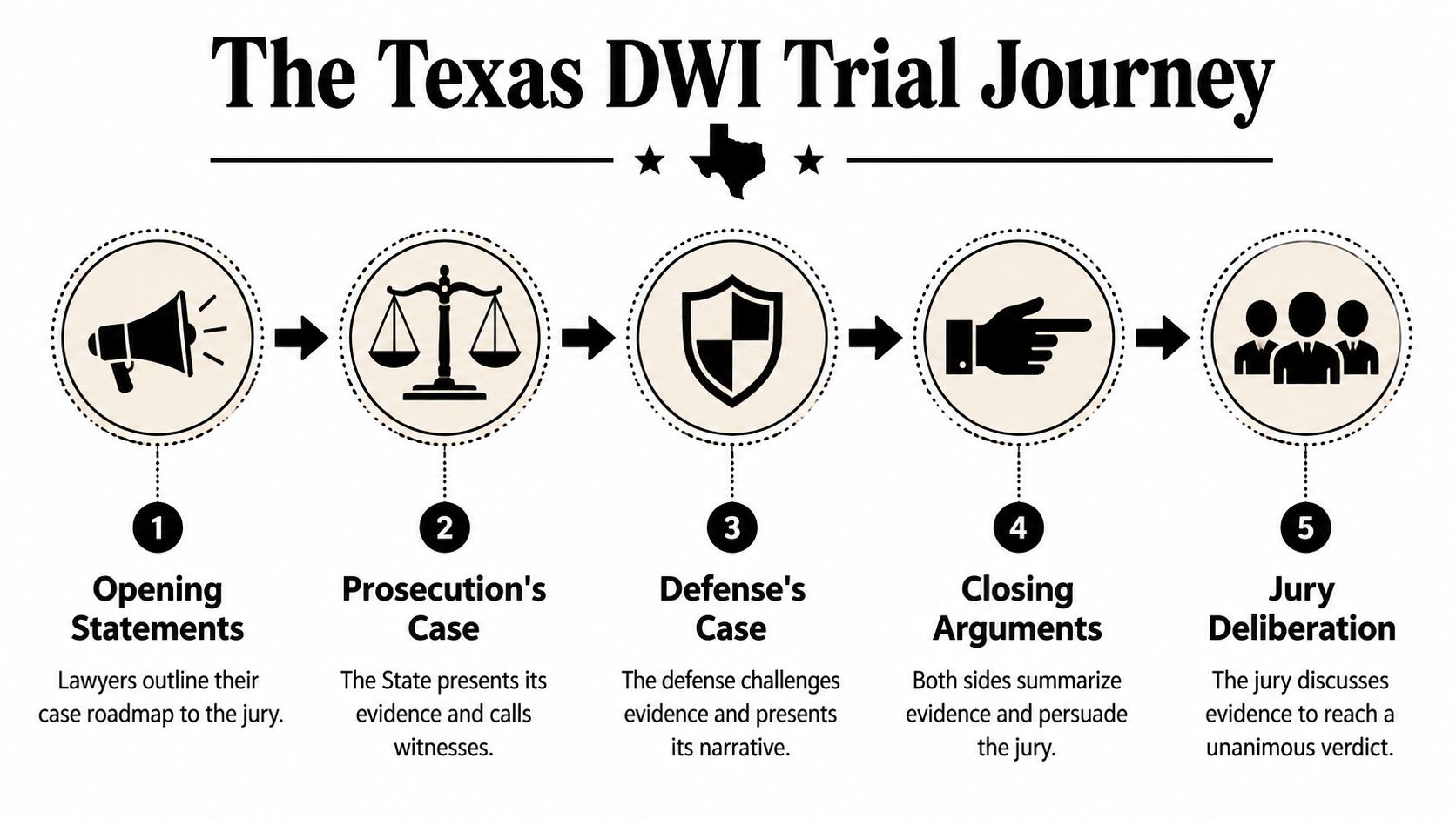
Opening statements
Openings are roadmaps, not evidence. The prosecutor tells the jury what they expect the evidence will show. The defense tells the jury where the State's proof will break down.
In a DWI case, that often means the defense immediately focuses the jury on specific weak points rather than broad emotion. Was the stop questionable. Does the video match the officer's description. Were the field sobriety tests done under poor conditions. Is the chemical evidence reliable.
The State presents its case
A Texas DWI jury trial is a burden-of-proof contest. The prosecution must prove the DWI allegation beyond a reasonable doubt, and the burden stays on the State throughout the case. Typical evidence can include officer testimony, dash-cam video, body-cam footage, field sobriety testing, breath or blood results, witness testimony, and lab evidence, as explained in this review of what evidence prosecutors use in Texas DWI cases.
That's why the prosecutor usually starts with the arresting officer.
Common State witnesses
Arresting officer
The officer describes your driving, your speech, your balance, your appearance, and your performance on field sobriety tests.Breath or blood witness
Depending on the case, this may be the person who administered a breath test or handled a blood draw.Lab witness
If the case involves blood testing, the State may call a lab witness to explain the result.Civilian witnesses
Sometimes the State uses crash witnesses, passengers, or bystanders.
Cross-examination is where the fight happens
A seasoned Houston DWI lawyer earns their fee at this stage.
Cross-examination isn't theater. It's controlled damage to the State's story. The defense tests whether the officer remembers the event, whether the report was inflated, whether the roadside tests were explained correctly, and whether the video supports the claims made in court.
A few examples of useful cross points:
| Witness | What the defense may challenge |
|---|---|
| Officer | Basis for the stop, consistency of observations, training limits, omissions from report |
| Breath witness | Procedure, observation period issues, machine assumptions |
| Lab witness | Handling, contamination concerns, chain-of-custody gaps |
| Civilian witness | Memory, position to observe, bias, confusion |
Trial rule: The defense does not need to prove you were sober. The defense needs to show why the State's proof can't be trusted enough to convict.
The defense case
After the State rests, the defense may present evidence. Sometimes that means witnesses. Sometimes it means documents, video clips, expert testimony, or resting and arguing that the State failed to carry its burden.
Not every good defense calls the defendant to testify. That decision is strategic. Some cases are stronger when the defense stays focused on the State's weak evidence. Others benefit from testimony that supplies missing context.
Possible defense themes include:
- Bad stop
- Poor field sobriety testing conditions
- Normal behavior mistaken for intoxication
- Inconsistent officer testimony
- Video that contradicts the written report
- Questionable chemical evidence
A careful defense lawyer doesn't put on evidence just to look active. Every witness creates risk. The jury only needs one solid reason to doubt the State.
Here's a useful overview if you want to hear trial mechanics discussed in a more visual format.
Closing arguments
Closing is where the evidence gets organized into a verdict request.
The prosecutor will argue that all the pieces point to guilt. The defense should narrow the jury's focus. Not suspicion. Not possibility. Not “probably.” The question is whether the State proved the required elements beyond a reasonable doubt.
A strong closing in a DWI case often does three things:
- Returns to the burden of proof
- Shows where the State's evidence conflicts with itself
- Reminds the jury that doubt based on evidence is enough for a not guilty verdict
This is why people asking how jury trials work in Texas DWI cases need to understand one practical truth. Trial is not about one dramatic moment. It's the accumulation of many disciplined attacks on the State's evidence.
The Jury Deliberates Understanding the Verdict
The lawyers sit down. You wait. Twelve strangers walk into the jury room with your future in their hands.
At that point, the case is no longer about who sounded more confident in court. It is about the court's charge. That document controls deliberations. It tells jurors what law applies, what questions they must answer, and how they are allowed to use the evidence. If a juror wants to rely on something outside that charge, the law says no.
Texas courts make the division clear. The judge decides the law. The jury decides the facts and applies the written instructions to the evidence admitted at trial, as explained by the Texas courts' overview of the judicial system and jury role.
What happens in deliberations
Jurors go behind closed doors and start sorting out credibility.
They talk through what they saw, what they heard, and what still does not add up. They may focus on the officer's testimony, a body cam video, the timing of a stop, the reliability of a breath or blood result, or whether the State proved intoxication under the law given in the charge. A strong defense wants jurors doing exactly that. Examining details. Testing assumptions. Asking whether the proof holds up.
They cannot use rumor, Google, outside advice, or their own investigation. They are limited to the evidence admitted in court.
That matters more than clients usually realize. If harmful evidence was kept out before trial, it stays out of the jury room. If the State's evidence came in but looked weak, inconsistent, or overstated, deliberations are where that weakness starts to matter.
Beyond a reasonable doubt in plain language
Jurors do not need absolute certainty to convict. They do need more than suspicion.
Reasonable doubt exists when the evidence leaves a fair-minded juror with a real question about whether the State proved the charge. In a DWI case, that often sounds like this:
- Why does the video look different from the officer's description?
- Why is the testing method open to attack?
- Why do the details shift from one witness to another?
- Why should we trust a result that rests on a shaky foundation?
Those are not minor issues. Those are verdict issues.
A not guilty verdict can come from one real failure in the State's proof. The defense does not have to explain everything. The State has to prove its case.
Possible outcomes
The jury can return a verdict of guilty or not guilty.
A third result is a hung jury. That means the jurors cannot reach the level of agreement the law requires. The judge can declare a mistrial. That is not a win in the final sense, but it is not a conviction either. It forces the prosecution to make a hard decision about whether the case is strong enough to try again, worth resolving on better terms, or ready to dismiss.
Do not assume the story ends when the verdict is read. In a Texas DWI case, the next phase can affect your license, your record, and your long-term options just as much as the trial itself. That is where smart case strategy separates itself from generic trial talk.
Life After the Verdict Sentencing and Clearing Your Record
The verdict matters. What you do next matters too.
Too many DWI guides stop at the courtroom door, as if the case is over the second the jury speaks. That's bad advice. A smart defense looks past the verdict to your license, your record, your career, and your long-term options.
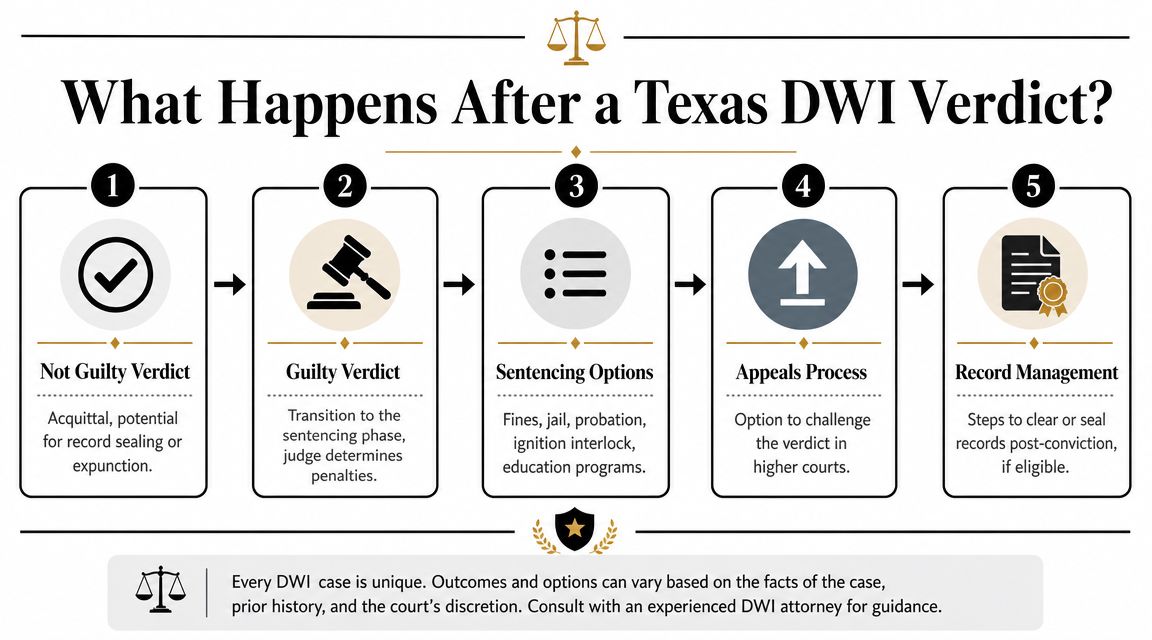
If the verdict is not guilty
This is the outcome everyone wants. It means the State failed to prove the charge.
But don't make the mistake of thinking that acquittal automatically wipes the slate clean. A not-guilty result may make you eligible to seek expunction of the arrest and even related administrative license revocation issues, and some people may qualify for nondisclosure after certain guilty outcomes. These post-verdict consequences are often overlooked even though they affect employment, driving privileges, and record strategy, as noted in this article on the DWI court process and post-trial consequences.
Terms to know after trial
Expunction
A court process used to erase eligible arrest records from public view.Nondisclosure
A court order that seals qualifying records from public access, though not in the same way as an expunction.Administrative license suspension
A separate process tied to your driving privilege. A criminal win helps, but you still need to review the license side carefully.
If the verdict is guilty
A guilty verdict does not mean you stop fighting. It means the case shifts into a different phase.
In many Texas DWI cases, punishment can involve jail, fines, probation or community supervision, ignition interlock requirements, classes, and other conditions. The exact outcome depends on the charge level, the facts, your history, and who is deciding punishment in that case.
Immediate decisions after a guilty verdict
At this stage, disciplined legal advice matters most.
Sentencing strategy
The punishment phase needs preparation. Mitigation, employment issues, treatment history, and family obligations can all matter.Appeal review
Some trial errors can be challenged on appeal. Not every loss is a final one.Motion for new trial
In some cases, post-trial motions may be appropriate depending on what happened during the proceedings.Record planning
Even after a conviction, future record sealing options may matter if the disposition qualifies.
Don't ignore the license issue
A lot of people focus so heavily on the criminal verdict that they forget the driving side of the case. That's a mistake.
Your DWI license suspension issue may involve deadlines, reinstatement steps, and collateral consequences that affect work and family life long after trial. This is especially serious for CDL holders, people who drive for work, and licensed professionals who need a clean record and valid license to stay employed.
Practical next steps after the verdict
Here's the order I recommend clients think in:
Get the verdict explained clearly
You need to know what happened, what did not happen, and what remains open.Address sentencing or release conditions immediately
Don't assume details will sort themselves out.Review your license status
Criminal court and license consequences don't always move together.Ask about expunction or nondisclosure
If you're eligible, move with purpose.Protect your employment and professional licensing issues early
Waiting usually makes these problems harder.
Winning trial is powerful. Finishing the cleanup is what protects your future.
You Don't Have to Face a DWI Trial Alone
The phone rings the day before court, and you realize this case is no longer about a quick plea offer. The State is ready to put on witnesses, argue the stop was lawful, defend the breath or blood result, and ask 12 jurors to trust its version of events. That is the moment you need a real trial plan, not guesswork.
A DWI jury trial is uncommon for one reason. It usually means there is a real fight worth having. The dispute may be about the stop, the officer's observations, the testing, the video, or the State's ability to prove intoxication beyond a reasonable doubt. Trial also is not the end of the story. The right defense strategy has to account for what happens after the verdict, including your license, sentencing issues, and whether your record can be cleared later.
What strong DWI defense looks like
It starts with preparation.
Strong defense work means reviewing every report, every video, every lab record, and every timeline problem in the State's case. It means deciding early whether a jury trial helps you, whether a bench trial makes more sense, and whether pretrial motions can weaken the prosecution before a jury is ever seated.
It also means giving you a straight answer. Some cases should be tried. Some should be resolved on terms that protect your future better than a risky verdict. A serious Texas DUI attorney should be able to explain that decision clearly and back it up with reasons.
What to ask in a consultation
Use that meeting to test whether the lawyer is thinking past the first court date.
- What are the weak points in the State's evidence?
- Do you see a suppression issue with the stop, arrest, or testing?
- Is this better suited for a bench trial or a jury trial?
- What happens to my driver's license while the criminal case is pending?
- If the case ends well, can I seek an expunction?
- If I am convicted, what are the next legal steps and record-clearing options?
Those last two questions matter more than many people realize. A good defense lawyer is not just trying to win the courtroom fight. The lawyer should also be protecting what comes after, including license consequences, expunction opportunities, and nondisclosure options when the law allows them. That is where a lot of DWI guides fall short.
The right mindset for your case
Treat this like a serious legal problem that can be managed with a clear strategy.
Whether this is your first DWI in Texas or a more serious charge, fear clouds judgment. Good decisions come from understanding the process, testing the evidence, and planning for both possible outcomes. You need to know how the jury will hear the case, how the defense will challenge it, and how you will protect your future after the verdict is read.
You need a plan.
If you've been arrested and need clear advice about jury trial strategy, license protection, or how to fight DWI Texas charges, contact the Law Office of Bryan Fagan, PLLC for a free consultation. We'll listen to what happened, explain your options in plain English, and help you decide the smartest next step for your case.