 Skip to content
A DWI arrest can shake your confidence fast. One night, one traffic stop, one set of handcuffs, and suddenly you're trying to make sense of bond conditions, court dates, your driver's license, and whether your job is at risk.
Many individuals facing this situation ask the same questions. What happens next? Do I have to talk in court? Is the pretrial hearing just paperwork, or does it matter? When looking into what happens at a pretrial hearing for DWI Texas, you are examining one of the most important stages of the case.
The process becomes much more manageable once you understand what each court date is for. A pretrial hearing is not the end of your case, but it can be the point where your defense starts gaining traction. At this stage, preparation matters, legal issues get tested, and weak spots in the State's case can start to show.
You don't have to know how to do any of that on your own. You do need to know why this hearing matters and how to approach it strategically.
A DWI Arrest Is Overwhelming But You Are Not Alone
A lot of clients come in feeling embarrassed, angry, or scared. Some are worried about a first DWI in Texas. Others are more concerned about missing work, keeping a professional license, or figuring out how they'll get around if they're facing a DWI license suspension.
Those reactions are normal.
A DWI case throws several legal tracks at you at once. You may hear terms like arraignment, bond conditions, administrative license suspension, and pretrial hearing before you've even had time to catch your breath. The court system can feel impersonal, but your case is not just another file number.
What usually confuses people first
Many are unaware that a DWI case can involve both a criminal case and a separate driver's license issue.
Here are a few key terms that often come up early:
- BAC means blood alcohol concentration. In a DWI case, the State may rely on a breath or blood test to argue that alcohol was in your system.
- Field sobriety test usually refers to roadside balance and coordination exercises an officer may ask you to perform during a stop.
- Implied consent refers to the rule that by driving in Texas, a driver can face consequences in the license process for refusing a requested breath or blood specimen after a DWI arrest.
- Administrative license suspension is the separate license-related process that can follow a refusal or failed chemical test. It is different from the criminal court case.
Practical rule: Your case is easier to manage when you separate the issues. One track deals with your license. The other deals with the criminal charge.
That distinction matters because the pretrial hearing belongs to the criminal case. It is one of the first times your lawyer can begin pressing the State on evidence, procedure, and weaknesses in the accusation itself.
This court date can create leverage
Clients sometimes assume the important day is the trial. In reality, many of the important fights start earlier.
The pretrial hearing is where your lawyer begins using the law, the evidence, and the facts of your arrest to protect your future. That can affect whether damaging evidence stays in the case, whether negotiations improve, and whether the State has to rethink its position.
The DWI Pretrial Hearing Explained More Than a Formality
Many people think a pretrial hearing is just a scheduling stop. In a Texas DWI case, that's often wrong.
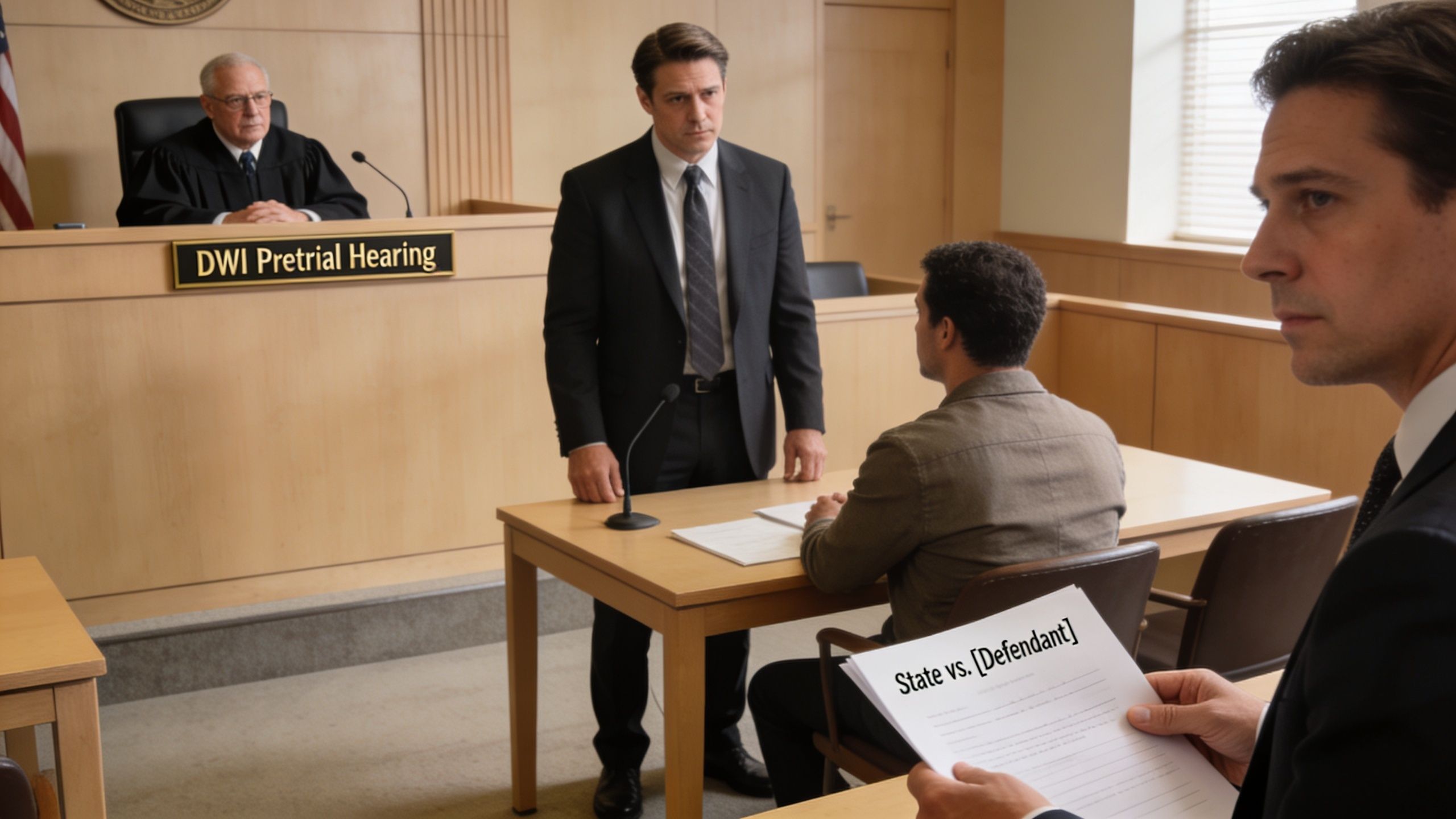
A pretrial hearing is better understood as a strategy checkpoint in open court. It is where the defense and the prosecutor address the status of the case before trial, raise legal issues, exchange and review evidence, and sometimes test whether the State's case is strong enough to keep its current shape.
How it differs from other early court dates
Confusion usually starts because several early hearings can sound similar.
| Court event | Main purpose |
|---|---|
| Arraignment | Formal reading of the charge and entry of a plea |
| ALR hearing | Separate civil process focused on license suspension issues, discussed on this page about Texas ALR hearings |
| Pretrial hearing | Criminal court stage where evidence, motions, negotiations, and case strategy take center stage |
It's like reviewing the blueprint before a building goes up. If the foundation is flawed, you want to know before everything else is built on top of it.
In Texas DWI cases, the pretrial stage is not just a scheduling step. It is where the defense can use discovery and motion practice to attack the State's evidence before a jury is ever seated. Texas criminal procedure commonly requires the prosecution to turn over core evidence such as police reports, bodycam and dashcam video, witness statements, and breath or blood test records during discovery, and defense counsel may file motions to suppress, dismiss, or change venue. Practically, this means a pretrial hearing can determine whether critical evidence is excluded, whether plea negotiations improve, or whether the case is narrowed before trial. In major Texas markets like Houston, Dallas Fort Worth, Austin, and San Antonio, this hearing often becomes the first meaningful test of probable cause and evidentiary strength after arrest, shaping whether the case moves forward or resolves early, as explained in this discussion of the Texas DUI trial process.
Why this stage matters so much
A trial is expensive in time, stress, and risk for everyone involved. That gives the pretrial process real importance.
Your lawyer may use this hearing to:
- Push for evidence the State hasn't fully turned over
- Challenge legality of the stop, arrest, or testing
- Frame negotiations from a stronger position
- Preserve issues for later hearings or trial
Here is a short video that helps frame how these early hearings fit into the larger process.
A pretrial hearing isn't where your case gets rubber-stamped. It's where your lawyer starts forcing the State to prove that its case can withstand scrutiny.
If you're trying to fight DWI Texas charges, this is one of the first court dates where strategy can change the direction of the case.
Who Attends and What Is Discussed at the Hearing
When you go to a DWI pretrial hearing, the room is usually less dramatic than television makes it seem. But what happens there can still affect your case in a serious way.
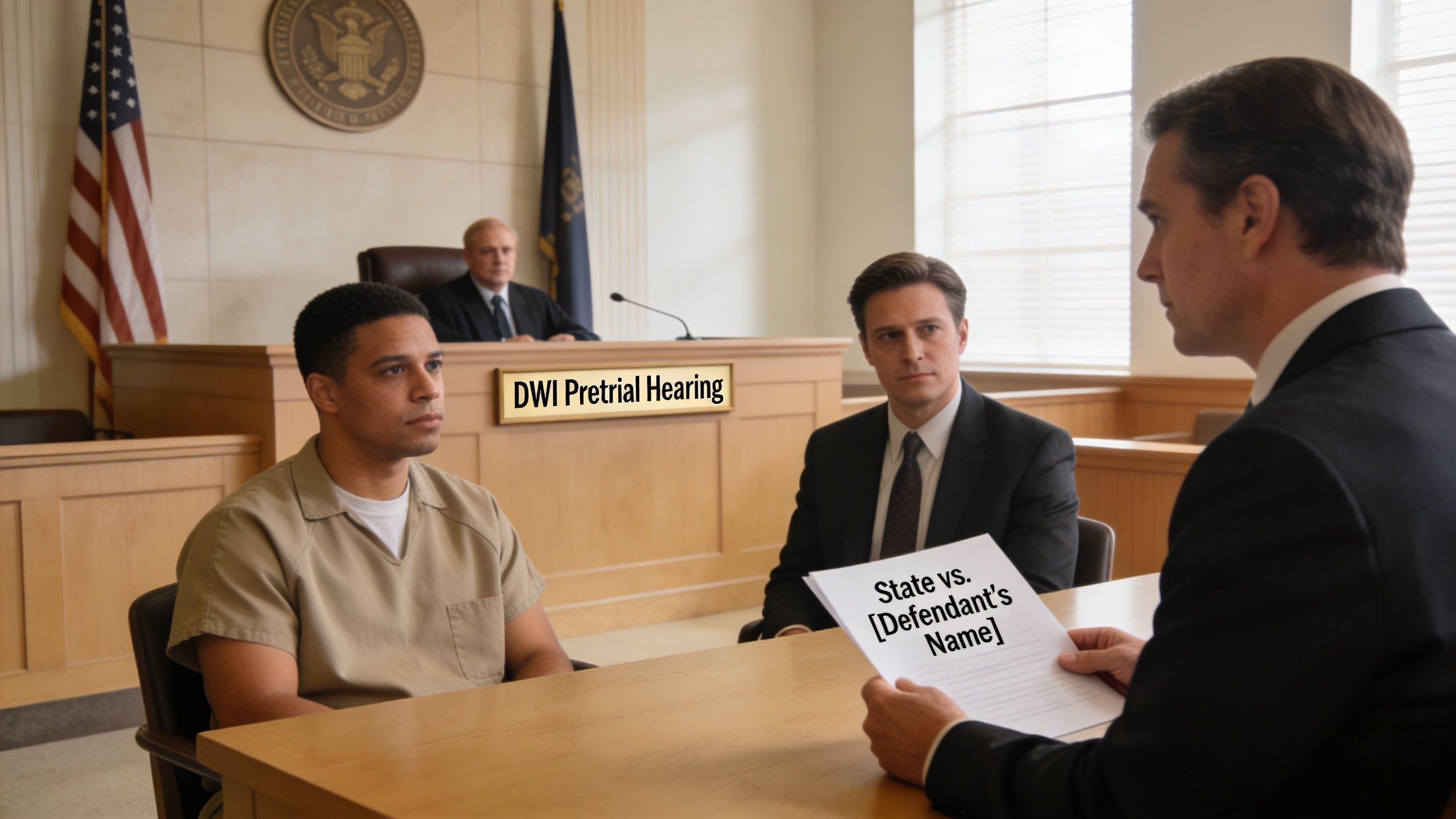
The key people in the room
You will usually see four main participants.
- You are the defendant. Your presence may be required depending on the court and the issues being addressed.
- Your defense lawyer speaks for you, protects your rights, and pushes the case forward strategically.
- The prosecutor represents the State and argues for the charge to proceed.
- The judge manages the hearing, rules on motions, and decides procedural issues.
The judge is not there to help either side. The judge's role is to make sure the law is followed and to decide disputed legal issues.
What is usually discussed
A pretrial hearing often centers on three things. Evidence, legal challenges, and case positioning.
Discovery is the formal process of obtaining the evidence. In plain language, this means your lawyer is getting the materials the State plans to rely on, such as reports, video, witness statements, and chemical test records.
Motions are written legal requests asking the judge to do something. One common example is a motion to suppress, which asks the court to exclude evidence that was obtained unlawfully or unreliably.
Negotiations can also happen around the hearing date. The prosecutor may be more willing to discuss options once your lawyer has identified weaknesses or factual disputes.
Bond conditions may also come up
A Texas DWI pretrial hearing also functions as a procedural checkpoint that can change bond conditions and litigation strategy. Courts may review release terms, including ignition interlock requirements, which some sources note can be imposed as a bond condition in higher-risk situations such as BAC of 0.15 or more, a second-or-subsequent DWI, or a case involving a child passenger, as described in this overview of the Texas DWI court process. That matters because bond conditions affect day-to-day mobility, employment, and compliance risk while the case is pending.
If you're unclear about how this differs from your first criminal court appearance, this guide on what happens at arraignment hearing helps separate the two.
What clients often miss: Even when no final ruling happens that day, the hearing can still shape bond terms, expose evidence problems, and improve the defense position for the next step.
A simple example
Suppose the police report says you showed signs of intoxication, but the bodycam tells a more mixed story. Your lawyer may use the hearing to press for complete video, challenge the State's interpretation, and argue that the evidence is not as strong as the report suggests.
That doesn't guarantee dismissal. It does create pressure on the prosecution to deal with the case more realistically.
Strategic Defense How We Use the Pretrial Hearing to Fight Your DWI
The pretrial hearing reveals defense work. Preparation happens outside the courtroom, but at this hearing, that preparation starts producing effectiveness.
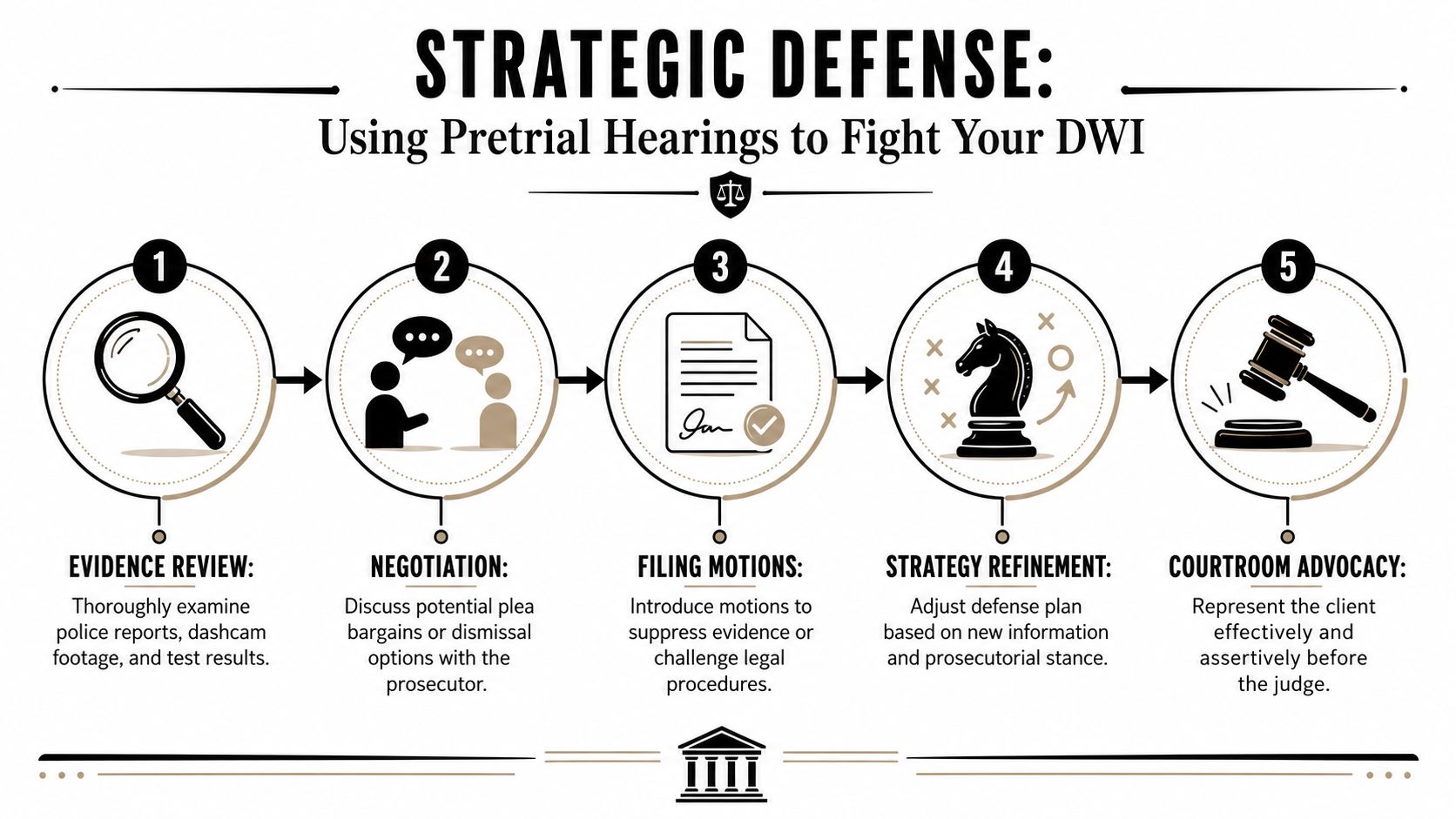
We start by testing the State's evidence
A police report is only one version of events. A careful defense compares that report against everything else.
That may include:
- Video review of bodycam or dashcam footage
- Chemical test review of breath or blood records
- Timeline analysis of the stop, investigation, and arrest
- Witness comparison to see whether statements line up
This is also where key terms matter in practical ways. A field sobriety test may be challenged based on how it was explained, demonstrated, or recorded. A BAC result may raise questions about collection, handling, or legal procedure. Implied consent issues may affect the separate license side of the case, but the surrounding facts can also matter to the criminal defense strategy.
Motions can remove damaging evidence
A strong pretrial motion does more than complain. It gives the judge a legal reason to limit what the jury can hear later.
A motion to suppress may target:
- the reason for the traffic stop
- the basis for the arrest
- the way a specimen was obtained
- statements gathered in violation of legal rules
If a judge excludes important evidence, the State may have a much harder time proving the charge. Sometimes that changes the negotiation posture. Sometimes it changes the entire case.
For readers looking closely at this part of the process, this page on Texas DUI pretrial motions defense gives more detail about how those challenges work.
Negotiation gets stronger when backed by facts
Good negotiation in a DWI case isn't about asking for mercy. It's about showing the prosecutor where the case is weak, uncertain, or costly to prove.
That might mean pointing out:
- incomplete discovery
- contradictions between report and video
- questionable testing procedures
- factual details that make the charge harder to sustain as filed
At that point, the discussion can shift toward reduction, alternate resolution, or a more favorable plea structure.
The strongest plea discussions usually happen after the defense has done enough work to make the prosecutor take the risk of trial seriously.
Diversion may be part of the strategy for some cases
Another frequently asked but under-addressed issue is what a pretrial hearing can realistically change in a DWI case beyond getting a trial date. Local programs can be highly conditional. Some counties offer pretrial diversion for first-time offenders, but eligibility can depend on factors like no prior arrests, no open-container violation, employment or school status, BAC thresholds, and payment of program fees. Fort Bend County also treats DWI Court Tier 1 as a pre-trial diversion track for first-time offenders, as noted in this discussion of pretrial diversion in Texas for DWI offenders.
That creates a real strategic choice. In some cases, your lawyer may press hard on suppression issues. In others, it may make sense to explore a program that protects your record better than a straight conviction would. And in some situations, both tracks need to be evaluated at the same time.
The Law Office of Bryan Fagan, PLLC handles Texas DWI defense matters that involve these pretrial decisions, including evidence review, motion practice, and negotiation over case resolution.
This is where defense becomes proactive
Many people expect a Houston DWI lawyer or Texas DUI attorney to show up and react. Effective pretrial work is the opposite.
It means using the hearing to:
- get missing evidence,
- challenge unreliable or unlawful proof,
- protect your bond status,
- evaluate diversion or reduction options,
- and prepare for trial from a position of knowledge instead of guesswork.
That is how this hearing becomes an opportunity, not just another hurdle.
Possible Outcomes of a DWI Pretrial Hearing
One reason clients feel nervous before this court date is that they don't know what result to expect. Several outcomes are possible, and more than one of them can still be a good sign.
The case may be reset
A reset means the court continues the case to another pretrial date.
That can happen because evidence still needs to be produced, motions need more briefing, witnesses are unavailable, or negotiations are ongoing. A reset doesn't automatically mean the case is getting worse. In many DWI cases, it means the legal work is still underway.
A plea offer may be discussed or accepted
Sometimes the hearing leads to a negotiated resolution. That may involve a reduced charge, an agreed recommendation, or another structured outcome depending on the facts and the county.
Whether to accept a plea is a major decision. The right answer depends on the evidence, your record, your goals, and the long-term consequences for work, insurance, licensing, and your criminal history.
The court may hear or schedule motion issues
Not every pretrial hearing ends with a full ruling on suppression or dismissal issues. Sometimes the court identifies the issues and sets a later hearing focused on those legal disputes.
That can still be important progress. It means the judge is treating those legal challenges as serious questions that need to be resolved.
A productive hearing does not have to end with fireworks. If the defense narrows the issues, locks in disclosures, or gets a motion set, the case may already be moving in your favor.
The case may move toward trial
If no agreement is reached and the State intends to proceed, the judge may set the case for trial.
That doesn't mean the pretrial stage was wasted. It means the groundwork has been laid. By that point, the defense usually has a clearer picture of the evidence, the legal weaknesses, and the arguments that will matter most in court.
How to Prepare for Your DWI Pretrial Hearing
Your lawyer handles the courtroom strategy, but your preparation still matters. A client who is organized, honest, and compliant gives the defense a much stronger foundation.

Focus on the basics first
A key procedural point in Texas DWI cases is that an arrestee must be brought before a magistrate within 48 hours after arrest, and that early appearance is where bail and bond conditions are set before the pretrial phase begins, as explained in this overview of the DWI process in Texas courts. That same source notes that judges may impose conditions such as random testing or an ignition interlock device in higher-risk cases, including when the alleged BAC is 0.15 or higher, for second or subsequent DWI arrests, or when a child passenger is involved.
By the time you reach pretrial, the court will expect full compliance.
A practical preparation checklist
- Follow every bond rule: If the judge ordered testing, classes, travel restrictions, or an ignition interlock device, treat each condition seriously.
- Give your lawyer the full story: Small details can matter. What you said, what the officer said, where you were driving, who was with you, and what happened during testing can all become important later.
- Gather requested records quickly: Work schedules, receipts, medical information, and witness contact details can all help your lawyer verify timelines or challenge assumptions.
- Stay off social media: Do not post about the stop, the arrest, the court date, drinking, or your frustrations with the case.
- Show up prepared: Dress neatly, arrive early, and know whether your personal appearance is required.
What not to do
Don't try to explain your case to the prosecutor yourself. Don't guess when your lawyer asks for facts. And don't treat bond compliance as optional because the hearing seems routine.
A missed test or a violation of an interlock rule can create a new problem that distracts from the legal issues your attorney is trying to challenge.
What Comes Next The Path After the Pretrial Hearing
The pretrial hearing doesn't end the stress overnight, but it usually gives the case a clearer direction. What happens next depends on what was accomplished in court and what still needs to be decided.
If the case was resolved
If you accepted an agreement, the next step may involve entering that plea formally and addressing sentencing terms or program requirements. At that point, your focus shifts from fighting the charge to completing whatever conditions apply and protecting your future as much as possible.
If the case was continued
A reset means the defense work continues. Your lawyer may still be waiting on records, preparing motions, reviewing video, or negotiating from a stronger position after the last court date.
For many clients, this is the hardest part emotionally. It can feel like not enough is happening. In reality, some of the most important work in a DWI case happens between court appearances.
If the case is going to trial
Trial preparation becomes the priority. That may include witness preparation, exhibit planning, legal briefing, and refining how the defense will challenge the State's proof before a judge or jury.
If you want a broader picture of how this hearing fits into the full criminal process, this guide on the timeline of a DWI case in Texas from arrest to trial helps connect the stages.
Stay engaged after the hearing. The next phase of the case usually depends on how quickly you respond, how carefully you follow instructions, and how consistently you communicate with your lawyer.
For someone dealing with a first DWI in Texas, this stage can feel unfamiliar. For someone with added complications, like CDL concerns or out-of-county travel, it can feel even more pressing. In either situation, the path forward becomes much easier when you know what each step is meant to accomplish.
Take Control of Your Case with a Strategic DWI Defense
A pretrial hearing in a Texas DWI case is not just a box to check. It is a chance to challenge the State's evidence, protect your bond status, press for better negotiations, and position your case for the best outcome available.
That matters whether you are trying to avoid a conviction, reduce the charge, protect your license, or to understand how to fight DWI Texas charges with a clear plan. A calm, strategic response is almost always better than panic.
If you're looking for a Houston DWI lawyer or Texas DUI attorney, focus on finding counsel who treats the pretrial phase as active defense work, not courtroom housekeeping. The right preparation at this stage can shape everything that follows.
You don't have to walk into that hearing confused or alone.
If you're facing a DWI charge, the Law Office of Bryan Fagan, PLLC can help you evaluate your next step, understand your court dates, and build a defense strategy specific to your case. Request a free, confidential consultation to discuss your arrest, your bond conditions, your license concerns, and what can be done before trial to protect your record and your future.

