
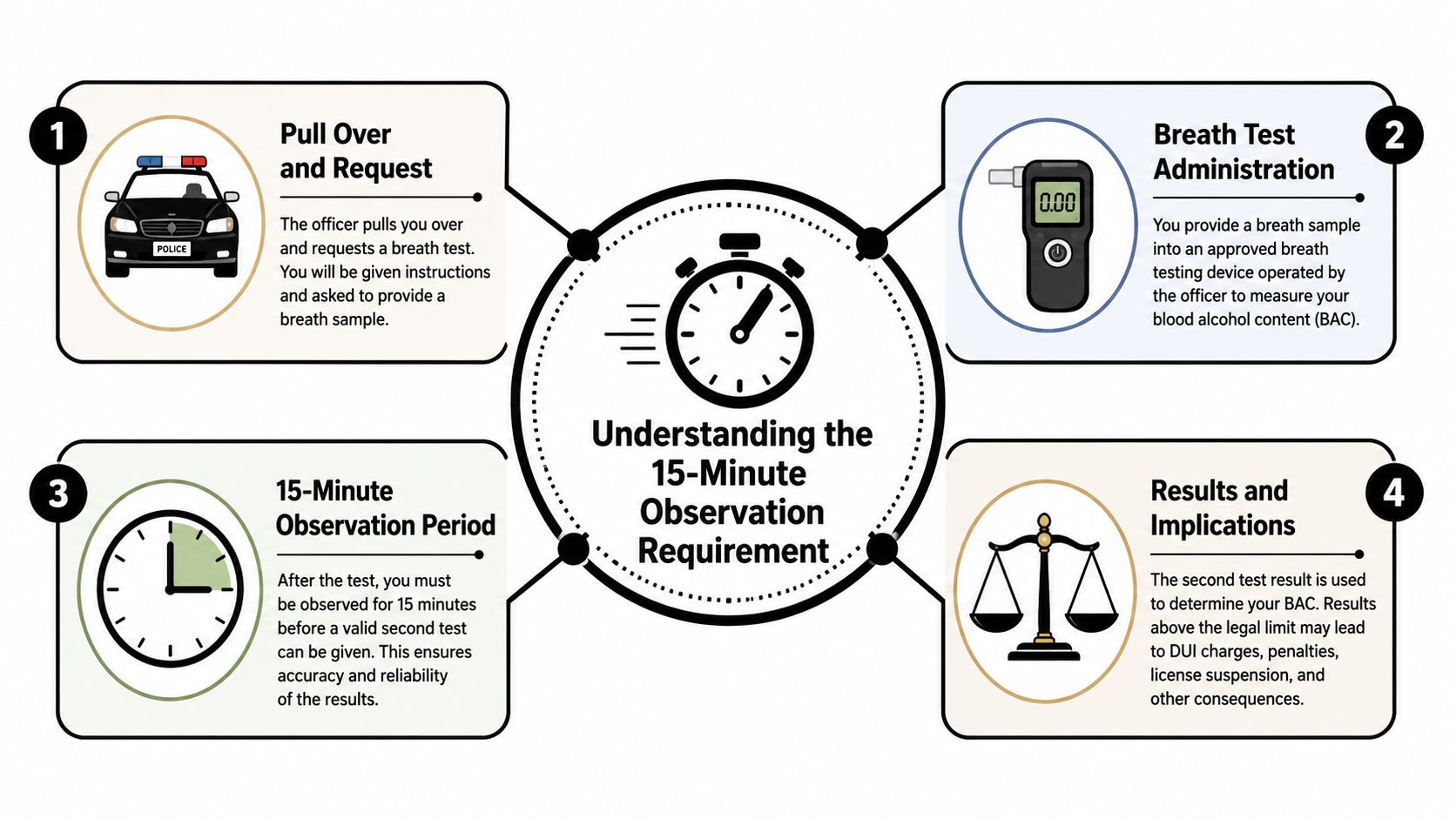
A DWI arrest can be overwhelming, but a violation of the 15-minute pre-test requirement may give you a strategy to protect your driving privileges and challenge the charges. Texas requires the operator to remain in your continuous presence for at least 15 minutes immediately before the breath test, while using reasonable care to prevent anything from entering your mouth.
You may be sitting in a station right now, trying to remember whether the officer stayed nearby, whether you were left alone, or whether the test began after you burped, vomited, drank, smoked, or placed something in your mouth. Those details can matter. The modern rule doesn't require an officer to stare at you continuously, but it does require continuous presence and reasonable care. A careful review of video, reports, test records, and witness testimony can expose whether the State followed the required procedure.
Understanding the 15-Minute Observation Requirement
A traffic stop can move quickly. An officer asks questions, performs or requests field sobriety testing, arrests you, and later takes you to a station or jail for an evidentiary breath test. In that setting, “wait 15 minutes” sounds simple. The legal requirement is more precise.
Texas breath-testing rules require the operator to remain in the continuous presence of the subject for at least 15 minutes immediately before the test. The operator must also use reasonable care to ensure that the person doesn't place substances in the mouth. The Texas District and County Attorneys Association discusses this requirement and explains why the timing must be the 15 minutes directly before testing, rather than an earlier 15-minute period (Texas breath-test case-law summary).
Suppose an officer brings you into a testing room, starts paperwork, walks away to handle another task, and returns later. The printed report may say the observation period was complete. That statement isn't necessarily the end of the issue. The defense can compare the documented time with station video, dispatch records, the breath-test printout, and the operator's testimony.
Why the waiting period exists
The safeguard addresses the risk of mouth alcohol. Alcohol remaining in the mouth, or reaching the mouth through burping, regurgitation, or vomiting, can interfere with a breath sample intended to represent deep-lung air. The rule therefore places responsibility on the operator to maintain presence and exercise reasonable care before testing.
This doesn't mean every imperfect memory automatically invalidates a result. It means the prosecution must present evidence that the required procedure was followed. A Houston DWI lawyer can examine the timing and surrounding conduct instead of accepting a conclusory checkbox in an arrest report.
Your own timeline can help. Write down when you arrived at the testing location, where the officer stood, whether anyone left the room, what you consumed, and anything that happened before you blew. A plain-language explanation of how long after drinking you can fail a breath test in Texas can also help you identify details worth telling counsel.
The Legal Shift From Observation to Presence
The most important distinction in this area is the difference between direct observation and continuous presence. Older Texas materials described a technician continuously observing a person for 15 minutes before administering the test. In Lonnie Brett Watson v. State, the court described those DPS rules and quoted language requiring the operator to remain in the subject's presence for at least 15 minutes before testing (Watson v. State).
Modern Texas Administrative Code language changed the focus. Section 19.3(a)(1) requires continuous presence for at least 15 minutes immediately before the test. The rule also states that direct observation isn't required to ensure the test's validity or accuracy (Texas Administrative Code section 19.3).
That change creates a practical limitation on some defenses. An argument that says, “The officer wasn't staring at me every second,” may not be enough. The State can argue that the officer remained close enough to maintain presence while completing paperwork or operating the instrument.
Where the distinction creates leverage
The stronger question is whether the officer's conduct satisfied both parts of the rule:
- Was the operator continuously present during the 15 minutes immediately before testing?
- Did the operator use reasonable care to prevent substances from entering your mouth?
An officer may not need uninterrupted eye contact, but the officer still must be able to account for your presence and respond to events that could affect the sample. Video can show whether the officer was close enough to notice a problem, whether you were unattended, and whether the test started too soon.
Practical rule: Challenge the facts the rule actually requires, not an older version of the rule that Texas courts no longer apply in the same way.
This distinction matters in every DWI case, but the stakes rise when the charge may carry felony consequences. A resource on Felony DWI in Texas: Third Offense and Child Passenger addresses when a Texas DWI becomes a felony charge. The procedural question remains the same: whether the State can establish compliance with the governing breath-test standard.
Common Violations of the Observation Period
The 15-minute window can fail in several different ways. Some problems involve time. Others involve what happened during the time. Your attorney should separate those issues rather than treating the requirement as a single yes-or-no question.
The operator leaves or loses practical control
Continuous presence doesn't necessarily require the officer to stare at you, but it does require the operator to remain present. If the officer leaves the room, takes you somewhere else without maintaining the required presence, or allows you to remain outside the operator's practical control, the timeline deserves scrutiny.
The defense should identify the exact interval involved. Station video may reveal an officer exiting, a door closing, or a gap between arrival and the start of the test. A report may describe the process generally, while video supplies the more precise account.
Something enters the mouth
The operator must use reasonable care to prevent you from placing substances in your mouth. Relevant events can include eating, drinking, smoking, chewing gum, taking medication, burping, or regurgitating. Texas training materials treat a mouth-related event during the interval as requiring the waiting period to begin again, so counsel should determine whether the operator noticed the event and whether testing followed too soon.
Medical conditions can also matter. Acid reflux may bring stomach contents into the mouth without a deliberate act. If that occurred, acid reflux as a DWI breath-test defense may require medical history, witness testimony, and a careful review of the video.
The clock starts at the wrong time
The relevant period is the 15 minutes immediately before the test. An earlier delay doesn't automatically satisfy the requirement. For example, time spent waiting in a booking area may not establish that the operator remained in your continuous presence during the period directly preceding the breath sample.
Build the timeline from objective sources:
- Arrival records: Compare booking or station-entry times with the breath-test time.
- Video evidence: Look for departures, interruptions, and events affecting your mouth.
- Test documentation: Review the operator's recorded observation-period information.
- Witness accounts: Identify anyone who saw you before testing or can describe what occurred.
- Your recollection: Record details promptly, before stress and time blur the sequence.
The point isn't to manufacture a technical argument. It's to test whether the State's evidence matches the actual procedure. A small procedural conflict can become significant when the breath result is the prosecution's principal chemical evidence.
How Violations Impact Your Case and License
A breath-test challenge can affect two connected but separate proceedings. The criminal DWI case determines whether the State can prove the offense in court. The administrative license suspension, often called an ALR suspension, is a Department of Public Safety process concerning your driving privileges.
Implied consent means Texas law treats a person arrested for DWI-related conduct on a public road as having consented to provide a breath or blood specimen for alcohol or controlled-substance testing. Because that consent comes from statute, a refusal or dispute can produce administrative consequences apart from the criminal prosecution (Texas ALR defense overview).
The ALR hearing
At an ALR hearing, the issues are limited and procedural. The State generally relies on the arrest paperwork and related evidence to support the suspension. A violation in the pre-test process can give the defense a basis to challenge whether the testing evidence supports the administrative action.
The hearing isn't the same as a criminal trial. Winning an ALR challenge doesn't automatically dismiss the DWI charge, and losing the hearing doesn't establish guilt in criminal court. Each proceeding has its own purpose, evidence, and consequences.
The criminal case
In criminal court, counsel may seek to suppress or limit chemical-test evidence when the State can't establish compliance with the governing requirements. The result depends on the facts, the available video, the judge's rulings, and how the prosecution tries to use the breath result.
A weak observation-period record can affect more than admissibility. It can undermine the reliability of the number, give counsel material for cross-examination, and make the State reassess whether it can prove intoxication beyond a reasonable doubt. A breath result isn't the entire case. The prosecution may still rely on officer observations, driving conduct, statements, field sobriety testing, and other evidence, so the defense must evaluate the whole record.
The stakes in a first case
Texas DWI penalties can begin with a first-offense punishment of up to a $2,000 fine, up to 180 days in jail, and driver-license loss of up to one year, with at least three mandatory days in jail upon conviction (Texas Department of Transportation DWI penalties). Those consequences explain why a technical review matters even when the alleged violation seems minor.
A field sobriety test is a roadside evaluation of physical and divided-attention tasks used by an officer to form an opinion about impairment. It isn't the same as a breath test, and a challenge to one doesn't automatically defeat the other. Likewise, BAC, or blood alcohol concentration, is a measure of alcohol concentration used in DWI evidence. The instrument and testing method determine what the reported figure represents, so counsel should avoid treating every “breath number” as interchangeable with a blood measurement.
Protecting Your Rights After a DWI Arrest
The first hours after an arrest can shape both your license case and your criminal defense. Don't try to reconstruct the event from memory months later. Write down what happened while the sequence remains clear, including the officer's location, any breaks in the process, anything you consumed, and whether you experienced reflux, coughing, vomiting, or another event before testing.

Take these steps promptly
- Protect the license deadline. Ask counsel about requesting an ALR hearing immediately. The hearing process has strict deadlines, and missing the applicable deadline can allow the suspension to proceed without your challenge.
- Preserve your account. Record the stop, arrest, transport, testing location, and every interruption you remember. Don't guess at details. Mark uncertainty clearly.
- Identify the evidence. Counsel should seek station video, body-camera footage, dispatch records, breath-test paperwork, and other materials showing the relevant timeline.
- Avoid discussing the facts publicly. Social media posts, messages, and casual explanations can create additional evidence for the prosecution.
- Follow release conditions. Ask your lawyer what court dates, bond terms, testing requirements, or driving restrictions apply to you.
An ALR hearing is the administrative proceeding used to contest a DWI license suspension. It doesn't replace the criminal case, but it can provide an early opportunity to test the State's account and preserve your ability to drive. The Texas ALR hearing process should be reviewed with counsel because the proper response depends on the paperwork served in your case.
A bond hearing or release process normally comes before the criminal case moves through discovery, motions, negotiations, and trial. Your lawyer can explain whether a motion to suppress is appropriate, whether the breath evidence can be challenged, and whether a negotiated resolution serves your interests. Don't assume that signing a form or waiting for a court notice protects your license.
Here is a practical explanation of the documentation process:
Early action is especially important when the report and the video tell different stories. The longer you wait, the harder it may be to locate witnesses, preserve footage, or identify exactly when the 15-minute period began.
Next Steps and When to Contact an Attorney
You don't have to decide the entire case on the night of the arrest. You do need to protect the immediate deadlines and preserve the evidence that can make a later defense possible. A qualified Texas DUI attorney can review the testing timeline, explain the ALR process, and assess whether the officer met the continuous-presence and reasonable-care requirements.
| If you ignore the arrest | If you challenge the evidence |
|---|---|
| The license process may move forward without your position being presented. | Counsel can evaluate an ALR hearing and protect your response rights. |
| Video or records may become harder to preserve or interpret. | Counsel can seek records and compare them with the report. |
| You may accept the breath result without testing its foundation. | Counsel can examine timing, presence, mouth-related events, and other weaknesses. |
| You may make decisions without understanding criminal and administrative consequences. | You can make informed decisions about motions, negotiations, and trial strategy. |
A Houston DWI lawyer can also coordinate the criminal defense with the administrative license case. To fight DWI in Texas, look for counsel who will examine the actual video and records, not just repeat general advice. People facing a first DWI in Texas may need a different strategy from someone with prior allegations, a commercial license, or a potential felony charge.
Request a case evaluation as soon as possible. Bring the paperwork you received, your court information, and a written timeline of the stop and breath test. The sooner an attorney can assess the fifteen minute observation period breath test Texas issues, the sooner you can make a clear plan.
The Law Office of Bryan Fagan, PLLC offers free consultations for Texans facing DWI charges, ALR proceedings, and breath-test challenges. Contact the firm to discuss the testing timeline, preserve critical evidence, and learn how local defense counsel can protect your license and your future.