
A DWI arrest can be overwhelming, but you don't have to face it alone.
If you were arrested with your child in the car, you're probably thinking about ten problems at once. You may be worried about jail, your driver's license, what your family is hearing, whether CPS will contact you, and what this could do to custody or your job. That reaction is normal.
Many parents in this position aren't hardened criminals. They're scared, ashamed, confused, and trying to figure out what happens next. The good news is that panic doesn't help the State prove its case. A careful defense still matters. What you do in the next few days can make a real difference.
Facing a DWI with Your Child A Guide for Texas Parents
The first night after an arrest often feels like the worst part. You replay the stop, the officer's questions, whether your child was crying, who picked them up, and what happens when court starts. You may also be hearing conflicting advice from friends or family members who mean well but don't know Texas felony DWI procedure.
This kind of case is different from a routine first DWI in Texas. It can involve a felony charge, a separate process that threatens your driving privileges, and family-related consequences that can start quickly. If you need a basic checklist for the first hours after release, review what to do after a DWI arrest in Texas immediately.
Practical rule: Your case gets safer when you get organized. Save paperwork, stop talking about the facts, and get legal advice before you try to explain yourself.
Parents often make the same early mistake. They assume that if nobody was hurt and this is their first arrest, the case will be treated like a misdemeanor and resolved discreetly. In a child-passenger case, that assumption can put you behind from the start.
You need a clear plan, not worst-case thinking. That plan starts with understanding what the charge is, what the State must prove, and why the criminal case is only one part of the problem.
Understanding the Felony Charge DWI with a Child Passenger
A parent can walk into court expecting a first-time DWI and find out the case was filed as a felony on day one. That happens because Texas created a separate offense for driving while intoxicated with a child passenger. Under Texas Penal Code §49.045, the State can file this charge if it claims you were intoxicated while operating a motor vehicle with a passenger younger than 15.
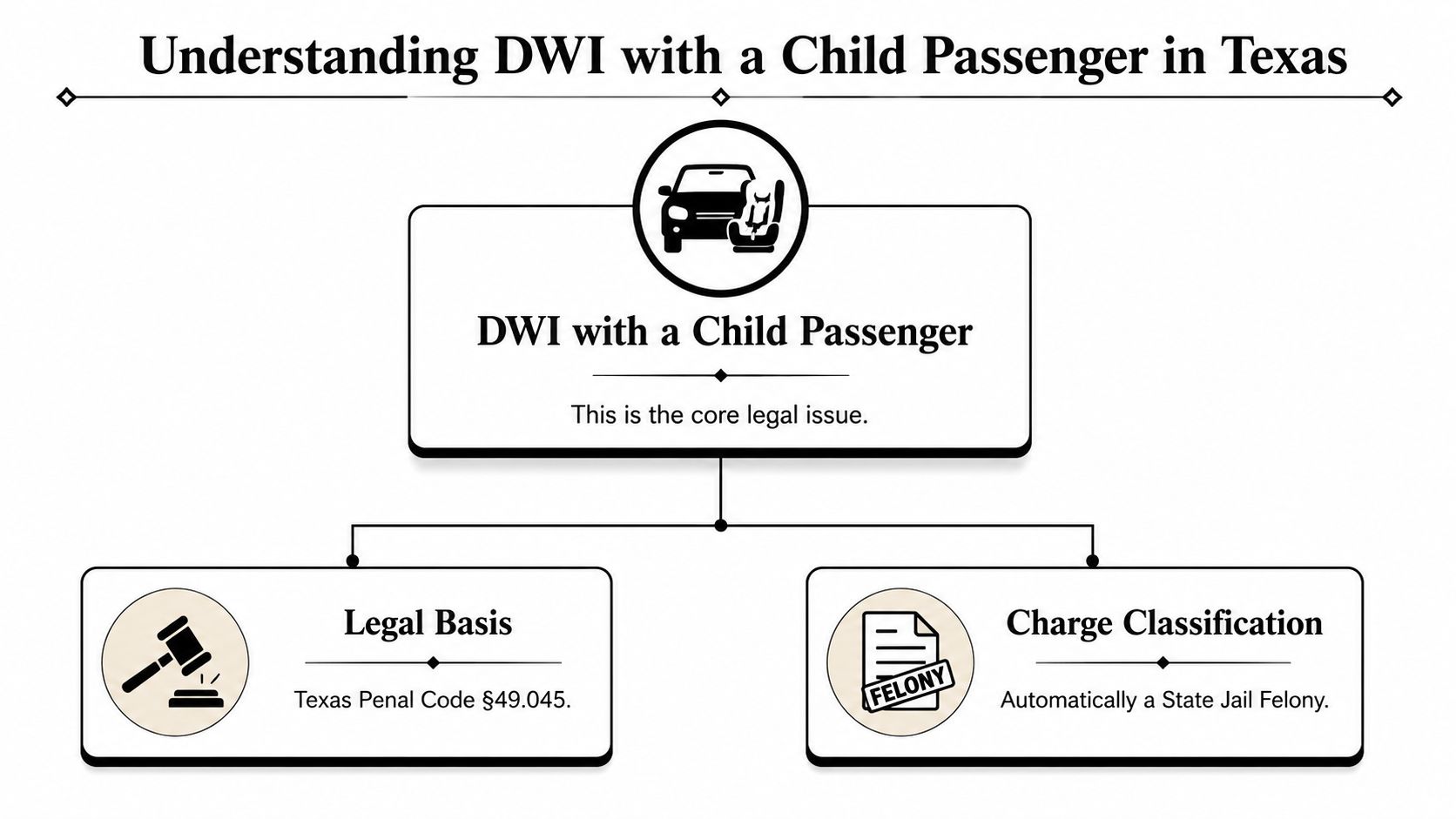
That distinction matters early. It changes how prosecutors evaluate the case, how judges set bond conditions, and how seriously outside agencies may react. It also means you should treat the criminal case and the family-related fallout as two separate problems, even though they started with the same arrest.
What the prosecutor has to prove
The State still has to prove each element. In practice, that usually means evidence on three points:
- Operation of a vehicle: The prosecutor has to show you were operating the motor vehicle, not just sitting in it or near it.
- Intoxication: Texas can try to prove intoxication through an alleged BAC, or blood alcohol concentration, at or above the legal limit, or by claiming you lost the normal use of your mental or physical faculties because of alcohol, drugs, or a combination.
- Passenger younger than 15: The child's age and presence in the vehicle are part of the offense itself.
Those issues are often less straightforward than the police report makes them sound. I regularly look at whether the stop was lawful, whether the officer's observations match the video, whether roadside tests were administered correctly, and whether the State can prove operation and intoxication at the relevant time.
The child-passenger element also needs proof. Age may be easy to show. Presence can raise factual disputes in some cases, especially when the timeline is sloppy, the report is vague, or the officer relied on statements that may be challenged.
Key terms you need to know
A field sobriety test is a series of roadside tasks officers use to support an intoxication allegation. These tests can be challenged. Uneven pavement, poor instructions, footwear, weather, fatigue, anxiety, injuries, and medical conditions all affect performance.
Implied consent means Texas can seek a breath or blood specimen after a lawful DWI arrest, and a refusal can trigger a separate license process. If that part of your case is already in motion, review how the Texas DWI license suspension process works because the deadline is short and it runs on a different track than the felony case.
If you are comparing this charge to a standard DWI under Penal Code 49.04, a Texas DWI Defense Lawyer handles the underlying intoxication issues in both settings. The difference here is that the prosecution also has to prove the child-related element, and the arrest can trigger a parallel CPS response that requires its own strategy.
Strong defense work starts with proof, not assumptions. An arrest report is the State's version of events. It is not the final version.
The Severe Penalties Criminal and Administrative Consequences
A lot of parents hear "first arrest" and assume they are dealing with something they can clean up later. That assumption causes damage in this type of case. A DWI with a child passenger puts you on two separate legal tracks right away. One is the felony prosecution. The other is the license case with the Department of Public Safety.
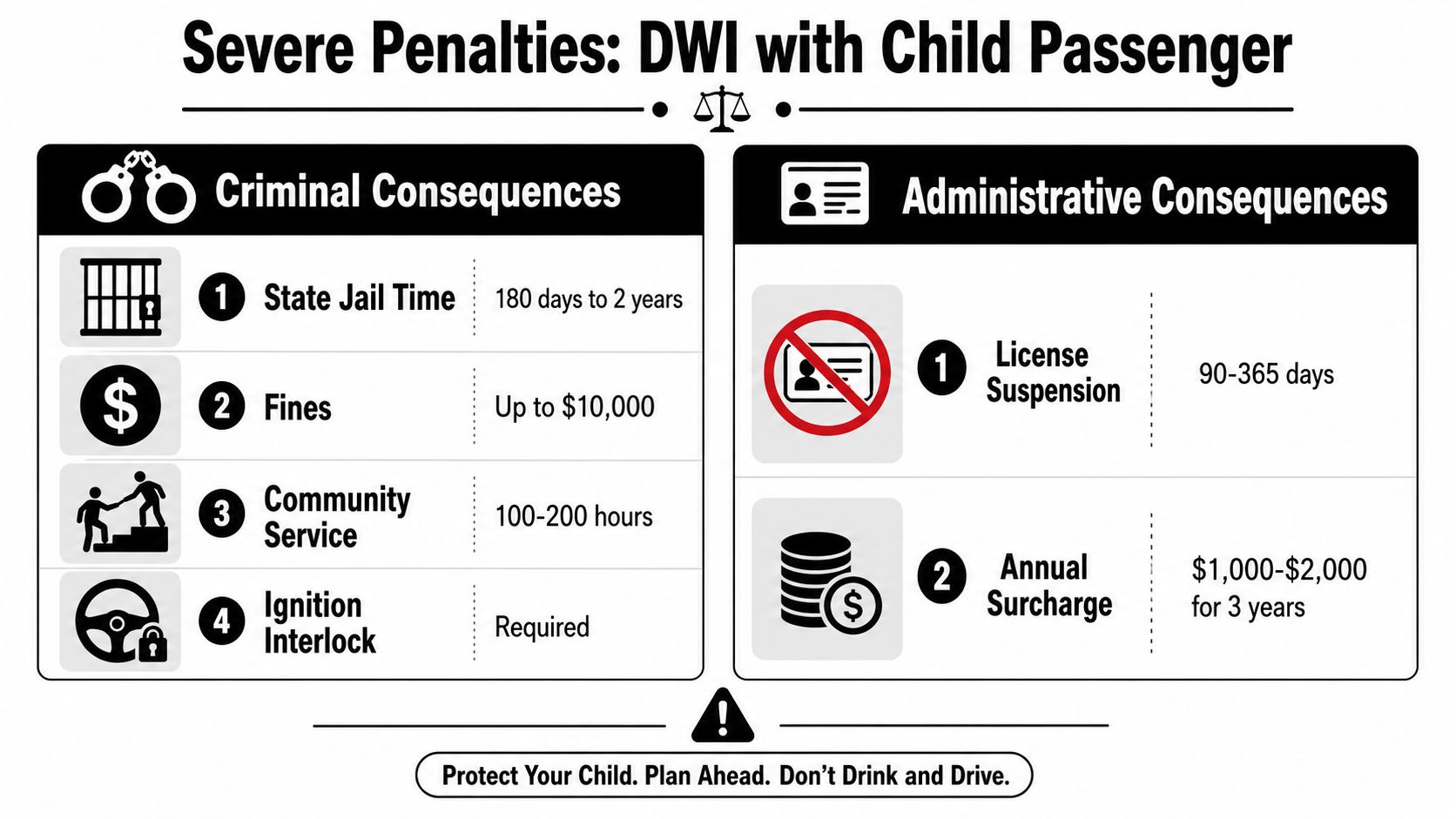
Criminal penalties
If the State gets a conviction, the punishment range is serious. This offense is charged as a state jail felony, which can mean time in a state jail facility, a substantial fine, community supervision terms, and a felony judgment that follows you long after the court date.
The record problem is often bigger than people expect. A felony involving alcohol and a child in the car can affect hiring, professional licensing, insurance costs, firearm rights, and how a family court views your judgment. For many parents, the practical fallout starts before any final outcome. Bond conditions, travel limits, ignition interlock requirements, alcohol monitoring, and court appearances can disrupt work and parenting quickly.
A conviction here also does not lend itself to the kind of quiet resolution people associate with some misdemeanor cases. That is why early case review matters. The defense is not just about avoiding jail. It is about protecting your record, your ability to keep working, and your credibility in every other proceeding that may follow.
Administrative license consequences
Your driver's license is a separate problem with its own deadline. DPS can try to suspend your license based on an alleged test failure or refusal, even while the criminal case is still pending. That process is civil, but the consequences are personal and immediate. You still need to get to work, pick up your child, and comply with court settings.
If you have not already requested a hearing, review the Texas DWI license suspension process right away. The window to act is short.
Why the ALR hearing matters
I tell clients not to treat the license case like paperwork. It can be one of the first opportunities to pin the officer down under oath.
That testimony matters.
An ALR hearing can expose timing problems, weak grounds for the stop, poor documentation, confusion about the request for a breath or blood specimen, or gaps in the officer's memory. Sometimes the hearing helps preserve driving privileges. Sometimes it gives the defense useful testimony for the felony case. Sometimes it does both. Sometimes it does neither, and I tell clients that plainly. But giving up that chance without a strategic reason is usually a mistake.
| Issue | Criminal case | ALR case |
|---|---|---|
| Main question | Can the State prove intoxication and the child-passenger element beyond a reasonable doubt? | Can DPS justify a license suspension based on the stop, arrest, and test refusal or failure? |
| Where it happens | Criminal court | Administrative hearing process |
| Focus of defense | Stop legality, officer observations, test reliability, child-passenger proof, procedure errors | Basis for the stop and arrest, warnings, refusal or failure issues, officer testimony |
| Why it matters | Felony record, punishment exposure, bond conditions, long-term collateral consequences | Ability to drive, early cross-examination, testimony that may help the defense later |
Definitions that affect your choices
A BAC result is not the whole case. Prosecutors can also try to prove intoxication through driving facts, body camera footage, officer observations, field sobriety testing, and statements you made.
A chemical test usually means a breath or blood test. The defense reviews how the sample was requested, whether the legal warnings were handled correctly, how the sample was collected, and whether the result can be trusted.
One more point matters here. The criminal case and the license case overlap, but they are not the same fight. A parent who understands that early is in a better position to make sound decisions.
The Second Front Your CPS Investigation
Many parents focus only on the criminal charge at first. That's understandable, but it can leave them exposed. In these cases, the arrest often opens a separate child-safety investigation at the same time.
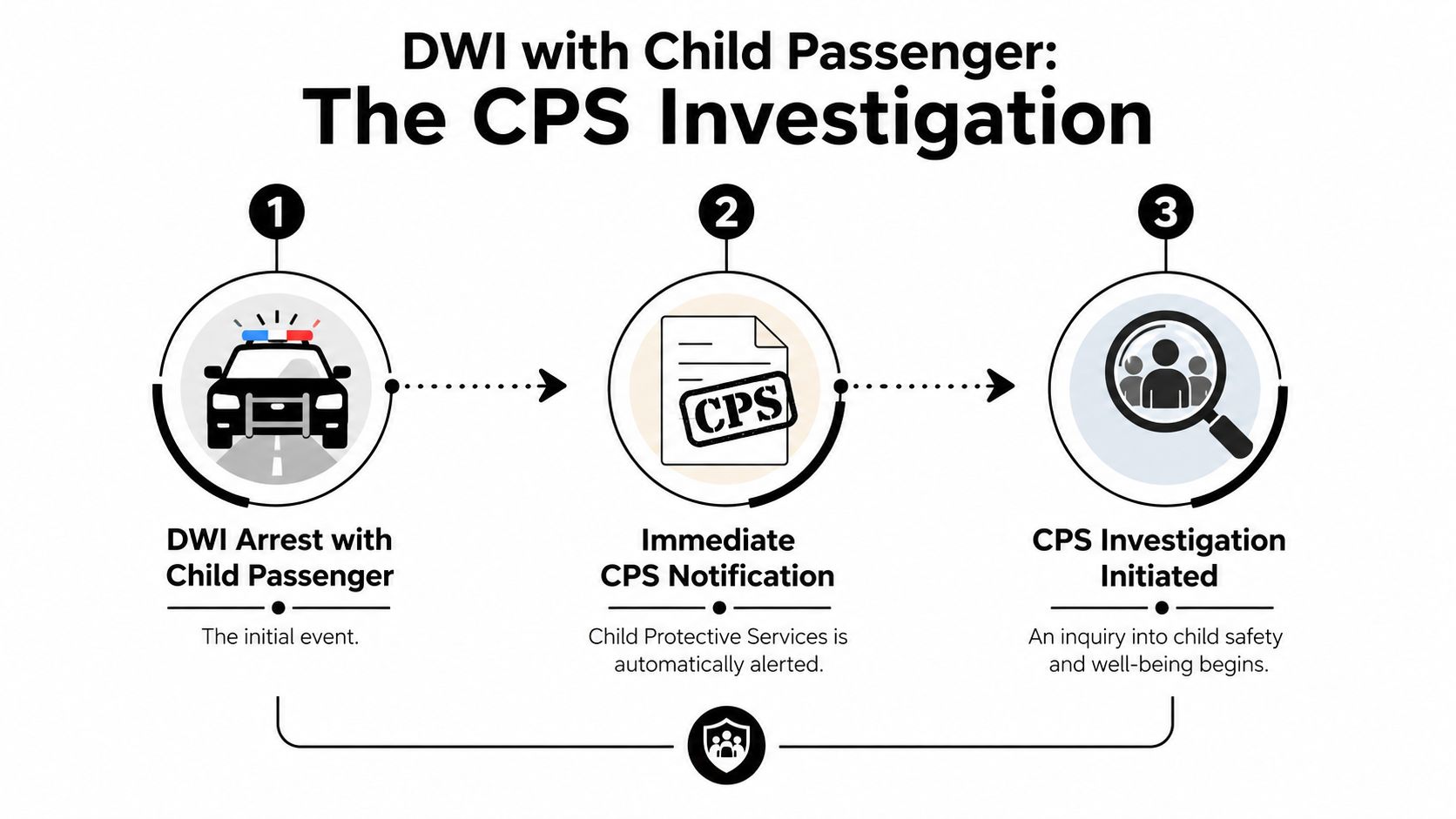
Why CPS is a separate legal problem
A DWI arrest with a child under 15 can trigger an immediate CPS investigation that runs parallel to the criminal case. As noted in this discussion of Texas DWI with a child passenger and CPS cases, prosecutors routinely file CPS reports under Section 261.101(a) after charging, creating two distinct legal battles.
That means you may be dealing with a criminal prosecutor and a CPS investigator at the same time. Those two systems don't have the same goals, the same procedures, or the same timeline.
What parents often get wrong
Many parents think, “If I'm not convicted, CPS will just close it.” That isn't a safe assumption. CPS can make decisions about safety plans, interviews, home conditions, and family supervision before the criminal case is resolved.
The overlap with custody concerns is real. If you're already in a divorce, modification, or parenting dispute, the arrest may become an issue there too. For more on that family-law side, see how a DWI impacts child custody battles in Texas.
A calm approach works better than panic
You should take CPS seriously, but panic usually makes things worse. Parents sometimes talk too much because they think cooperation means giving a full narrative on the spot. In practice, statements made to CPS can create problems in the criminal case.
A more disciplined response usually works better:
- Get advice before interviews: What helps in one case can hurt in the other.
- Keep records: Save bond papers, release terms, treatment records, and communication related to child pickup or care.
- Follow court orders carefully: Judges notice who complies and who improvises.
Your criminal defense and your family protection strategy need to work together. If they don't, one can damage the other.
How a Houston DWI Lawyer Can Defend Your Future
The most important shift in your case is moving from reaction to strategy. A felony arrest involving your child can feel personal and chaotic, but the defense still turns on evidence, procedure, and proof.

Defending the criminal charge
A Houston DWI lawyer or other Texas DUI attorney handling this type of case should examine the stop first. If the officer lacked a lawful basis to pull you over or extend the detention, that can affect what evidence comes in.
The next step is testing the intoxication evidence. That often includes:
- Roadside investigation issues: Field sobriety testing may have been poorly instructed, improperly scored, or conducted under conditions that made the results unreliable.
- Breath or blood scrutiny: A lawyer can review maintenance records, collection procedures, chain-of-custody issues, and whether the State can properly connect the test result to the time of driving.
- Statements and video: Patrol car video, body cam footage, dispatch logs, and booking video often tell a more complete story than a short offense report.
A child-passenger felony also requires proof on the child element. The State must show the child was present and was younger than the required age. Those facts may sound simple, but the defense should never concede what the State still has to prove.
Defending the family side at the same time
Many individuals falter at this stage. They hire someone to handle only the criminal file and assume the CPS matter will sort itself out. In reality, strategy has to be coordinated.
A lawyer can help by managing communication, preparing you for contact with investigators, identifying records that support stability, and reducing avoidable admissions. If the case facts suggest treatment, counseling, or parenting-focused steps would help, those choices should be made thoughtfully and with legal guidance.
For readers dealing with the felony side more broadly, felony DWI in Texas is another useful starting point.
Here is a short explanation of how these cases are built and challenged:
What legal help should actually do
Good representation doesn't mean empty promises. It means someone reviews the stop, the tests, the timelines, the reports, the video, the bond conditions, the license issue, and the CPS overlap as one connected problem.
The Law Office of Bryan Fagan, PLLC handles DWI and related criminal defense matters, including ALR hearings, felony DWI allegations, and cases where family consequences are part of the picture. That kind of coordinated review is often what a parent needs when trying to fight DWI Texas charges without making the custody side worse.
Your Immediate Action Plan After an Arrest
When you're under stress, simple steps help. Focus on actions that protect your rights and avoid new damage.
Four steps to take now
Use your right to remain silent
Be polite, but don't explain, argue, or try to talk your way out of the case. You can identify yourself and comply with lawful instructions without giving a detailed statement.Discuss the facts only with your lawyer
Don't talk about the arrest with friends, relatives, your co-parent, or on social media. Even well-meaning conversations can turn into evidence or become part of the CPS story.Request your ALR hearing fast
If there is a threat to your license, the deadline is short. This is one of the first moves that can protect your ability to drive and give your defense team early access to officer testimony.Prepare for the CPS side carefully
If CPS contacts you, don't assume this is a casual conversation. Get advice before interviews, document all contact, and follow any valid court or bond conditions closely.
Keep these documents together
Start one folder, paper or digital, and keep everything in it:
- Arrest paperwork: Booking records, bond conditions, towing information, and notice related to your license
- Case-related communication: Voicemails, emails, or written instructions from the court, DPS, or CPS
- Stability records: Proof of work, counseling, treatment, childcare arrangements, and any records showing your child's safe care after the arrest
If you feel embarrassed, that's normal. Don't let embarrassment delay your defense. Early action protects more options.
This isn't the time to guess your way through a felony case. If you're facing a DWI with child passenger Texas charge, the smartest move is to get a focused legal review of both the criminal case and the family-related fallout before you make statements or miss deadlines.
If you need answers now, contact Law Office of Bryan Fagan, PLLC for a free, confidential consultation. A calm review of your arrest, your DWI license suspension risk, and any CPS issues can help you protect your rights and decide your next step with confidence.