 Skip to content
A DWI arrest can be overwhelming, especially when your first thought isn't the court date. It's your kids. You're staring at the paperwork, replaying the stop, and asking the question every parent asks in private: Am I going to lose custody?
Most parents don't need a lecture. They need a straight answer.
A DWI can absolutely affect a custody fight in Texas. But it does not automatically mean you lose your children. What matters is context, timing, and what you do next. That's the part many articles miss, and it's the part that matters most if you're trying to protect your rights and keep your family stable.
A DWI Arrest Is Overwhelming Especially with Your Kids in Mind
You may be dealing with two cases at once now. A criminal case about the DWI, and a family law problem that can move fast if the other parent decides to use the arrest against you. That pressure is real. So is the fear that one bad night will define you forever.
In my view, the biggest mistake parents make is assuming every DWI gets treated the same in custody court. It doesn't. Texas judges don't look at the label alone. They look at risk.
If your child was not in the car, it was a first offense, and there's no wider pattern of alcohol abuse, the case is very different from a recent repeat DWI or a DWI tied to child endangerment. One Texas family-law source makes that exact point. Custody decisions are highly fact-specific under the best-interest standard, and an older isolated misdemeanor DWI may matter much less than recent, repeated, or substance-related conduct, while a DWI with a child passenger is far more damaging because it raises child-endangerment concerns and affects a judge's view of parental fitness, as discussed in this Texas DWI and child custody analysis.
The first question is not whether a DWI matters
The first question is how much it matters in your facts.
That means a judge will care about things like:
- Recency: A fresh arrest creates more concern than an old incident followed by stability.
- Pattern: One event is different from repeated alcohol-related problems.
- Child safety: A child in the vehicle changes the case dramatically.
- Aftermath: Your response after the arrest can either calm the court's concerns or confirm them.
Practical rule: If you're in a custody dispute after a DWI, stop thinking only like a criminal defendant. Start thinking like a parent whose judgment is being evaluated.
You need a plan, not panic
A lot of parents freeze after arrest because they assume the damage is already done. It isn't. Courts pay attention to whether you act responsibly after the incident. Quick, thoughtful action can limit the fallout. Delay makes the other side's story stronger.
If you're worried about how a DWI impacts child custody battles in Texas, the answer is simple. It can be manageable, or it can become the center of your custody case. The difference usually comes down to the facts and the strategy.
Understanding the Best Interest of the Child Standard
Texas custody cases turn on one core rule. The court must decide what serves the best interest of the child. Texas Family Code § 153.002 states that standard plainly, and a DWI becomes important because it can affect how a judge sees safety, judgment, and stability, as explained in this Texas custody and DWI overview.
Think of it as a judge's scorecard. Not a mathematical formula, but a practical review of your parenting life. A DWI doesn't decide the whole case by itself. It becomes one piece of the larger picture.
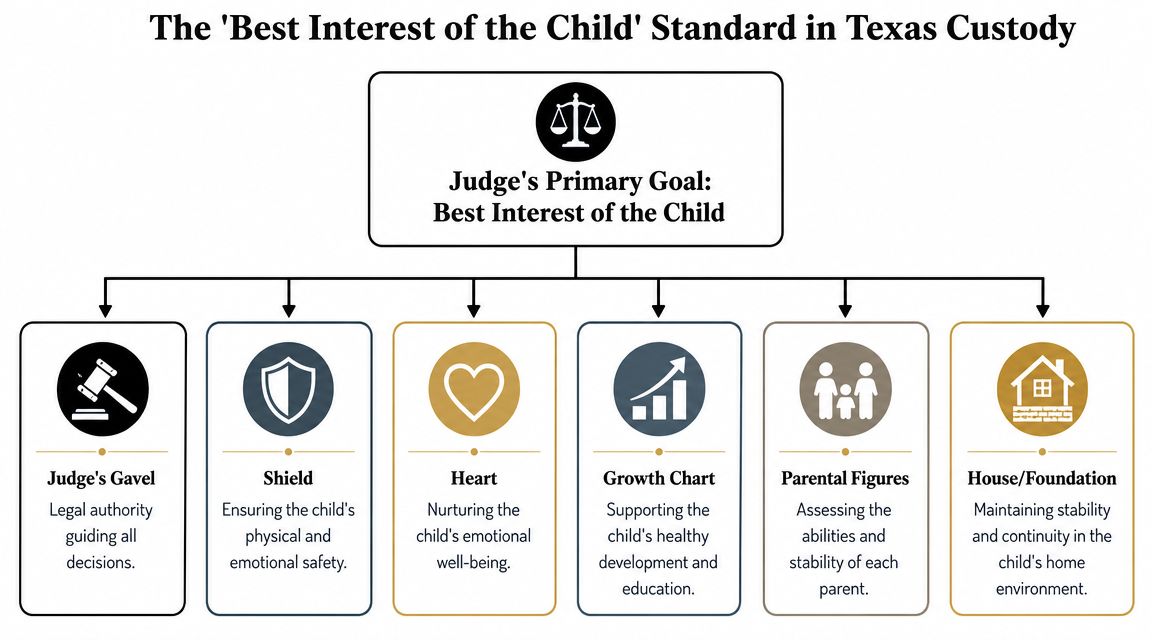
What the judge is really measuring
A judge is usually asking practical questions, not abstract ones.
- Is the child safe with you? If alcohol use appears to create physical or emotional risk, the court takes that seriously.
- Can you make sound decisions? A DWI can be framed as impaired judgment. Your job is to keep that from turning into a broader attack on your parenting.
- Is your home stable? Arrests, transportation problems, missed exchanges, and chaos after a case can all affect the court's view.
- Can you meet daily parenting demands? Judges look at reliability. Getting the child to school, medical appointments, and visitation exchanges matters.
- Are you taking responsibility? A parent who addresses the issue directly usually looks better than a parent who minimizes everything.
Why a DWI fits into that analysis
Family court isn't trying to punish you for the criminal charge. It is trying to assess future risk to the child. That's an important distinction. The judge isn't asking whether you deserve another chance in the abstract. The judge is asking whether your child is safe and supported under your care.
That is why the same DWI can land differently in different families.
A first arrest with no child present, no accident, and strong evidence of responsible parenting may lead to limited restrictions. A recent DWI tied to instability, missed parenting duties, or alcohol misuse may push the court toward supervision or reduced decision-making power.
What parents should focus on
You should be prepared to show the court these three things:
| Concern | What the judge wants to see |
|---|---|
| Safety | Clear evidence that your child is not at risk during your parenting time |
| Stability | Steady routines, dependable transportation, and consistent involvement |
| Accountability | Real steps taken after the arrest, not excuses |
The best-interest standard rewards parents who solve problems quickly and put the child first.
Key terms you need to understand early
Since DWI and custody cases often move side by side, you need plain-English definitions of the terms you'll hear most:
- BAC: Blood alcohol concentration. This is the measurement used to describe the amount of alcohol in a person's system.
- Field sobriety test: Roadside exercises officers use to claim they observed signs of impairment.
- Implied consent: Texas drivers are considered to have consented to certain chemical testing rules by driving on Texas roads. Refusing testing can create separate consequences.
- Administrative license suspension: A license action handled outside the criminal trial process, often tied to testing issues and the driver's arrest record.
Those terms matter because they don't stay in the criminal file. They often show up later in custody disputes as talking points about responsibility, credibility, and day-to-day parenting stability.
How Family Courts View a DWI Arrest and Conviction
A lot of parents think they can wait for the criminal case to finish before worrying about custody. That's risky. Family court doesn't have to sit on its hands.
An arrest and a conviction are not the same thing, but both can affect your custody case. The other parent may use the arrest itself to argue that you exercised poor judgment. If the criminal case later ends in a conviction, that argument gets stronger.
An arrest can still create custody trouble
The other side may bring up the stop, police report, your statements, any alleged refusal, and the surrounding circumstances. Even before a conviction, the arrest can become part of a temporary orders hearing or a modification request.
That matters because family court operates on a practical timeline. If the other parent is asking for immediate restrictions, the judge may focus on safety concerns first and wait for the criminal case later.
If you're worried about visibility, it also helps to understand how these records can surface. This guide on whether DWI arrests are public records in Texas explains why arrest information can quickly become part of the dispute.
A conviction carries more weight
A conviction is harder to explain away because it gives the other side a fixed event they can point to in court. A Texas family-law source notes that a single isolated DWI may lead to restrictions rather than a full loss of custody, while multiple convictions or a recent offense can trigger supervised visitation, court-ordered monitoring, or modified conservatorship orders. The same source notes that a first-time DWI in Texas can include up to six months in jail, a fine of up to $2,000, and a license suspension of up to one year, which can affect how a judge views a parent's stability, according to this Texas DWI conviction and child custody discussion.
Why the license issue matters in custody court
Parents often underestimate the license problem. But courts notice when a parent suddenly can't drive legally, struggles to get the child to school, or depends on last-minute rides for exchanges.
The criminal case asks whether the State can prove the charge. Family court asks a different question. Can you still provide a safe, stable, reliable routine for your child?
That is why administrative license suspension matters. It refers to the separate process that can affect your driving privileges after a DWI arrest. Even if the criminal case hasn't ended, the license issue can disrupt parenting logistics fast.
Field sobriety tests and implied consent don't stay in the criminal file
Two terms show up often in DWI cases and can echo into custody disputes:
- Field sobriety test: These roadside exercises are often used by officers to justify arrest. In family court, the other side may point to them as evidence of visible impairment.
- Implied consent: This is the legal framework that affects chemical testing. If there was a refusal issue, expect the other parent to argue that refusal shows consciousness of guilt or evasiveness.
The family judge may never decide whether the DWI case is winnable. But the judge will decide whether the surrounding facts raise concern about your parenting.
What to do with that reality
Treat the criminal case and custody case as connected from day one. Don't make statements in one that hurt you in the other. Don't agree to temporary family court terms that become the new normal just because you're rattled by the arrest.
A weak response early can create long-term restrictions that are harder to undo than people expect.
Critical Risk Factors That Turn a DWI into a Custody Crisis
Not every DWI creates the same custody danger. Some cases are containable. Others turn into full-scale family emergencies because the facts suggest direct danger to the child.
This is the section where parents need honesty. If one of these aggravating factors is present, your custody exposure rises fast.

The factor that changes everything
A DWI with a child passenger under 15 is in a different category. Texas guidance explains that this can trigger Texas Penal Code § 49.045, a state jail felony, and the offense carries a potential fine up to $10,000 and up to two years in state jail. In custody court, judges can view that as direct evidence of parental endangerment and impaired judgment, as outlined in this Texas explanation of DWI with a child passenger.
If your child was in the car, don't assume the court will treat it as a simple first-offense mistake. It won't.
Other facts that raise the court's concern
Some facts don't create the same felony exposure, but they still make the family case much harder.
- Recent repeat arrests or convictions: This suggests the problem isn't isolated.
- A crash or dangerous driving facts: Judges pay attention when the alleged conduct moved from poor judgment to actual danger.
- Test refusal or other noncooperation: The other side may frame this as avoidance and lack of accountability.
- Broader substance-related behavior: Missed visits, intoxicated calls, or alcohol-related instability can turn one charge into a larger narrative.
Lower-impact facts versus higher-impact facts
Here's the practical way I explain it to parents:
| Lower impact facts | Higher impact facts |
|---|---|
| Older isolated incident | Recent incident during active custody conflict |
| No child in vehicle | Child present in vehicle |
| Strong follow-through after arrest | Continued alcohol-related problems |
| Stable parenting record | Missed exchanges or unsafe parenting conduct |
| No related accident | Crash, injury, or clear endangerment concerns |
Why judges react so strongly to patterns
Judges know people make mistakes. What they don't tolerate well is recurring conduct that suggests your child may face the same risk again. A single event can often be managed with proof of sobriety, treatment, and compliance. A pattern tells the court the problem may not be under control.
That is where many parents lose ground. They focus on arguing about the arrest itself while ignoring the pattern the other side is building around them.
If your case includes aggravating facts, the right move is not denial. The right move is damage control, proof, and disciplined compliance.
How much does a first offense matter
If this is your first DWI in Texas, no child was in the car, and there is no broader history of alcohol-related parenting concerns, the custody impact may be limited to temporary safeguards. That could mean restrictions on driving the child, alcohol testing, or conditions around possession periods.
If the facts are worse, the court may move quickly toward supervised visitation or modified conservatorship. That's why how a DWI impacts child custody battles in Texas depends less on the charge label and more on whether the facts look like a one-time lapse or a real safety threat.
When a DWI Triggers a CPS Investigation
For many parents, CPS involvement is scarier than the criminal charge. That's understandable. Once Child Protective Services enters the picture, the case stops feeling theoretical.
A DWI can trigger CPS attention when the facts suggest child endangerment, especially if a child was present in the vehicle or the arrest involved dangerous circumstances. If that happens, your goal is to stay calm, stay organized, and stop making unforced errors.
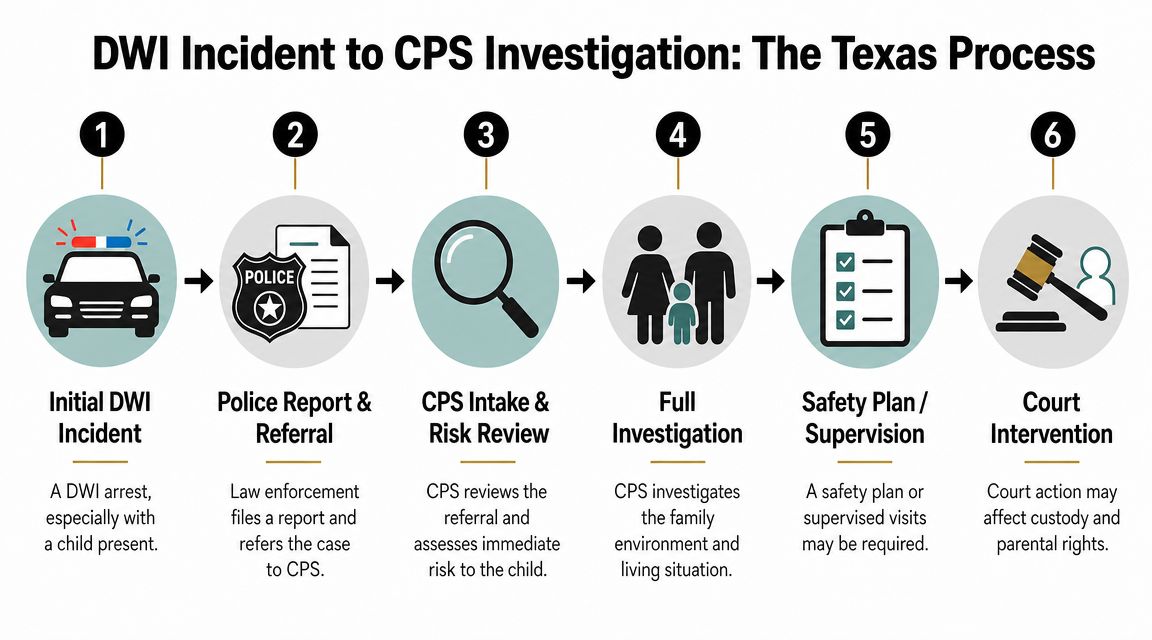
What the process usually looks like
While every case differs, parents often see a sequence like this:
- A report is made: Law enforcement or another person reports conduct raising concerns about the child's safety.
- CPS screens the report: The agency decides whether the allegation warrants investigation.
- Initial contact happens: A caseworker may call or appear at your home.
- Interviews begin: CPS may want to speak with you, the child, and other caregivers.
- Safety decisions are considered: The agency may propose a safety plan or other restrictions.
- Court involvement may follow: If concerns remain serious, CPS findings can overlap with custody litigation.
What you should do right away
A lot of damage happens because parents panic and start talking too much.
- Get legal advice immediately: CPS interviews are not casual conversations.
- Be respectful, not reckless: You don't need to be combative, but you also don't need to volunteer harmful details.
- Keep your home in order: Clean, calm, and child-focused matters.
- Document everything: Save texts, exchange records, school involvement, and proof of compliance.
- Follow temporary safety measures carefully: Sloppy compliance can become the new story.
One issue that often comes up is whether an existing custody or guardianship arrangement can change after a DWI. This overview of whether guardianship can be taken away for a DWI gives useful context on how these concerns can spill into broader parenting-rights disputes.
What not to do
Don't coach your child. Don't destroy evidence. Don't treat the caseworker like an enemy you can outtalk. And don't assume an informal safety plan is harmless just because it isn't a final court order.
A CPS investigation is a fact-gathering process. Every conversation can affect custody.
How CPS findings can affect family court
Family judges take CPS concerns seriously, even when the criminal case is still pending. If CPS sees ongoing risk, that can support requests for supervision, restrictions, or emergency orders.
The good news is that early, disciplined action still matters. Parents who show stability, sobriety, and cooperation often put themselves in a far stronger position than parents who react emotionally and make the case look worse.
Proactive Steps to Protect Your Parental Rights
The morning after a DWI arrest, many parents make the same mistake. They focus on what happened in the traffic stop and ignore what a family judge will care about next. That is backwards. In custody court, the question is not just whether you were arrested. The question is whether the facts suggest an ongoing risk to your child.
That is why your response has to match the seriousness of the case. A first DWI with no child in the car usually calls for fast, credible proof of judgment and stability. A repeat offense, a high BAC, an accident, or any case involving your child calls for stronger steps right away. If you treat every case the same, you either underreact or waste time on the wrong fixes.
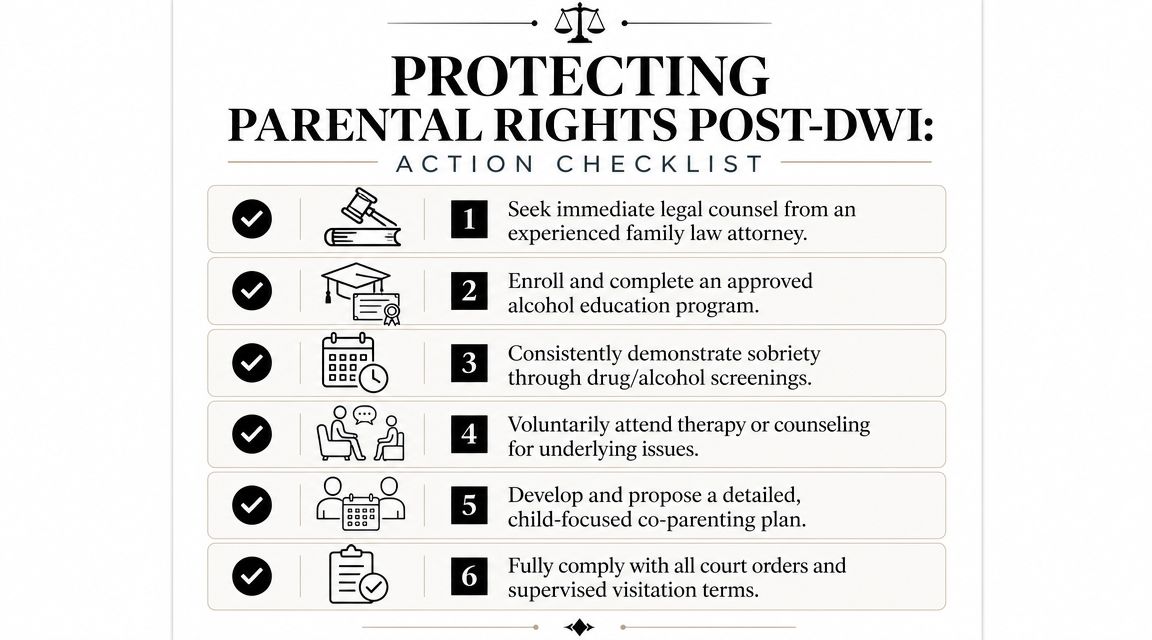
Match your mitigation to the risk
Judges believe records. They do not give much weight to promises.
Start building proof that shows this was a contained incident, or that you took immediate action to fix a serious problem. The right steps depend on the facts:
- Address the criminal case with a custody strategy in mind: What happens in criminal court can shape how the family court views risk, judgment, and credibility.
- Start services before anyone has to force you: Alcohol education, counseling, or treatment can help. The more serious the facts, the more important early enrollment becomes.
- Use testing if alcohol use will be disputed: Clean, consistent testing is often more persuasive than arguing with the other parent.
- Protect your parenting track record: Keep exchanges smooth, stay involved with school and activities, and avoid last-minute cancellations.
- Get third-party support where it counts: Teachers, counselors, supervisors, and other credible adults can help confirm that your child is safe and well cared for in your possession.
The Law Office of Bryan Fagan, PLLC handles Texas DWI defense matters that can overlap with custody disputes.
Know which part of the DWI case can hurt you in family court
Parents get blindsided when they treat the DWI as one problem. It is several problems at once, and each one can affect custody differently.
- Bond conditions: If the court orders no alcohol use, ignition interlock, travel limits, or reporting requirements, follow them exactly. A violation looks worse in family court than the original promise to comply.
- ALR hearing: License problems can affect school drop-offs, exchanges, and work stability. If transportation becomes unreliable, fix it early and document your backup plan.
- Criminal filings and statements: Anything you say in one case can show up in the other. Sloppy explanations, angry texts, and inconsistent positions create credibility problems fast.
Here's a quick video that helps explain the broader legal process and response strategy:
The steps that usually help most
Some parents need a short period of damage control. Others need a documented rebuild. The table below shows which actions tend to carry real weight with a family judge.
| Action | Why it helps in custody court |
|---|---|
| Alcohol education | Shows you treated the arrest as a warning, not an inconvenience |
| Counseling or therapy | Helps address judgment, stress, or substance-use concerns the court may infer from the facts |
| Documented sobriety efforts | Gives the judge objective proof instead of competing stories |
| Full compliance with orders | Protects your credibility and limits arguments that you are unreliable |
| Child-focused co-parenting plan | Keeps attention on stability, routines, and your child's needs |
One point matters more than parents want to hear. If your facts are bad, denial will hurt you more than the DWI itself. A parent with a difficult case can still protect meaningful custody rights by acting early, following every condition, and creating a clean record of stability. A parent with a less serious case can still lose ground by acting defensive and disorganized.
Stop making arguments that do not help
Family judges are not impressed by speeches about how unfair the arrest was if your conduct after the arrest looks careless. Save legal defenses for the criminal case. In the custody case, show judgment, sobriety, consistency, and respect for your child's routine.
That is how you protect parental rights after a DWI in Texas. You prove the level of risk is low, or you reduce it and document every step.
Take Control of Your Case and Protect Your Family's Future
A DWI is serious. In a Texas custody fight, it can become a major issue fast. But it is not an automatic custody disqualifier.
The question is whether the facts make you look like an ongoing risk to your child. If the answer is no, your strategy should prove that clearly and quickly. If the facts are worse, your strategy should focus on containment, compliance, and rebuilding credibility before temporary restrictions become long-term ones.
That's the practical answer to how a DWI impacts child custody battles in Texas. Context matters. Timing matters. Your response matters most.
If you're facing a custody dispute after a DWI arrest, don't split the problem into separate boxes and hope it works itself out. Your criminal case, your license issues, possible CPS attention, and your parenting rights all interact. They need a coordinated response.
Act early. Get organized. Protect the record. And make every decision with your child and the judge's safety concerns in mind.
Frequently Asked Questions About DWI and Custody
| Question | Answer |
|---|---|
| Will I automatically lose custody after a DWI in Texas? | No. A DWI does not automatically end custody rights. Texas courts look at the child's best interest and decide whether the facts show a real safety concern. |
| Does a first DWI in Texas matter less than a repeat offense? | Usually, yes. An isolated first offense is often easier to manage than repeated alcohol-related conduct, especially when there is no child in the vehicle and no broader pattern. |
| What if my child was not in the car? | That usually helps. Courts still care about judgment and stability, but the case is generally less damaging than a DWI involving a child passenger. |
| Can I still get visitation after a DWI arrest? | In many cases, yes. But the court may impose conditions such as supervised visits, testing, or limits on transporting the child if it believes safeguards are needed. |
| What's BAC? | BAC means blood alcohol concentration. It refers to the amount of alcohol measured in a person's system. |
| What is a field sobriety test? | A field sobriety test is a roadside exercise officers use to claim they observed signs of impairment. These tests often become part of the evidence in the criminal case. |
| What does implied consent mean in Texas? | Implied consent means Texas drivers are subject to legal testing rules tied to driving on public roads. Testing issues can trigger separate consequences involving your license. |
| What is an administrative license suspension? | An administrative license suspension is a driver's license action handled outside the criminal trial. It can affect your ability to drive your child and maintain normal parenting routines. |
| Can a DWI cause supervised visitation? | Yes. If the court believes there is a current safety risk, supervised visitation is one option it may use. |
| Should I wait for the criminal case to finish before addressing custody issues? | No. That's usually a mistake. Family court can move before the criminal case ends, so you need to protect your custody position immediately. |
If you're dealing with a DWI and worried about your children, don't try to guess your way through it. The stakes are too high. The attorneys at Law Office of Bryan Fagan, PLLC offer free consultations and case evaluations for Texans facing DWI charges and related custody concerns. You can get clear answers, a practical defense plan, and guidance on how to protect your parental rights, your license, and your future.

