
A DWI arrest can be overwhelming, but you don't have to face it alone. Maybe you were leaving a late dinner along SH-78 when blue lights appeared behind you, or you were driving home through Wylie after work when a traffic stop suddenly turned into handcuffs, a tow truck, and a ride toward the Wylie Police Department or Collin County Jail. An arrest can feel final. Legally, it isn't.
You haven't been convicted just because an officer arrested you. You're facing two separate legal matters, the criminal DWI case and the administrative fight over your driver's license. A prompt call to a qualified DWI lawyer in Wylie, TX can protect both.
A DWI Arrest in Wylie Does Not Have to Define Your Future
The first question most drivers ask is, “What happens now?” The answer depends on the facts of the stop, the evidence collected, your prior record, and how quickly you respond. Collin County prosecutors take DWI allegations seriously, but the State still must prove its case through admissible, reliable evidence.
Wylie's transportation environment makes these arrests a recurring concern. The city had an estimated population of 62,954 on July 1, 2024, compared with 57,526 in the 2020 Census, an increase of 5,428 residents, or 9.5% in four years, according to the U.S. Census Bureau's Wylie QuickFacts data. A growing suburb brings more commuters, visitors, roadside stops, and drivers moving through North Texas corridors.
That context doesn't determine your guilt. It does explain why you need a defense strategy built for Wylie and Collin County rather than generic internet advice.
The first days require action
The most urgent issue is usually the Administrative License Revocation, or ALR, process. Texas DPS describes ALR as a civil proceeding triggered by a refusal, a failed test, or a BAC of 0.08% or higher in a non-commercial vehicle. The hearing must be requested within the applicable notice period, and the suspension can begin on the 40th day after notice if you don't act, according to the Texas DPS ALR program.
Your statements, decisions about chemical testing, and choice of lawyer can affect both tracks. Don't post about the arrest, argue about the facts online, or assume that a later dismissal will automatically restore your license. Criminal court and license court operate separately.
Practical rule: Treat the arrest as the beginning of a process, not the conclusion of your story. Move quickly, preserve evidence, and get advice before making decisions that can't be undone.
What Happens Right After a DWI Arrest in Texas
A Texas DWI arrest generally unfolds in a predictable sequence, although the details vary by agency and case. Knowing the sequence helps you avoid mistakes.
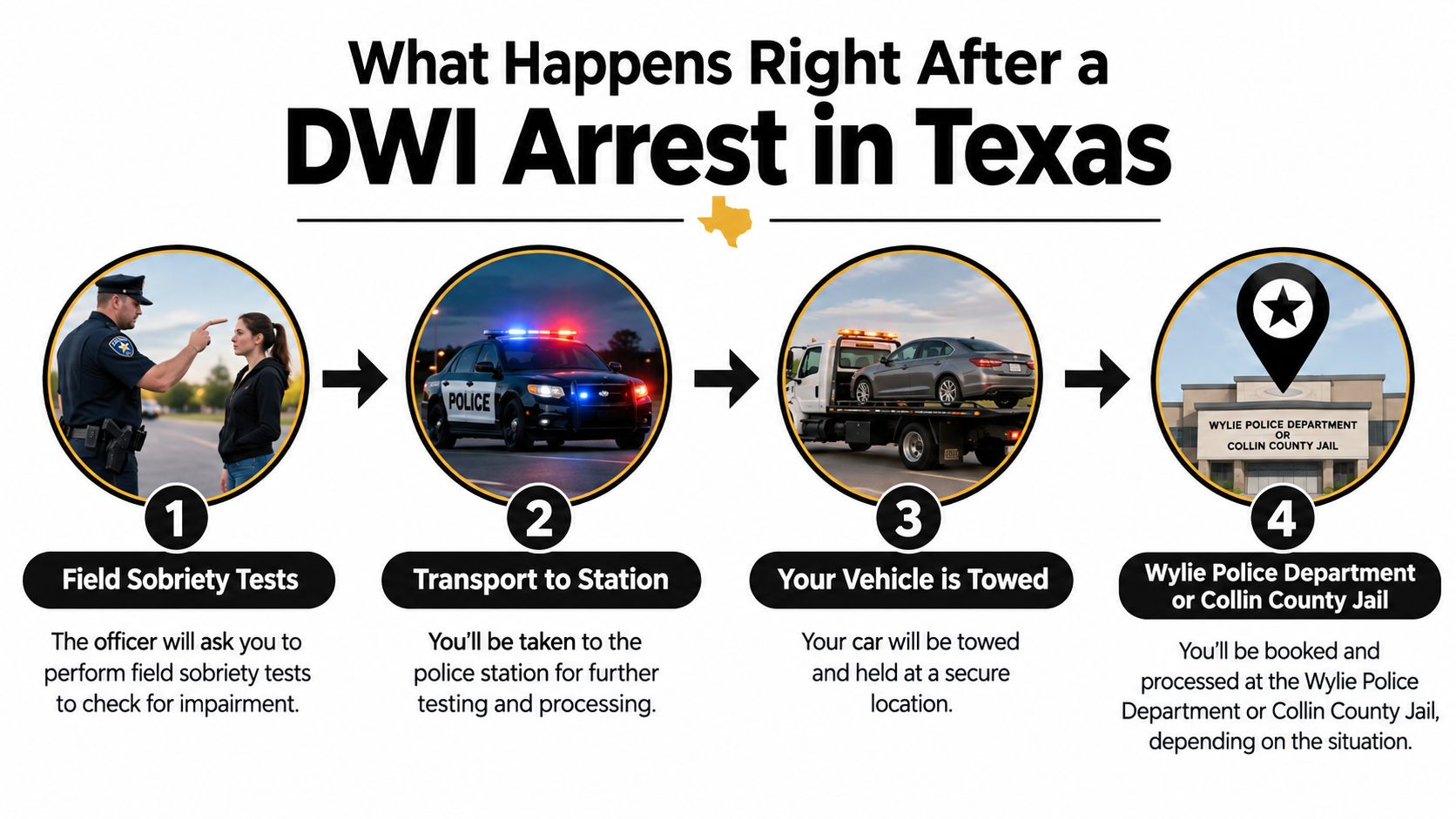
At the roadside
The officer may ask questions, conduct a field sobriety test, and request a roadside breath sample. A field sobriety test is a group of physical and eye-movement exercises used to evaluate possible impairment. The standardized tests include horizontal gaze nystagmus, the walk-and-turn, and the one-leg stand.
You have the right to remain silent about drinking, where you were, and what you consumed. Provide identifying information, remain respectful, and clearly request a lawyer before answering investigative questions. Don't argue, resist, or try to explain your way out of the stop.
Booking and evidence collection
After handcuffing, officers may impound your vehicle and transport you for booking. The booking record may include officer observations, field sobriety scores, photographs, breath-test information, and blood-draw documentation. Review every document with counsel. Small differences between the report, video, and forms can matter.
Bond may include conditions such as an ignition interlock device, SCRAM monitoring, or restrictions on contact with particular people. Follow every condition. A violation can create problems separate from the underlying DWI allegation.
The ALR deadline
The license case demands immediate attention. Texas DPS explains that a hearing must be requested within the required period after notice. Missing the deadline can forfeit your opportunity to challenge the administrative suspension, even if the criminal case later improves.
Don't assume your criminal defense lawyer automatically handled the ALR matter. Ask directly whether the hearing request was filed and whether counsel will appear.
Court proceedings
After release, you'll receive information about an arraignment or initial court setting. The court will address the charge and procedural requirements. Misdemeanor matters may proceed in municipal court, while more serious allegations can move into Collin County District Court.
Don't skip court, discuss the case on social media, or speak with an insurer about fault and alcohol use without legal advice. Save citations, notices, receipts, medical information, and any messages or location records that help establish your timeline.
A short video can help you understand the general arrest sequence, but it can't evaluate your specific stop:
Texas DWI Penalties Explained for Wylie Drivers
If you are arrested after a stop in Wylie, separate the criminal charge from the driver's license case immediately. Texas generally treats a first DWI as a Class B misdemeanor, with at least 72 hours of confinement, according to the Texas DWI assessment published by the Texas Department of Public Safety. The allegation can become more serious with a 0.15 or higher BAC, prior DWI history, an injury or death, or a child passenger.
For a first offense, the potential criminal range includes up to 180 days in jail, a fine of up to $2,000, and driver's license loss of up to one year, as explained in TxDOT's impaired-driving guidance. A separate state fine may apply. Under Texas Transportation Code § 709.001, that fine is $3,000 for a qualifying first conviction and $6,000 when the trial shows an alcohol concentration of 0.15 or more, under the Texas Transportation Code.
Criminal punishment and license consequences are different
The criminal court decides guilt and punishment. DPS handles the ALR suspension. A favorable result in one case does not automatically end the other, so your Wylie defense plan must address both.
| Offense Level | Criminal Penalty | License Suspension | Annual Surcharge |
|---|---|---|---|
| First DWI | Up to 180 days in jail, at least three mandatory days of confinement, and a fine up to $2,000 | Suspension may follow a refusal or failed test through the ALR process | A separate state fine may apply under Texas law |
| First DWI with qualifying high BAC | More serious treatment may apply, including the separate state fine described above | Administrative consequences remain separate from criminal court | $6,000 state fine when the trial shows BAC of 0.15 or more |
| Repeat or aggravated DWI | Prior convictions, intoxication assault, intoxication manslaughter, or other aggravating facts can increase exposure | License and commercial-driving consequences may be more severe | Depends on the charge and statutory findings |
Wylie enforcement is active, not a one-off concern. Texas DPS reporting lists 153 Wylie Police Department DWI arrests in one 2024 report and 171 in another reporting period. Those figures reinforce the need to preserve video, challenge the State's proof, and address the license case before the ALR deadline closes.
How a DWI Lawyer Challenges the Evidence Against You
A prosecutor's case usually depends on a chain of evidence, not one fact. The defense should test every link, beginning with the traffic stop and ending with the laboratory or breath-test result.
The stop and officer observations
An officer must have a lawful basis to stop your vehicle. The report should identify the traffic violation or facts supporting reasonable suspicion. Video may show a different driving pattern than the report describes. Missing or incomplete dashcam and body-camera evidence can also affect how confidently the State can present its version.
The next question is probable cause. An odor, admission, red eyes, or poor performance can be offered as clues, but the defense should examine when each observation occurred and whether the officer interpreted ordinary behavior as impairment.
Field sobriety testing
NHTSA materials report separate accuracy figures for the standardized tests at a BAC of 0.08 or higher, with HGN at 77%, walk-and-turn at 68%, and one-leg stand at 65%. When officers combine all three, the materials report 91% correct arrest decisions at that level and 86% correct arrest or release decisions overall, according to the NHTSA refresher manual.
Those figures don't turn a roadside test into a chemical measurement. A defense attorney should examine lighting, traffic, pavement slope, footwear, weather, instructions, demonstrations, balance, eye conditions, medications, and medical history.
HGN involves three clues in each eye, six possible clues total: lack of smooth pursuit, sustained nystagmus at maximum deviation, and onset before 45 degrees. Four or more clues are commonly associated with a BAC of 0.08 or higher, but the officer must administer and score the test correctly, as explained in this guide to challenging field sobriety test results in Texas.
Chemical testing
Breath and blood evidence requires technical review. Counsel may examine observation periods, certification, maintenance, collection procedures, chain of custody, warrants, laboratory analysis, and whether the result accurately reflects your alcohol concentration at the legally relevant time. The legal issues surrounding Challenging Breath and Blood Tests in Texas DWI Cases often determine whether chemical evidence can be narrowed or excluded.
| Evidence Type | Typical Defense Challenge |
|---|---|
| Traffic stop | No reasonable suspicion or inconsistent video |
| Officer observations | Ambiguous facts, poor documentation, or innocent explanations |
| Field sobriety tests | Medical, environmental, footwear, instruction, or scoring problems |
| Breath test | Certification, maintenance, protocol, interference, timing, or reliability |
| Blood test | Warrant, consent, collection, storage, laboratory, or chain-of-custody issues |
A suppression motion, expert review, or focused negotiation can change the case. The correct strategy depends on the actual records, not the arrest label.
Choosing the Right DWI Lawyer in Wylie TX
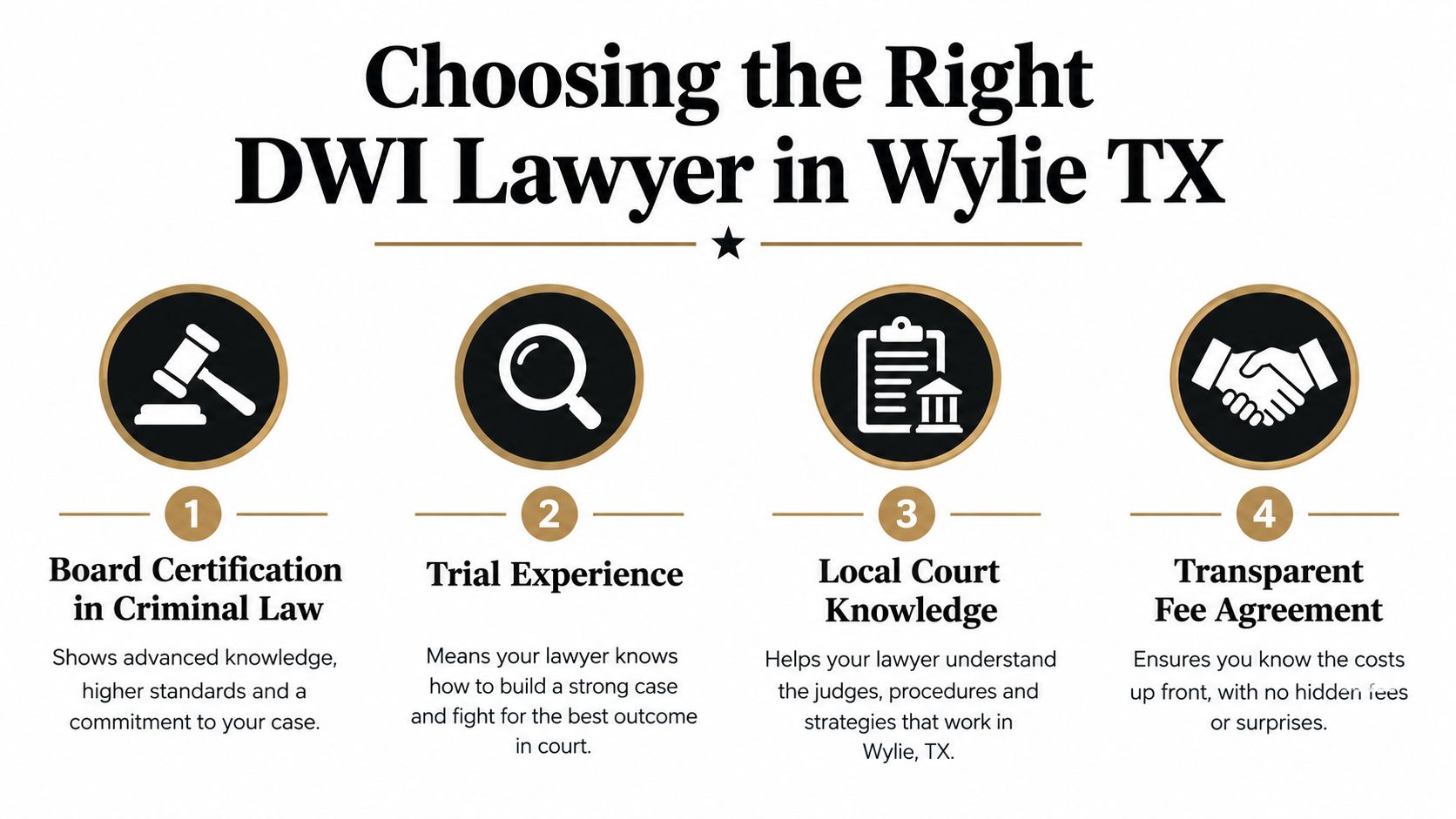
Don't hire a lawyer because the website says “DWI defense.” Ask how often that lawyer handles these cases, whether the lawyer tries them, and whether the lawyer understands Wylie and Collin County procedures.
Board certification in criminal law can be one useful credential. It isn't a substitute for personal attention, trial preparation, or a careful review of your evidence.
Questions to ask before signing
Use the consultation to get specific answers:
- Practice focus: What portion of the attorney's practice involves DWI cases?
- Trial experience: Has the attorney handled DWI jury trials, and who will personally appear in court?
- Local knowledge: Does the lawyer regularly work with Wylie Municipal Court and Collin County courts?
- Case assessment: What evidence needs review before anyone recommends a plea?
- ALR representation: Is the license hearing included, and what separate fee applies?
- Fee structure: What services are covered, and what costs could arise if the case proceeds toward trial?
A responsible lawyer won't guarantee dismissal, acquittal, or a particular sentence. The lawyer should explain strengths, weaknesses, deadlines, likely options, and the decisions that remain yours.
Bring the paperwork
Gather the arrest report, citation, charging instrument, DL-26 or suspension notice, breath or blood results, bond paperwork, and any court notices. Write down the stop while your memory is fresh, including where you drove, what the officer said, which tests were requested, and when any sample was taken.
Preserve photos of the roadway, footwear, and physical conditions if they help explain the testing environment. Don't contact witnesses, post evidence online, or alter messages.
For a practical screening framework, review this guide to choosing a criminal defense attorney. The right Texas DUI attorney should explain the plan in plain English and tell you what happens next.
License Defense, ALR Hearings, and Life After the Case
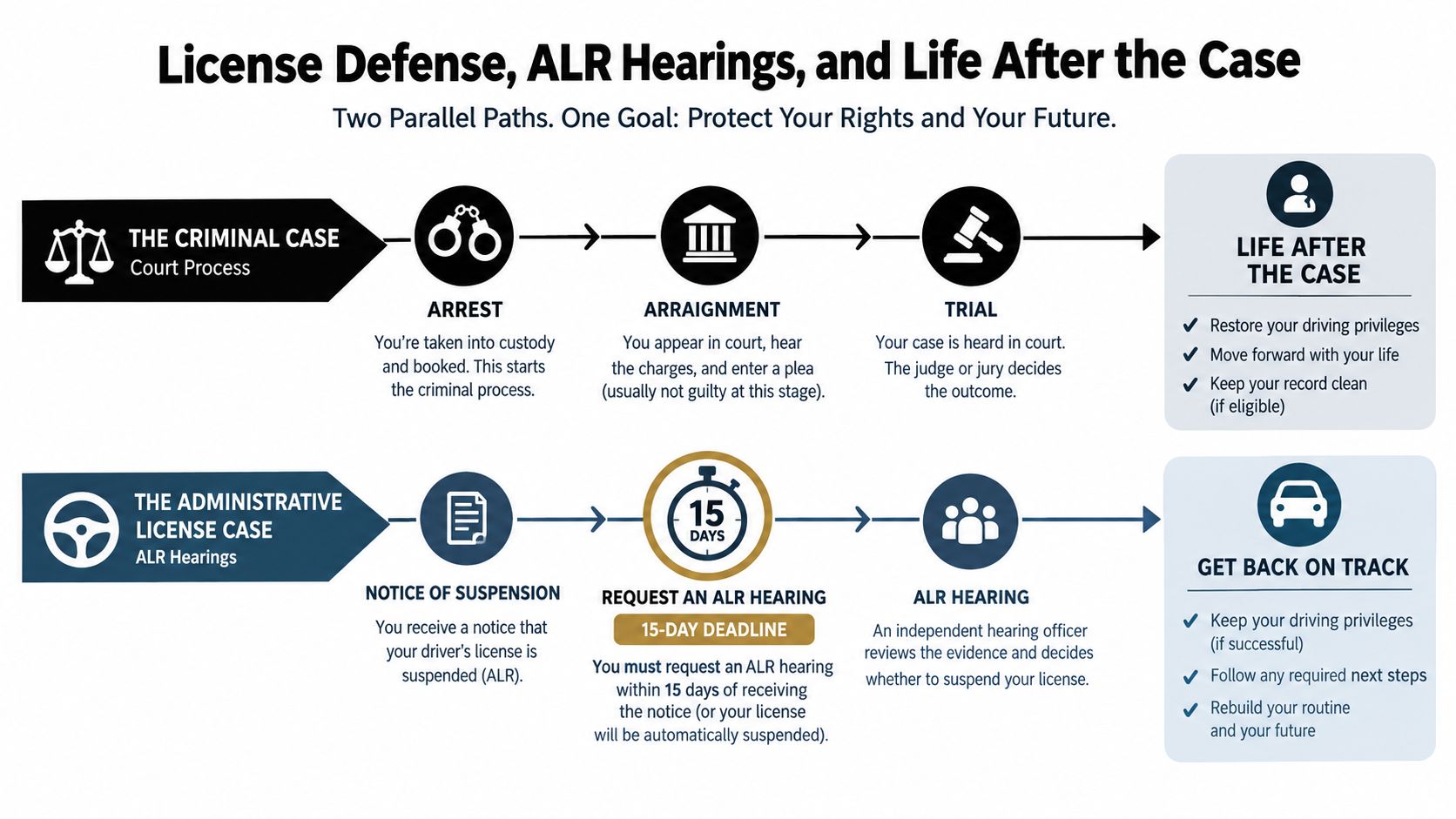
A DWI arrest in Wylie creates two separate cases. The criminal charge proceeds through municipal or Collin County criminal court. The Texas Department of Public Safety handles the license case through an administrative license revocation, or ALR, hearing. Winning one does not automatically end the other.
The ALR process
An ALR hearing is a civil administrative proceeding before a hearing officer. The issues can include whether the Wylie-area officer had reasonable suspicion for the stop, probable cause for the arrest, proper notice, and whether a breath or blood test was administered and analyzed correctly.
The deadline on your suspension notice controls. Request the Texas ALR hearing process before that deadline expires. Counsel can question the officer, challenge the State's documents, and identify defects that may prevent the suspension. A favorable ruling can protect your driving privilege. If the suspension remains, ask about an occupational or restricted license and any ignition interlock requirement.
Do not rely on broad statewide assumptions. Wylie drivers may face different procedures and evidence from cases handled elsewhere in Collin County. The hearing record can also preserve testimony and documents that matter in the criminal case, so preparation should address both proceedings without treating them as one case.
After criminal court
A dismissal, reduction, or other favorable criminal result does not automatically erase an ALR suspension. Record relief has separate rules. Expunction generally requires an acquittal or another qualifying non-conviction outcome. Nondisclosure can seal eligible records from public view, but it does not treat the record as though it never existed. Review the differences in this discussion of expunction and sealing.
CDL holders need separate advice. A commercial driver faces a 0.04% BAC threshold in a commercial vehicle, and CDL or commercial learner permit holders are categorically ineligible for deferred adjudication on a DWI or BWI charge. A criminal dismissal may still leave commercial-driving consequences in place.
Your Next Step With the Law Office of Bryan Fagan PLLC
You don't need to solve the entire case tonight. You do need to protect the deadlines and preserve the facts while the evidence is available.
A useful first consultation should be practical. Bring your paperwork, explain the stop from the beginning, identify any medical or physical issues, and describe what happened after arrest. Counsel should then explain the criminal charge, the ALR position, the evidence that needs testing, the likely timeline, and the choices available to you.
The Law Office of Bryan Fagan, PLLC handles Texas DWI defense, field sobriety and chemical-test challenges, ALR hearings, and criminal court representation. The firm serves Texans in major metropolitan areas and surrounding counties, including drivers dealing with first offenses, repeat allegations, felony charges, CDL concerns, and record-relief questions.
What a focused defense should address
Your lawyer should look at:
- The stop: Whether the officer had a lawful reason to initiate contact.
- The arrest: Whether the observations established probable cause.
- The testing: Whether field sobriety, breath, or blood procedures were reliable.
- The license: Whether the ALR request was filed and the suspension can be challenged.
- The outcome: Whether dismissal, reduction, trial, record relief, or another resolution fits your facts.
The firm can also explain the practical difference between a DWI license suspension and the criminal case. That matters for Wylie drivers who need transportation for work, school, family responsibilities, or commercial driving.
Don't wait for a court date to make the first call. Request a free consultation, bring every notice you received, and ask direct questions about the ALR deadline and the evidence. Early legal review gives you more control and keeps you from making avoidable decisions under pressure.
The Law Office of Bryan Fagan, PLLC offers free case evaluations for Wylie drivers facing DWI charges, ALR proceedings, and related license or record concerns. Visit Law Office of Bryan Fagan, PLLC to request a review of your case, discuss the stop and testing evidence, and protect your next step before the ALR deadline window closes.