
A DWI arrest can be overwhelming, but you don't have to face it alone. Maybe you're sitting at home after a late-night stop near McPherson Road, trying to understand the paperwork you received, wondering whether you'll lose your license, and worrying about what the arrest means for your job or family. Take a breath. Your Laredo DWI case has two separate tracks from the beginning, and both require prompt attention.
The criminal case concerns the State's allegation that you operated a vehicle while intoxicated. The second track is the Administrative License Revocation, or ALR, process, which can affect your driving privileges even before the criminal case is resolved. A DWI lawyer in Laredo, TX should address both tracks immediately, not treat the license issue as an afterthought.
What To Do Right Now After a DWI Arrest in Laredo
The red and blue lights appear behind you on McPherson Road. The officer asks where you're coming from, whether you've been drinking, and whether you'll perform roadside tests. Later, you're transported to the Webb County Jail. At that point, the most important decisions often happen away from the courtroom.
You have two urgent tasks in the next day. First, protect your driving privileges by determining whether you received an ALR notice and requesting a hearing within the required deadline. Second, protect the criminal case by avoiding statements and preserving evidence before memories fade or recordings are overwritten.
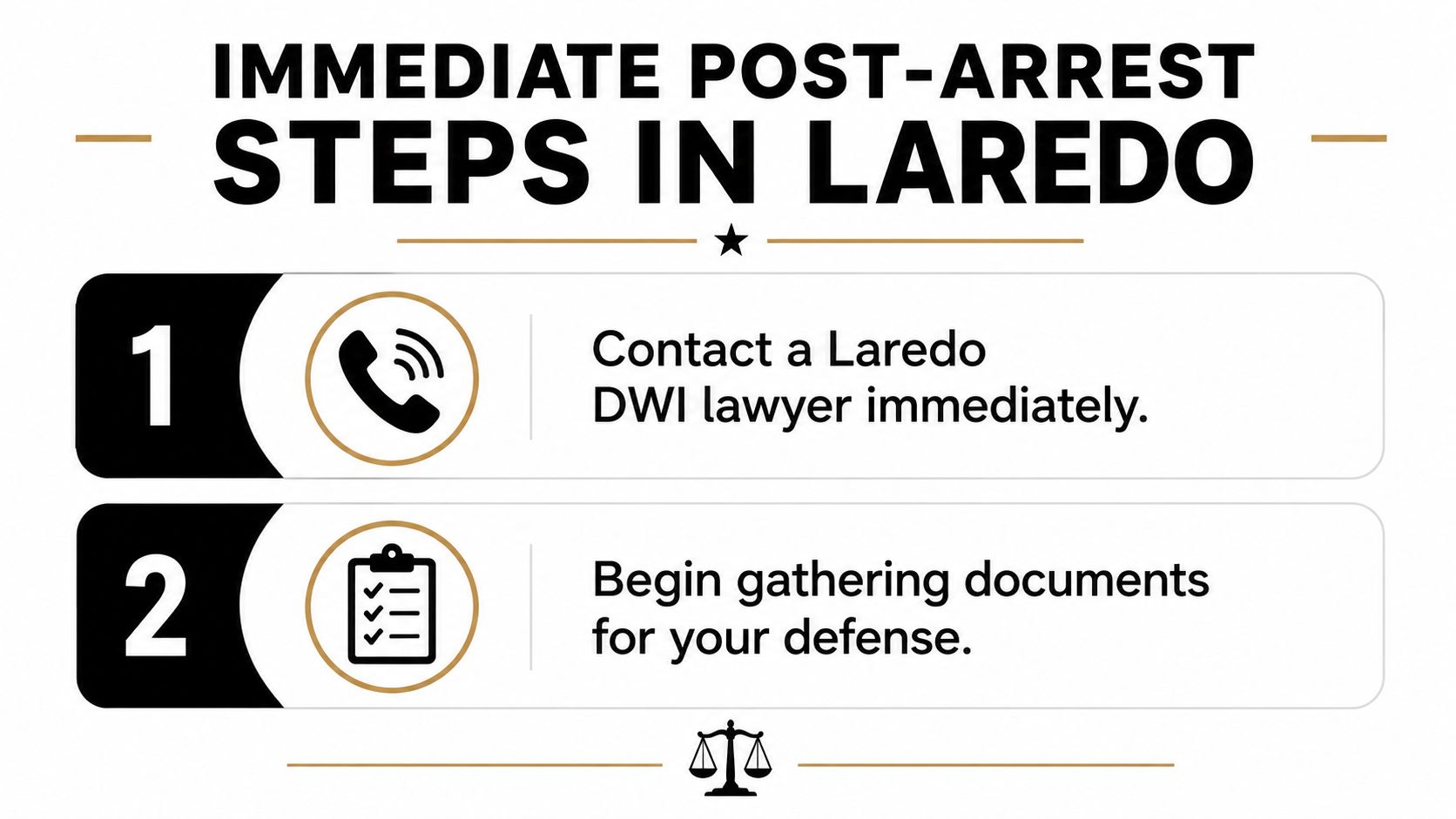
Your first practical steps
- Limit your answers: Provide identifying information and comply with basic booking procedures, but don't explain the evening or try to persuade an officer that you're innocent.
- Ask for legal advice: Don't agree to an interview with a detective or investigator before speaking with counsel.
- Preserve the timeline: Write down where you were, what you ate or drank, when you drove, where the stop occurred, what the officer said, and when testing took place.
- Identify witnesses: Save names and contact information for passengers, friends, restaurant staff, or anyone who saw your driving or the arrest.
- Save available video: Ask the vehicle owner to preserve and screenshot relevant dash-camera footage. Don't edit or overwrite the original recording.
- Protect testing evidence: If you provided a breath or blood specimen, tell your lawyer exactly what you remember about the request, collection, and paperwork.
Texas treats a DWI as both a criminal matter and an administrative-license matter. The Texas DPS ALR information should not replace advice about your specific notice, deadline, or driving status.
Practical rule: Don't call the prosecutor, explain the facts to the arresting agency, or post about the arrest before a Laredo DWI lawyer reviews the situation.
Doing nothing on day one can damage both tracks. Call a lawyer before answering questions beyond basic identification, and bring every document from the jail, officer, and license process to that consultation.
Inside the Laredo DWI Process From Booking to Court
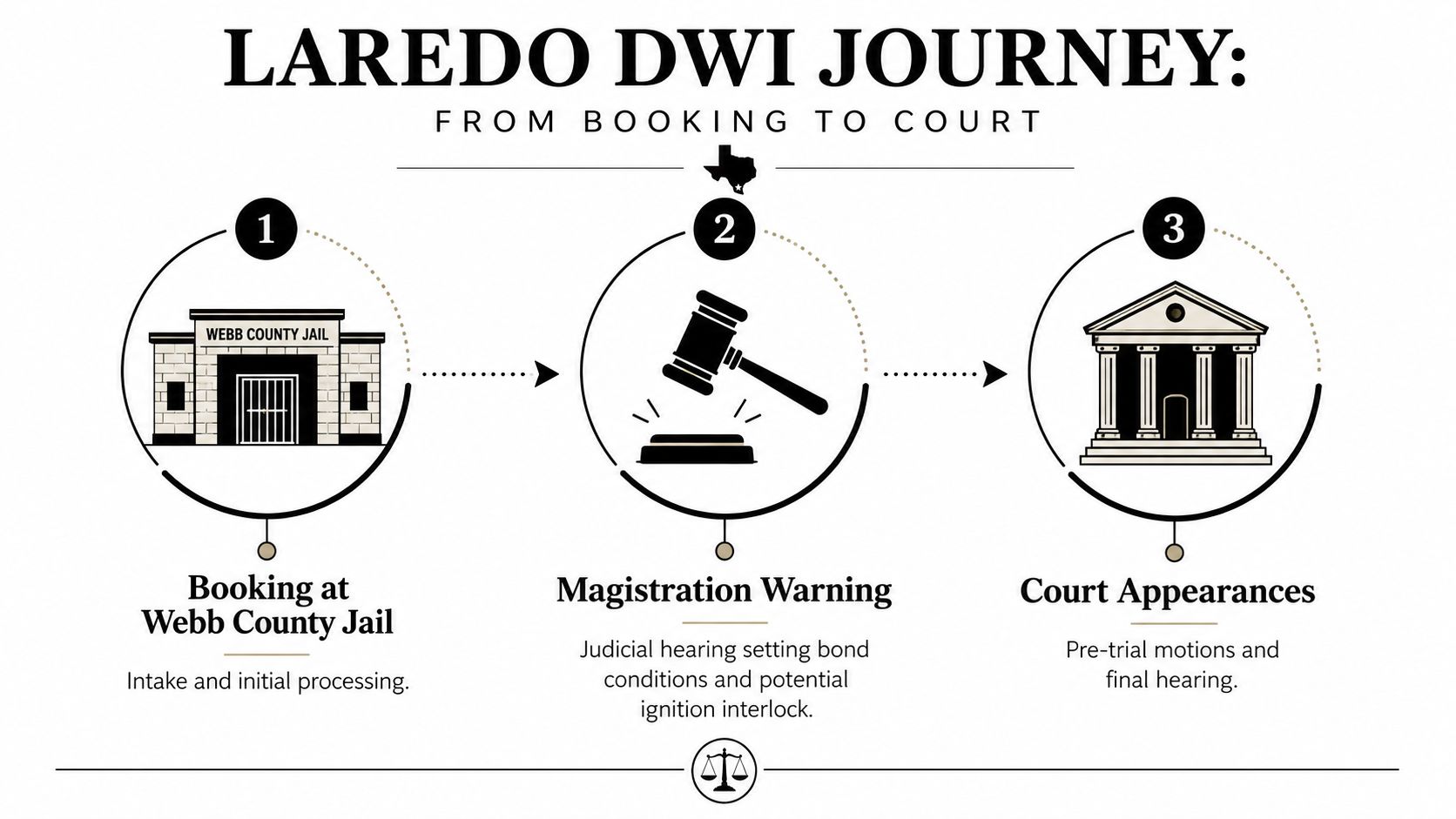
The process usually begins with intake at the Webb County Jail. Officers document the arrest, inventory personal property, collect identifying information, and process the charge. Bond follows, subject to the conditions imposed in the case.
The next important event is magistration. A magistrate advises you of basic rights and addresses bond conditions. Depending on the facts, conditions may involve an ignition interlock device or other restrictions. Listen carefully, answer only what's necessary, and avoid giving a narrative about the alleged incident. Statements made during an early hearing can appear later in reports or testimony.
You may also receive paperwork affecting your driving privileges. That temporary document and any ALR notice should be photographed, stored, and sent to counsel immediately. The criminal court process and the ALR process move separately, so a bond release doesn't resolve the license issue.
What the evidence file may contain
A defense lawyer will seek material such as:
- Video: Body-camera footage, dash-camera recordings, jail video, and nearby surveillance.
- Testing records: Breath-test results, blood-test documents, collection records, and related maintenance material.
- Officer documentation: The crash report, offense report, field sobriety worksheets, and arrest affidavit.
- Witness information: Names, statements, and records that may confirm your location, condition, or driving.
Law enforcement records may be requested before formal discovery is completed, but the defense must still follow the criminal case and obtain evidence through the proper legal process. Preserving video early matters because agencies and private businesses may not retain recordings indefinitely.
After the first docket appearance, the case may involve negotiations, motions, evidentiary hearings, and trial preparation. The resource Challenging Breath and Blood Tests in Texas DWI Cases describes how chemical-test evidence can be questioned in a DWI defense.
How a DWI Lawyer Attacks the State's Evidence
The State's case isn't one indivisible story. It's a chain of separate decisions and evidence points. A defense lawyer should test each link independently, from the first reason for the traffic stop to the reliability and handling of any chemical test.
The four pressure points
The traffic stop comes first. The question is whether the officer had reasonable suspicion to stop you on I-35, Del Mar Boulevard, or another roadway. A vague hunch isn't automatically enough. The report, dispatch information, video, and driving pattern must be examined together.
Probable cause for arrest is a separate question. Even if the stop was lawful, the officer still needed sufficient facts to arrest. The analysis may include driving conduct, statements, physical observations, and the circumstances surrounding any requested testing.
Field sobriety testing requires close review. A field sobriety test is a roadside evaluation, commonly involving the Horizontal Gaze Nystagmus, Walk-and-Turn, and One-Leg Stand tests. NHTSA's manual reports that the three-test battery produced 91% correct arrest decisions at the 0.08 BAC threshold, while individual reported accuracy was 77% for HGN, 68% for Walk-and-Turn, and 65% for One-Leg Stand (NHTSA SFST manual). Those figures don't decide your case. They show why each test must be examined rather than accepted as conclusive.
Chemical-test compliance is the fourth point. Counsel should review the request, observation period, instrument records, operator qualifications, calibration and maintenance material, and the chain of custody for blood. Medical conditions, footwear, fatigue, weather, surface conditions, and language barriers can also affect roadside testing.
| Evidence Element | What the State Must Prove | Common Defense Angle | Why It Matters |
|---|---|---|---|
| Traffic stop | A lawful basis for the stop | Question the observed violation, dispatch information, or video | An unlawful stop can undermine later evidence |
| Arrest | Sufficient facts for probable cause | Compare the report with video and witness accounts | Weak arrest grounds may support suppression arguments |
| Field sobriety tests | Reliable observations under proper conditions | Examine instructions, conditions, scoring, and physical limitations | A test result can be less reliable than it appears |
| Chemical evidence | Proper request, collection, handling, and analysis | Review records, timing, custody, and procedure | Testing evidence must satisfy legal and technical requirements |
A single weak link can change the case. Review when DWI evidence can be suppressed before assuming the State's evidence is complete.
The 15-Day ALR Hearing Deadline You Cannot Miss
After a Laredo DWI arrest, two cases begin at once. The criminal charge proceeds through court, while the ALR process addresses your driver's license separately. Treat both tracks as urgent from the first hour.
Implied consent means Texas law treats a driver as having agreed to provide a breath or blood specimen under certain DWI circumstances. The Texas DPS ALR program explains that ALR may apply when a driver refuses or fails to complete a breath or blood test, or when testing shows a BAC of 0.08% or more in a non-commercial vehicle. DPS also identifies a 0.04% threshold for a commercial motor vehicle.
BAC, or blood alcohol concentration, is the alcohol concentration measured in blood or an equivalent breath measurement. A refusal and a reported BAC result raise different legal issues. Your lawyer needs the exact notice, test history, and paperwork before choosing a defense strategy. CDL holders, drivers under 21, and people with an out-of-state license face additional consequences that require a case-specific review.
What the deadline means
The officer may serve an ALR notice with a temporary driving document, often called the pink sheet or pink receipt. Texas DPS states that you may request an ALR hearing within 15 days of being served notice. A timely request leads DPS to send hearing information by mail. Requests made after 15 days are denied, according to Texas DPS hearing information.
Send the notice and temporary document to counsel immediately. Confirm how the request must be submitted, and keep proof of filing. Do not assume mailing a form completes the process. The hearing can challenge the administrative suspension and require DPS to present the basis for the proposed action. Review our guide to Texas DWI administrative penalties for the separate license consequences.
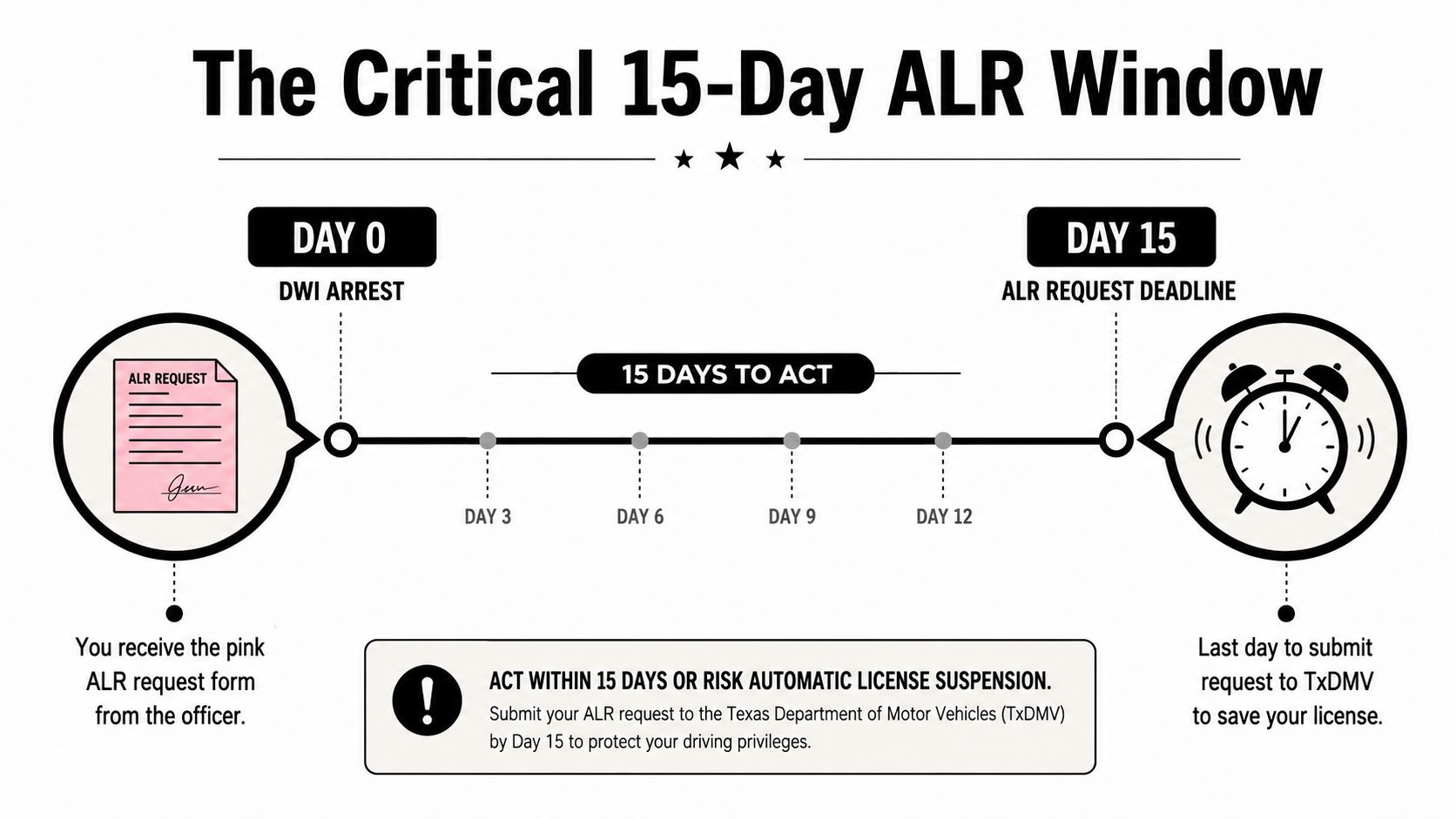
Here's a short visual reminder of the timeline:
Requesting a hearing can protect driving privileges while the criminal case develops. That matters for work, school, medical appointments, and family responsibilities in Webb County. The ALR record may also expose gaps in the traffic stop, field sobriety testing, or chemical-test evidence that belong in the criminal defense.
The Texas DWI Defense Lawyer resource concerns defense for drivers charged under Texas Penal Code 49.04. Handle the ALR deadline as a separate emergency, not paperwork that can wait for the first criminal court date.
Texas DWI Penalties by Offense Level
Texas DWI consequences depend on the charge, prior convictions, alleged BAC, injuries, passengers, and other facts. Don't assume the word “first” tells the whole story. A first DWI in Texas can still produce jail exposure, license consequences, and professional problems, while prior convictions or serious harm can increase the charge.
The verified materials for this guide don't establish a complete penalty schedule for jail terms, fines, surcharges, or suspension periods. A lawyer should calculate those consequences from the actual charging language, criminal history, and current Texas law rather than rely on a generic internet chart.
| Offense Level | Jail Time | Fines | License Suspension | Annual Surcharge | Interlock Required |
|---|---|---|---|---|---|
| First DWI | Depends on the charged offense and case facts | Depends on the charged offense and court outcome | May involve criminal and administrative consequences | Must be confirmed from current law and the specific case | May be ordered as a bond or court condition |
| Second DWI | Increases with the prior conviction history | Increases with offense level and court outcome | Requires case-specific review | Must be confirmed from current law and the specific case | May be ordered or required by the court |
| Felony DWI | Depends on the felony allegation, prior history, and harm alleged | Depends on the felony offense and outcome | Can create serious long-term driving consequences | Must be confirmed from current law and the specific case | May be ordered or required by the court |
Factors that change the analysis
A DWI involving a child passenger, two prior convictions, or serious injury can create exposure beyond a routine misdemeanor analysis. A reported BAC above 0.15 can also affect the way prosecutors and courts treat the case, even though the exact legal consequences depend on the charge and applicable law.
Texas law also creates a separate administrative track. DPS states that ALR may be triggered by refusal or by a result at or above the applicable threshold. The 2024 Texas Impaired Driving Plan explains that ALR authorizes seizure of a license in those circumstances and that the driver receives notice that can be contested during the temporary driving period (2024 Texas Impaired Driving Plan).
A conviction may also affect immigration concerns, employment, professional licensing, commercial driving, and insurance renewal. Those collateral effects deserve a direct conversation with counsel, particularly if your work or immigration status depends on a clean record.
Why Hiring a Local Laredo DWI Lawyer Changes the Outcome
The first month after arrest is where a prepared defense begins separating itself from a do-it-yourself approach. A local lawyer can identify the ALR deadline immediately, preserve available recordings, request relevant testing material, and build a factual timeline before the State's version becomes the only organized account of the night.
That work is concrete. Counsel may seek Laredo Police Department body-camera and dash-camera material, request Intoxilyzer 9000 maintenance and operator records from the Webb County breath-testing location, and review the arrest affidavit against video and witness information. The lawyer can also prepare the ALR request promptly and contact the prosecutor assigned to the 49th District Court before the first docket call.
Local knowledge has a practical role
Laredo cases arise from local roads, local agencies, local jail procedures, and local courtrooms. A lawyer who regularly handles those cases understands how reports are prepared, how evidence is stored, and which factual details require follow-up. That familiarity can help counsel ask sharper questions about stops on I-35 or Loop 20, officer observations, language issues, and field sobriety conditions.
The Texas DPS DWI Completeness report lists 553 DWI charges reported by the Laredo Police Department in 2023, along with 105 prosecution actions and 20 court actions. For 2022, the same report lists 460 DWI charges, 298 prosecution actions, and 143 court actions (Texas DPS crime records reports). The shift in reported enforcement and processing volume reinforces why local, current case analysis matters. A lawyer should not assume that an old strategy or generic Texas checklist fits the present docket.
A pro se defendant may focus on the criminal court date and overlook the license deadline, fail to preserve video, or accept a proposed resolution without understanding the evidence. Local counsel can keep the criminal case, ALR matter, employment concerns, and driving needs in one defense plan.
Special DWI Situations and Your Next Step
Laredo's location creates recurring complications for drivers whose licenses or jobs extend beyond an ordinary personal-vehicle case. The answer depends on the vehicle involved, the driver's age, the test result, prior history, and the state that issued the license.
What CDL holders need to know
A commercial driver can face a separate license consequence even when the arrest occurred in a personal vehicle. Federal and Texas rules can trigger a one-year CDL disqualification after a first DWI and a lifetime disqualification after a second offense (Texas DWI with CDL guidance). Those consequences can threaten employment before the criminal case is finished.
A commercial motor vehicle also has a 0.04% BAC threshold for the ALR process under Texas DPS guidance. A CDL holder should notify counsel immediately, avoid assuming that a personal-vehicle arrest is harmless to the commercial license, and ask how employer reporting and return-to-work requirements apply.
What happens to an underage driver
Texas distinguishes underage alcohol-related driving from the adult DWI track. A driver under 21 may face a zero-tolerance issue when alcohol is alleged, even if the facts don't match an adult intoxication theory. The criminal classification, license action, school or employment impact, and available defenses must be reviewed separately.
Parents should preserve the notice, testing paperwork, and school or work obligations. They shouldn't let a young driver discuss the facts with investigators or post about the incident without legal advice.
What an out-of-state driver should ask
An out-of-state driver arrested in Laredo may face a Texas case and a possible notice to the licensing state. The Interstate Driver License Compact can create reciprocal reporting and suspension questions, but the timing and effect depend on Texas action and the home state's rules.
Don't wait for a letter from your home licensing agency before getting advice. Your Texas defense and the administrative response in the other state may require coordinated attention.
| Driver Type | BAC Limit | License Penalty | Other Consequences |
|---|---|---|---|
| CDL holder | Texas DPS identifies 0.04% for a commercial motor vehicle | One-year CDL disqualification for a first DWI and lifetime disqualification after a second offense may apply | Employment, reporting, and federal compliance concerns |
| Underage driver | A zero-tolerance track may apply below the adult threshold | Suspension and criminal consequences depend on the allegation and result | School, family, employment, and record concerns |
| Out-of-state driver | Texas rules apply to the arrest and testing | Texas may report the matter to the home licensing state | Reciprocal suspension and separate home-state procedures may follow |
The Law Office of Bryan Fagan, PLLC offers free consultations for Texas DWI matters, including ALR hearings, field sobriety and chemical-test challenges, first and repeat offenses, felony allegations, CDL concerns, and underage cases. Contact the firm now for a case evaluation so a Laredo DWI lawyer can protect the 15-day license deadline and begin reviewing the criminal evidence.