 Skip to content
A DWI arrest can be overwhelming, but you don't have to face it alone.
If you were arrested in Austin last night or over the weekend, you're probably dealing with the same questions almost everyone asks first. Will I lose my license? Do I have to go to court? Is this going to stay on my record forever? Those are the right questions. Panic isn't a plan, but a structured response is.
The good news is that a DWI charge is serious without being hopeless. A smart defense starts early, focuses on deadlines, and looks at both the criminal case and the damage a record can cause years from now. If you're searching for a DWI lawyer in Austin, what you need most right now is clarity.
You Were Arrested for DWI in Austin Here Is What Matters Now
Individuals don't call a lawyer because they understand the process. They call because the process feels like it's moving faster than they can think. You may have been stopped after dinner downtown, on the way home from an event, or after an ordinary traffic stop that suddenly turned into handcuffs, testing, towing, and a long night.
That feeling of your life narrowing into one bad moment is real. It's also not the whole story.
Austin sees DWI arrests every day. According to local reporting based on Austin Police Department data, Austin experiences between 5,000 and 6,000 DWI arrests annually, averaging over 16 DUI arrests per day (FOX 7 Austin reporting on APD data). That matters for one reason above all others. You are not walking into some rare or improvised process. Travis County courts, prosecutors, judges, and defense lawyers handle these cases constantly.

Focus on the next move, not the worst-case scenario
The first mistake people make is talking themselves into defeat. They assume that because they were arrested, the case must be airtight. That isn't how DWI defense works in Texas. Arrests happen quickly. Good defense work takes time, records, video review, legal analysis, and pressure applied in the right place.
A strong response usually starts with a few immediate priorities:
- Protect your license quickly: The driver's license issue has its own deadline, separate from the criminal case.
- Stop guessing about the evidence: The officer's report is not the same thing as proven facts.
- Treat every statement as important: What you said at the roadside, in the patrol car, and during booking can affect the case.
- Think beyond the first court date: A DWI case isn't only about today. It can affect employment, professional licensing, insurance, and future background checks.
Practical rule: In the first days after an arrest, speed matters more than emotion. The sooner a lawyer starts preserving issues, the more options you usually have.
What a newly arrested client needs to understand
You don't need to know every detail of Texas DWI law today. You do need to know that your case has moving parts, and each part can be challenged. The stop can be challenged. The field sobriety test process can be challenged. The breath or blood evidence can be challenged. The license suspension can be challenged.
That's why the right Austin DWI strategy starts with triage. First, deal with the urgent deadline tied to your license. Then build the criminal defense case carefully. Then plan for the long-term impact on your record and future.
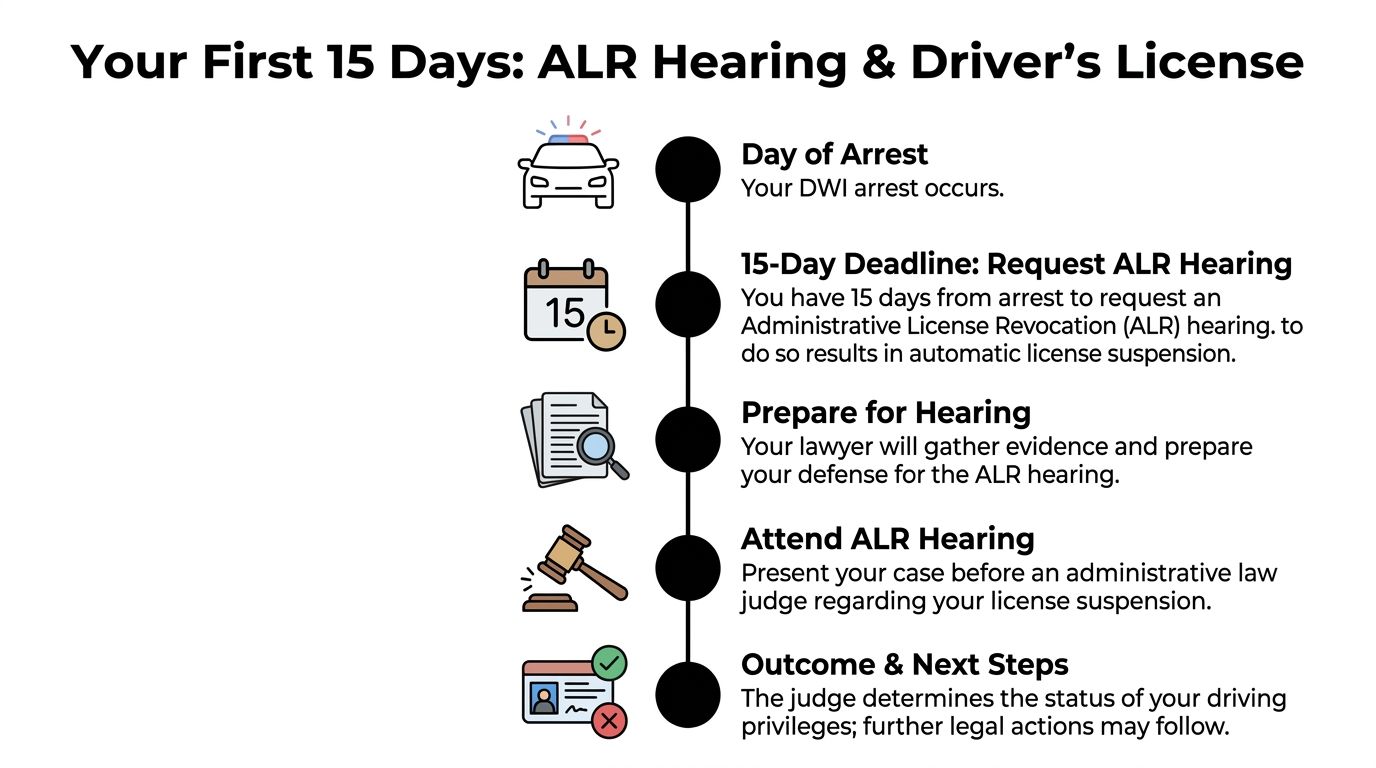
Your First 15 Days The ALR Hearing and Your Driver's License
The most urgent issue after a DWI arrest often isn't court. It's your license.
Texas uses a separate process called administrative license suspension, often called the ALR process. ALR stands for Administrative License Revocation. This is a civil case about your driving privileges. It is separate from the criminal DWI charge. If you want a plain-language breakdown of that split, What Is an ALR Hearing in Texas? explains how the civil license-suspension case differs from the criminal DWI case.
What implied consent means
Implied consent means that by driving on Texas roads, you are considered to have agreed to provide a breath or blood specimen if an officer lawfully requests one under Texas DWI laws. That doesn't mean every request or every suspension is valid. It means the state has a legal framework to pursue license consequences when a driver refuses testing or when the state claims the test supports intoxication.
Why the 15-day window matters
After an arrest, you have a short window to request an ALR hearing. If that request isn't made in time, the suspension process can move forward without that hearing. This is why people often hire counsel immediately, even before they have a criminal court setting.
Here is the practical sequence:
- The arrest happens. The officer may take your license and issue paperwork.
- The deadline starts running. You need to act quickly to preserve your right to contest the suspension.
- Your lawyer requests the hearing. That stops the case from moving forward without challenge.
- The state has to present its basis. The officer's grounds, the stop, and the testing issue can all matter.
- The result affects driving privileges, not guilt or innocence. You can still fight the criminal case either way.
Key terms you need to know
| Term | What it means |
|---|---|
| Administrative license suspension | A civil process that can affect your right to drive after a DWI arrest |
| ALR hearing | The hearing where an administrative judge reviews whether the suspension should stand |
| Implied consent | The rule that Texas drivers are considered to have agreed to chemical testing under certain lawful circumstances |
| BAC | Blood Alcohol Concentration, the measurement often used in breath or blood testing |
The ALR case and the criminal case travel on parallel tracks. Winning one doesn't automatically win the other, but the ALR process can still create useful testimony and early leverage.
What your lawyer is doing during this stage
A lawyer handling the first days correctly isn't just filing paperwork. The ALR stage can open the door to evidence review and officer examination much earlier than many clients expect. That's one reason many defense attorneys treat it as more than a license problem.
For a practical look at officer questioning in that process, see this guide on ALR hearing cross-examination in Texas.
If you've been arrested, don't wait to “see what happens.” The first move is preserving your ability to contest the suspension. That gives you room to breathe and keeps the state from getting a free pass on your license.
Understanding Texas DWI Charges and Potential Penalties
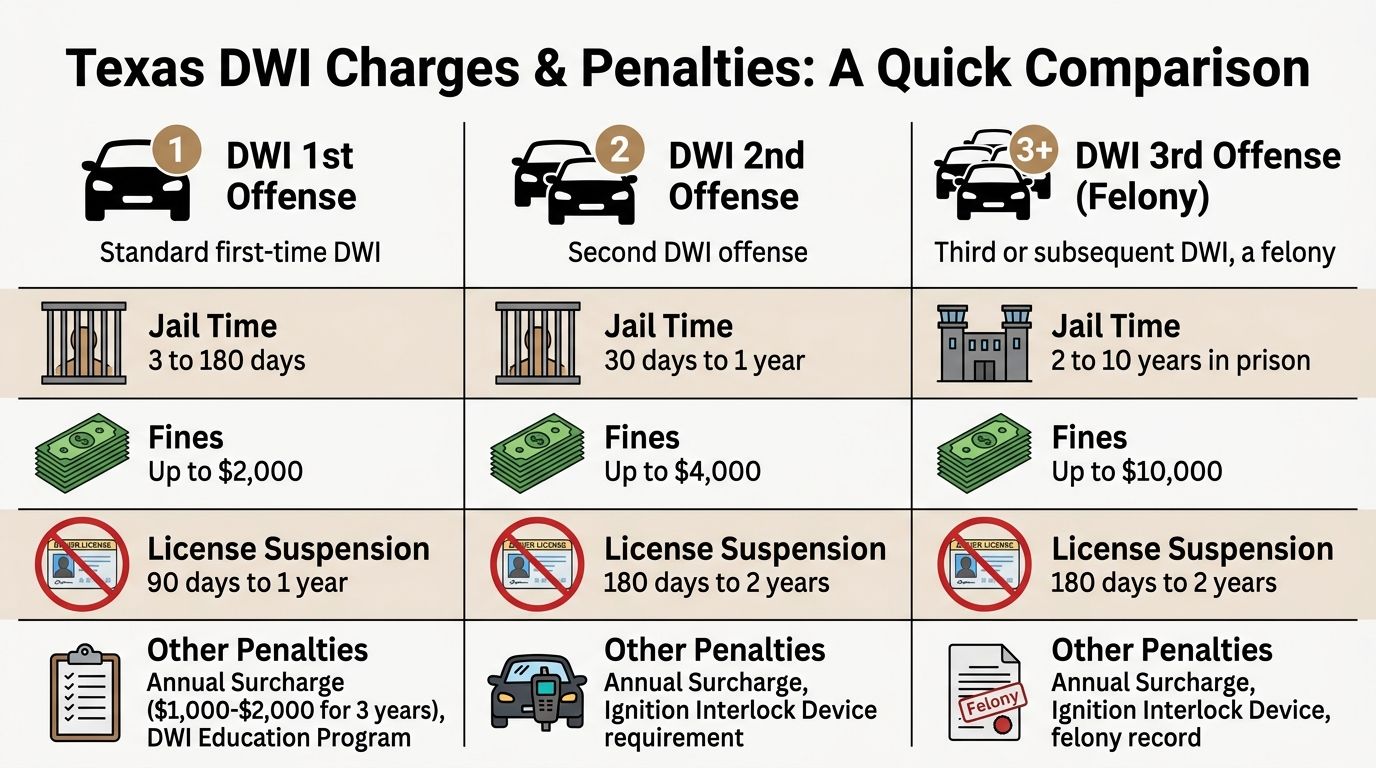
The criminal case is where the state tries to prove that you were driving while intoxicated. In Texas, BAC means Blood Alcohol Concentration. Texas law defines legal intoxication as having a BAC of 0.08 percent or more, but a person can still be charged below that level if the state claims the driver had lost the normal use of mental or physical faculties at the time of driving (Texas BAC limit guide).
That point surprises many people. A test result is important, but it is not the only thing the state may rely on.
The charge level can change quickly
For many first arrests, the case begins as a misdemeanor. But the details matter. One of the most important enhancement issues is the alleged BAC level.
In Texas, a first-time DWI with a BAC of 0.15 or higher automatically reclassifies the offense from a Class B to a Class A misdemeanor, doubling the maximum potential fine to $4,000 and jail time to one year (Texas high-BAC DWI explanation).
That enhancement affects how the case is negotiated, how the court views risk, and what conditions a judge may impose. The same source notes that a first-time DWI with a BAC of 0.15 or higher generally comes with an ignition interlock requirement if community supervision is ordered.
Terms clients hear and what they mean
A few definitions make the process much easier to follow:
- Field sobriety test: A set of roadside tasks officers use to claim impairment. These are not simple pass-fail school tests. Lighting, footwear, weather, nerves, medical issues, and instructions all matter.
- Breath test: A chemical test that estimates alcohol concentration from a breath sample.
- Blood test: A chemical test based on a blood specimen. This often brings chain-of-custody and lab procedure issues into the defense.
- Class B misdemeanor: The starting point for many first-time DWI charges.
- Class A misdemeanor: A more serious misdemeanor level that can apply in a high-BAC first-offense case.
What works and what doesn't
Many clients think the answer is to “explain” the stop to the prosecutor and hope common sense wins the day. That rarely works by itself. The legal system responds better to legal weaknesses than personal fairness arguments.
A more productive approach is to identify where the state's proof may break down:
- The stop itself: Did the officer have a lawful reason?
- The roadside investigation: Were instructions clear, conditions fair, and observations reliable?
- The testing sequence: Was the sample obtained, handled, and interpreted properly?
- The timeline: Can the state prove intoxication at the time of driving?
For a deeper look at what a first arrest usually means in practice, First-Offense DWI in Texas: Penalties and Defenses covers what a first DWI charge means and how it can be challenged.
How an Austin DWI Lawyer Can Fight Your Case
A DWI defense is not one argument. It's a chain of challenges. The best results usually come from breaking the state's case apart piece by piece instead of treating the arrest like one unchangeable event.
In Travis County, that work matters. Austin's DWI conviction rate has fallen to just 15% in recent years, which shows that many cases end in outcomes other than conviction, including dismissals or charge reductions (local Austin discussion of DWI conviction rates). That doesn't guarantee a result in any individual case. It does show that fighting a DWI in Austin is often worth doing.
The first pressure point is the stop
A lawful stop is the foundation of the case. If the officer did not have a valid reason to stop your vehicle, the defense may have grounds to challenge everything that followed. That includes observations, statements, field sobriety testing, and chemical evidence.
This is one reason clients should avoid assuming that a minor traffic allegation settles the issue. Officers still have to justify their actions under the law, and body camera or dash camera footage sometimes tells a more complicated story than the report.
Field sobriety tests are often treated as stronger than they are
A field sobriety test is not a machine-generated truth. It is an officer-administered set of tasks performed under roadside conditions. People do poorly on them for many reasons that have nothing to do with intoxication, including fatigue, anxiety, injury, uneven pavement, poor footwear, flashing lights, and unclear instructions.
An experienced lawyer will look closely at questions such as:
- How were the tests explained
- Whether the location was suitable
- Whether medical issues were ignored
- Whether the officer scored the tests correctly
- Whether the video matches the written report
A field sobriety test is only as persuasive as the conditions, instructions, and scoring behind it.
Breath and blood cases can be challenged
Chemical testing sounds final, but it isn't. Breath and blood evidence can be attacked from different angles, and the right defense depends on how the sample was obtained and what records exist.
When evaluating a test-based case, a lawyer may examine:
| Defense issue | Why it matters |
|---|---|
| Timing | The law focuses on intoxication at the time of driving, not just at the time of testing |
| Procedure | Errors in collection, maintenance, or handling can affect reliability |
| Interpretation | A number must still be connected to the legal question the state must prove |
| Documentation | Missing records or gaps in the file can weaken admissibility or weight |
A good defense is strategic, not theatrical
What doesn't work is hiring a lawyer who treats every case the same way or who talks only about “beating” cases without explaining how. A real defense plan should identify factual disputes, legal disputes, negotiation options, and trial posture.
That usually means asking:
- Can the stop be suppressed?
- Is the officer's narrative consistent with the video?
- Are the field tests useful to the state or vulnerable to challenge?
- Is the chemical evidence admissible, persuasive, both, or neither?
- Is there a path to dismissal, reduction, deferred resolution, or trial?
For a practical overview of defense methods, this guide on how lawyers beat DWI cases in Texas lays out common ways attorneys challenge the state's proof.
If you are comparing counsel, the Law Office of Bryan Fagan, PLLC handles ALR hearings, field sobriety challenges, chemical test review, and trial defense in Texas DWI cases. That's the kind of scope you should look for from any lawyer you interview, whether you hire that firm or someone else.
How to Choose the Right DWI Lawyer in Austin
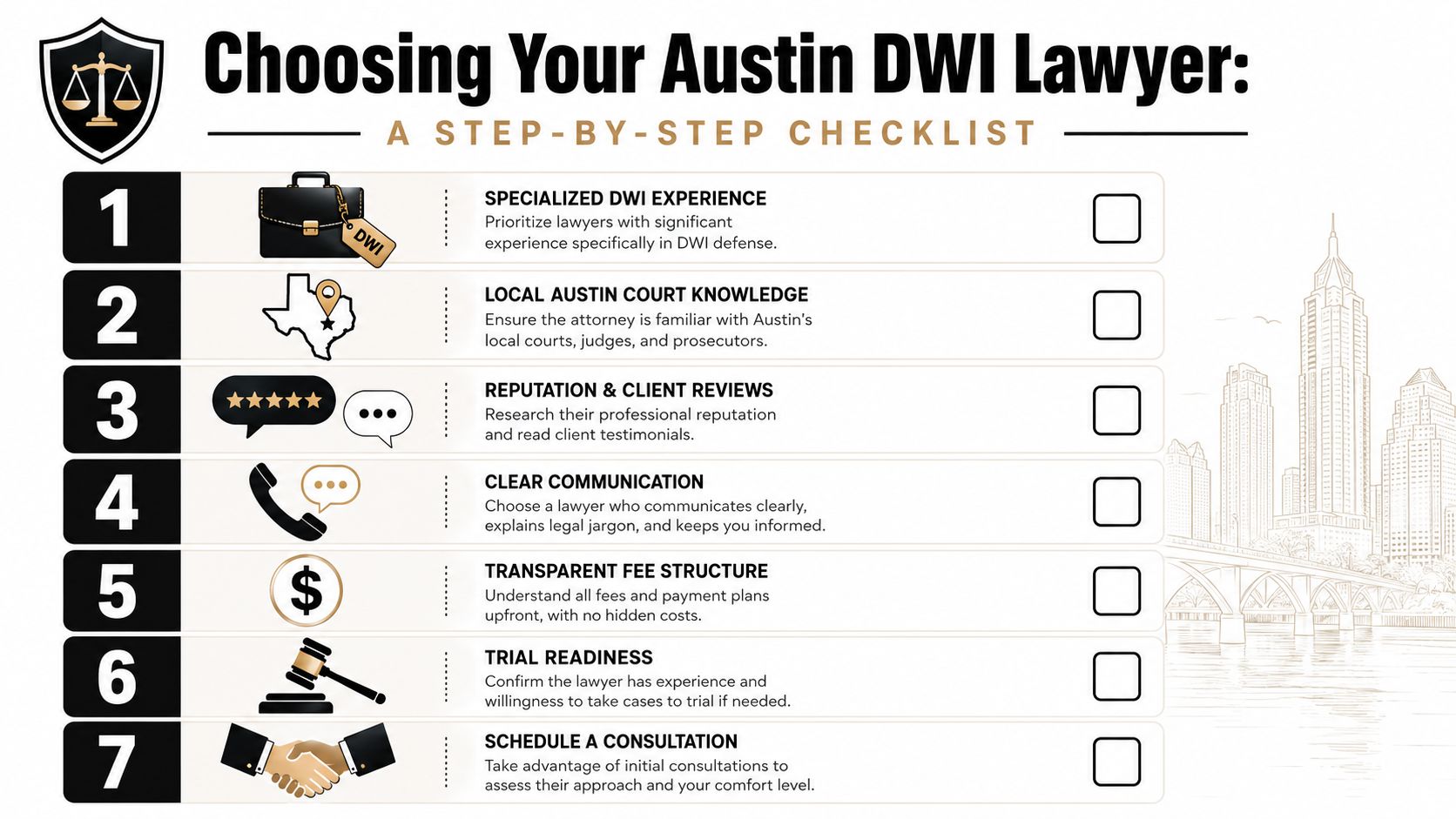
Hiring a lawyer is not about finding the person who sounds the most confident on the phone. It's about finding someone who can explain the case clearly, move quickly on deadlines, and make decisions that fit the facts instead of forcing your case into a script.
Start with whether the attorney handles DWI defense, not just general criminal matters. DWI cases involve a mix of traffic law, criminal procedure, scientific evidence, administrative license issues, and local court practice. That combination matters.
Questions worth asking in a consultation
You don't need to impress the lawyer. The lawyer should be helping you understand your options. Ask direct questions and listen for direct answers.
- Ask about Travis County practice: Does the lawyer regularly handle DWI cases in Austin and know how local courts approach these files?
- Ask about the ALR process: Will the lawyer handle the license issue right away and explain how it interacts with the criminal case?
- Ask about proof, not promises: What specific issues do they want to investigate in your stop, testing, and arrest paperwork?
- Ask about trial readiness: If the case can't be resolved on acceptable terms, are they prepared to take it to trial?
- Ask about communication: Who updates you, how often, and what happens if you have an urgent question?
One question that reveals a lot
Texas law defines legal intoxication as a BAC of 0.08 percent or more, but charges can still be filed below that level. Ask a potential lawyer how they challenge cases where the BAC is at or below the legal limit. That question shows whether the attorney understands the difference between a headline number and the actual burden of proof in a DWI case.
If a lawyer can't explain how they attack a borderline or below-limit case, keep looking.
A short video can also help you get a feel for how an attorney explains these issues:
Understand fees before you sign
Fee conversations shouldn't feel mysterious. Most DWI lawyers use a retainer or flat-fee structure for defined stages of the case. Ask what the fee covers, whether the ALR hearing is included, whether trial is included, and whether payment plans are available.
Also ask what will happen first if you hire the lawyer today. The answer should sound concrete. File the ALR request if needed. Obtain reports and video. Review testing issues. Set expectations for the first court setting. That is what an organized defense practice sounds like.
If you're also comparing firms outside Austin, terms like Houston DWI lawyer, Texas DUI attorney, DWI license suspension, first DWI in Texas, and fight DWI Texas can help you find lawyers who focus on this area of law. The key is still the same. Find someone who can apply those skills to your case, your court, and your timeline.
Life After a DWI Case Protecting Your Record and Your Future
Many people think only about jail, court, and license issues at the start. Later, the bigger question hits them. What happens to my record?
Much online information often gets sloppy. The words sound similar, but the legal outcomes are very different.
A Texas DWI conviction can never be expunged. However, a first-time DWI that is dismissed or completed under deferred adjudication may be eligible for an Order of Nondisclosure after a waiting period (Austin DWI record-sealing explanation). That distinction matters for jobs, housing, professional licenses, and reputation.
What the record terms actually mean
- Dismissal: The case is not carried through to conviction. In some situations, this may open the door to clearing the record.
- Conviction: The conviction remains. A DWI conviction is not something Texas allows you to expunge.
- Order of Nondisclosure: This is record sealing, not erasure. It can limit who sees the case, but it is not the same as making it disappear.
- Expunction: This is stronger relief, but it is not available for a DWI conviction.
For background on record clearing generally, expungement of records in Texas is a useful starting point.
The practical point is simple. The best time to protect your future record is during the defense itself. The outcome you accept now can control what is possible later. That's one reason a DWI lawyer in Austin should be thinking beyond the next court date from the beginning.
If you've been arrested and need a clear plan, contact Law Office of Bryan Fagan, PLLC for a free consultation or case evaluation. You can get answers about your license, your court process, your defense options, and the long-term impact on your record without guessing your way through the next step.

