
A DWI arrest can be overwhelming, leaving you with a record that can follow you everywhere—from job applications to housing opportunities—long after your case is resolved. But you don’t have to face it alone. In Texas, a legal process called expungement of records in Texas offers a way to completely destroy the record of an arrest, while another option, an order of nondisclosure, can seal it from public view.
Your Path to a Clean Slate After a DWI Arrest

It’s completely understandable to feel overwhelmed after a DWI arrest. You might be worried that one mistake or a wrongful accusation will trail you forever, showing up on background checks and closing doors on future opportunities. That concern is valid, but you don't have to let a past event define your future. The Texas legal system provides powerful tools to help you move on with a truly clean slate.
With a strategic legal plan, you can pursue either an expungement or an order of nondisclosure. Here’s a simple way to think about it: an expungement is like taking the file related to your arrest, putting it in a shredder, and destroying it so completely that no one can ever see it again. A nondisclosure, on the other hand, is like locking that file in a secure vault where the general public is legally forbidden from looking at it. Both provide immense relief, but the right path for you depends entirely on how your case was resolved.
Why Clearing Your Record Matters
A public arrest record—even without a conviction—can create serious roadblocks in your life. Many people are surprised to learn that an arrest stays on your record forever unless you take legal action to have it removed. This can impact your ability to:
- Secure Employment: Most employers run background checks, and an arrest record can be enough for them to withdraw a job offer.
- Rent a Home: Landlords almost always screen potential tenants. A DWI arrest could be the reason your rental application is denied.
- Obtain Professional Licenses: If you're in a field like nursing, teaching, or aviation, a criminal record can put your professional license in jeopardy.
- Qualify for Loans: Lenders might see a past arrest as a sign of risk, which can hurt your chances of getting a mortgage or other types of financing.
By proactively seeking an expungement or nondisclosure, you are not just clearing a record; you are reclaiming control over your future. It's a strategic step toward ensuring a past event doesn't unfairly define your personal and professional life moving forward.
Navigating the details of expungement law requires precision and experience. At The Law Office of Bryan Fagan, PLLC, our team understands what’s at stake. We provide the confident, knowledgeable guidance you need to determine your eligibility, file the correct petitions, and successfully clear your name. A past mistake shouldn't close the door on your future, and we're here to help you open it wide again.
Expungement vs. Nondisclosure: What Is the Difference?
When you’re seeking to move on from a criminal charge in Texas, you will often hear two key terms: expungement and nondisclosure. They might sound similar—both offer a fresh start—but in the eyes of the law, they are very different. Understanding this distinction is the most important first step, especially after a DWI-related arrest.
Here’s a clear way to understand the difference. An expungement is like taking every single file connected to your arrest—the police report, court records, fingerprints—and feeding them into a high-powered shredder. They are completely and permanently destroyed. Legally, it's as if the arrest never happened.
A nondisclosure, on the other hand, is like gathering those same files and locking them away in a secure vault. The general public, including landlords and most employers, cannot see what’s inside. However, a select group of government agencies and licensing boards still has a key to that vault and can access the records if needed.
The Power of an Expungement
An expungement is the highest standard of record clearing. It offers the most complete fresh start possible. Once a judge grants your expungement of records in Texas, you can legally deny the arrest ever occurred on job applications, in interviews, or almost anywhere else. Every agency that held your records is ordered to destroy them, giving you a truly clean slate.
An expungement isn’t just about hiding a record; it's about the legal erasure of an event. This powerful remedy is usually reserved for cases where you were never found guilty in the first place, such as a dismissal or an acquittal at trial.
When Nondisclosure Is the Right Path
While an expungement is the ideal outcome, it’s not an option for everyone. Nondisclosure, often called "record sealing," is the more common route for people who successfully completed a deferred adjudication probation for a DWI. This is a crucial point: completing deferred adjudication means you were never formally "convicted," which is what opens the door to sealing your record.
Even though a nondisclosure doesn't destroy the record, its impact is still life-changing. It removes the arrest and case details from public view, clearing your name on background checks run by most private employers, landlords, and schools. If you believe this might be your situation, you can find out more about an order of nondisclosure in our detailed guide.
Expungement vs. Nondisclosure at a Glance
To make it even clearer, let’s put the two side-by-side. This table breaks down the key differences between the two primary ways to clear your record in Texas.
| Feature | Expungement (Record Destruction) | Order of Nondisclosure (Record Sealing) |
|---|---|---|
| What Happens to the Record? | All records are physically destroyed. | The record is sealed from public view. |
| Who Can See the Record? | No one. It's as if it never existed. | Government agencies, law enforcement, and certain licensing boards. |
| Effect on Background Checks | The arrest will not appear on any public or private background check. | The arrest will not appear on public background checks (e.g., employers, landlords). |
| Can You Legally Deny It? | Yes, you can legally deny the arrest and case ever happened. | Generally, yes, but there are exceptions when dealing with government agencies. |
| Typical Eligibility | Your case was dismissed, you were acquitted at trial, or you were arrested but never charged. | You successfully completed a deferred adjudication program for a qualifying offense. |
Ultimately, which path is right for you depends entirely on how your DWI case was resolved. An experienced Houston DWI lawyer can analyze your case history, confirm which option you’re eligible for, and file the correct petition to get you the best possible result. Making the right choice here is fundamental to reclaiming your future and moving forward with confidence.
Determining Your Eligibility for an Expungement in Texas
Not every arrest record in Texas can be wiped clean. The law is very specific about who qualifies for this powerful second chance, and understanding those rules is the first—and most important—step in putting a DWI arrest or any other charge behind you for good.
The principle behind an expungement of records in Texas is to correct the record for individuals who were arrested but never actually found guilty. It is the justice system's way of ensuring that an arrest that did not lead to a conviction does not unfairly follow you.
This flowchart breaks down the basic paths your case can take, leading to either total record destruction (expungement) or having it sealed from public view (nondisclosure).
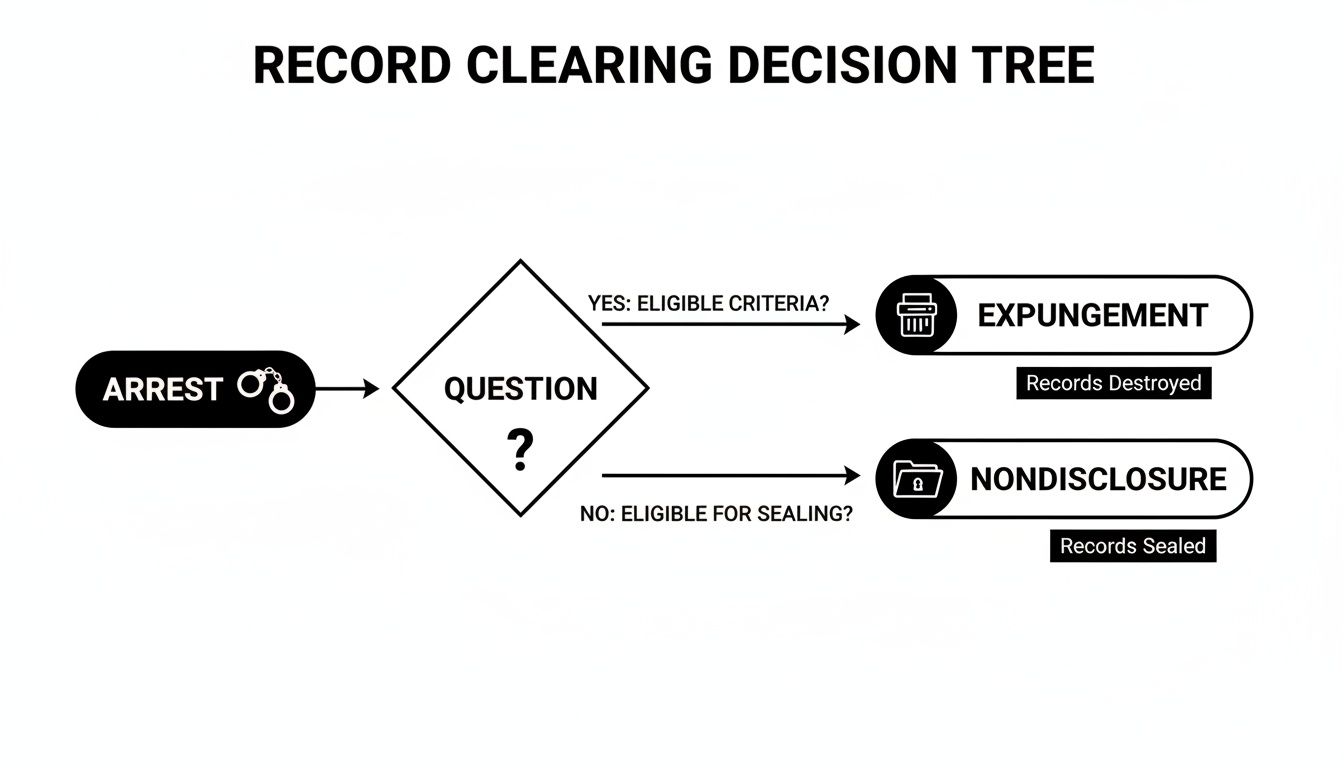
As you can see, the final outcome of your case is the single biggest factor that determines whether you can erase the record or simply seal it.
Who Qualifies for an Expungement
Under the Texas Code of Criminal Procedure, you are generally in a strong position to obtain an expungement if your case concluded in one of several key ways. These are the most common scenarios where you have the right to have your record completely destroyed.
You are likely eligible if:
- You were acquitted at trial. This is a clear victory. A judge or jury found you "not guilty," and the law affirms your right to an expungement. For example, if your Houston DWI lawyer proved the traffic stop was illegal and the judge dismissed the case, you qualify.
- Your case was dismissed. The prosecutor dropped the charges, perhaps due to insufficient evidence or a missing key witness. As long as the statute of limitations has expired, you can typically file for an expungement.
- You were arrested but never formally charged. This occurs more often than you might think. You are arrested, released, and the district attorney's office decides not to proceed. After a waiting period, you can have that arrest removed from your record.
- You received a pardon. While less common, receiving a full pardon from the Governor of Texas for that specific crime also makes you eligible.
These rules exist to ensure that individuals who are not convicted do not have to live with the stigma and consequences of an arrest for the rest of their lives.
Common Reasons for Ineligibility
It is just as important to understand what disqualifies you from an expungement. If your case ended in a certain way, you will not be able to destroy the record, though you may still be able to have it sealed through a nondisclosure.
You are generally not eligible for an expungement if:
- You were convicted of the crime. A final conviction for a DWI or any other offense makes an expungement for that charge impossible.
- You received deferred adjudication. Successfully completing deferred adjudication is a positive outcome, but it does not lead to an expungement (unless it was for a low-level Class C misdemeanor). It usually makes you eligible for a nondisclosure instead. The reason is that deferred adjudication requires you to first plead "guilty" or "no contest," which takes expungement off the table.
The legal distinction is crucial: an expungement erases the past, while a nondisclosure seals it. Deferred adjudication, while a positive outcome, falls into the "sealing" category because it starts with a guilty plea.
Trying to figure this out on your own can be confusing, especially when the small details of your case determine everything. For a more detailed breakdown of the rules, you can learn more about DWI expungement eligibility in Texas in our in-depth guide.
An experienced Texas DUI attorney can review the specifics of your arrest and how the case was resolved to give you a clear, confident answer about your options. That initial analysis is the foundation for building a successful strategy to clear your name and protect your future.
How The Expungement Process Works Step-by-Step

Filing for an expungement can feel like a legal maze, but with a clear roadmap, the journey becomes much more manageable. Think of it as a series of deliberate steps, each one moving you closer to a clean slate. The process begins with a formal legal document and, if successful, ends with a judge's order to destroy your records permanently.
This is your pathway to reclaiming your future. Understanding how it all unfolds is the first real step toward taking back control. Let's walk through it together, from the initial filing to the final order.
Step 1: Filing the Petition for Expunction
Everything starts with filing a Petition for Expunction. This is much more than filling out a form; it's a detailed legal document that must be filed in the same court where you were originally charged. If charges were never filed, it goes to a court in the county where the arrest occurred.
This petition is your official request to the court, and it must be precise. Accuracy isn't just important here—it's essential.
The petition must clearly state:
- Your personal identifying information.
- All the specifics of your arrest, including the date, the offense you were accused of, and which agency arrested you.
- A comprehensive list of every single government entity that might have records of your arrest.
That last point is absolutely critical. You must correctly identify every agency holding your records, from the local police department and county sheriff to the Texas Department of Public Safety (DPS). Missing even one can disrupt the entire process.
Step 2: Notifying the Agencies and Setting a Hearing
Once your Petition for Expunction is filed, the work continues. The law requires that all the government agencies you listed be formally notified. This is called "service," and it gives each agency a chance to appear and object to the expungement.
After the agencies have been served, the court will set a hearing date. In many cases, the prosecutor's office will review your petition and confirm your eligibility. If your case is a clear-cut example for an expungement of records in Texas, the prosecutor may agree to it without objection.
But what if there's a question about your eligibility? Or what if an agency objects? That's when a formal hearing is necessary. Your attorney will have to present evidence and legal arguments to the judge, proving that you are entitled to the expungement under Texas law.
This step is a perfect example of why having an experienced Houston DWI lawyer on your side is so important. A good attorney ensures every agency is properly notified and is prepared to advocate for you in court, addressing any potential objections.
Step 3: The Judge's Order and Record Destruction
If the judge agrees that you meet all the legal requirements, they will sign the Order of Expunction. This is the moment it all becomes official—the final command that gives you your fresh start.
That signed order is then sent to all the government agencies listed in your petition. It legally requires them to find every record related to your arrest—both physical paper files and digital entries—and completely destroy them. This includes police reports, fingerprints, mugshots, and court files.
Agencies are given a specific timeframe to complete this and must confirm to the court that the records are gone. Once the process is complete, you can legally deny the arrest ever happened. For a practical look at what this process entails, we have a helpful guide on how to expunge your record in Texas.
The system is designed to provide second chances, and data shows it is working. The path to a clean slate is achievable, but it demands skilled legal navigation to get across the finish line.
New Texas Laws Are Opening New Doors for Record Clearing
The laws around expungement in Texas are not static—they are constantly evolving. Recently, Texas lawmakers have made significant changes to help more people clear their records and get the second chance they deserve. These updates are a game-changer, especially for individuals who were previously told they did not meet the strict eligibility criteria.
Keeping up with these changes allows us to provide our clients with the best possible opportunity for a clean slate. We stay on top of every legal shift to ensure you can take advantage of every opportunity the law provides.
The Big One: House Bill 4504
One of the most significant recent updates comes from a piece of legislation known as House Bill 4504. This law represents a major overhaul of the old system, designed to make record clearing more accessible and efficient for many more people.
Going into effect on January 1, 2025, this bill creates a new section of the law (Chapter 55A of the Code of Criminal Procedure) that replaces outdated rules. This isn't just a minor adjustment; it dramatically expands eligibility to cover more misdemeanor offenses, including some DWI-related charges that used to be nearly impossible to seal.
Most importantly, it introduces automatic expungement for certain dismissed cases and acquittals. This could save you the time, stress, and expense of filing a formal petition. If you want to dig into the details, you can learn more about the new Texas expunction law and see how it might benefit you.
For some Texans, the path to a fresh start just got much shorter.
Key Changes You Need to Know About
This new legislation brings several practical improvements that could directly affect your ability to clear your record after a DWI arrest or another charge. These changes are all about removing old barriers and smoothing out the road to a clean slate.
Here are some of the most impactful updates:
- Automatic Expungements: This is a major development. For certain cases that end in a dismissal or an acquittal, the expungement process may now happen automatically. No petition, no lengthy court process. It’s designed to save you time, money, and significant stress.
- Expanded Eligibility: The new law opens the door for more types of misdemeanor offenses to be expunged. This means relief is now available for a much wider group of Texans who were previously excluded.
- Shorter Waiting Periods: In some situations, the time you must wait after finishing probation or deferred adjudication before you can file has been reduced. This allows you to move forward with your life much faster.
- Lower Costs and Faster Processing: The law also aims to address financial barriers. It seeks to reduce filing fees, offer more hardship waivers, and use digital processing to speed up the entire system. The goal is to make justice more accessible to everyone.
These are not just minor legal adjustments. They represent a fundamental shift in how Texas views second chances. It’s a move toward rehabilitation, acknowledging that one mistake shouldn't unfairly limit a person's future potential forever.
At The Law Office of Bryan Fagan, PLLC, we make it our business to monitor every legal development. If you were previously told that you did not qualify for an expungement, these new laws may have completely changed your situation.
Your Future Is Worth the Fight
You’ve reviewed the guide and you understand your options. That's the first step. But knowing the difference between an expunction and a nondisclosure is one thing—taking action to secure your clean slate is another. A DWI arrest record shouldn't be a life sentence, blocking you from the job, home, or professional license you've worked so hard for.
Throughout this guide, we've explained the important distinctions: an expungement of records in Texas literally destroys the record of your arrest, while a nondisclosure seals it away from the public. Each path has strict, specific rules. Determining which one you qualify for isn't just a good idea; it's the entire foundation of a successful case.
Don't Let a Past Mistake Define Your Future
Here’s a hard truth: even an arrest that never led to a conviction can follow you for years. It can appear on background checks, complicate apartment applications, and raise red flags for licensing boards. If you do nothing, that public record remains. The process to clear it is filled with legal complexities and deadlines, and one small error can send you right back to square one.
This is where The Law Office of Bryan Fagan, PLLC, can help. We don't just give you information; we empower you to use it. Our team has extensive experience helping people across Houston and Texas navigate the complex maze of expunctions and nondisclosures. We’re here to protect your rights and fight for the fresh start you deserve.
A single mistake doesn’t have to dictate the rest of your life. Taking back control starts now, with a clear, honest assessment of your case from a team that knows how to win.
The weight of a DWI arrest can feel crushing, but you absolutely do not have to carry it alone. We invite you to request a free, confidential case evaluation to discuss your specific situation. Let our dedicated Houston DWI lawyers provide the straightforward advice and strategic guidance you need to finally move forward.
Your Top Questions About Texas Expungements, Answered
The legal world is full of complex terms and procedures, so it's natural to have questions when you're considering clearing your record. We get asked these all the time. Here are some straightforward answers to help you understand what to expect.
How Long Does the Expungement Process Take in Texas?
This is a common question, and the answer is: it depends. Most cases, from the day the petition is filed to the final order, take somewhere between three to six months.
What causes this variation? It really comes down to the court's schedule in your specific county and how quickly the various government agencies—like the police department or the district attorney's office—respond. After your attorney files the petition, the court sets a hearing date. Once a judge signs off, that final order is sent out to every agency with a record of your arrest, and they have a deadline to destroy those files and report back. An experienced lawyer can usually give you a more accurate timeline based on which court you're dealing with.
Can I Get a DWI Conviction Expunged in Texas?
This is a critical question, and the answer is a firm no—a final DWI conviction cannot be expunged in Texas. The law is very clear that expungement, which is the total destruction of a record, is only for cases that did not result in a conviction.
However, that is not the end of the story. If you completed a deferred adjudication program for a first-time DWI, you may be eligible for an order of nondisclosure. Think of it as sealing the record instead of destroying it. It hides the offense from the public, meaning most employers and landlords will never see it. It's crucial to speak with a Houston DWI lawyer to determine exactly what your case outcome means for your future.
How Much Does It Cost to Get a Record Expunged?
Clearing your record is an investment in your future. The total cost usually breaks down into three parts: court fees, service fees, and attorney fees.
- Court Filing Fees: These are set by the county and typically range from $250 to $400.
- Service Fees: These are smaller costs for formally notifying all the government agencies that have copies of your record.
- Attorney Fees: This covers the legal expertise needed to draft a precise petition, represent you in court, and handle any challenges that may arise.
While there is an upfront cost, the value of a clean record is immeasurable. It reopens doors to better jobs, housing opportunities, and professional licenses that might have been inaccessible. We offer a free consultation to give you a transparent breakdown of what the costs would look like for your specific case.
What Happens After My Record Is Expunged?
This is the best part. A successful expungement is a powerful, life-changing event. Once the judge's order is final and every agency has confirmed they've destroyed their records, you can legally deny that the arrest and court case ever happened.
What does that really mean? When you're filling out a job application, leasing an apartment, or applying for a professional license, you can check "no" when asked if you've ever been arrested for that offense. The records aren't just sealed or hidden—they are gone for good. You get a true clean slate.
This legal erasure is the entire purpose of the process. It allows you to move on with your life without a past mistake casting a long shadow over your future.
Your future is too important to leave to chance or to be defined by a past arrest. At The Law Office of Bryan Fagan, PLLC, we provide the strategic guidance and assertive representation needed to navigate the complexities of Texas expungement law. Contact us today for a free, confidential consultation to discuss your case and learn how we can help you fight for a clean slate.