
A DWI arrest can be overwhelming—but you don’t have to face it alone. When you're facing a DWI in Texas, it feels like your world is spinning. Many people don't realize right away that you're not just fighting one battle—you're fighting two. There's the criminal case, with the risk of jail time and serious fines. Then there's the administrative case, which is a direct attack on your driver's license. The most urgent deadline? You have a mere 15-day window to request a special hearing to save your license from automatic suspension. Acting quickly isn't just a good idea; it's essential for a strong defense.
Your First Steps After A Texas DWI Arrest

A DWI arrest is jarring. It can leave you feeling overwhelmed, confused, and worried about what comes next. The hours and days that follow are absolutely critical, but the most important thing to remember is that you do not have to figure this out on your own. The single best action you can take for yourself is to understand the immediate challenges and get a strategic plan in place with a trusted legal professional.
From the moment you are arrested for a DWI in Texas, a clock starts ticking on your right to drive. You have only 15 days from the date of your arrest to formally request an Administrative License Revocation (ALR) hearing. This hearing is your one and only opportunity to challenge the Texas Department of Public Safety (DPS) and prevent the automatic suspension of your license.
The Two Fronts Of A DWI Case
Think of a DWI charge as fighting on two separate fronts at the same time. Each has its own rules, timeline, and set of consequences. It's crucial to understand they are completely separate proceedings.
- The Criminal Case: This is the legal process where the State of Texas prosecutes you for the crime of Driving While Intoxicated. A conviction here can mean fines, jail time, and a permanent criminal record that follows you. This is where a skilled DWI lawyer will analyze the evidence against you, from the reason for the traffic stop to the chemical test results, to build your defense.
- The Administrative License Revocation (ALR) Case: This is a civil process handled by the DPS, not the criminal courts. Its only goal is to decide the fate of your driver’s license. If you refused a breath or blood test, or if you provided a sample over the legal limit, the state will try to suspend your license unless you demand an ALR hearing.
If you miss that 15-day deadline to request the hearing, your license gets suspended automatically. It doesn't matter what happens in your criminal case—you could be found not guilty and still lose your license. This is why taking immediate action is so critical. You can learn more about what to do after a DWI arrest in our detailed guide to ensure you don't miss this crucial first step. Protecting your ability to drive is the cornerstone of a strong defense strategy.
Understanding Texas DWI Laws and Key Definitions
To effectively fight a DWI in Texas, you first need to understand the laws the state is using against you. The legal system is full of complex jargon, but once you break it down, it's not as intimidating as it seems.
Getting a handle on these key definitions is the first step toward building a powerful defense and feeling back in control of your situation.
What “Intoxicated” Really Means in Texas
At the heart of every DWI case is the legal definition of "intoxication." Most people think it all comes down to a number on a machine, but Texas law is much broader.
The prosecution only needs to prove one of the following two things to get a conviction:
Loss of Normal Faculties: This is a subjective standard. You can be found legally intoxicated if you’ve lost the normal use of your mental or physical abilities because of alcohol or drugs. This is often based on the arresting officer’s observations—how you were driving, the way you spoke, your balance, and your performance on roadside tests.
Blood Alcohol Concentration (BAC) of 0.08% or Higher: This is the more scientific standard. If a chemical test (breath or blood) shows your BAC is 0.08% or more, the law states you are intoxicated. This is known as a per se offense, meaning you’re considered intoxicated by the letter of the law.
Because the "loss of normal faculties" standard is so subjective, it’s a key area for a skilled Houston DWI lawyer to challenge. An officer can easily mistake things like fatigue, nerves, or even a medical condition for signs of intoxication.
Texas Implied Consent and Your Rights
Here’s something most Texas drivers don’t realize: when you get your driver's license, you automatically agree to the state's Implied Consent law. In plain English, this means you've already consented to provide a breath or blood sample if you're lawfully arrested for DWI.
However, you still have the absolute right to refuse that test. Refusing is not a crime, but it does trigger an immediate civil penalty: an automatic driver's license suspension. This is the exact battle the Administrative License Revocation (ALR) hearing is designed to fight. Additionally, the prosecutor may try to use your refusal against you in the criminal case as evidence of guilt—though a good attorney knows how to counter that argument effectively.
Understanding your rights under Implied Consent is critical. Refusing a test starts an immediate administrative fight for your license, but it also denies the prosecution one of their most powerful pieces of scientific evidence. It's a strategic choice you should discuss with an attorney right away.
To help you get up to speed, here’s a quick guide to some of the most common terms you'll hear.
Key DWI Terms at a Glance
| Term | What It Means for You |
|---|---|
| Field Sobriety Tests (FSTs) | These are the roadside "tests" an officer may ask you to perform, like the walk-and-turn or one-leg stand. They can be difficult even for sober people, and you have the right to politely refuse them without a direct legal penalty. |
| Administrative License Revocation (ALR) | This is the civil (non-criminal) process that deals only with the suspension of your driver's license. It runs separately from your criminal case, and you must request an ALR hearing within 15 days of your arrest to fight the suspension. |
| Blood Alcohol Concentration (BAC) | The percentage of alcohol in your bloodstream. In Texas, 0.08% is the legal limit for most drivers, but commercial drivers and those under 21 have stricter limits. |
| Per Se Intoxication | A legal term meaning you are considered intoxicated "by law" if your BAC is 0.08% or higher, regardless of whether you appeared impaired. |
Each of these terms represents a different piece of the puzzle the prosecution will try to build against you. A smart defense requires a clear understanding of both the criminal case threatening your freedom and the civil ALR case threatening your ability to drive.
The Reality of DWI Enforcement on Texas Roads
To build a strong defense, you must understand why Texas pursues DWI cases so aggressively. Law enforcement agencies and district attorneys across the state take a hard line on driving while intoxicated. It’s important to recognize the landscape you are in—not to be scared, but to be prepared to fight back effectively.
When you look at the numbers behind the state's tough stance, it becomes clear why a strategic, vigorous defense is not just an option—it's a necessity. The state is serious about these charges, and at The Law Office of Bryan Fagan, PLLC, we are just as serious about protecting your rights and challenging every piece of evidence.
Why Texas Takes DWI So Seriously
Texas roads see a high number of traffic accidents, and a significant percentage of them involve alcohol. This has created intense public and political pressure on law enforcement to crack down on anyone suspected of impaired driving. Police departments often receive grants and funding specifically for DWI enforcement, which means more patrols, especially during weekends and holidays.
This high-pressure environment means officers are actively looking for any reason to pull someone over. A minor weave, driving too cautiously, or making a late-night lane change can all draw unwanted attention. From the moment those lights flash, they are building a case against you. That’s why knowing how police enforce DWI checkpoints in Texas and what your rights are during a traffic stop is so critical.
The numbers paint a clear picture. In 2023, Texas recorded 1,699 alcohol-impaired driving fatalities involving drivers with a blood alcohol concentration (BAC) of 0.08 or higher. This accounts for 40% of all motor vehicle fatalities in the state—one of the highest percentages in the country. This statistic is the fuel behind the aggressive enforcement you are now facing.
What This Aggressive Enforcement Means for Your Case
This intense focus on getting convictions often leads to police making mistakes. Officers are human. In their rush to make an arrest, they can cut corners, misinterpret signs of intoxication, or improperly administer field sobriety tests.
Here’s what this data-driven enforcement means for you:
- Subjective Evidence: Police often rely on subjective observations like "slurred speech" or "red, glassy eyes." These can easily be caused by allergies, fatigue, or nerves—not alcohol.
- Flawed Testing: Field sobriety tests are notoriously unreliable and difficult for anyone to perform perfectly, even when completely sober. Breathalyzer machines are also prone to error if not calibrated or operated correctly.
- Pressure to Plead Guilty: The system is designed to secure convictions quickly. Prosecutors will often present what looks like an open-and-shut case, hoping you'll feel overwhelmed and accept a plea deal without a fight.
The state's aggressive stance is built on statistics, but your case is about your specific circumstances. A skilled DWI lawyer knows how to turn the state's high-pressure tactics into a weakness by scrutinizing every detail for procedural errors and constitutional violations.
By understanding the reality of DWI enforcement, you can see that an arrest is just the beginning of the story, not the end. The prosecution has a high burden of proof, and our job is to hold them to that standard every step of the way.
Navigating the Texas DWI Process Step-by-Step
After a DWI arrest, the legal system can feel like a confusing maze. You're suddenly thrown into a world of unfamiliar terms, strict deadlines, and high stakes. This section provides a clear, chronological roadmap of the entire DWI in Texas process, cutting through the uncertainty and showing you how a skilled attorney can guide you through every turn.
The path forward is unique because it involves two separate but parallel legal tracks: one is civil, and the other is criminal. Each has its own timeline and potential consequences, and both demand immediate, strategic action to protect your rights.
This flowchart breaks down the main phases of a DWI case, from the initial traffic stop to the crucial defense stage where the fight for your future begins.
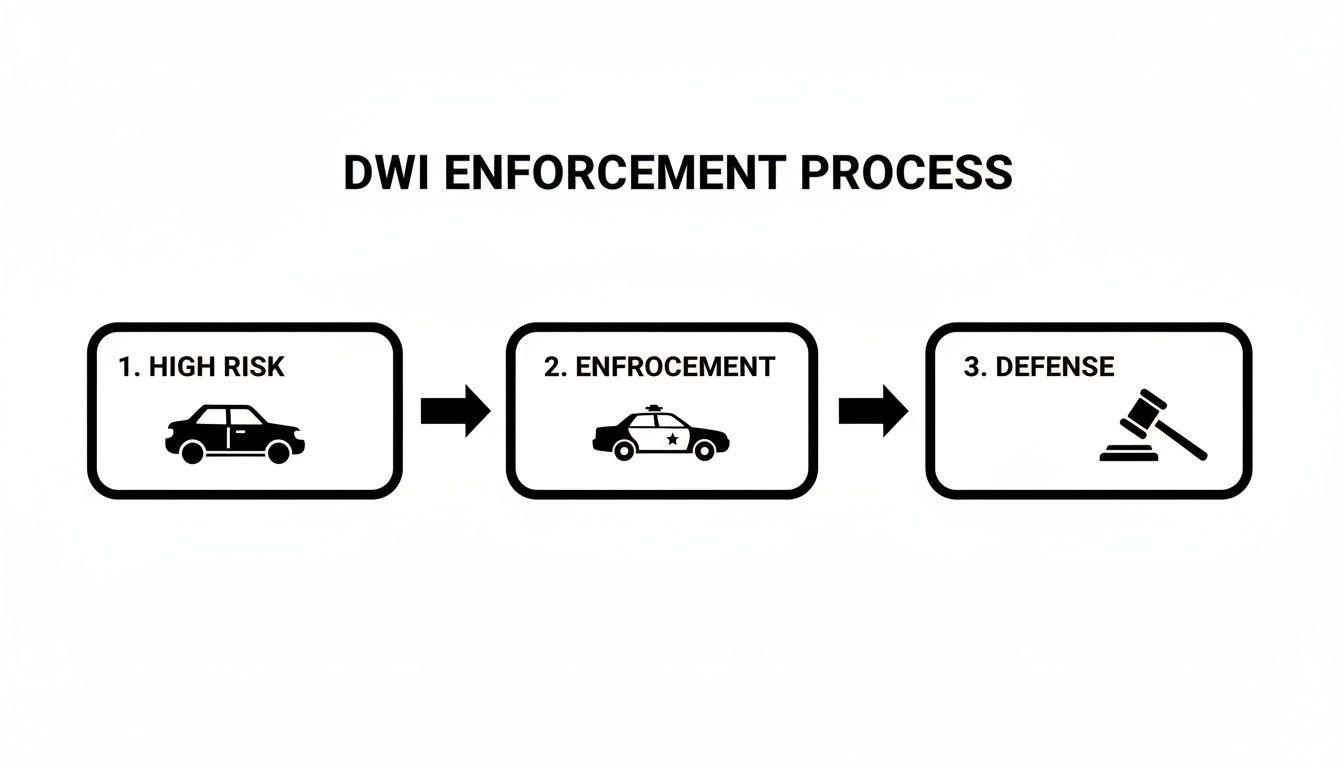
As you can see, an arrest is not the end of the story. It is the beginning of a critical legal process where a strong defense can completely change the outcome.
Step 1: The Arrest and Booking
It all starts when a police officer pulls you over. If the officer suspects you've been drinking, they will arrest you and take you to a police station or county jail for booking. This involves being fingerprinted, photographed, and asked for basic identifying information.
At this point, you will likely be asked to submit to a chemical test (either a breath or blood sample) to determine your Blood Alcohol Concentration (BAC). Remember, under Texas's implied consent law, you have the right to refuse this test. A refusal, however, triggers an automatic attempt by the state to suspend your driver's license, which makes the next step incredibly urgent.
Step 2: The 15-Day ALR Deadline
This is, without a doubt, the most time-sensitive step in the entire process. From the day of your arrest, a 15-day countdown begins. You have just over two weeks to request an Administrative License Revocation (ALR) hearing to fight the automatic DWI license suspension.
If you miss this deadline, the Texas Department of Public Safety (DPS) will suspend your license, usually starting 40 days after your arrest. Winning the ALR hearing is your first and best chance to keep your driving privileges while the criminal case is pending. A seasoned Texas DUI attorney can handle this request for you, ensuring it's filed correctly and on time.
Step 3: Bond and Arraignment
After booking, you’ll need to post bond to be released from jail. The bond amount depends on factors like the severity of the charge and your prior criminal history. Once released, you will receive a date for your first court appearance, called an arraignment.
At the arraignment, the judge will formally read the charges against you, and you will enter a plea. It is almost always the best move to plead "not guilty" at this stage. This preserves all your legal rights and gives your attorney the time needed to examine the state's evidence.
Your arraignment is not a trial. It’s a procedural hearing that officially begins the criminal court process. Pleading "not guilty" is a standard, strategic move that allows your defense team to get to work.
Step 4: The Two Parallel Paths
From here, your case splits and moves along two different tracks at the same time. It’s critical to understand that these two cases are completely separate.
- The Civil ALR Case: This battle is fought before the State Office of Administrative Hearings (SOAH). Its only purpose is to decide whether the DPS has the legal right to suspend your license. Your attorney will argue that the officer didn't have reasonable suspicion for the stop or probable cause for the arrest, potentially saving your license.
- The Criminal Court Case: This is where the prosecutor must prove you are guilty of DWI "beyond a reasonable doubt." This process involves several phases, including pre-trial conferences, evidence review (discovery), and filing legal challenges called pre-trial motions.
Your lawyer will use the pre-trial phase to negotiate with the prosecutor and file motions to have illegally obtained evidence thrown out. For example, if the traffic stop was unlawful or the breathalyzer wasn't calibrated correctly, that evidence could be suppressed, weakening the state's case. Most DWI cases are resolved during this phase, but if a fair agreement can't be reached, the case will proceed to trial.
A DWI charge is serious, but the process is manageable with the right legal guidance. If you are ready to fight DWI Texas charges, our team is here to help. Contact The Law Office of Bryan Fagan, PLLC for a free and confidential case evaluation to discuss your next steps.
Potential Penalties for a DWI Conviction in Texas
A DWI conviction in Texas brings a storm of consequences that can follow you for years. Understanding what’s on the line is the first step toward building a defense that protects your future.
The system is designed to be tough, with penalties that get significantly harsher with each offense. This information isn’t here to cause fear. It’s here to give you a clear, honest picture of the fight ahead and to show you why acting quickly with a strategic defense is non-negotiable.
Criminal Penalties by Offense Level
In Texas, DWI offenses are tiered. A first-time charge is typically a misdemeanor, but subsequent arrests can quickly escalate the charge to a felony, bringing life-altering penalties.
This can feel like a trap that's hard to escape. Texas has a DWI recidivism rate of 30.52% for arrests and 28.75% for convictions, according to the latest state data. In simple terms, nearly one out of every three DWI arrests involves someone who has been through this before. That statistic is precisely why prosecutors and judges increase the pressure with each subsequent charge, making a skilled defense more vital than ever. You can read more about the state's findings on repeat DWI offenses here.
To help you see how the stakes rise, here is a straightforward breakdown of the potential criminal penalties you could face.
Texas DWI Penalties by Offense
The following table outlines the standard criminal penalties for a DWI conviction. Keep in mind these are statutory ranges, and the actual outcome depends heavily on the specifics of your case and the strength of your defense.
| Offense Level | Potential Jail Time | Maximum Fine | License Suspension |
|---|---|---|---|
| First DWI (Class B Misdemeanor) | 72 hours to 180 days | Up to $2,000 | 90 days to 1 year |
| Second DWI (Class A Misdemeanor) | 30 days to 1 year | Up to $4,000 | 180 days to 2 years |
| Third DWI or More (Third-Degree Felony) | 2 to 10 years in prison | Up to $10,000 | 180 days to 2 years |
While these court-ordered penalties are serious, a conviction is just the beginning. It sets off a domino effect of other problems that can disrupt your life for a very long time.
The Hidden Costs and Collateral Consequences
The punishment for a DWI doesn't end when you leave the courtroom. The "collateral consequences" can be just as damaging, impacting your finances, your career, and your freedom long after the legal case is officially closed.
Here’s what many people don’t see coming:
- Skyrocketing Insurance Rates: Your auto insurance premiums can increase significantly—often by hundreds of dollars a month—and stay high for years.
- Professional License Issues: If you're a nurse, pilot, commercial driver (CDL holder), or another licensed professional, a conviction can trigger a review board investigation, suspension, or even the loss of your license.
- A Permanent Criminal Record: A DWI on your record can be an automatic disqualifier on background checks for jobs, apartment leases, and even college applications.
The true cost of a DWI conviction is measured not just in dollars, but in lost opportunities. An experienced Houston DWI lawyer works to protect you from both the immediate penalties and the long-term damage that follows.
The only way to shield yourself from this wide array of consequences is with a proactive, aggressive defense. Don't wait for the system to decide your fate. Contact The Law Office of Bryan Fagan, PLLC for a free, confidential consultation to get clarity on your case and learn how we can start fighting to protect your future today.
Building a Strong Defense Against Your DWI Charge
An arrest is not a conviction. While it can feel like the walls are closing in after being charged with a DWI in Texas, it is important to remember that the prosecution's case is often not as strong as it appears.
Now is the time to shift from worrying to acting. Building a powerful defense means picking apart every detail of your case, from the moment the flashing lights appeared in your rearview mirror to the way the lab handled any test results. The state has the burden to prove you are guilty—our job is to make that as difficult as possible for them.
Challenging the Traffic Stop
The entire DWI case rests on a fundamental question: did the officer have a legal reason to pull you over? The U.S. Constitution protects you from unreasonable searches and seizures, which means a police officer needs "reasonable suspicion" that you have broken a traffic law or committed a crime.
They cannot just stop you on a hunch or because you were on the road late at night.
Common reasons officers give for a traffic stop include:
- Speeding or driving too slowly
- Swerving, weaving, or drifting out of your lane
- Failing to use a turn signal
- Running a stop sign or red light
If the officer cannot provide the court with a clear, legally sound reason for the initial stop, then any evidence gathered after that point—the field sobriety tests, breath or blood results—can be thrown out. This is often the first and most powerful way to fight a DWI charge in Texas.
Attacking Field Sobriety and Chemical Test Evidence
Police and prosecutors often treat test results like infallible, scientific proof of intoxication. However, both Field Sobriety Tests (FSTs) and chemical tests like breath or blood draws are vulnerable to human error, faulty equipment, and sloppy procedures.
The so-called FSTs—like the walk-and-turn or the one-leg stand—are designed to be difficult for anyone, even someone who is perfectly sober. Factors like bad lighting, an uneven road surface, a pre-existing medical condition, or simple nervousness can easily cause someone to "fail." A good Houston DWI lawyer knows exactly how to point out these flaws to a jury.
Breathalyzer and blood tests can also be challenged on several grounds:
- Improper Administration: The law requires officers to follow a strict protocol when giving these tests. Any deviation can contaminate the results.
- Machine Malfunction: Breathalyzers are sensitive machines that need constant calibration and maintenance. If records show the machine wasn't working properly, its results are unreliable.
- Chain of Custody Errors: From the moment a blood sample is drawn, it must be properly stored and tracked. Any gap or mistake in this chain of custody can lead to contamination or a spoiled sample.
Harris County consistently leads the state in DWI arrests, with 12,255 charges filed in 2024 alone. With that much pressure to make arrests, officers often rush and make procedural mistakes that can be used to your advantage.
Remember, the prosecution must prove every element of their case beyond a reasonable doubt. By challenging the stop, the tests, and the procedures, we introduce that doubt and protect your future.
A DWI arrest feels like a setback, but it doesn't have to define your life. With the right legal team on your side, you can aggressively challenge the state’s evidence and fight for the best possible outcome. Contact The Law Office of Bryan Fagan, PLLC today for a free, confidential case evaluation and let's discuss how we can start building your defense.
Common Questions After a Texas DWI Arrest
A DWI arrest is disorienting, and it’s natural to have many questions running through your mind. Below, we’ve answered some of the most urgent concerns we hear from clients every day to give you clarity so you can make informed decisions.
Can My DWI Charge Be Dismissed?
Yes, a dismissal is often a realistic goal in a Texas DWI case. Just because you were arrested does not mean you will be convicted. An experienced Houston DWI lawyer will examine every detail of your case, from the traffic stop to the final chemical test result.
We look for weaknesses in the prosecution's case. For example, a dismissal could happen if:
- The officer lacked a legitimate reason—what the law calls reasonable suspicion—to pull you over.
- The Field Sobriety Tests were conducted on an uneven surface, in bad weather, or were otherwise administered improperly.
- The breathalyzer machine has a history of errors, was not calibrated correctly, or the officer was not certified to operate it.
- The blood sample was contaminated or the chain of custody was broken.
An arrest is just the start of the process. Our job is to dismantle the case against you, piece by piece, and fight for a complete dismissal.
Will I Go to Jail for a First DWI in Texas?
While jail time is a possibility, it is far from guaranteed for a first DWI in Texas. For a standard first offense, a Class B Misdemeanor, the sentencing range is between 72 hours and 180 days in jail. However, most first-time offenders do not end up serving significant time.
A skilled attorney can often negotiate for outcomes that keep you out of jail. We frequently secure alternatives like probation (community supervision), deferred adjudication (which can keep a conviction off your record), or enrollment in DWI education programs. The sooner we start building your defense, the better your chances are of avoiding jail time.
Can I Keep My Driver’s License After a DWI Arrest?
Yes, but you have to act fast. You have only 15 days from the day you were arrested to formally request an Administrative License Revocation (ALR) hearing. This is your one and only chance to fight the automatic DWI license suspension.
If you miss this critical deadline, your license will be suspended automatically, regardless of what happens with the criminal charge. Winning the ALR hearing can stop the suspension completely, allowing you to keep driving while we handle the criminal side of your case.
Feeling overwhelmed is normal, but you don't have to navigate this alone. At The Law Office of Bryan Fagan, PLLC, our team is on standby to protect your rights and walk you through this from start to finish. Contact us 24/7 for a free, confidential case evaluation to get your questions answered. Let's start protecting your future today.