
A DWI arrest can be overwhelming—but you don’t have to face it alone. The hours and days that follow are critical, and the steps you take can have a profound impact on your freedom, your driver's license, and your future. The two most important things you can do are simple: remain silent and contact an experienced DWI defense lawyer immediately. These aren’t just suggestions; they are your first and best line of defense.
Your First 24 Hours After a Texas DWI Arrest
A DWI arrest is a whirlwind of confusion and anxiety. The moment you’re released from jail, a critical clock starts ticking, and every move you make can impact your case. While feeling overwhelmed is completely normal, you can take back control by taking a few calm, strategic steps right away.
After being fingerprinted, photographed, and posting bond, you might be tempted to vent to family or friends. It's crucial to remember your constitutional right to remain silent. Anything you say—even in a text message or on social media—can be used by the prosecution against you.
Preserve Every Single Detail of Your Arrest
Your memory is one of the most important pieces of evidence you have right now, and it fades quickly. As soon as you are in a quiet place, write down everything you can recall about the arrest. Don’t filter it or try to make sense of it yet; just document the facts. Every detail could be the key to building a strong defense.
Try to document these key moments:
- The Traffic Stop: Why did the officer say they pulled you over? Note the location, time, and road conditions.
- Your Conversation: What questions did the officer ask? What were your responses? Describe the officer's tone and behavior.
- Field Sobriety Tests: Detail every test you were asked to perform. Was the ground flat and well-lit? What type of shoes were you wearing? Did you have any physical limitations that could have affected your performance?
- Chemical Tests: Did you take a breath or blood test? Write down everything you remember about how it was administered. For example, did the officer observe you for the required period before the breath test? You can find more information in our guide on whether you should refuse a breathalyzer test in Texas.
This detailed account provides your DWI lawyer with the raw material needed to challenge the state's case and identify procedural errors or rights violations.
The Most Important Phone Call You Will Make
The single most critical action you can take in these first 24 hours is to call an experienced Texas DUI attorney. This isn't just about getting legal advice; it’s about meeting urgent deadlines that could save your driver's license.
An arrest is just an accusation, not a conviction. The steps you take right now are your first real chance to build a powerful defense and challenge the state’s story from the very start.
A skilled DWI lawyer will immediately begin working to protect you. They can preserve critical evidence, like dashcam and bodycam video, before it is erased. Most importantly, they will ensure you don't miss the 15-day deadline to request an Administrative License Revocation (ALR) hearing—the only way to prevent the automatic suspension of your license.
Facing a DWI charge is serious, but it is a challenge that can be managed and fought. By documenting everything, remaining silent, and engaging an expert on your side, you begin to take a proactive stance in protecting your freedom.
The 15-Day Deadline You Cannot Afford to Miss
After a Texas DWI arrest, you are fighting a battle on two separate fronts. The first is the criminal case, where you face potential fines, probation, or jail time.
But there’s a second, more immediate administrative battle with the Texas Department of Public Safety (DPS) over your right to drive. A silent countdown starts the moment you are arrested.
You have just 15 days to request a hearing to challenge the suspension of your license. This is a hard deadline. If you fail to act, the DPS will automatically suspend your driver's license.
Understanding the Administrative License Revocation (ALR)
This process is called an Administrative License Revocation (ALR). It is essential to understand that the ALR hearing is entirely separate from your criminal DWI case. Even if your criminal charges are later dismissed, you can still lose your license if you miss this administrative deadline.
The ALR process is triggered if you either:
- Refused to provide a breath or blood sample.
- Provided a sample that showed a Blood Alcohol Concentration (BAC) of 0.08% or higher.
Missing the 15-day deadline is like forfeiting the fight before it begins. The state wins by default, and your license suspension will begin about 40 days after your arrest. For a first-time DWI in Texas, this could mean losing your driving privileges for up to 180 days.
This timeline illustrates just how critical those first two weeks are. Protecting your rights and your ability to drive depends on the actions you take almost immediately.
The key takeaway? You must be strategic from day one. Involving an experienced lawyer immediately is the only way to effectively navigate these critical first steps.
Why the ALR Hearing is Your First Line of Defense
Requesting an ALR hearing does more than just pause an automatic license suspension; it provides your Houston DWI lawyer with a significant strategic advantage. This hearing is often the first opportunity to challenge the state's evidence and question the arresting officer under oath, long before a criminal trial.
Think of it as a preview of the prosecution's case. During this hearing, your attorney can:
- Cross-Examine the Officer: We can lock the arresting officer into their sworn testimony, forcing them to justify the traffic stop and the administration of sobriety tests. Any inconsistencies can be used to weaken the criminal case.
- Get an Early Look at the Evidence: We gain access to police reports, dashcam videos, and breathalyzer records. This allows us to spot procedural errors that could lead to evidence being suppressed.
- Directly Challenge the Suspension: We can argue that the officer lacked reasonable suspicion for the stop or probable cause for the arrest, potentially preventing the license suspension altogether.
The ALR hearing isn't just about saving your license. It's a critical intelligence-gathering mission that lays the foundation for your entire DWI defense.
Even if the administrative judge ultimately suspends your license, the testimony and evidence gathered are invaluable for fighting the criminal charges. If a suspension occurs, your attorney can immediately help you take the next steps. To learn more, check out our guide on applying for an occupational driver license.
Don't let this 15-day window close without a fight. Retaining a Texas DWI attorney ensures this vital deadline is met, turning the ALR process from a threat into a powerful strategic opportunity.
Texas DWI Administrative vs. Criminal Case Timeline
It's easy to get confused by the two parallel tracks your DWI case runs on. The administrative process is fast and focuses only on your license. The criminal court process moves much slower and deals with potential penalties like fines and jail time. This table breaks down the key differences.
| Aspect | Administrative License Revocation (ALR) | Criminal DWI Case |
|---|---|---|
| Who's Involved | Texas Department of Public Safety (DPS) | County or District Attorney's Office |
| What's at Stake | Your driver's license | Fines, probation, jail time, criminal record |
| Key Deadline | 15 days from arrest to request a hearing | Months or over a year to resolve |
| The Goal | To prevent automatic license suspension | To get charges dismissed, reduced, or win at trial |
| Standard of Proof | "Preponderance of the evidence" (easier for the state to meet) | "Beyond a reasonable doubt" (much higher standard) |
| Outcome | License suspended or not suspended | Not guilty, dismissal, plea bargain, or conviction |
Understanding these two distinct processes is crucial. Winning the ALR hearing doesn't guarantee a win in your criminal case, but a strong performance in the ALR hearing can provide significant leverage for achieving a better outcome in criminal court.
Getting a Handle on Texas DWI Laws and What You're Up Against
To build a solid defense, you first need to understand what you are facing. A DWI charge in Texas has its own legal language and a tiered penalty system that can feel complex. Our goal is to explain it in clear terms so you know what’s at stake and how we can help you fight back.
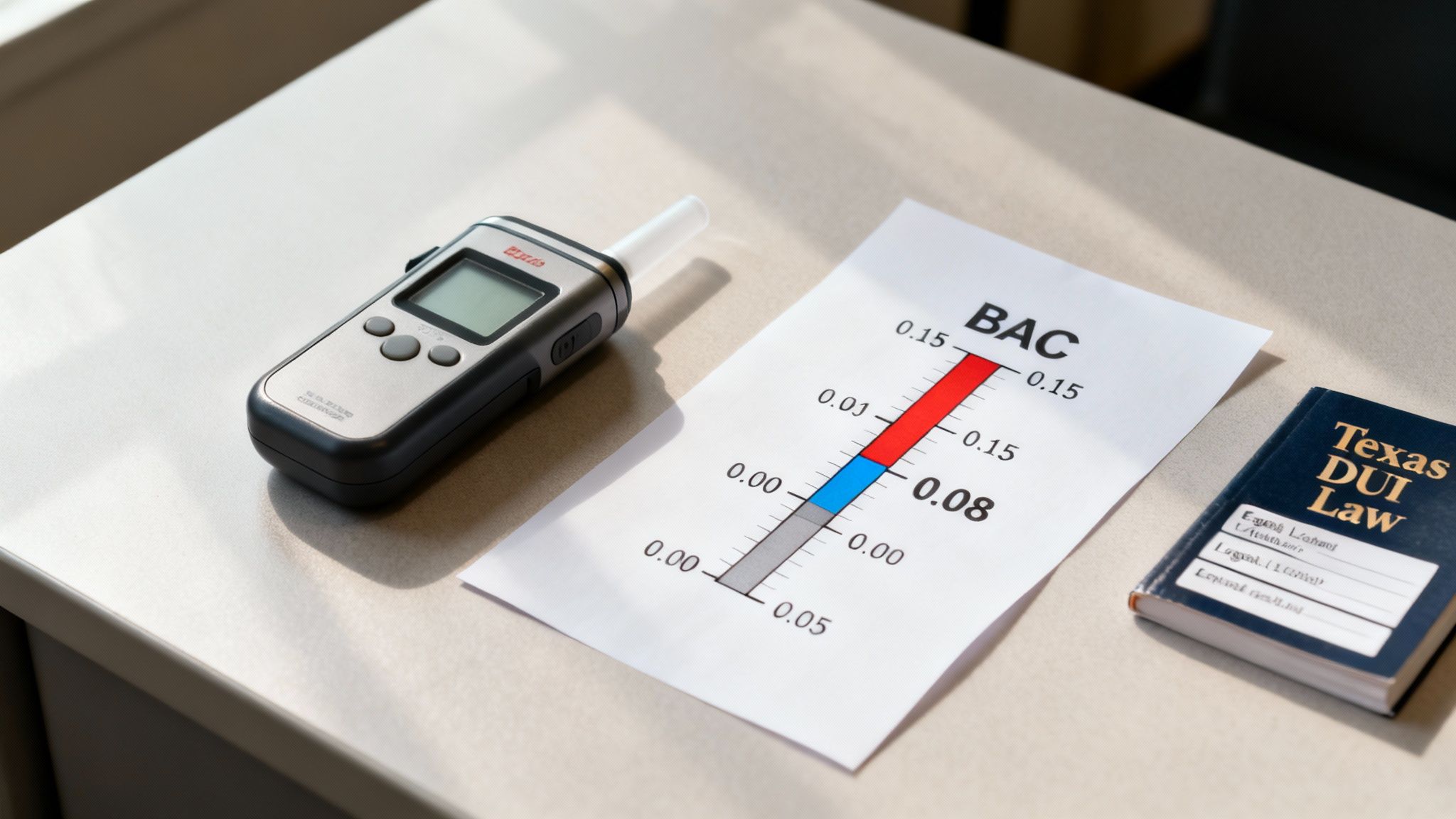
This information isn't meant to cause alarm—it's meant to empower you. Understanding the laws and potential outcomes highlights why a skilled Houston DWI lawyer is so crucial for protecting your rights.
Key DWI Terms You Need to Know
When arrested for DWI, you will encounter several acronyms and legal terms. Let's define the most important ones.
- Blood Alcohol Concentration (BAC): This is the percentage of alcohol in your bloodstream. The legal limit for most drivers in Texas is 0.08%. For commercial drivers, the limit is 0.04%, and for anyone under 21, any detectable amount of alcohol is illegal.
- Implied Consent: When you obtain a Texas driver's license, you legally "consent" to provide a breath or blood sample if lawfully arrested for DWI. Refusing a test triggers an automatic license suspension, which must be challenged at an ALR hearing.
- Standardized Field Sobriety Tests (SFSTs): These are the roadside coordination tests like the walk-and-turn or one-leg stand. These tests are notoriously unreliable, subjective, and often administered incorrectly, making them a frequent target for a strong legal defense.
The state’s case is built on these concepts. A knowledgeable attorney knows how to find and exploit the weaknesses in each one.
The Real Cost of a First-Time DWI
For a first DWI in Texas, you are typically charged with a Class B Misdemeanor, assuming your BAC was under 0.15% and no other aggravating factors were present. Though it's a lower-level charge, the penalties are significant.
A conviction for a first offense can include:
- Fines: Up to $2,000.
- Jail Time: Between 72 hours and 180 days.
- License Suspension: From 90 days to one year.
These direct penalties do not include thousands more in court costs, mandatory DWI education classes, annual DPS surcharges, and skyrocketing insurance premiums. An experienced Texas DUI attorney’s primary goal is to seek a dismissal or a reduction in charges to help you avoid this cascade of consequences.
The state prosecutes these cases aggressively. In 2023, alcohol-impaired driving was a factor in 31% of all U.S. traffic fatalities. You can discover more about these drunk driving statistics to understand why prosecutors take these cases so seriously—and why your defense must be equally robust.
How DWI Charges Get More Serious
DWI penalties increase significantly with prior convictions or if "aggravating factors" are involved. This is why it is so critical to fight every charge, beginning with the first one.
- Second DWI Offense: This is a Class A Misdemeanor. Potential jail time increases to 30 days to one year, and the maximum fine doubles to $4,000. Your license can be suspended for up to two years.
- Third DWI Offense (or more): This is a third-degree felony in Texas, carrying a potential sentence of two to ten years in state prison, a fine up to $10,000, and a lengthy license suspension.
Facing a felony DWI is a life-altering event, but it does not mean your case is hopeless. The state has a much higher burden of proof, and a strategic defense can dismantle the evidence and protect your freedom.
A charge can become a felony even on a first offense if a child passenger under 15 is in the vehicle (State Jail Felony). Causing an accident that leads to serious injury (Intoxication Assault) or death (Intoxication Manslaughter) will also result in severe felony charges. These are legal emergencies that require an aggressive lawyer who knows how to fight DWI Texas charges from the moment you call.
How a Strategic DUI Defense Can Protect Your Future
An arrest for Driving While Intoxicated is a serious matter, but it is crucial to remember that an arrest is not a conviction. It’s natural to feel that the fight is already lost, but this is precisely when a powerful defense begins to take shape. Your future is not defined by this one event; it is protected by the actions you take right now.
An experienced Texas DWI attorney understands that the prosecution's case is rarely as strong as it appears. Every DWI case is built on evidence, and each piece must be legally obtained and scientifically sound. Our job is to challenge the foundation of the state's case, turning their own procedures into tools for your defense.
Questioning the Initial Traffic Stop
The entire case hinges on one question: did the officer have a legal reason to pull you over? The Fourth Amendment protects you from unreasonable searches and seizures, including your vehicle.
To stop you, an officer needs reasonable suspicion—a specific, articulable reason to believe you violated a law. It cannot be based on a hunch. If the reason for the stop is weak, everything that followed—field sobriety tests, breathalyzer results, and the arrest itself—could be thrown out of court.
For example, we scrutinize dashcam footage to see if the officer’s report accurately reflects what happened. If we can show the stop was unlawful, the case against you can be dismissed.
Exposing Flaws in Field Sobriety Tests
Standardized Field Sobriety Tests (SFSTs) are often presented as definitive proof of impairment, but they are subjective and prone to error. These are divided-attention tasks that many sober individuals would find difficult, especially on the side of a busy road at night.
An effective defense examines how these tests were conducted:
- Were the instructions given correctly? Officers must follow a strict, standardized script. Any deviation can invalidate the results.
- What were the conditions? Uneven pavement, poor lighting, or even the type of shoes you were wearing can impact performance.
- Did you have a medical condition? Balance issues, injuries, or high anxiety can cause a sober person to "fail" these tests.
By highlighting these flaws, we can argue that the officer’s decision to arrest was based on subjective opinion, not on credible evidence of intoxication.
Remember, the burden of proof is always on the state. It is their job to prove every element of the case beyond a reasonable doubt. A strategic defense is about ensuring they are held to that high standard.
Contesting Chemical Test Results
Breathalyzer and blood test results may seem conclusive, but they are far from infallible. The machines require precise calibration, regular maintenance, and a properly trained operator to produce an accurate reading.
You can learn more by reading about the common Texas DUI defense strategies our firm uses to challenge scientific evidence.
A sharp Houston DWI lawyer will investigate every step of the chemical testing process. We subpoena maintenance logs, check the officer's training records, and analyze the timeline for improper delays. For blood tests, we scrutinize the chain of custody to ensure the sample wasn't contaminated or mishandled.
Discovering a single procedural mistake or machine error can create the reasonable doubt needed to win your case. An arrest is just the beginning of the story. With a strategic, aggressive defense, you have the power to write a much better ending.
Preparing for Your First Meeting With a DWI Attorney
Choosing the right legal advocate is the most critical decision you will make. Your first consultation is a strategic interview to find a lawyer with the experience, local knowledge, and commitment to fight your DWI charge.
When you arrive prepared, you shift from feeling anxious to feeling confident. It shows the attorney you are serious about your defense and helps you determine if they are the right partner to protect your future.
What to Bring to Your Consultation
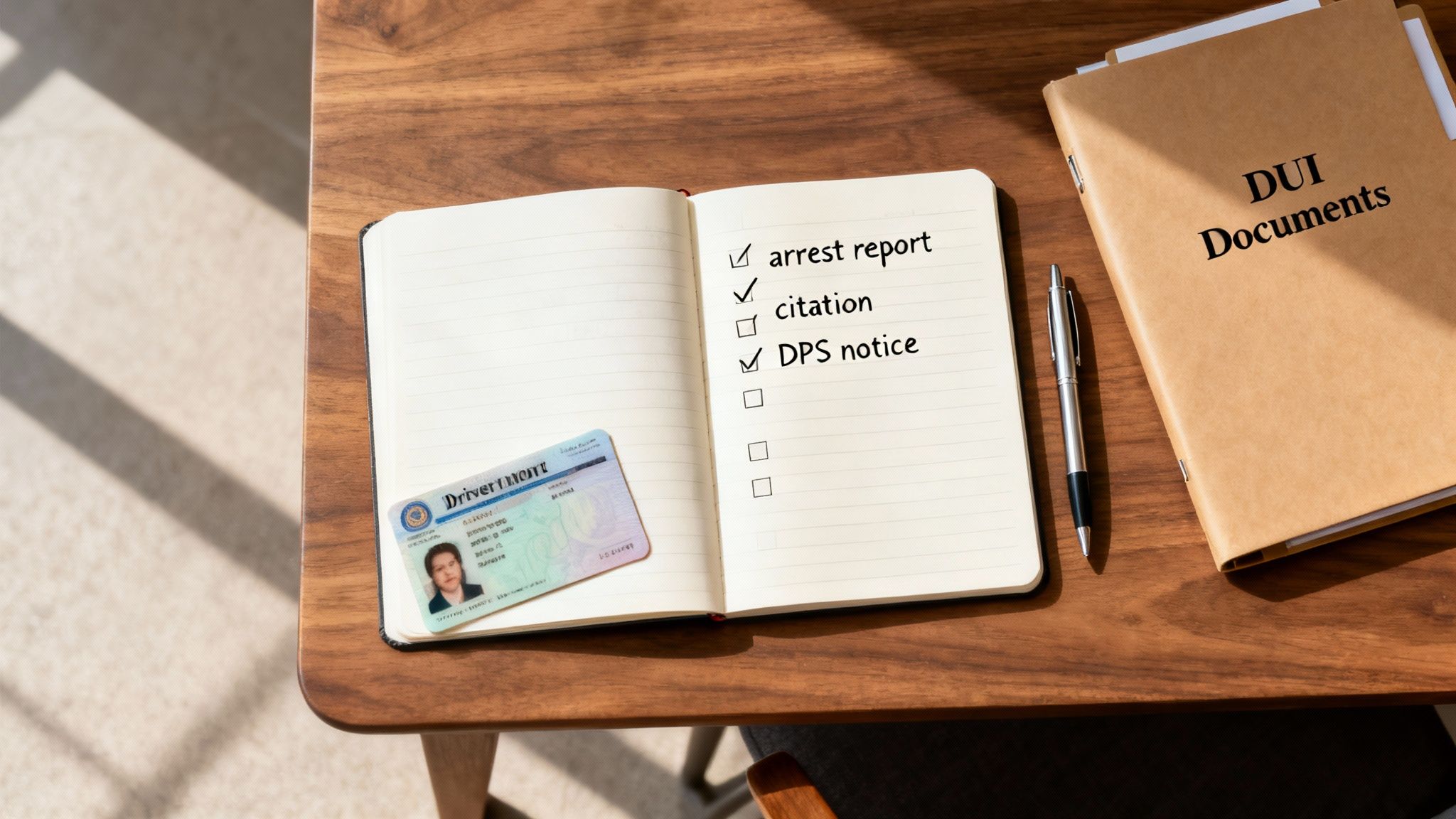
To make the most of your initial meeting, gather all the paperwork you received. Having these documents ready allows a potential lawyer to provide a more accurate assessment of your case.
Try to bring these items:
- Arrest Paperwork: This includes citations, bond release papers, and the Notice of Suspension from the officer.
- ALR Hearing Request: If you have already filed the request for your Administrative License Revocation hearing, bring a copy.
- Your Written Account: Bring the detailed notes you wrote about the traffic stop and arrest.
- Court Date Information: Any documents listing your upcoming court appearance are essential.
- Your Driver's License and Criminal History: This helps the attorney understand your background and whether prior offenses could be a factor.
Don't worry if you are missing a document. Bring what you have. The goal is to provide as much information as possible so your attorney can begin mapping out a defense strategy.
Your first meeting is a two-way street. While the attorney is evaluating your case, you are evaluating their ability to handle it. Come prepared to ask tough, specific questions.
Questions to Ask a Houston DWI Lawyer
The quality of your defense is directly tied to the skill of your attorney. Use your free consultation to vet them. Go beyond fees and ask questions that truly matter.
Here are some insightful questions to ask:
- Experience in Your Court: "How much of your practice is dedicated to DWI cases in this county? How familiar are you with the local prosecutors and judges?"
- Case Strategy: "Based on what I've told you, what are some potential defense strategies you see? What are the biggest weaknesses in the state’s case against me?"
- Client Communication: "Who will be my main point of contact? What is your typical response time to calls or emails?"
- Fee Structure: "Do you charge a flat fee or an hourly rate? Can you provide a clear breakdown of what that fee covers and what other costs I might face?"
The answers will tell you everything you need to know. You are looking for a Houston DWI lawyer who provides confident, specific answers, not vague promises. You need a strategic partner ready to fight for you, and being prepared for this first meeting is the best way to find one.
Common Questions After a Texas DWI Arrest
After a DWI arrest, your mind is likely filled with questions. It’s normal to feel uncertain about what comes next. Getting clear, straightforward answers is the first step toward regaining control. Here are some of the most common questions we hear, along with the answers you need.
Can I Refuse a Breathalyzer in Texas? What Happens If I Do?
Yes, you have the right to refuse a breathalyzer or blood test in Texas. However, this decision has immediate consequences. Under Texas's "implied consent" law, having a driver's license means you have already legally agreed to provide a sample if lawfully arrested for DWI.
Refusing triggers an automatic driver's license suspension—180 days for a first-time refusal. On the other hand, your refusal denies the prosecution its most powerful piece of evidence: your specific Blood Alcohol Concentration (BAC). An experienced DWI lawyer will immediately fight the license suspension in an ALR hearing and build your criminal defense around the lack of scientific evidence.
Will a DWI Charge Affect My Job or Professional License?
A DWI conviction can absolutely jeopardize your career, especially if you hold a professional license (e.g., as a nurse, pilot, or teacher) or a Commercial Driver’s License (CDL). Many licensing boards require self-reporting of criminal convictions, which can trigger disciplinary investigations.
For CDL holders, a DWI conviction leads to a mandatory one-year disqualification. For many commercial drivers, this is career-ending. A conviction also appears on background checks and can limit future job opportunities. Fighting the charge to obtain a dismissal or a reduction to a non-alcohol-related offense is about protecting your livelihood.
Is It Really Possible to Get a First-Time DWI Dismissed in Texas?
Yes, getting a first-time DWI dismissed is a primary goal and is often achievable. An arrest is an accusation, not a conviction, and the state's case frequently has weaknesses.
A dismissal can be won by challenging the prosecution's evidence. Was the traffic stop legal? Were field sobriety tests administered incorrectly? Was the breathalyzer machine properly calibrated? If your attorney can successfully challenge any of these elements, a judge may suppress the evidence.
Without key evidence, the prosecutor's case can fall apart, often leading them to dismiss the charges. Other favorable outcomes, such as deferred adjudication that can keep a conviction off your public record, are also possible for a first DWI in Texas.
How Much Does a Good Houston DWI Lawyer Cost?
The cost of a DWI lawyer depends on the complexity of your case, the attorney's experience, and whether the case proceeds to trial. Most reputable DWI attorneys work on a flat-fee basis, ensuring you know the exact cost upfront without surprise hourly bills.
While hiring a skilled lawyer is a significant investment, the long-term costs of a DWI conviction—including fines, court costs, surcharges, increased insurance premiums, and potential career impact—are almost always higher. We offer free consultations to provide a transparent understanding of the legal fees involved in protecting your future.
At The Law Office of Bryan Fagan, PLLC, we understand how stressful this experience is. You do not have to face this challenge alone. We are dedicated to defending Texans against DWI charges with confidence and strategic skill. Contact us 24/7 for a free, confidential case evaluation to discuss your rights and begin building your defense today.