 Skip to content
A DWI arrest can be overwhelming, especially when your car never moved.
You may have done what felt like the safer thing. You pulled over, turned into a parking lot, or decided to sleep in your car instead of driving any farther. Then an officer knocked on the window, asked questions, and before long you were arrested for DWI. That often seems contrary to common sense.
Texas law can be harsh in these situations. A parked car does not automatically protect you from a charge. But an arrest is not the same as a conviction, and parked-car cases often turn on details that people miss in the moment. If you're looking for DWI in a parked car Texas law explained in plain English, the key is this: the prosecutor will try to show you were in control of the vehicle, and the defense will work to show the state can't prove that beyond a reasonable doubt.
The Shock of an Arrest in a Parked Car
A lot of parked-car DWI cases begin the same way. Someone realizes they shouldn't be driving. They stop. They sit in the vehicle, sometimes with the air on, sometimes with the keys nearby, sometimes already asleep. An officer approaches because of a welfare check, a citizen call, or an observation in a parking lot.
From your side, the thinking is simple. "I chose not to drive."
From the state's side, the thinking is different. They ask whether you were still in a position to drive at any moment. That gap between common sense and legal interpretation is what catches people off guard.
Why people are so confused after these arrests
The confusion is understandable because it's commonly thought DWI requires movement. In Texas, that isn't always how police or prosecutors view it. The issue becomes whether the officer believes you had enough control over the vehicle to operate it.
That means facts that seemed harmless at the time can suddenly matter a lot:
- Where you were sitting: Driver's seat facts usually draw the most attention.
- Where the keys were: In your hand, pocket, cup holder, or ignition can all become evidence.
- What the officer observed: Engine status, your statements, and body camera footage often shape the case early.
- Where the vehicle was parked: Public access matters.
A parked-car DWI case often feels unfair at first. The legal question isn't whether you intended to be responsible. It's whether the state can prove you were operating, or in actual physical control, under Texas law.
That distinction is why early legal advice matters. Cases like this are won and lost on details, not assumptions.
The Legal Concept of 'Actual Physical Control'
Texas Penal Code § 49.04 makes it illegal to operate a motor vehicle in a public place while intoxicated. The difficult word in parked-car cases is operating. Texas courts have interpreted that word broadly under the idea often called actual physical control, or APC.
In simple terms, APC means you may not have been driving down the road, but the officer and prosecutor claim you were in a position to make the car move. Under Texas law on sleeping in a car while intoxicated, that issue can become the center of the case.

What actual physical control means in everyday language
Think of it this way. If you're standing at your front door with the key in your hand, you haven't gone inside yet, but you plainly have the ability to do it. Prosecutors use similar reasoning with vehicles. If you're behind the wheel and the keys are accessible, they argue you had the present ability to operate the car.
That doesn't mean every parked-car arrest is valid. It means the state starts with a theory that control can exist before movement.
Texas courts have supported that broad view. As explained in this discussion of Texas parked-car DWI law and Ball v. State, sleeping in a parked car while intoxicated can lead to a DWI arrest under APC, and the vehicle does not need to be in motion. The article notes that Ball v. State (1993) involved a defendant found asleep in the driver's seat with the engine running, and the court upheld that APC finding.
The two words that drive these cases
Two parts of the law usually get the most attention.
First is public place. A public road obviously qualifies, but many parking areas and lots can also become part of the argument if the public can access them.
Second is operating. Parked-car cases, therefore, become fact-heavy. The prosecutor doesn't need a video of the car moving if they can convince the court that you had the immediate ability to set the car in motion.
What does not automatically protect you
Many people assume one fact alone will save them. Usually it won't.
- Asleep doesn't end the case: Being asleep may still leave the question of control open.
- Engine off isn't a full defense by itself: The state may still focus on keys, seat position, and location.
- Good intentions don't erase legal exposure: Trying to "sleep it off" may help explain your thinking, but it doesn't automatically defeat the charge.
- Saying you weren't driving isn't enough: The rest of the evidence still matters.
Practical rule: In a parked-car case, no single fact decides everything. The court looks at the whole scene.
That is why these cases require a careful defense. The law sounds simple from a distance, but APC cases are built from small observations, and those observations can be challenged.
How Prosecutors Build a Parked Car DWI Case
Prosecutors try to turn a quiet parking lot scene into a simple story for the judge or jury. Their theme is usually straightforward. You had the vehicle, the means to start it, and signs of intoxication, so you must have been operating it.
That story can sound stronger than the evidence really is.
The evidence they try to stack together
A parked car DWI case is usually built from details that seem minor by themselves but become more persuasive when grouped together. The prosecutor wants those details to point in one direction and leave no innocent explanation.
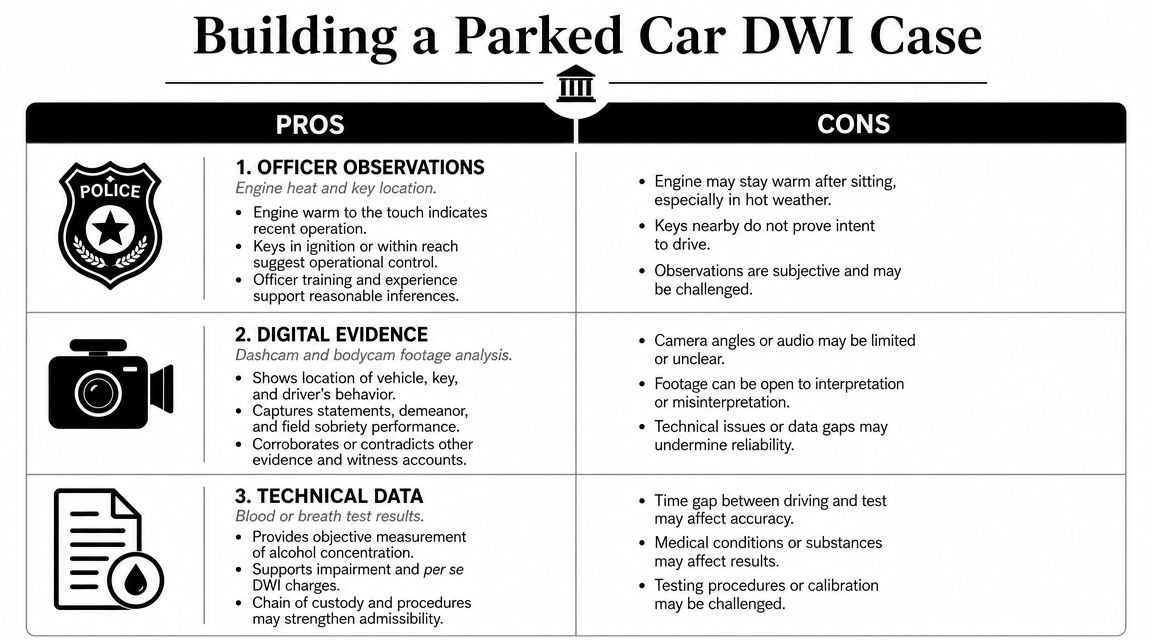
Texas Penal Code section 49.01 defines intoxication, but parked-car cases are usually won or lost on the surrounding facts that prosecutors use to argue operation. They often focus on points like where you were sitting, where the keys were, whether the engine was running or still warm, and whether anything about the vehicle suggested it was ready to move. You can review the statute here: Texas Penal Code section 49.01.
Here is how those facts are commonly framed in court:
| Evidence point | How the prosecutor uses it |
|---|---|
| Driver's seat position | Argues you had immediate access to the controls |
| Keys accessible | Supports a claim that you could put the car in motion |
| Engine running or warm | Suggests recent driving or present readiness to drive |
| Foot on brake or vehicle in gear | Lets the state argue active control instead of mere presence |
A prosecutor does not need every one of those facts. Two or three clean facts, presented well, can be enough to carry the state's theory.
Police reports often become the blueprint
The first version of the case is usually the officer's report. If that report says you were slumped over in the driver's seat, keys in the console, headlights on, engine warm, and you smelled of alcohol, the prosecutor starts with a ready-made narrative.
Video matters here, but reports still shape charging decisions. Prosecutors often read the report before they ever watch body camera footage in full. That is one reason common police errors in Texas DWI arrests matter so much. If the report leaves out context, overstates what the officer observed, or turns a welfare check into a criminal case too quickly, the defense has room to attack the foundation.
I look closely at timing in these cases. When did the officer first see the keys. When did the officer ask about drinking. When did the investigation shift from checking on your safety to building a DWI case. Those details often tell me where the state's proof is solid and where it is vulnerable.
Prosecutors also rely heavily on your own words
In many parked-car cases, the statement causes more damage than the scene itself.
A person tries to sound responsible and says, "I pulled over because I knew I shouldn't drive," or "I was waiting until I felt better." Prosecutors use that to argue two things at once. First, you drove there. Second, you believed you were impaired around the time you drove.
That is why these cases require careful damage control early. A single admission can supply the missing link in an otherwise thin operation case.
Intoxication evidence comes next
After the state builds its control argument, it turns to intoxication. That usually includes the officer's observations, any field sobriety testing, statements about drinking, and breath or blood results if they exist.
A few terms come up often:
- BAC: Blood Alcohol Concentration.
- Field sobriety test: A set of divided-attention exercises officers use to claim impairment.
- Implied consent: Texas law allows requested chemical testing after a lawful DWI arrest under certain conditions.
- Administrative license suspension: A separate license process that can move forward apart from the criminal charge.
What makes the state's case stronger or weaker
The state's case gets stronger when the scene looks organized and consistent. Driver's seat. Keys within reach. Vehicle capable of immediate movement. Statements tying you to recent driving. Video and report telling the same story.
The case gets weaker when those pieces do not line up. Conflicting statements, unclear key location, a poor camera angle, no sign the vehicle was being used for transportation, or an officer who made assumptions too fast can all create reasonable doubt.
That is the prosecutor's playbook in a parked-car DWI. They gather ordinary facts, line them up, and argue they prove operation beyond a reasonable doubt. A good defense lawyer studies that same chain and starts breaking links.
Strategic Defenses for a Parked Car DWI
A parked-car DWI defense starts with one practical question. Where is the state's proof weakest?
In these cases, prosecutors usually rely on inference. They take a set of ordinary facts, your seat position, key location, engine status, statements, test results, and ask the jury to fill in the gaps. The defense approach is to slow that story down, test every assumption, and cut off weak links before they harden into a narrative.
Challenge how the encounter turned into a DWI investigation
A lot of parked-car arrests begin as a welfare check. That does not give police unlimited room to investigate for DWI. A defense lawyer studies the first few minutes closely because bad decisions early in the encounter can affect everything that came after.
Key questions include:
- Why was the officer there: Was there a real community-caretaking reason, or did the officer treat a parked car as a crime scene without enough facts?
- When were you no longer free to leave: The timing matters. A consensual contact can turn into a detention, and a detention needs legal support.
- What do the videos show: Body cam and dash cam footage often tell a more measured story than the report.
If the detention, arrest, or search was not legally supported, the court may exclude statements, test results, or other evidence the state planned to use.
Force the state to prove actual physical control with real evidence
This is usually the pressure point in a parked-car case. Prosecutors want the jury to believe you were in a position to operate the vehicle right away. The defense focuses on facts that make that conclusion less certain.
A few examples matter more than people realize:
- Where you were sitting: A person found in the back seat raises a very different issue from someone found behind the wheel.
- Where the keys were: Keys tucked away, left outside the vehicle, or not within reach can weaken the claim that the car was readily operable.
- Whether the vehicle could be driven: Mechanical problems, a dead battery, or some other condition can matter if they fit the facts.
- How the scene looked overall: Reclined seat, blanket, phone charger, and no sign of recent driving can support the argument that you were using the car as shelter, not transportation.
That last point matters in real life. Jurors understand why a tired or intoxicated person might sit in a parked car without planning to drive. The defense has to present those facts carefully, because good intentions alone are not enough.
Examine field sobriety testing with skepticism
Field sobriety tests often look stronger on paper than they do on video. I see reports that say a client "failed" a test when the recording shows unclear instructions, poor lighting, uneven ground, or a person who is cold, exhausted, injured, or scared.
Those details are not technicalities. They go directly to whether the officer's conclusions deserve trust.
A strong defense reviews:
- whether the instructions were complete and understandable
- whether the officer demonstrated the tests correctly
- whether footwear, medical issues, age, weight, fatigue, or anxiety affected performance
- whether the officer scored the test consistently with training
A shaky field sobriety test does not prove intoxication. In a parked-car case, it may only prove that the scene was stressful and the testing was poorly done.
Test the chemical evidence instead of accepting it at face value
Breath and blood evidence can be challenged in a focused, practical way. The issue is not whether a number exists. The issue is whether the state can connect that number to lawful police work and to your condition at the relevant time.
That review may include the basis for the arrest, the legality of the request, machine maintenance records, blood-draw procedures, chain of custody, and whether the result fits the timeline the prosecutor is trying to sell. In a parked-car case, timing can be especially important because the state still has to tie intoxication to operation or control, not just to a later test.
Law Office of Bryan Fagan, PLLC is one option for defending this kind of case because its practice includes review of probable cause, chemical testing, ALR hearings, and trial strategy in Texas DWI matters.
Use the facts that help, but build a legal defense around them
Clients often tell me, "I was trying to do the right thing by not driving." That fact can help with context. It can make a prosecutor more open to negotiation, and it can make a judge or jury listen more carefully. But it does not erase the charge by itself.
What improves the case is turning that context into a defense plan. That may mean attacking control, challenging the detention, limiting statements, disputing test reliability, or showing that the officer jumped to conclusions. Prosecutors build these cases by stacking assumptions. A good defense works by removing enough of them that reasonable doubt is no longer hard to see.
Texas DWI Penalties for a Parked Car Conviction
A parked-car conviction is still a DWI conviction. Texas does not create a lighter category just because the vehicle was not moving. That is one reason these cases deserve a serious response from the start.
The main penalties come from the offense level, your alleged BAC, whether you refused testing, and whether you have prior DWI history.
Key terms you should know
Before looking at the penalty table, a few terms matter.
BAC means Blood Alcohol Concentration. If the alleged BAC is high enough, the charge level can increase.
Implied consent means Texas treats drivers as having agreed to chemical testing in certain post-arrest circumstances. If you refuse, that can trigger a separate license consequence.
Administrative license suspension refers to the driver's license action handled apart from the criminal court case. Many people focus only on court and miss the license side until it's too late.
Texas DWI penalties at a glance
According to this summary of Texas parked-car DWI penalties, a first-offense DWI in Texas can carry 72 hours to 180 days in jail, fines up to $2,000-$4,000, and a license suspension from 90 to 365 days. The same source explains that a BAC of 0.15% or higher can make the case a Class A misdemeanor, that a chemical test refusal triggers an automatic 180-day license suspension, and that a third DWI offense becomes a third-degree felony with 2 to 10 years in prison.
| Offense | Jail Time | Maximum Fine | License Suspension |
|---|---|---|---|
| First-offense DWI Class B misdemeanor | 72 hours to 180 days | Up to $2,000 to $4,000 | 90 to 365 days |
| DWI with alleged BAC of 0.15% or higher | Elevated to Class A misdemeanor | Higher misdemeanor exposure applies | License consequences may still apply |
| Chemical test refusal | Separate from criminal punishment | Not stated separately here | Automatic 180-day suspension |
| Third DWI offense | 2 to 10 years in prison | Felony exposure applies | Serious license consequences can follow |
Trade-offs that matter in real cases
Some people want to contest everything immediately. Others want to avoid jail, protect a professional license, or reduce the charge if dismissal is not realistic. Those are different goals, and the right strategy depends on the evidence.
A first DWI in Texas may open doors that are not available in repeat-offense cases. On the other hand, if the state claims a high BAC or test refusal, the risk analysis changes quickly.
For many people, the hidden punishment is not just the court sentence. It is the effect on work, insurance, travel, background checks, and daily driving. That is why a defense plan should look beyond the first court date.
The parked-car setting does not soften the penalties. If the state proves the charge, the consequences can look much like any other Texas DWI conviction.
The ALR Hearing Your First Deadline to Save Your License
The criminal case is only part of the problem. Your driver's license faces a separate process called an Administrative License Revocation hearing, often shortened to ALR hearing.
That hearing is handled through the administrative side of the case, not the criminal court. It can become your first real chance to test the state's evidence and protect your ability to drive.

Why this deadline matters
Texas gives you a short window to act. The verified guidance in the materials above states that you should request the ALR hearing within 15 days after arrest to challenge the suspension.
If you miss that window, you can lose the chance to contest the license suspension early. Many people don't realize this because they are focused on bond conditions, court dates, work, and family fallout.
If you want a fuller overview, this Texas ALR hearing process guide explains how the administrative side fits into a DWI case.
What happens at an ALR hearing
An ALR hearing is not the same as a criminal trial. The issues are narrower, but the hearing still matters.
The hearing can involve questions such as:
- Whether the officer had legal grounds: The administrative judge may look at the basis for the arrest and testing request.
- Whether a refusal or failure is properly supported: Paperwork and officer testimony matter here.
- Whether testimony creates useful admissions: Defense counsel can often learn details that become valuable later in the criminal case.
That means the ALR hearing can do two things at once. It can help you fight the license suspension, and it can also help your Houston DWI lawyer evaluate how the officer will present the case.
A brief explanation can help if this process is new to you:
How this fits into your overall defense
A good ALR approach is practical, not symbolic. Sometimes the hearing exposes weak testimony. Sometimes it preserves important evidence. Sometimes it narrows the issues and gives the defense a better path in criminal court.
What does not help is waiting to "see what happens." In DWI cases, delay usually helps the state more than the defense. Early action protects options.
What to Do Immediately After a Parked Car DWI Arrest
The first few days matter. Small decisions can affect both your criminal case and your DWI license suspension issue.
Use this checklist as a starting point.
Say less than you want to say. You don't need to explain why you stopped, how much you drank, or whether you planned to drive later. Statements made in a stressed moment often become the backbone of the prosecutor's story.
Write down everything while it's fresh. Note where the car was parked, where you were sitting, where the keys were, what the officer said, whether the engine was on, and whether there were witnesses nearby. Details fade fast.
Preserve anything that helps your timeline. Save receipts, rideshare records, text messages, parking receipts, and names of people who saw you before the arrest. In a parked-car case, timing and context can matter as much as the officer's observations.
Follow bond conditions carefully. Missing court, skipping a requirement, or violating bond can create new problems that distract from the defense.
Request legal help immediately. A Texas DWI attorney can evaluate the operation issue, the testing issue, and the ALR deadline before opportunities are lost.
Keep your own copy of every paper you received at release. Those papers often contain dates and warnings that become important sooner than people expect.
If you want to fight DWI Texas charges effectively, the first step is getting the facts organized before the state's version hardens into the official record.
Frequently Asked Questions About Parked Car DWIs
Can I get a DWI if I was on private property
Possibly. A parked-car DWI does not automatically disappear just because the arrest happened off a public road. Prosecutors often look first at whether the area qualifies as a public place under Texas law, and they usually argue that apartment complexes, store parking lots, hotel lots, and other areas open to public access meet that definition.
A restricted area with limited access can create a stronger defense. That issue turns on the details, including who could enter, whether gates or barriers were present, and how the officer described the location.
What if I was in the passenger seat or back seat
That fact can help a lot because it makes the state's operation theory harder to prove. If you were not in the driver's seat, the prosecutor has to work harder to connect you to actual physical control of the vehicle.
Seat position is not a complete defense by itself. It needs to be backed up by body camera footage, dashcam video, witness statements, photos, and anything else that shows where you were when the officer made contact.
Does it matter if the car was inoperable
Yes, it can. If the vehicle would not start, had a dead battery, was missing a tire, or had some other problem that made immediate operation unrealistic, that can undercut the state's theory.
This is one of those issues that sounds simple but often turns on proof. A repair invoice, tow record, mechanic statement, or clear photos may matter more than a general claim that the car was "broken."
Will refusing a breath or blood test help me
Usually, refusal creates a mixed picture, not an automatic advantage. It may limit one part of the evidence, but it can also trigger separate license consequences and give the state another fact to argue about your conduct.
The right question is not whether refusal was good or bad in the abstract. The fundamental question is how the refusal fits with everything else, including the officer's observations, the timeline, any video, and whether police later obtained a blood warrant.
Can a parked-car DWI be dismissed
Yes. Some parked-car cases are dismissed because the state cannot prove operation, cannot support the arrest, or overreaches on what the facts show.
That is why these cases deserve a close review instead of quick assumptions. The prosecutor starts by building a story around keys, seat position, engine status, and your statements. The defense works by testing each part of that story, looking for gaps, contradictions, and legal issues the state cannot clean up later.
A parked-car DWI charge feels personal because you may have believed you were doing the safer thing by staying put. That does not mean the case is hopeless. It means the facts need to be examined carefully and early.
The Law Office of Bryan Fagan, PLLC represents Texans facing DWI charges, including cases built around a parked vehicle. If you were arrested in this situation, get the police reports, video, testing records, and license deadlines reviewed as soon as possible. Early case analysis often shapes whether the state keeps control of the story or whether the defense starts taking it apart.

