
A DWI arrest can be overwhelming, but you don't have to face it alone.
You may be reading this from your phone after a bad night. Maybe you did what responsible adults are supposed to do. You didn't drive. You pulled over, parked, and tried to sleep until you were safe.
In Texas, that choice can still put you in handcuffs.
If you want the direct answer to can you sleep in your car drunk in Texas legally, here it is: sleeping in your car isn't automatically illegal, but doing it while intoxicated can still lead to a DWI arrest. The problem isn't the sleeping. The problem is how Texas treats “operating” a vehicle.
The Responsible Choice That Can Still Lead to a DWI Arrest
You leave the bar, realize you should not drive, and do the adult thing. You pull into a legal parking spot, shut it down, and try to sleep it off. In Texas, that decision can still end with a DWI arrest.
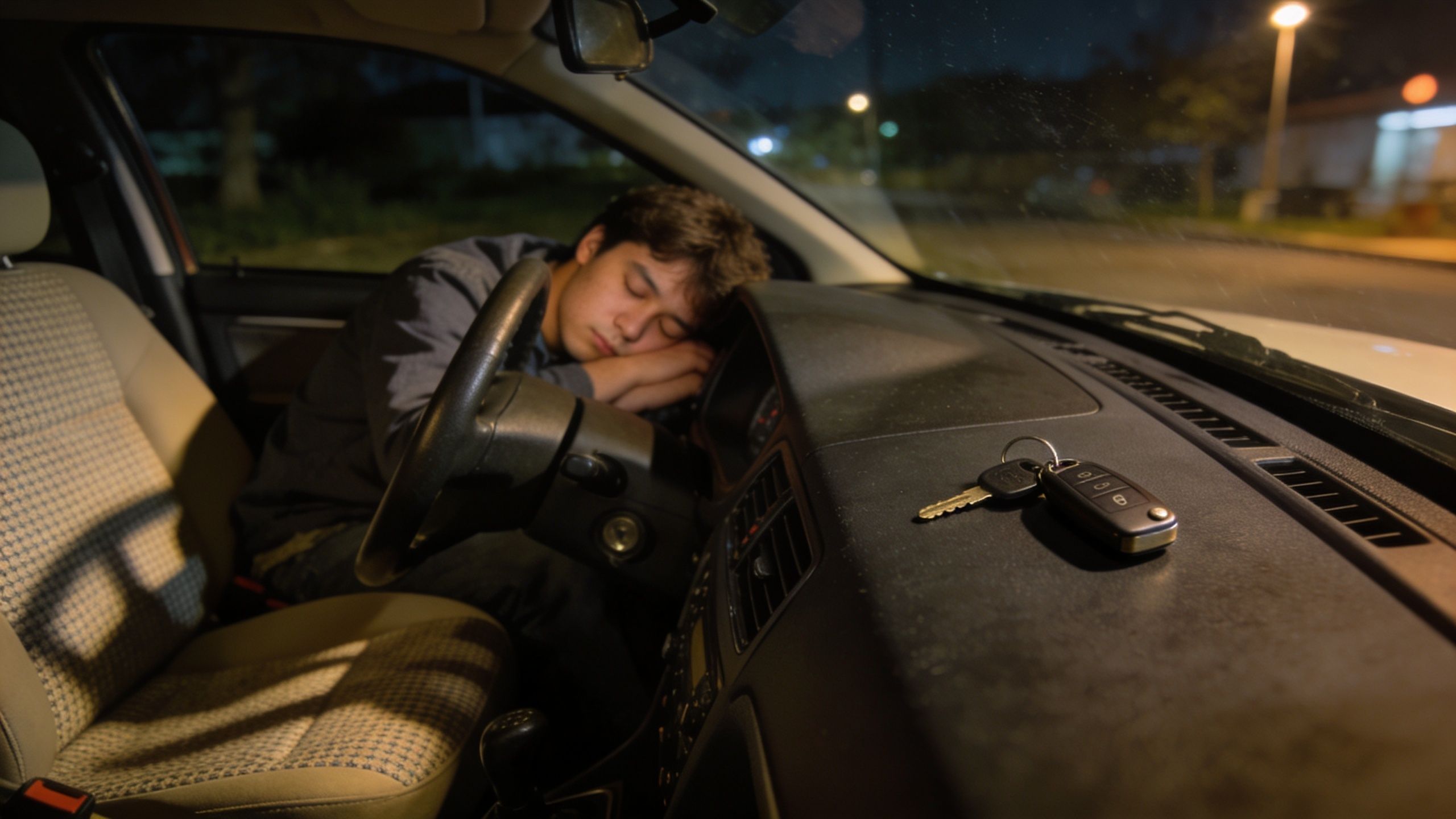
That catches people off guard because sleeping in a vehicle is not automatically illegal. The danger comes from how police and prosecutors treat a parked car when an intoxicated person is inside it. As this Texas parked-car DWI explanation makes clear, the State may argue you were still "operating" the vehicle even if nobody saw you drive.
Why good intentions do not stop an arrest
Officers do not grade your intentions. They build a case from facts they can write into a report.
If they find you in the driver's seat, with the keys nearby, in a place open to the public, you have a problem. If the engine is running, the heater is on, or the car looks ready to move, the problem gets worse. A cautious decision can still look like control of the vehicle.
That is why these cases feel unfair. They often start with someone trying to avoid a worse mistake.
The bigger trap is that Texas counties do not all treat these facts the same way. A prosecutor in Houston may view a sleeping-driver case differently than one in Dallas, Tarrant County, or Austin. Some offices file aggressively on thin facts. Others are more selective. Local practice matters, which is why a lawyer who knows the judges, prosecutors, and charging habits in that courthouse matters more than generic internet advice.
Ask the right question
Do not ask, "Was I driving?" Ask, "What facts let police say I could have used the car right then?"
That is the fundamental issue. Sleeping in the driver's seat is risky. Keeping the keys in your pocket is risky. Turning on the car for air conditioning, heat, music, or phone charging is risky. Each fact gives the State one more argument.
Consider these suggestions. If you have been drinking, do not use your car as your backup plan if you have any other option. Call a rideshare, get a hotel room, or ask for a sober ride. If you absolutely have no choice, make the car look unusable: stay out of the driver's seat, keep the engine off, and put the keys somewhere that does not suggest immediate control.
Texas gives officers a lot of room in these cases. You need to treat that reality seriously.
Understanding Why Sleeping in a Car Can Be a DWI
Texas DWI law hinges on one word that causes endless trouble: operating.
Under Texas Penal Code § 49.01, a person can be charged for being intoxicated while operating a motor vehicle in a public place. The problem is that the statute does not define what “operating” means. As explained in this discussion of parked-car DWI risk in Texas, that gap matters because it gives courts room to interpret the term broadly.
Texas left the key word undefined
That undefined term is where sleeping-in-car cases are born.
According to Renea Flores's explanation of Texas DWI law, Texas courts have treated “operate” broadly enough that it can exist when “the totality of the circumstances demonstrate that the defendant took action to affect the functioning of his vehicle that would enable the vehicle's use.”
That standard is much wider than commonly assumed. It does not require highway driving. It does not require weaving across lanes. It does not even require the vehicle to move.
What that means in real life
Once courts use a broad totality-of-the-circumstances test, ordinary actions can start looking dangerous in a police report.
Examples courts have treated as evidence of operating include actions like these:
- Sitting in the driver's seat while intoxicated
- Using the car's systems, such as the heater or radio
- Starting the vehicle
- Positioning yourself in a way that suggests readiness to drive
That's why people get shocked by these arrests. They think “I was parked” ends the discussion. In Texas, it often only starts the discussion.
Texas doesn't require obvious motion before an officer begins building a DWI case. The State may argue that your actions made the vehicle usable, and that's enough to trigger a prosecution.
Public place matters too
The law also requires the vehicle to be in a public place. That term reaches farther than many people think. Parking lots and private roads open to the public can still create exposure.
So if you're asleep in your vehicle outside a bar, apartment complex, gas station, restaurant, shopping center, or hotel, don't assume you're insulated from DWI enforcement. If the public can access that area, police may still treat it as a qualifying location.
The safest legal takeaway
If you're asking whether you can sleep in your car drunk in Texas legally, don't rely on the word “sleep.” Rely on reducing anything that looks like operation.
The safer setup is simple:
- Get out of the driver's seat
- Leave the engine off
- Don't activate vehicle functions
- Put the keys somewhere that does not show easy access
Those choices don't guarantee you won't be arrested. But they remove facts the prosecution would love to use against you.
The Evidence Police Use for a Sleeping DWI Charge
A sleeping DWI case is usually built with circumstantial evidence. Officers arrive, observe, ask questions, and document details that may seem minor in the moment but become central later.
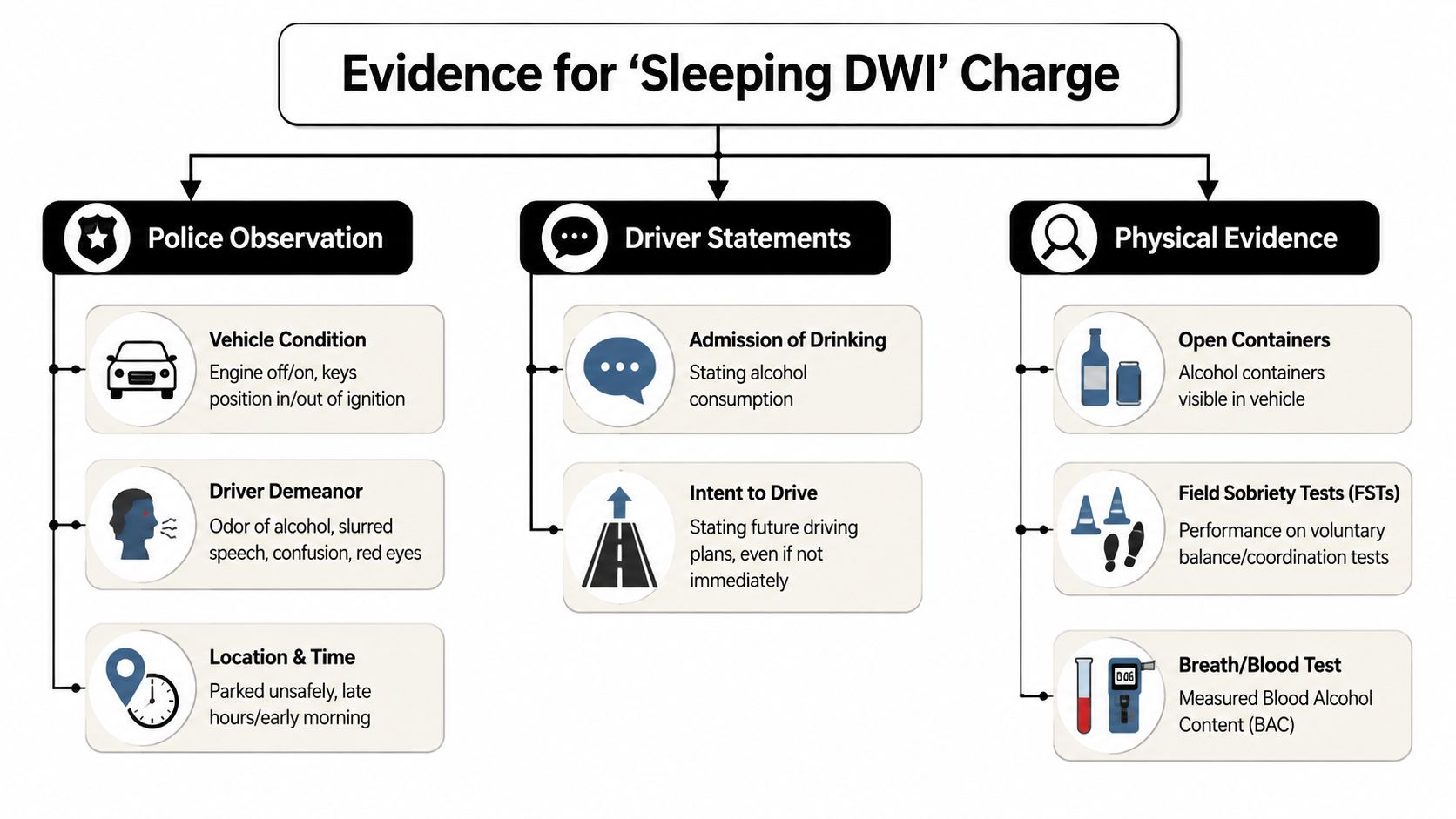
Under Texas Penal Code § 49.04, courts use a broad idea of operation that can include actual physical control. As outlined in this review of evidence used in Texas DUI convictions, prosecutors often point to facts that connect you to the vehicle's ability to be used. BHW Law's discussion of sleeping DWI cases identifies several common indicators: being in the driver's seat, having keys in the ignition or within reach, an engine that is running or recently run, the radio or heater being on, and seatbelt engagement.
What officers focus on first
Officers are trained to look at the scene as a whole. They aren't just checking whether the car moved. They're asking whether you appeared to have control over a vehicle that could be used right then.
Some of the details they may write down include:
- Your seat position. Driver's seat is the worst place to be.
- Where the keys were. In the ignition or within easy reach is dangerous.
- Vehicle status. Running engine, warm engine, lights on, radio on, heater on.
- How you were found. Seatbelt on, foot position, body posture, windows up or down.
- What you said. Admissions about drinking, where you came from, where you planned to go.
- What was visible. Open containers, receipts, bar wristbands, or other signs of recent drinking.
A quick risk comparison
| Factor | Low Risk Interpretation | High Risk Interpretation |
|---|---|---|
| Seat location | You were in the back seat or passenger seat | You were in the driver's seat |
| Keys | Keys stored away from immediate reach | Keys in ignition, hand, pocket, or easy reach |
| Engine status | Engine off with no sign of recent use | Engine running or appearing recently run |
| Vehicle systems | Heater, lights, and radio off | Heater or radio on, suggesting active use |
| Body position | Reclined away from a driving posture | Upright in a position consistent with driving |
| Seatbelt | Unfastened while resting | Fastened, suggesting driving preparation |
| Statements | You made no admissions about driving plans | You said you were about to leave or had driven there |
| Location | Legally parked in a low-concern setting | Parked in a suspicious or unsafe location |
Why small details matter so much
In most sleeping DWI cases, no officer watched you drive. So the State stitches together a story from details.
A running heater can become “he activated the vehicle's systems.” A seatbelt can become “he prepared himself as a driver.” Keys in reach can become “she had immediate physical control.” Once those facts are in the report, your case turns on whether your lawyer can pull that story apart.
The State likes facts that sound ordinary on paper but dangerous in court. Your defense often starts by challenging what those facts really prove.
Driver statements can do real damage
People talk too much during welfare checks. That's understandable. You're sleepy, confused, embarrassed, and trying to sound cooperative.
But statements like “I only had a few,” “I'm waiting to sober up,” or “I was about to head home” can become major evidence. You may think you're explaining that you were trying to be safe. The prosecutor may hear an admission that you drank and intended to drive.
That's why calm silence matters. Not rude silence. Smart silence.
Dual Penalties Criminal Charges and License Suspension
The arrest is only the start. In Texas, a sleeping-in-car DWI usually creates two separate problems at once. You have the criminal prosecution, and you have the fight over your driver's license.
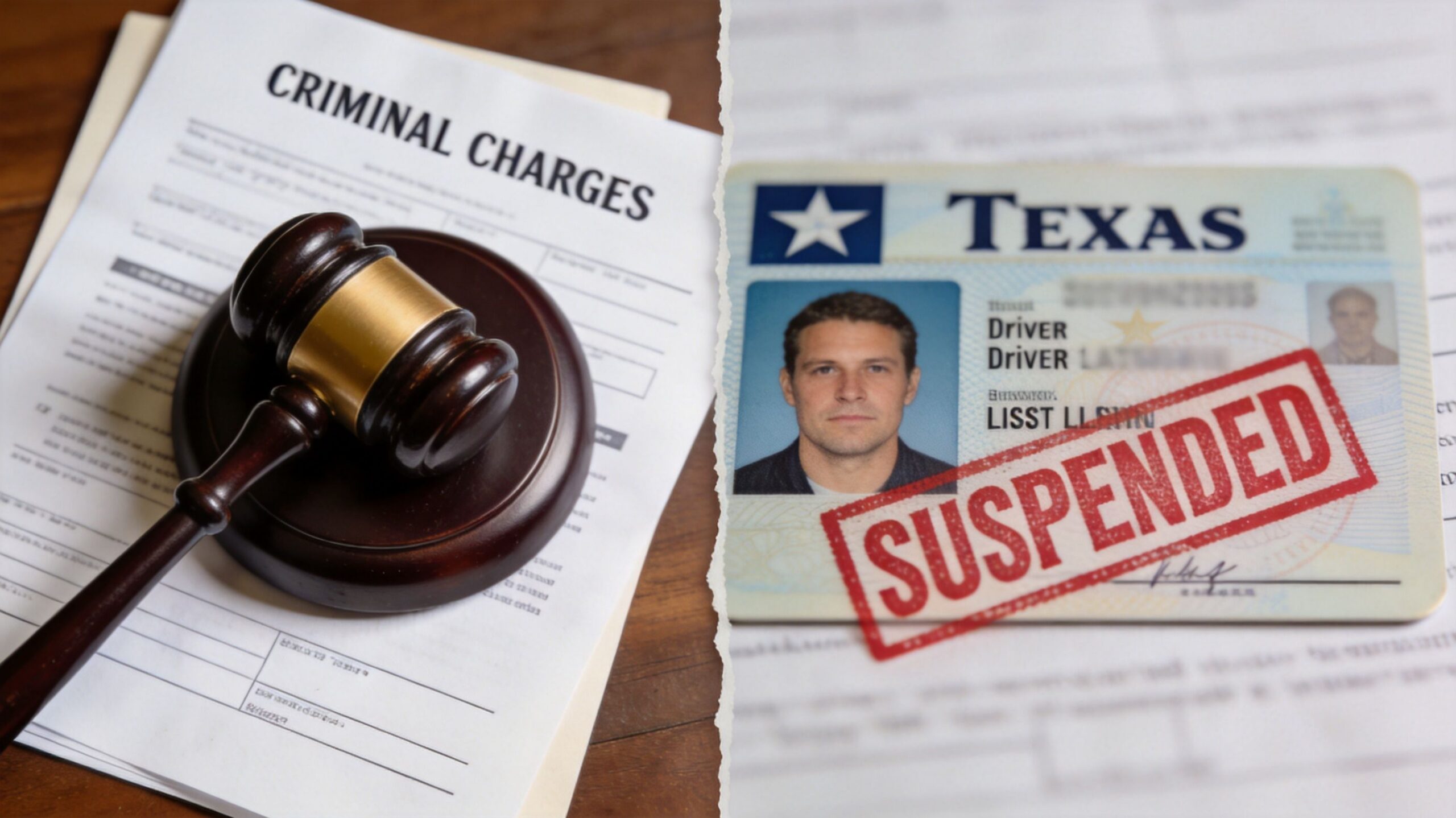
People often fixate on the handcuffs and ignore the license case until the deadline passes. That is a costly mistake.
The criminal case
The criminal case is where the State tries to convict you of DWI. In a sleeping-car case, that usually means prosecutors must prove two points: you were intoxicated, and you were legally “operating” the vehicle.
That second issue is where these cases get dangerous. Texas law does not give juries a neat checklist for what counts as operating. Police, prosecutors, and judges fill in the gaps from the facts. In Houston, a running vehicle and keys nearby may draw a harder charging decision. In parts of DFW, prosecutors often press on circumstantial facts and let a jury sort it out. Austin-area cases can turn heavily on the officer's report and body camera details. Same statute. Different local habits. That is why local defense strategy matters so much in sleeping DWI cases.
Even on a first arrest, the consequences are serious. You may be dealing with jail exposure, fines, bond conditions, mandatory classes, repeated court settings, and a permanent record if the case is mishandled.
Texas can also pursue a DWI without a test result at or above the legal limit. A blood or breath result can matter. So can the officer's account of your speech, balance, confusion, and where you were found in the car. If police pushed for roadside tests before the arrest, read this guide on refusing field sobriety tests in Texas so you understand how that evidence gets used later.
The license case
Separate from criminal court, Texas can also move against your license through an Administrative License Revocation (often called an ALR process), which is a civil action tied to the arrest.
That case has its own rules, its own timeline, and its own damage. You can still face a suspension based on an alleged test failure or refusal even while the criminal case is still pending. Winning one track does not automatically fix the other.
The key concept is implied consent. Texas treats driving on public roads as consent to certain chemical testing procedures under state law. If police say you refused, the State may try to suspend your license quickly. If police claim you failed a test, they may do the same.
Deadlines arrive quickly in these cases. If you miss the window to request a hearing, you lose the advantage you could have used to protect your license and question the officer under oath.
How this usually plays out
A sleeping DWI case often unfolds on two tracks at the same time:
- Police contact turns into a DWI investigation.
- Arrest and booking follow.
- Bond conditions may limit driving, travel, or alcohol use.
- ALR action starts on the license side.
- Criminal court begins reviewing whether the State can prove operation and intoxication.
That split matters. A good lawyer does not treat this like one file with one deadline. In sleeping-car cases, especially where no one saw you drive, the defense often starts by attacking the operating theory early while also protecting your license before the administrative side gets away from you.
If you want a plain-language overview of how these cases unfold, this video is a useful starting point.
A sleeping-in-car DWI can threaten your record and your license at the same time. Treat both fights seriously from day one.
What to Do If Confronted by Police
If an officer wakes you up in your car, treat that moment seriously. What begins as a welfare check can turn into a DWI investigation fast.
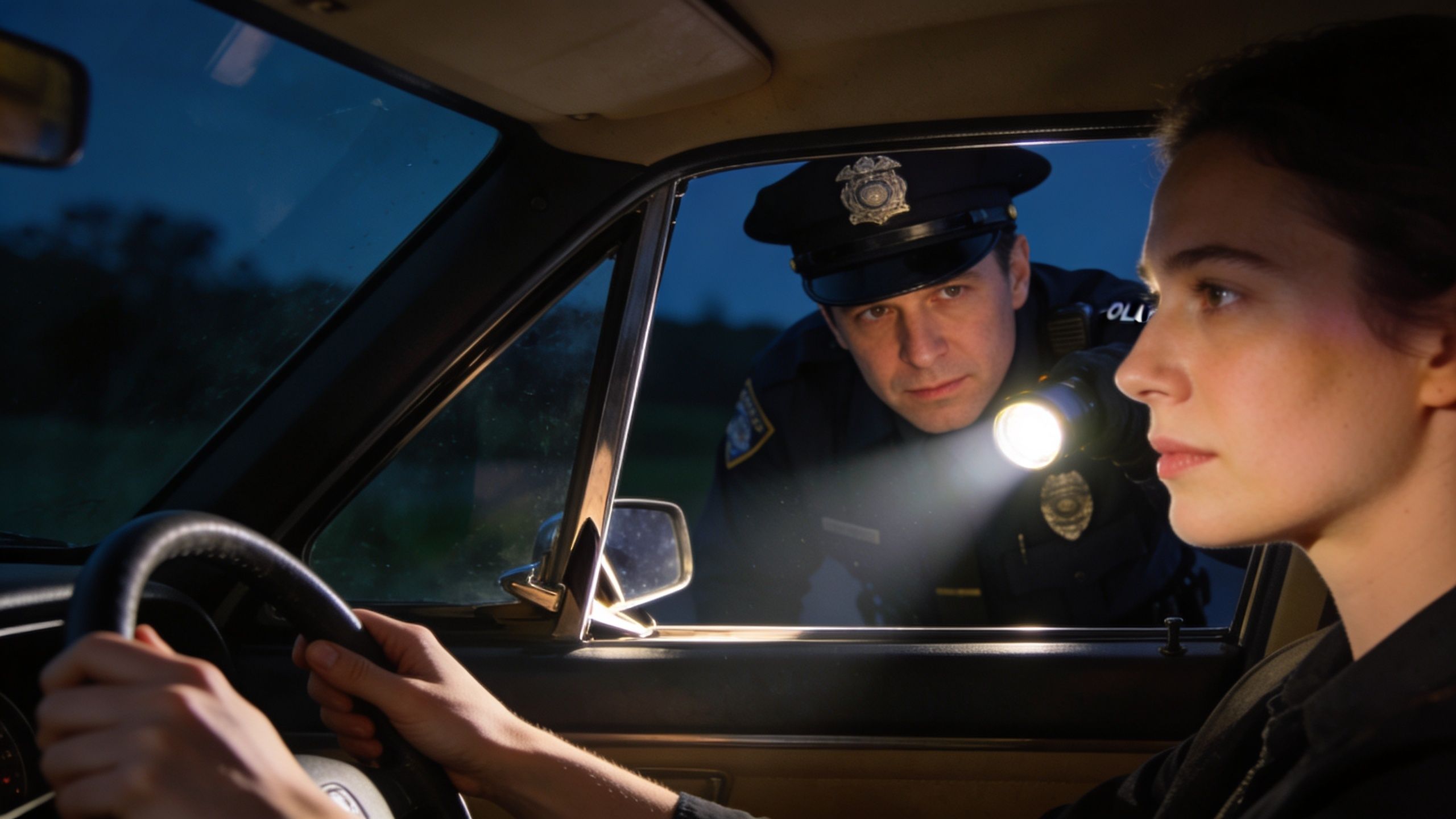
Your job is to stay calm, avoid making the case worse, and protect your rights without picking a fight.
What to say and what not to say
Be polite. Keep your hands visible. Give basic identifying information when required.
But don't try to talk your way out of it. That rarely helps.
A cleaner approach sounds like this:
- Provide identification if the officer asks for it.
- Stay respectful in your tone and movements.
- Don't volunteer explanations about how much you drank or where you were going.
- Say you want a lawyer before answering investigative questions.
A simple line works well: “Officer, I want to cooperate, but I'm not answering questions without a lawyer.”
Field sobriety tests and screening devices
A field sobriety test is a roadside coordination exercise officers use to look for signs of impairment. Common examples include balance, eye movement, and divided-attention tasks. These tests are not magic, and they can look bad even when a person is tired, nervous, injured, or just awakened from sleep.
If you're dealing with a sleeping-in-car investigation, those tests can be especially misleading because you may still be groggy and disoriented. That's one reason many defense lawyers tell clients to think carefully before agreeing. You can learn more in this guide on refusing field sobriety tests in Texas.
A preliminary breath test is a portable breath device sometimes used before arrest. It is different from later chemical testing issues that can affect the license case.
A calm step-by-step approach
Use this sequence if police approach your parked car:
Wake up and orient yourself
Don't make sudden movements. Officers are watching your hands and your responsiveness.
Keep your hands visible
Put them where the officer can see them. That reduces tension right away.
Answer only basic identification requests
You don't need to explain your night in detail.
Don't discuss drinking
Even partial admissions can become strong evidence later.
Don't explain intent
Saying “I was going to leave in an hour” can sound like planned driving.
Ask for counsel before detailed questioning
That is a right, not an act of disrespect.
If the officer already suspects DWI, your explanations usually become evidence, not protection.
If you're arrested anyway
Don't argue on the roadside. Don't resist. Don't try to litigate the law from the parking lot.
Save the fight for later, where it belongs. A good defense starts with what the officer did, what the report says, what the video shows, and whether the State can prove operation.
How a Texas DWI Attorney Defends These Cases
Sleeping DWI cases are defensible. They are not hopeless, and they are not automatic convictions.
The first target is usually the State's theory that you were operating the vehicle. In these cases, that issue is often the whole battlefield. If the prosecution can't connect your conduct to actual physical control in a convincing way, the case weakens quickly.
The defense starts with the scene
A strong lawyer studies the details the officer used to build the charge.
That includes questions like these:
- Were you in the driver's seat when police first made contact?
- Where exactly were the keys?
- Was the engine on, off, or merely assumed to have been used?
- Did the officer document facts carefully, or fill gaps with conclusions?
- Did body camera footage match the report?
- Did your statements come after confusing or improper questioning?
Those are not technical side issues. They are the case.
Then the attorney attacks the weak links
In many sleeping-in-car arrests, the State relies on inference stacked on inference. A defense lawyer works to separate suspicion from proof.
That may involve:
- Challenging the operation element by showing the vehicle was not being used in a way the law requires
- Exposing innocent explanations for facts the prosecutor wants to spin, such as resting rather than preparing to drive
- Questioning police observations when they are vague, inconsistent, or incomplete
- Reviewing constitutional issues including the stop, detention, questioning, and any search
- Examining test procedures if the case involves breath or blood evidence
- Using witnesses or records to show what happened before officers arrived
A careful lawyer also looks for practical evidence that many people overlook. Tow receipts, surveillance footage, receipts, phone records, and witness statements can all change the story of why you were in that vehicle and what you intended to do.
The ALR hearing matters too
A Texas DWI attorney doesn't just defend the criminal charge. The lawyer also addresses the license threat.
That means evaluating the administrative side early, preserving available rights, and using the hearing process strategically when possible. In some cases, the ALR hearing becomes an early chance to question the officer under oath and gather useful testimony before the criminal case develops further.
That can matter a lot in a sleeping DWI case, where the officer's exact observations often drive everything.
A smart defense doesn't start at trial. It starts by locking down the facts before the State polishes them.
Local knowledge is not optional
Many people often make a costly mistake. They think Texas DWI law works the same way everywhere.
It doesn't.
Texas law is not applied monolithically. Enforcement of actual physical control standards can vary significantly between Houston, Dallas-Fort Worth, Austin, and San Antonio. Local prosecutorial discretion and police department policies create different legal environments, which means a case in Harris County may be handled differently than one in a rural jurisdiction.
That matters in real life. The same fact pattern may draw a harder charging approach in one county and a more practical review in another. The same officer language may be treated one way by one prosecutor and differently by another. A lawyer who knows the local court, local prosecutors, and local habits has an advantage that a generic defense approach does not provide.
What you should do right now
If you were arrested after sleeping in your car, take these steps immediately:
Write down everything you remember
Where you parked, where the keys were, whether the engine was on, what the officer said, and what you said.
Save anything that helps your timeline
Receipts, rideshare history, texts, call logs, hotel confirmations, and photos can help.
Don't post about it
Social media turns bad facts into permanent exhibits.
Get legal advice quickly
Sleeping DWI cases often turn on details that are easiest to preserve early.
Treat the license issue separately
Don't assume the court case and the license case will sort themselves out.
If you came here hoping for a loophole, there isn't one. But there is a strategy. The right defense can challenge how police labeled your conduct, how prosecutors interpret the scene, and whether the evidence shows operation under Texas law.
If you were arrested after trying to sleep it off in your car, get answers now. The Law Office of Bryan Fagan, PLLC defends Texans facing DWI charges in Houston, Dallas-Fort Worth, Austin, San Antonio, and surrounding counties. Whether you need help with a DWI license suspension, an ALR hearing, a first DWI in Texas, or a plan to fight DWI Texas allegations, you can request a free consultation to review your case and protect your next steps.