
A DWI arrest can be overwhelming, but you don't have to face it alone.
If you're reading this after being told an old DWI may turn your current case into a second or third offense, the stress is real. Many people are stunned to learn that a mistake from years ago, sometimes from another state, can suddenly control what they're facing in a Texas courtroom. Others thought a deferred adjudication meant the case was behind them for good. Then the new arrest happens, bond conditions start piling up, and the fear shifts to jail time, a suspended license, work problems, and what comes next.
That reaction is normal. It's also exactly why you need clear answers instead of panic.
In Texas, DWI enhancement law is strict, but it isn't automatic in the way people assume. Prosecutors still have to prove what counts as a prior. They have to connect that record to you. They have to use the right documents. In some cases, they also have to overcome legal problems built into the old case itself. That gives a skilled Houston DWI lawyer room to work.
You also need to understand that a DWI case usually has two tracks moving at the same time. There is the criminal case in court, and there is the license case with the state. The license side often involves an administrative license suspension, which is the state's separate effort to suspend your driving privileges after an arrest. That process is commonly fought through an ALR hearing. “ALR” means Administrative License Revocation, even though many people use it to describe the broader DWI license suspension process.
A few terms matter early. BAC means blood alcohol concentration. A field sobriety test is the roadside set of divided-attention exercises an officer may ask you to perform. Implied consent means that by driving on Texas roads, you've agreed to provide a breath or blood specimen after a lawful DWI arrest, subject to legal consequences if you refuse.
Introduction Facing a Repeat DWI Charge in Texas
A repeat DWI charge usually doesn't feel like a legal issue at first. It feels personal. You may be thinking about your job, your family, your professional license, or whether a judge will only see your record and not the facts of this arrest.
That fear often gets worse when someone says, “Because of your prior, there's nothing to fight.” That's wrong. A prior conviction can raise the stakes, but the State still has to prove the current DWI case. If the stop was weak, the officer's observations were shaky, the field sobriety tests were poorly administered, or the breath or blood evidence has problems, those issues still matter.
What works in these cases is a disciplined review of both timelines. One timeline is the new arrest. The other is the old case the State wants to use against you. Good defense work doesn't treat enhancement as a side issue. It checks the old paperwork, the identity proof, the statute involved, and whether the prior legally qualifies at all.
Practical rule: In a repeat-offense case, never assume the prosecutor's enhancement allegation is correct just because it appears in the charging papers.
The first days after arrest are important. Common challenges include a bond, release conditions, and confusion about driving. If there's a threat to your license, fast action on the ALR side can matter. If you're trying to understand the basic process after an arrest, it helps to review resources on ALR hearings, first-time DWI issues, and record-clearing options such as expunctions when they apply.
What usually happens next
After arrest, the process often looks like this:
- Booking and bond. You're released with conditions that may include alcohol monitoring, travel limits, or ignition interlock requirements.
- License deadline concerns. You may need to act quickly to protect your driving privileges in the DWI license suspension process.
- Court settings begin. Your attorney starts gathering reports, video, testing records, and the alleged prior-conviction documents.
- Strategy develops. The defense may challenge the stop, the arrest, the chemical testing, and the enhancement itself.
A Texas DUI attorney should be looking at every one of those pressure points early, not waiting until the case is close to trial.
Texas DWI Enhancement and the Lifetime Lookback Rule
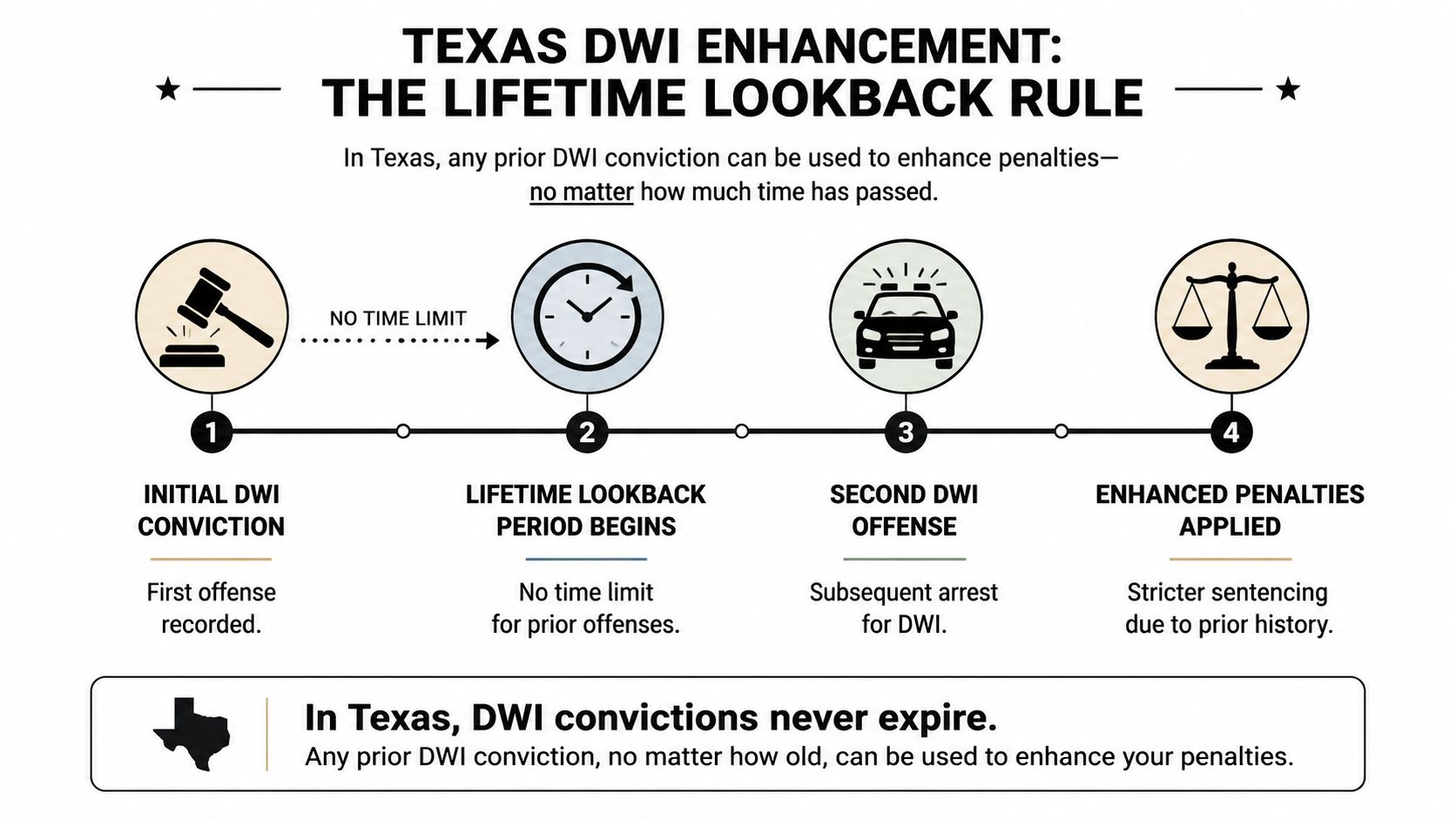
Texas applies one of the harshest enhancement systems in the country. The short version is simple. For many DWI enhancement purposes, Texas does not give old convictions an expiration date.
Under Texas Penal Code §49.09, Texas has a lifetime lookback rule for DWI priors. A prior from 30 years ago can count the same way as a much newer one, and Texas removed its previous 10-year remoteness rule in 2005. The rule applies to qualifying convictions on or after September 1, 1994, as explained in this discussion of Texas second DWI penalties and the no time-limit lookback rule.
Why old cases still matter
Many drivers expect DWI law to work like credit history. They assume enough time passes and the old case stops counting. Texas doesn't treat DWI priors that way.
If you had a DWI long ago, stayed out of trouble, and then got arrested again, the prosecutor may still use that old conviction to increase the level of the new charge. That's why the phrase DWI enhancement prior conviction Texas matters so much. The question isn't just whether you have a prior. The question is whether Texas law still allows the State to use it. In many cases, the answer is yes.
For a detailed overview of that rule, see this discussion of the Texas DWI lookback period.
Texas doesn't care that a prior DWI is old. The real legal fight is whether the old case qualifies and whether the prosecutor can prove it correctly.
The practical effect in court
The lifetime lookback rule changes negotiations, charging decisions, and trial strategy. A person who thought they were facing “just another misdemeanor” may suddenly be dealing with a more serious accusation because of something from decades ago.
That's also why felony exposure can appear sooner than people expect. If the State alleges enough qualifying priors, a new DWI may cross into felony territory. This overview of Felony DWI in Texas: Third Offense and Child Passenger explains when a Texas DWI becomes a felony charge.
What this rule does not mean
The lifetime lookback rule does not mean you should give up. It means you need a defense strategy built for enhancement issues, not a generic response to a first DWI in Texas.
A seasoned attorney looks at questions like these:
- Did the conviction qualify under the Texas statute?
- Can the State establish identity with admissible records?
- Was the prior conviction constitutionally sound, including the right to counsel where required?
- Is the current arrest independently defensible, regardless of the prior?
That's where repeat-case defense becomes technical, and that technical work often matters.
How Prior Convictions Escalate DWI Penalties
Enhancement changes the case in concrete ways. It affects charge level, mandatory minimum exposure, and often the pressure you feel from the start of the case.
For a DWI with one prior DWI conviction, Texas Penal Code §49.09(a) enhances the offense to a Class A misdemeanor and imposes a mandatory minimum jail term of 30 days, which is higher than the 72-hour minimum for a standard Class A offense, as outlined in this summary of Texas DWI penalty calculations.
Texas DWI penalties explained
Here's the cleanest way to understand the ladder of consequences:
| Offense Level | Criminal Charge | Jail Time | Fines | Driver's License Suspension |
|---|---|---|---|---|
| First DWI | Class B misdemeanor | Qualitatively lower than repeat-offense exposure | Qualitative penalties apply | DWI license suspension may be pursued through the administrative process |
| Second DWI | Class A misdemeanor | Mandatory minimum 30 days | Qualitative financial penalties apply | Longer suspension exposure than many first-offense cases |
| Third or subsequent DWI | Third-degree felony | 2 to 10 years in prison | Up to $10,000 | Suspension can reach up to 2 years |
The table shows the basic pattern. The jump from first to second isn't just a label change. The mandatory minimum jail term matters in plea negotiations, sentencing risk, and how urgently the defense must examine the prior case.
Criminal case and license case are separate
Many people focus only on the court date and miss the license problem. That's a mistake. A DWI arrest can trigger an administrative license suspension, which is separate from the criminal prosecution. The hearing used to challenge that suspension is commonly called an ALR hearing.
An ALR hearing can help in more than one way:
- It protects driving privileges when a suspension is being pursued.
- It creates early testimony from the arresting officer.
- It exposes weaknesses in the stop, arrest, or testing process.
If you need to fight DWI Texas cases effectively, you don't treat the ALR hearing as a side issue. You use it as an early discovery tool when the facts support that approach.
Definitions clients often ask about
Some terms get thrown around quickly after arrest. Here's what they mean in plain English:
- Implied consent means you've accepted the legal framework for chemical testing by driving on Texas roads after a lawful DWI arrest.
- BAC means blood alcohol concentration.
- Field sobriety test means roadside exercises officers use to claim they observed intoxication.
- Administrative license suspension means the state's separate action against your license, apart from the criminal case.
A repeat DWI case is never only about the old conviction. It's also about whether the police can prove the new arrest lawfully and reliably.
That distinction matters. Some cases are won by defeating the enhancement. Others are won by attacking the present case itself.
What Legally Counts as a Prior Conviction
Many people are often blindsided by this. Not every prior contact with the system counts. Some things do. Some things don't. The details matter.
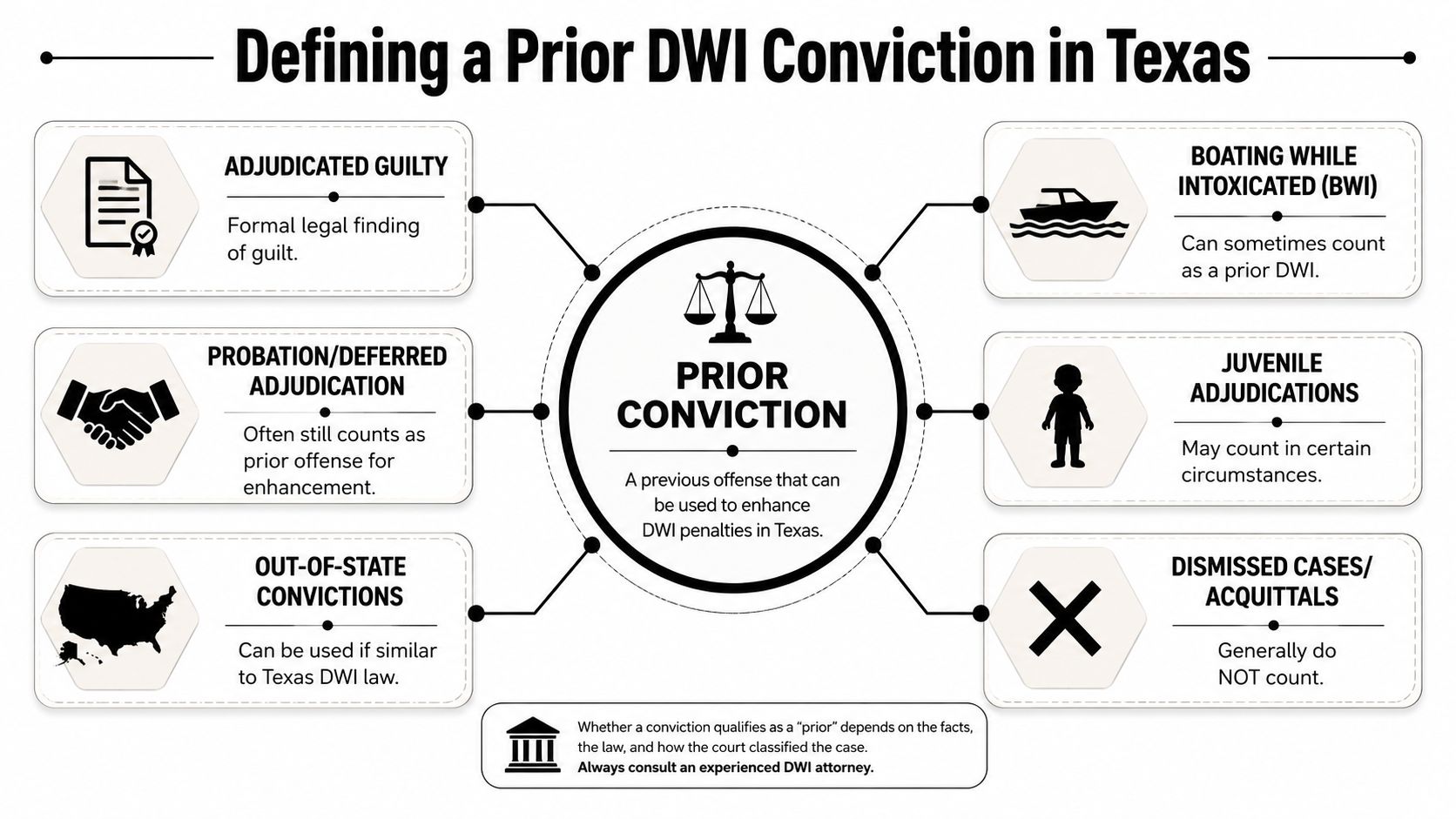
Texas law treats deferred adjudication community supervision for DWI as a conviction for enhancement purposes under §49.09(c), even though deferred adjudication is generally non-convictional for most other purposes. For out-of-state convictions, Texas applies a substantial-similarity analysis under §49.09(d), as explained in this discussion of second and third DWI felony enhancement in Texas.
Deferred adjudication catches many people off guard
A common misunderstanding goes like this: “I completed probation, the case was dismissed, so it can't be used against me.”
That logic doesn't hold for Texas DWI enhancement. A DWI resolved through deferred adjudication can still count as a prior for enhancement. If you're trying to understand how that works, this guide to deferred adjudication for Texas DWI cases gives useful background.
By contrast, a dismissed DWI charge does not count as a prior conviction for enhancement purposes, as noted in this explanation of the difference between first, second, and third DWI in Texas.
Out-of-state convictions can count
A prior from another state doesn't get ignored just because it happened outside Texas. Texas can use out-of-state DWI convictions if the foreign offense has elements substantially similar to the Texas statute. The prosecutor must prove that similarity and must prove the conviction with certified records, identity evidence, and the specific statute of conviction, as discussed in this review of how Texas uses out-of-state DWI convictions for enhancement.
That proof requirement matters. Similar names aren't enough. Incomplete records aren't enough. A lawyer should ask exactly what statute was involved and whether the elements match.
What usually qualifies and what usually doesn't
In broad terms, courts and prosecutors look at categories like these:
- Qualifying priors can include prior Texas DWI convictions, deferred adjudication DWI cases used as convictions for enhancement, and certain out-of-state impaired-driving convictions with substantially similar elements.
- Related intoxication offenses may also matter in some enhancement situations, including intoxication assault, intoxication manslaughter, and certain boating or flying while intoxicated convictions.
- Non-qualifying events can include dismissed cases, acquittals, and priors the State can't properly connect to the accused.
Key distinction: The label on the old case matters less than the legal elements, the final disposition, and the prosecutor's ability to prove identity.
This is one reason repeat cases deserve a close file review. Whether something “counts” is a legal question, not just a paperwork question.
Strategic Defenses Against DWI Enhancement
Enhancement allegations look intimidating on paper, but they can be challenged. A prosecutor doesn't win this issue by merely saying you have priors. The State has to prove them in a legally proper way, and that opens several defense paths.

One practical starting point is this: the defense reviews the enhancement documents as carefully as the arrest evidence. That means checking whether the State has a certified judgment, usable identity evidence such as fingerprints or photographs, and the underlying statute needed for any substantial-similarity analysis. If that proof is weak, the enhancement may fail.
For readers comparing defense approaches, this overview of how lawyers beat DWI cases in Texas gives a helpful look at the broader toolbox used in these cases.
Documentation and identity challenges
Texas prosecutors often rely on a certified pen packet to prove prior convictions. If the packet is incomplete, if the identity evidence doesn't clearly tie the old case to you, or if the records are not admissible, the enhancement can be attacked.
These are common pressure points:
- Bad identity linkage. Similar names are not enough. The State should be able to connect the prior conviction to the correct person with reliable evidence.
- Missing or weak records. If the judgment is incomplete or the records don't establish the necessary facts, the enhancement may not hold.
- Wrong statute problem. In an out-of-state case, the prosecutor must show the foreign law is substantially similar to Texas law.
Constitutional attacks on the prior
Not every old conviction is usable forever. If the prior was obtained in violation of constitutional rights, the defense may challenge its use for enhancement. One example is a prior conviction where the defendant was denied counsel in a way that makes the enhancement invalid.
That kind of attack requires careful record review. It won't exist in every case, but when it does, it can change the charge level dramatically.
A good repeat-offense defense also attacks the current case. That means testing the legality of the stop, the officer's basis for arrest, the reliability of field sobriety tests, and any breath or blood evidence. A weak current case remains weak even if the prosecutor alleges an old prior.
Here's a useful explanation of courtroom strategy in repeat cases:
The Oliva rule matters in second-offense cases
There is also an important trial rule many people don't know. Under the 2018 Texas Court of Criminal Appeals ruling in Oliva v. State, a single prior DWI conviction is a punishment-only issue and cannot be admitted during the guilt-innocence phase of a trial for a second DWI offense. That means the jury deciding whether you were intoxicated in the current case should not hear about that one prior during the guilt phase, as explained in this discussion of Oliva and why a prior DWI is not an element at guilt-innocence.
That rule creates real strategic value. If the case is tried correctly, the defense can fight the central question of intoxication without the jury being primed by prior-record evidence.
When a prior is kept out of the guilt phase, the case often becomes what it should have been from the start. A contest over the evidence from this arrest.
That doesn't guarantee a win. It does protect fairness, and fairness matters in close cases.
Protecting Your Future After a DWI Arrest
A repeat DWI allegation in Texas is serious, but serious doesn't mean hopeless. The law is complicated enough that small details can change the outcome. Whether the issue is a deferred adjudication, an out-of-state conviction, a flawed pen packet, or a weak stop, the right defense starts with getting specific about the facts.
Your next steps should be practical.
- Stop talking about the case with police, coworkers, or on social media.
- Keep documents and dates from the arrest, bond paperwork, towing records, and any notices about your license.
- Write down what happened while your memory is still fresh, including the stop, the testing, and what the officer said.
- Speak with counsel quickly so the criminal case and the license case can be evaluated together.
If you're worried about a first DWI in Texas turning into something more because of your history, or you need a Houston DWI lawyer or Texas DUI attorney to evaluate whether the alleged prior qualifies, early action matters. The same is true if your priority is protecting your license, reducing exposure, or building a strategy to fight DWI Texas charges in court.
You don't need to guess your way through enhancement law. You need a grounded review of the old case, the new arrest, and the options that fit your record and your goals.
If you're facing a repeat DWI allegation and need answers about enhancement, prior convictions, deferred adjudication, or DWI license suspension risk, request a free consultation with Law Office of Bryan Fagan, PLLC. Our team helps Texans review the arrest, challenge the prior when the law allows it, and build a strategy for court and ALR issues with clear, practical guidance.