 Skip to content
A DWI arrest can be overwhelming, but you don't have to face it alone.
You may be sitting at home after release on bond, staring at paperwork, trying to answer one question: does that old DWI still count? Many people are shocked to learn that a conviction from years ago can suddenly become the center of a new case. That surprise often changes how they think about plea offers, license issues, and whether they need a Houston DWI lawyer or Texas DUI attorney right away.
The confusion gets worse because a DWI case in Texas often splits into two tracks. One is the criminal case. The other is the license case with the Department of Public Safety. If you don't understand how those tracks work together, it's easy to miss deadlines or overlook defenses that matter.
Facing a DWI Arrest in Texas
A man gets stopped on his way home from work in Harris County. He thinks the case is serious, but manageable. Then he learns the state is looking at a DWI from decades ago. He hasn't had trouble since then, and he assumed the old case had faded away. It hadn't.
That's the moment many people realize the Texas DWI lookback period works very differently from what they expected. A prior case that felt buried can change the charge level, the bond conditions, and the risk to your license.
If you've been arrested for DWI in Texas, the first step is getting clear on what the state is trying to prove. Prosecutors don't just look at what happened during the latest stop. They also examine your record for prior convictions they can use to increase punishment.
Old doesn't always mean unusable. In Texas, the age of a prior DWI is often not the main issue. The real questions are whether the record is valid, whether the state can prove it's yours, and whether it legally qualifies.
That matters because the defense strategy may start long before trial. Your lawyer may need to review court files, compare statutes, request driving records, and challenge how a prior offense is being counted. If you're dealing with a first DWI in Texas, your approach may look very different than if the state claims you have one or more prior convictions.
Defining the Lookback Period in Texas
The simplest definition is this. The lookback period is the amount of time the state can look into your past to use a prior DWI against you in a new case.
In Texas, that period has no set end point for DWI enhancement. Texas has no statutory lookback period for DWI enhancements, meaning any prior DWI conviction, regardless of how many decades old, counts toward elevating a current charge. The state repealed its former 10-year lookback provision in 2003 according to Texas DWI Site's explanation of second DWI enhancement rules.
The legal terms that matter
A few phrases cause the most confusion.
- Predicate offense means an earlier offense the state uses as a building block to increase the charge or punishment in the new case.
- Enhancement means the prosecution uses that earlier offense to raise the stakes in the current case.
- BAC stands for blood alcohol concentration. It's a measurement used in many DWI investigations.
- Implied consent means that by driving on Texas roads, you are considered to have agreed to provide a breath or blood specimen in certain lawful DWI investigations. Refusing can trigger a separate license problem.
- Field sobriety test refers to roadside tests officers use to claim a driver showed signs of intoxication.
- Administrative license suspension or ALR refers to the civil process that can suspend your license apart from the criminal case.
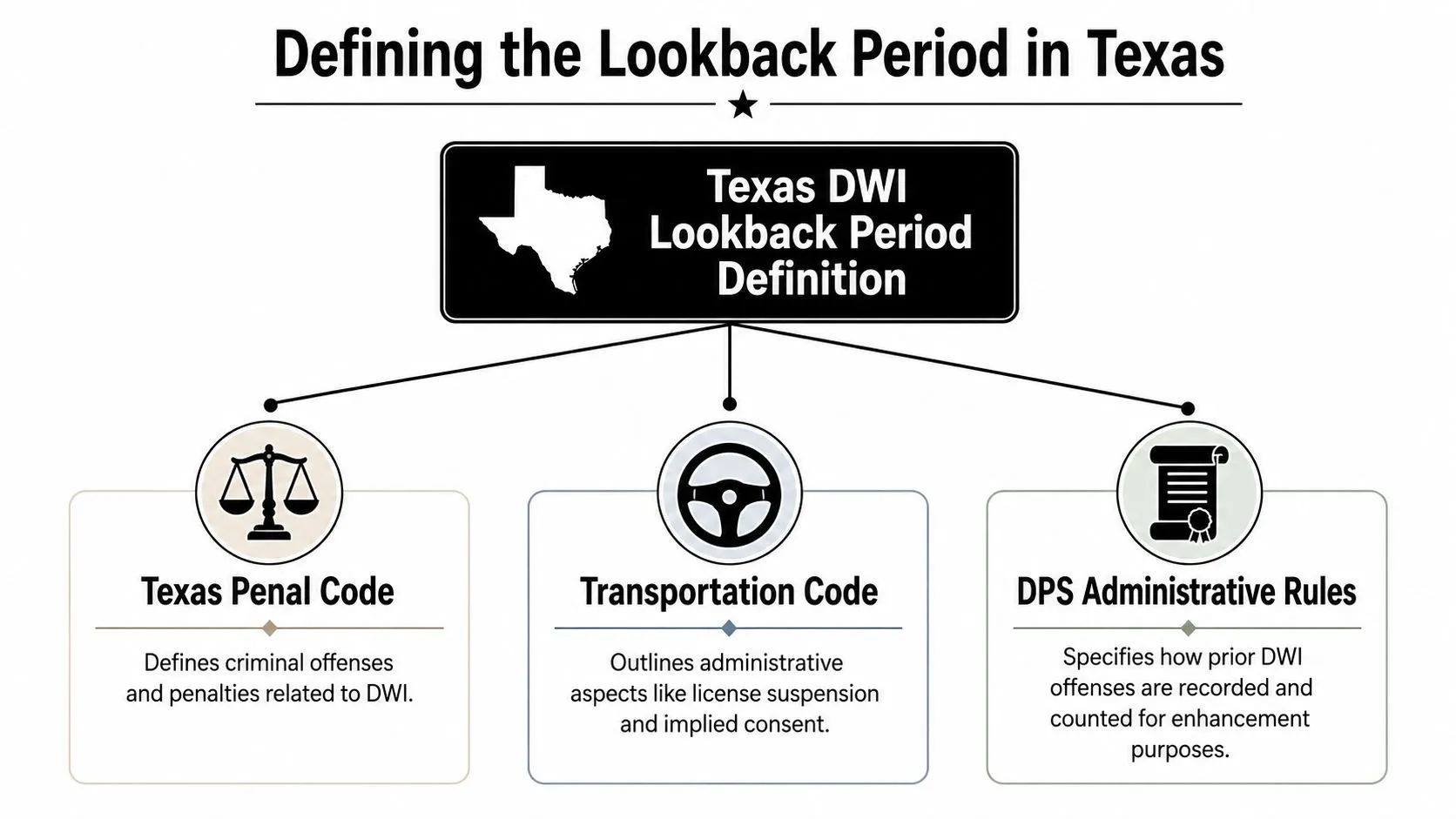
Those terms connect because Texas handles DWI through more than one legal system at once. The Texas Penal Code addresses the criminal offense and punishment. The Transportation Code governs major license consequences, including implied consent and DWI license suspension issues. DPS procedures affect how license actions are processed and tracked.
Why the 2003 change still matters
Before 2003, Texas had a washout rule. After the repeal, the state stopped using a fixed time cutoff for DWI enhancement. That's why an old conviction can still appear in a modern prosecution.
That doesn't mean every old record is automatically valid. It means the defense can't rely on age alone. Instead, the focus shifts to proof, identity, admissibility, and legal similarity.
For readers trying to understand when repeat allegations become much more serious, Felony DWI in Texas: Third Offense and Child Passenger gives a factual overview of when a Texas DWI becomes a felony charge.
Practical rule: The word "lookback" makes people think Texas only checks a recent window of time. For DWI enhancement, that's not how Texas works.
How Prior Convictions Affect Sentencing and Licenses
A prior DWI doesn't just change a label on paper. It can alter the court's view of bond conditions, affect whether ignition interlock becomes part of the case, and increase the risk tied to a plea.
One key point is settled. Under Texas's lifetime lookback, a DWI from 30 years ago carries the same weight as a recent conviction, making a third offense a third-degree felony punishable by 2 to 10 years in prison and up to $10,000 in fines according to The Texas Trial Attorney's discussion of DWI lookback and limitations.
The sentencing effect in plain English
Think of prior convictions like steps on a ladder. The current arrest is the event in front of you, but the state says your past determines which rung you're standing on.
If prosecutors claim one prior qualifying conviction, they may seek repeat-offense treatment. If they claim two prior qualifying convictions, the case may be filed as a felony. That is why a defense lawyer studies the prior cases as closely as the current stop.
Here is a simple comparison:
| DWI Enhancement Thresholds | Offense Level | Potential Penalties |
|---|---|---|
| No prior convictions alleged | Misdemeanor level case | Penalties depend on the facts of the present case |
| One prior conviction alleged | Higher misdemeanor exposure | Penalties increase and license consequences often become harder to manage |
| Two prior convictions alleged | Third-degree felony | 2 to 10 years in prison and up to $10,000 in fines |
For a broader discussion of repeat-charge treatment, see multiple DUI offenses in Texas.
The license side of the case
People often think the criminal court decides everything. It doesn't. A DWI arrest can also trigger an administrative license suspension, often called an ALR case. That process deals with your driving privilege, not guilt or innocence in the criminal case.
An ALR hearing is where your lawyer may challenge the stop, the arrest basis, or the officer's request for testing. Sometimes that hearing also helps the defense learn facts early through officer testimony. That's useful even though the criminal enhancement question is separate.
A few related terms matter here:
- Implied consent means Texas can seek license consequences when a driver refuses or fails a lawful breath or blood test process.
- Administrative license suspension means DPS may suspend your license through a civil process tied to the arrest.
- Ignition interlock device means a court may require a device that must be cleared before the vehicle starts.
The criminal case asks whether the state can convict you. The ALR case asks whether the state can suspend your license. They often overlap in facts, but they aren't the same fight.
For commercial drivers, licensed professionals, and people who drive for work, this split process can feel especially harsh. Even before trial, a DWI license suspension problem can affect employment, transportation, and daily routines.
Calculating Lookback with Step by Step Examples
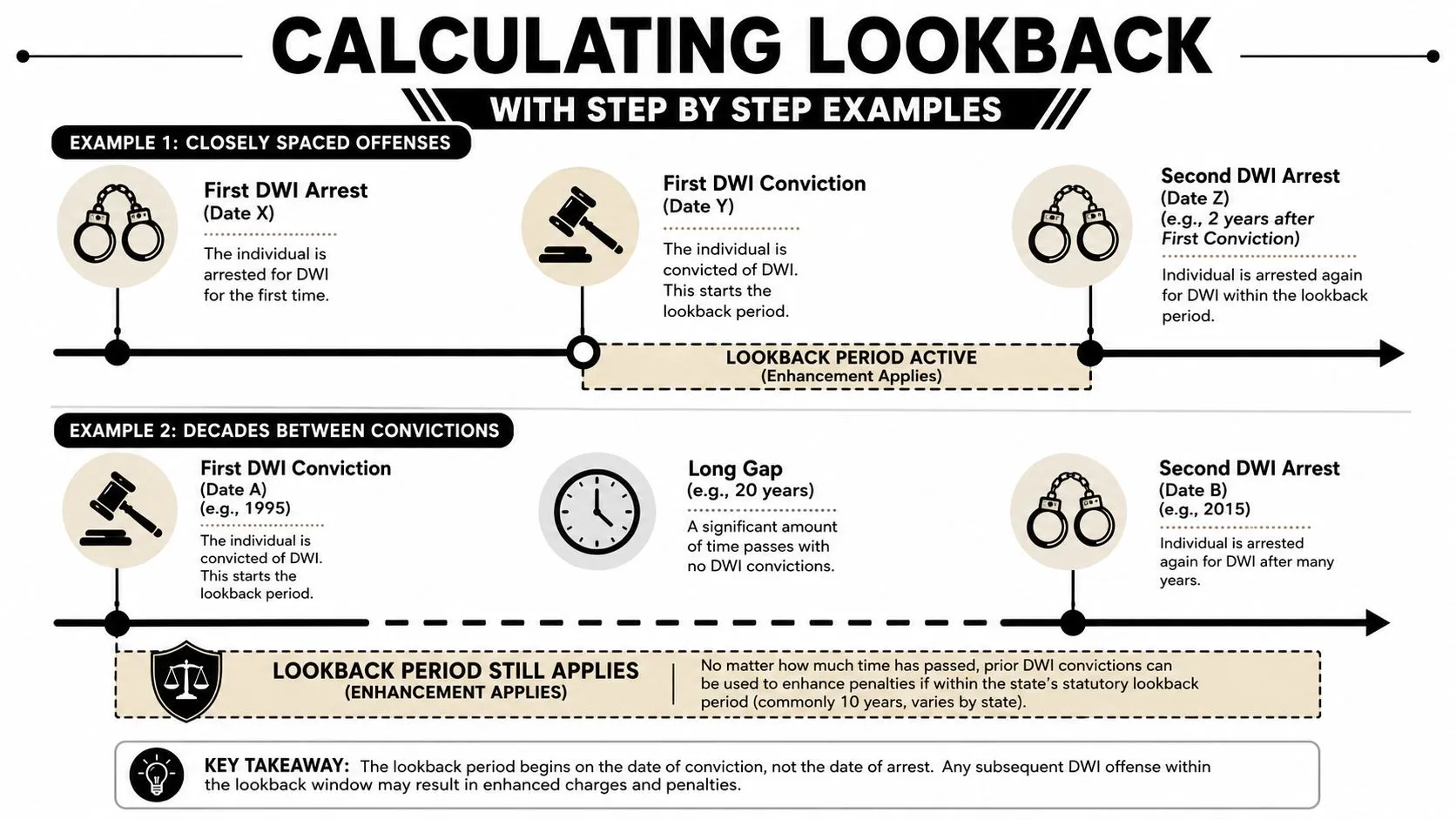
The easiest way to understand the Texas DWI lookback period is to build a timeline. Dates matter. So do conviction records. What surprises many people is that the gap between cases may be huge, yet the prior offense may still count.
The lifetime lookback rule was solidified after the repeal of the 10-year washout in 2003, so a 1998 DWI still counts toward any later offense according to this Texas third-DUI explanation.
Example one with a shorter gap
Start with a simple timeline.
- You are convicted of a first DWI.
- A few years later, you're arrested again for DWI.
- The prosecutor checks for a prior conviction.
- If the prior conviction is valid and provable, the new case may be treated as a repeat offense.
The short gap doesn't usually create confusion. A recent prior is typically expected to matter. The legal work often focuses on whether the stop was lawful, whether the BAC evidence is reliable, whether field sobriety testing was administered correctly, and whether the prior conviction paperwork is accurate.
Example two with a long gap
Now take a more surprising timeline.
- A person has a DWI conviction from 1998.
- There is a long period with no new DWI cases.
- Years later, the person is arrested again in Texas.
- The old conviction may still be used for enhancement because Texas doesn't apply the former washout rule anymore.
A common question from readers is, "Can they really use something that old?" In Texas, the answer can be yes. But "can use" doesn't mean "will successfully prove."
The defense may ask:
- Is the record complete
- Can the state prove the conviction belongs to you
- Was the prior judgment legally valid
- If the prior came from another jurisdiction, do the legal elements match Texas law
A remote conviction often creates a paperwork case inside the DWI case. Older records can raise identity issues, certification problems, and legal mismatch questions.
That is why your own timeline should include more than arrest dates. Include conviction dates, court locations, the exact offense name, and whether the prior case was in Texas or another state.
Exceptions and Special Situations
The hardest DWI cases usually involve records that don't fit neatly into one box. A prior case may look minor, administrative, or distant. It may still affect enhancement analysis.
Deferred adjudication for a prior DWI is treated as a conviction for enhancement purposes under Texas Penal Code §49.09, and Texas retains all DWI convictions on your driving record permanently unless sealed according to this discussion of how long driving offenses stay on a Texas record.
A checklist for tricky lookback issues
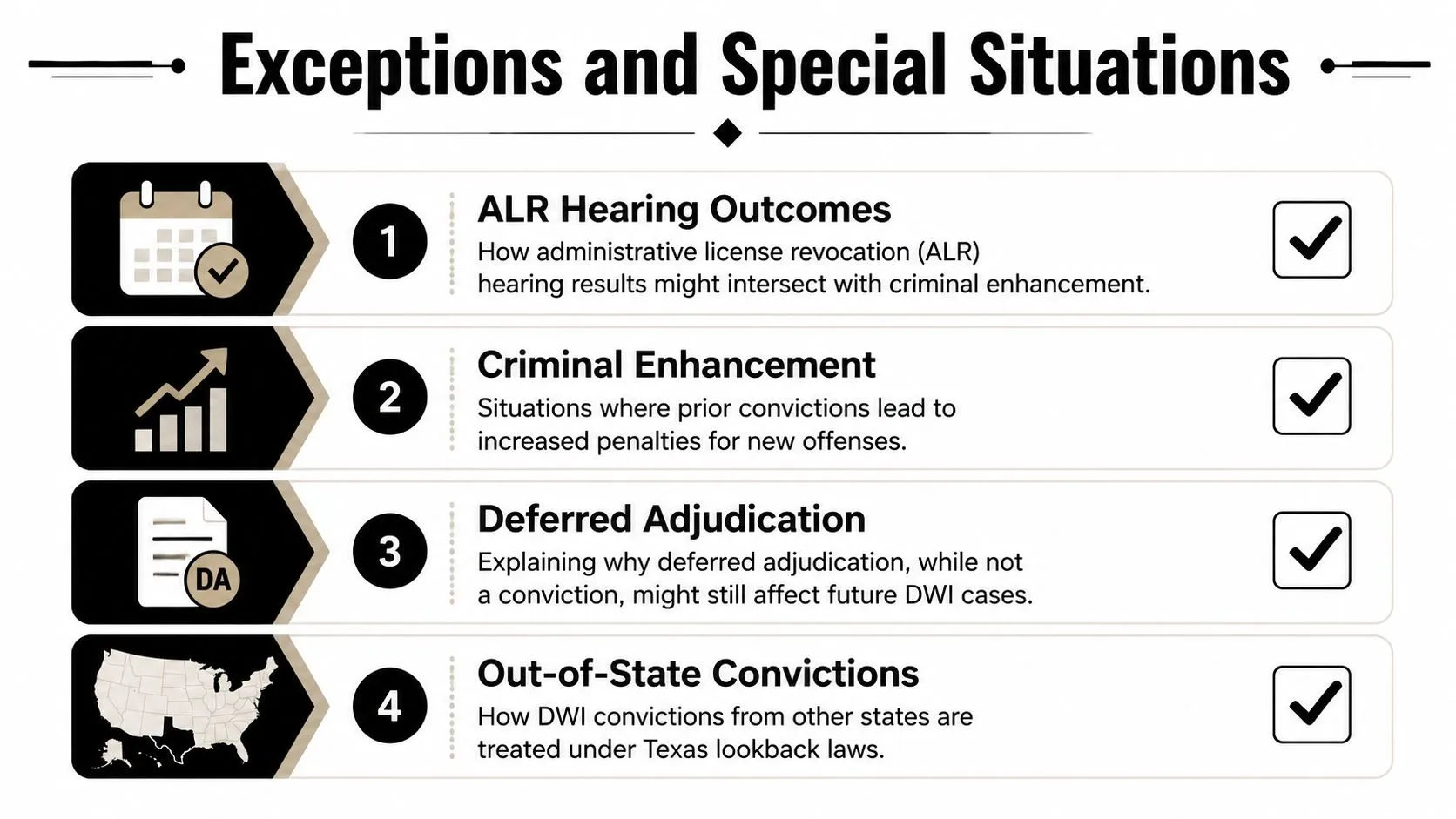
ALR outcomes and criminal enhancement
Winning an ALR hearing can help protect your license or expose weaknesses in the officer's account. But it doesn't automatically erase the criminal case or remove a prior conviction from enhancement analysis.Deferred adjudication
Many people think deferred adjudication means the case won't count later. For DWI enhancement, that assumption can be dangerous.Permanent driving record issues
A DWI can remain on your driving record unless a court grants sealing or expungement where allowed. That means records may stay visible much longer than drivers expect.Out-of-state convictions
A prior DUI from another state may be used if the offense matches Texas law closely enough. That comparison is legal, not just clerical.
Why these situations matter to the defense
The key isn't just whether a prior appears on a background check. The key is whether prosecutors can lawfully use it in court.
An ALR result may affect your practical driving situation right away. A deferred case may affect enhancement later. An out-of-state prior may require a statute-to-statute comparison. A sealed or expunged matter may raise different questions about access and use.
Don't assume a prior case is harmless because it was old, from another state, or resolved without a traditional conviction. Those are exactly the records a defense lawyer should examine carefully.
Potential Defenses and Practical Next Steps
The defense in a lookback case often starts with documents, not drama. Your lawyer may challenge whether the prosecution has the right judgment, the right person, the right statute, and the right legal basis to use the prior case at all.
One example shows why that work matters. Texas uses out-of-state DWI convictions to enhance penalties with no temporal limit, so a 1995 California DUI can trigger felony charges here if it matches Texas law elements according to Texas DWI Site's explanation of out-of-state enhancement.
A practical response often includes these steps:
- Request your records early. Get your DPS driving history and any court paperwork you can locate.
- Prepare for the ALR deadline. That hearing can affect your license and create valuable testimony.
- Review prior cases one by one. A valid defense may come from record defects, identity problems, or element mismatch.
- Plan for mobility. If your license is at risk, learn whether an occupational license in Texas may help you keep working and handling daily obligations.
If you need legal help evaluating those records, the Law Office of Bryan Fagan, PLLC handles DWI defense matters involving ALR hearings, repeat-offense allegations, and record review in courts across Texas.
If you're facing a DWI charge and worried about an old conviction, you don't have to sort through the Texas DWI lookback period on your own. A careful review of your arrest, your prior record, your ALR timeline, and any out-of-state history can make a real difference in how your case is charged and defended. Contact Law Office of Bryan Fagan, PLLC to request a free consultation or case evaluation and get clear guidance from a Texas team that helps clients fight DWI Texas cases in Houston, DFW, Austin, San Antonio, and beyond.

