 Skip to content
A DWI arrest can be overwhelming, but you don't have to face it alone.
If you're reading this after being released from jail, looking at bond papers, or trying to figure out what a test result means, you're probably dealing with two feelings at once. Stress about what could happen next, and confusion about how Texas treats a DWI tied to a high alcohol reading.
A driving while intoxicated BAC 0.15 case is serious in Texas, but serious doesn't mean hopeless. It does mean you need clear information, quick action, and a defense strategy built around the actual facts of your case. That includes the traffic stop, the field sobriety test, the breath or blood result, the county where the case was filed, and the deadlines that start running right away.
What a DWI with a BAC of 0.15 Means for You
The initial question is simple. “How bad is this?”
If the police or the lab says your BAC, or blood alcohol concentration, was 0.15 or higher, your case is treated more harshly than a standard first DWI in Texas. BAC is the measurement used to estimate the amount of alcohol in your breath, blood, or urine. In plain terms, it's the number the State uses to argue that alcohol affected your ability to drive.
That number matters because the law treats 0.15 as a line that changes the case, not just a slightly higher reading. National crash-risk studies show that drivers with a 0.15% BAC are at least 12 times more likely to be involved in a fatal crash than sober drivers, which helps explain why lawmakers and courts treat this level as especially dangerous, according to NHTSA's drunk driving overview.
Why readers often get confused
Many people assume there are only two categories:
- Under the limit
- Over the limit
Texas law is more layered than that. A DWI accusation can involve the officer's observations, field sobriety testing, and chemical testing. Once a reported BAC reaches the enhanced range, the legal consequences usually become more aggressive.
That doesn't mean the result is beyond challenge. It means your lawyer has to look closely at how the number was produced and whether it should hold up in court at all. Timing, absorption, testing procedures, and rising alcohol issues can matter, which is why it helps to understand how alcohol absorption rates affect DWI cases in Texas.
Practical rule: Don't assume a high number ends the case. It changes the stakes, but it also sharpens the defense focus.
What you should focus on first
Right now, the most helpful mindset is this:
- Treat the case seriously
- Preserve every document
- Stop talking about the arrest with anyone except your lawyer
- Act quickly on the license side of the case
People often lose ground by waiting. The better approach is to get oriented, learn what the State must prove, and make decisions early.
Texas DWI Law and the 0.15 BAC Enhancement
Texas starts with a basic DWI framework, then adds consequences when certain facts are present. A reported BAC of 0.15 or higher is one of those facts.
In Texas, a breath, blood, or urine BAC of 0.15 or higher at the time of arrest automatically reclassifies a standard Class B misdemeanor DWI under Penal Code § 49.04(a) into a Class A misdemeanor offense under § 49.04(d), irrespective of prior criminal history, as explained in this discussion of what a DWI 0.15 means under Texas law.

What that legal change means
Picture a speed limit zone. Driving one mile per hour faster doesn't always create a new legal category. But once you cross a posted line, the law treats you differently. In a Texas DWI case, 0.15 is that line.
For many readers, the most important point is this: even if it's your first DWI in Texas, the charge can still move into a more serious misdemeanor category because of the BAC result alone.
Here's a simple comparison:
| Charge level | BAC range involved | General classification |
|---|---|---|
| Standard DWI | 0.08 to 0.14 range | Usually Class B misdemeanor |
| Enhanced high-BAC DWI | 0.15 or higher | Class A misdemeanor |
That's the legal reason a high BAC case often feels very different from what friends or online forums describe about a typical first offense.
Key terms you need to know
A few definitions make the rest of the process easier to understand:
- BAC means blood alcohol concentration. It's the number reported from a breath, blood, or urine test.
- Field sobriety test means roadside exercises officers use to claim they observed signs of intoxication. These aren't chemical tests. They are coordination and attention tasks.
- Implied consent means that by driving on Texas roads, you're considered to have agreed to provide a breath or blood specimen if lawfully requested after a DWI arrest. Refusing can trigger separate license consequences.
- Administrative license suspension means the civil process that can suspend your license apart from the criminal court case.
Why the 0.15 threshold creates strategic issues
A reported result at or above 0.15 often pushes the defense toward technical scrutiny. The exact test method matters. So does machine maintenance, operator procedure, blood handling, and the timeline between driving and testing.
For a broader explanation of how those levels affect the charge itself, see Texas DWI BAC Levels and Enhanced Charges.
A BAC allegation is not just a medical fact. In court, it is evidence. Evidence can be tested, challenged, and sometimes excluded.
Harsher Penalties for a High BAC DWI Charge
Once the case moves from a Class B to a Class A misdemeanor, the possible punishment changes in ways that affect daily life fast.
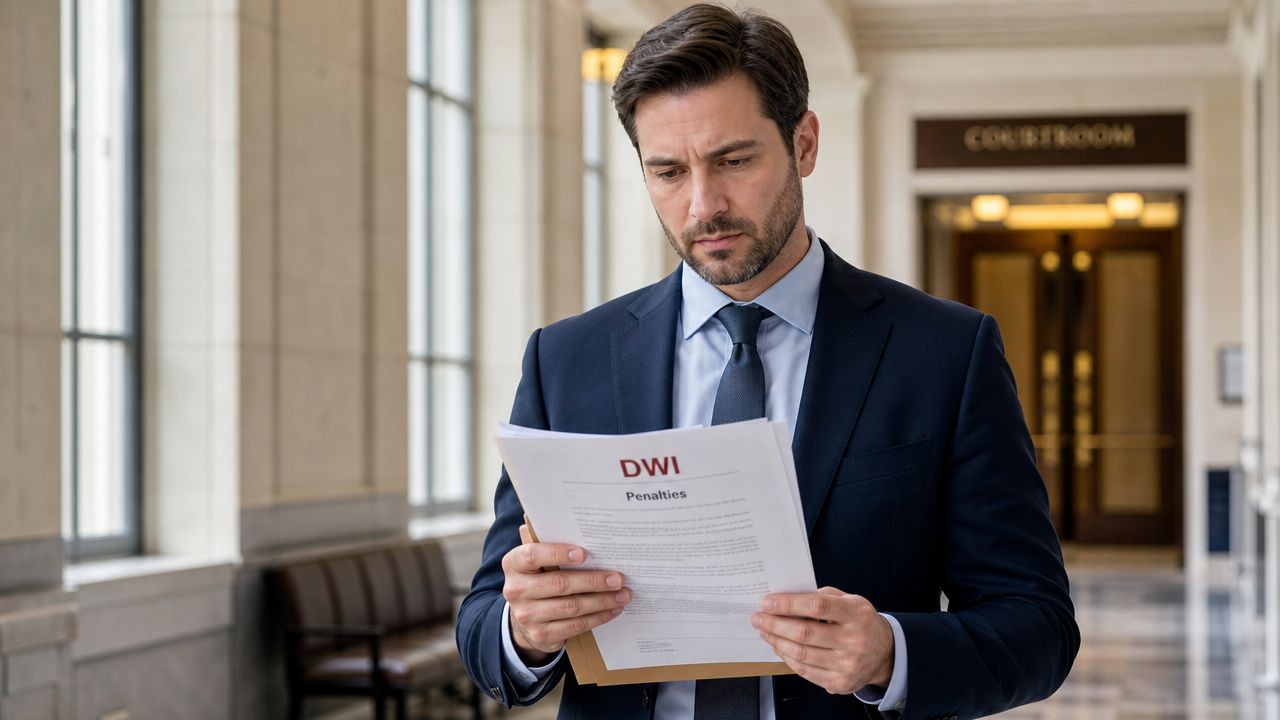
In Texas, a standard Class B DWI carries up to 180 days in jail and a $2,000 criminal fine, while a DWI with a BAC of 0.15 or higher carries up to 365 days in jail and a $4,000 fine under the enhanced Class A framework, as described in the same Texas DWI 0.15 legal discussion linked earlier. That same source also notes that even a first-time case at this level generally increases the likelihood of conditions such as an ignition interlock requirement.
A side by side view
| Issue | Standard DWI | DWI with BAC 0.15 or higher |
|---|---|---|
| Charge level | Class B misdemeanor | Class A misdemeanor |
| Maximum jail exposure | Up to 180 days | Up to 365 days |
| Maximum criminal fine | $2,000 | $4,000 |
| Court posture | Baseline first-offense framework | Enhanced penalty framework |
The numbers matter, but so do the practical conditions attached to the case. High BAC accusations often lead judges and prosecutors to push for tighter bond terms, alcohol classes, and interlock conditions.
What an ignition interlock device is
An ignition interlock device, often shortened to IID, is a breath-testing device installed in a vehicle. The driver must provide a breath sample before the vehicle will start and sometimes during use. Courts may require it as a condition of bond or probation.
That requirement can affect work, family routines, and transportation planning even before the criminal case is fully resolved.
Why the law treats 0.15 differently
The legal system isn't treating 0.15 as a random line. It reflects a policy judgment tied to roadway danger. As noted earlier, crash-risk research cited by NHTSA says a driver at 0.15% BAC is at least 12 times more likely to be involved in a fatal crash than a sober driver.
Higher BAC cases are often prosecuted with the assumption that the facts are worse. Your defense has to challenge assumptions, not just charges.
Consequences beyond the sentence
A conviction can also create problems that don't fit neatly into a sentencing chart:
- Driving restrictions: Your ability to commute, take children to school, or get to medical appointments may be affected.
- Employment concerns: Some jobs react strongly to alcohol-related driving charges, especially if driving is part of the work.
- Professional licensing issues: Nurses, teachers, commercial drivers, and other licensed professionals may face separate reporting concerns.
- Record impact: Even when jail is avoided, the existence of the case can continue to affect your future.
That's why a Texas DUI attorney looks at the whole picture, not just the courtroom penalty range.
The Two Battles You Face DWI Criminal Case and ALR Hearing
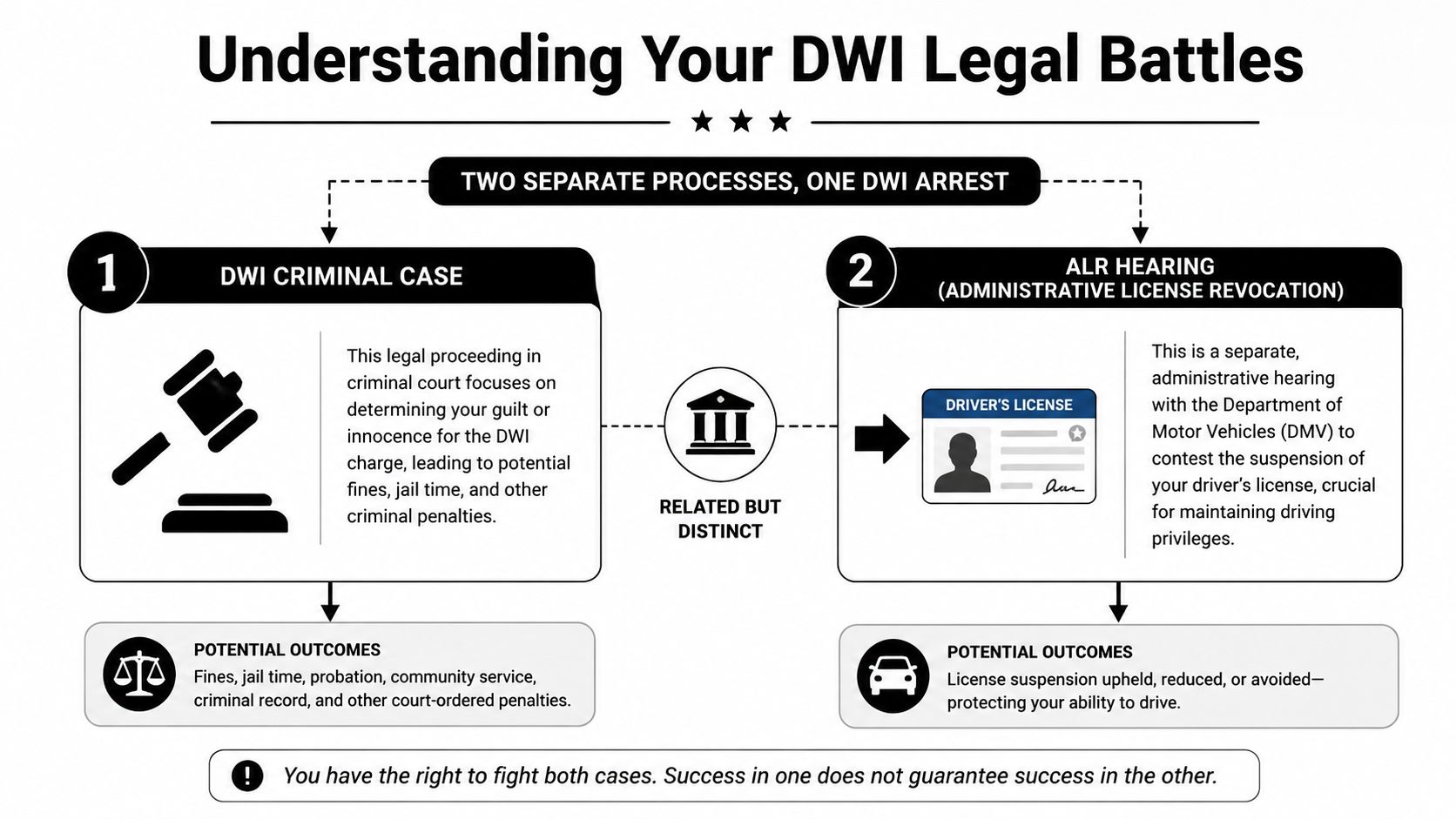
A lot of people think they have one DWI case. In reality, they often have two separate fights moving at the same time.
A DWI arrest in Texas with a BAC of 0.15 or higher initiates two separate legal processes: the criminal case and the administrative license suspension proceeding, and the license side has a strict deadline to request a hearing to contest the suspension, according to this explanation of Texas high-BAC DWI and the ALR process.
The criminal case
The criminal case is the one filed in court. That's where the State tries to prove you were intoxicated while operating a motor vehicle in a public place. The criminal court decides issues like guilt, plea terms, probation conditions, jail exposure, and fines.
That process usually involves:
- Arrest and booking
- Bond conditions
- Court settings
- Discovery and evidence review
- Negotiations, motions, or trial
The ALR hearing
The other track is the administrative license suspension, often called ALR. This is not the criminal prosecution. It is a civil process involving your driving privileges.
If you failed a test or refused one, the Department of Public Safety can move to suspend your license. According to the same high-BAC ALR explanation, if the suspension is triggered after arrest, it typically becomes effective 40 days after arrest and usually lasts 90 days for a first-time offense, while refusal can lead to a longer suspension period.
Why implied consent matters here
Implied consent is a key part of the ALR system. In plain language, Texas says that by driving on public roads, you've already agreed to provide a specimen if law enforcement lawfully requests one after a DWI arrest.
That does not mean officers can ignore procedure. It does mean your decision to provide or refuse a sample can trigger separate license consequences even before the criminal case is resolved.
If you ignore the ALR side, you can lose your license even while the criminal case is still in its early stages.
A simple roadmap after arrest
Here's how many cases unfold in practice:
| Stage | What happens | Why it matters |
|---|---|---|
| Arrest | Officer makes the DWI arrest and gathers evidence | Starts both the criminal and license issues |
| Bond release | Court or magistrate sets conditions | You may face travel, alcohol, or IID restrictions |
| ALR deadline | You must act quickly to contest suspension | Missing the deadline can cost your license |
| Court settings | Criminal case begins moving through court | This is where defense strategy develops |
What to do right away
Some steps help almost every person facing a DWI license suspension issue:
- Save paperwork: Keep the notice of suspension, bond papers, towing information, and any temporary permit.
- Request help early: A lawyer can evaluate both the criminal file and the license side before deadlines pass.
- Prepare for limited driving needs: If suspension becomes an issue, you may need information about a restricted license option. This guide on ALR hearing cross-examination in Texas also helps explain how the administrative process is challenged.
- List practical needs: Write down work hours, school obligations, child-care duties, and medical appointments. Those details matter if restricted driving becomes necessary.
A field sobriety test, by the way, is separate from all of this. It refers to the roadside exercises the officer used during the investigation. Those tests can become important in both the criminal case and the ALR hearing because they often appear in the officer's report and body camera video.
How a Houston DWI Lawyer Can Fight Your 0.15 Charge
A high BAC allegation may feel final when you first see it on paper. It isn't.
The prosecution still has to prove that the stop was lawful, the investigation was handled properly, and the chemical result is reliable enough to be admitted and believed. A Houston DWI lawyer or Texas DUI attorney should examine each link in that chain, because one weak link can change the outcome.

The stop and the roadside investigation
Every DWI case starts with police contact. The first legal question is often whether the officer had a valid reason to stop your vehicle or detain you.
A defense lawyer may ask:
- Was there actual reasonable suspicion for the stop?
- Does the dash cam match the written report?
- Did the officer overstate poor driving or omit helpful facts?
- Were the field sobriety tests given correctly?
Field sobriety tests are often presented as objective, but they depend heavily on instructions, conditions, footwear, lighting, surface quality, and the officer's interpretation.
The chemical test result
The next major issue is the breath or blood evidence. In many high BAC cases, the defense focuses here because the reported number drives the enhancement itself.
A lawyer may investigate:
- Breath machine maintenance
- Calibration and operator records
- Observation period issues
- Mouth alcohol or contamination concerns
- Blood draw procedures
- Sample handling and chain of custody
For readers trying to understand that angle in more detail, this guide on breathalyzer calibration errors in Texas DWI defense shows why a machine reading isn't automatically the end of the story.
Here's a helpful overview of how defense strategy can work in real cases:
County matters more than most people realize
This is one of the biggest gaps in online DWI content. Statewide law tells you the charge level, but it doesn't tell you how your specific courthouse may handle it.
Most online guides discuss the statewide law but fail to explain how prosecutorial discretion and local court trends in different Texas counties, like Harris versus Travis, can lead to vastly different outcomes for the exact same 0.15+ BAC charge, making local expertise essential, as noted in this discussion of Texas impaired driving enforcement realities.
That matters because outcomes often turn on local practices such as:
- Plea policies: Some offices are more flexible than others.
- Interlock expectations: Judges vary in how routinely they require IID conditions.
- Diversion access: Availability can differ by county and courtroom.
- Motion practice culture: Some courts litigate technical issues more actively than others.
The same charge on paper can play out very differently depending on where it was filed and who is handling it.
Building a strategy instead of reacting
A strong defense isn't just about denying everything. It's about deciding where the key pressure points are.
Sometimes the best path is attacking the stop. In another case, the right move is challenging the test result. In another, the priority may be protecting your driver's license, avoiding jail, or positioning the case for a reduction.
If you're trying to fight DWI Texas charges effectively, your lawyer should be evaluating all of these questions early:
- Can the stop be challenged?
- Can the BAC evidence be weakened or excluded?
- What does this county usually do with high-BAC first-offense cases?
- Is there a path to reduction, dismissal, deferred resolution, or a more manageable outcome?
The Law Office of Bryan Fagan, PLLC handles Texas DWI defense matters that include chemical-test challenges, ALR hearings, and criminal court representation, which are the main pressure points in a 0.15 case.
If this is your first DWI in Texas, the stakes are still high, but there may be defenses and negotiated options that aren't obvious from the arrest paperwork alone.
Take Control of Your Future and Protect Your Rights
A high-BAC DWI charge can leave you feeling like the system has already decided your future. It hasn't.
What matters now is how quickly and carefully you respond. A driving while intoxicated BAC 0.15 allegation in Texas can mean a Class A misdemeanor charge, tougher penalties, a separate DWI license suspension problem, and pressure from both the court and DPS. But it also creates a clear defense roadmap. Review the stop. Review the field sobriety test. Review the chemical test. Review the county-specific realities.
If you've been arrested, focus on what you can control:
- Protect your deadlines
- Preserve documents and evidence
- Avoid statements that can be used against you
- Get case-specific legal advice early
You don't need to know every statute before you ask for help. You just need to take the next smart step. A seasoned Texas DUI attorney can explain where your case stands, what risks are immediate, and what options may be available to reduce the damage.
Some people need help with the license side first. Others need a plan for bond conditions, work concerns, or the possibility of protecting a record later through options such as expunction-related relief if the law allows. What matters is getting advice tied to your facts, your county, and your goals.
If you're facing a high-BAC DWI charge, request a free consultation with Law Office of Bryan Fagan, PLLC. You can get clear answers about your criminal case, your ALR hearing, your options for a first DWI in Texas, and the steps available to protect your license, record, and future.

