
Receiving a traffic ticket can be a frustrating experience. Your first instinct might be to pay it and move on, but that simple act is legally an admission of guilt. Paying the fine puts a conviction on your driving record, and that's where the real trouble can start. A conviction often means points on your license, an unwelcome surprise on your next insurance bill, and sometimes even state-imposed surcharges.
But you don't have to face this alone, and you have options. One of the most powerful tools available in Texas is pursuing a deferred adjudication traffic ticket.
What a Deferred Adjudication Traffic Ticket Means for You

Think of deferred adjudication as a formal agreement with the court. It’s a chance for you to prove you are a safe and responsible driver. Under this arrangement, you agree to a probationary period with specific conditions set by the judge.
If you maintain a clean driving record for a set time—usually between 90 and 180 days—and meet all other conditions, the court dismisses the ticket. Legally, it's as if the violation never led to a guilty verdict, protecting your record from long-term consequences.
The Core Benefit: Protecting Your Driving Record
The primary goal of deferred adjudication is to avoid a conviction. When you successfully complete the deferral period and the charge is dismissed, it means:
- No conviction appears on your public driving record.
- No points are added to your driver's license.
- Your insurance company is much less likely to increase your rates.
This is a strategic advantage for responsible drivers who made a minor mistake. It offers a second chance to keep your record clean, which is crucial for maintaining affordable insurance rates and avoiding the penalties that come with multiple convictions.
A common question is whether deferred adjudication is technically a conviction. While you must enter a plea of "no contest" or "guilty" to be eligible, the judge defers a finding of guilt. This is a critical legal distinction. For a full explanation, see our guide on whether deferred adjudication is a conviction.
A Popular and Effective Solution in Texas
Deferred adjudication is an incredibly common and effective method for handling traffic tickets across Texas. It was designed to help drivers sidestep the long-term headaches that can arise from a single lapse in judgment.
Its widespread use speaks for itself. In 2020, Texas courts resolved over 250,000 traffic citations through deferred adjudication and similar programs. This figure shows how many Texans rely on this path to protect their driving records and financial well-being.
To give you a quick overview, here are the key pieces of the process.
Deferred Adjudication at a Glance
| Component | Description |
|---|---|
| Purpose | To keep a traffic ticket from becoming a conviction on your driving record. |
| Plea Requirement | You must plead "guilty" or "no contest" to the charge. |
| Probation Period | Typically lasts 90 to 180 days, during which you cannot get another ticket. |
| Court Fees | You must pay court costs and a special expense fee, which is often similar to the original fine. |
| Outcome | If you complete the probation successfully, the ticket is dismissed. |
| Benefit | No points on your license and your insurance rates are less likely to increase. |
This table helps break down the core elements, showing that it’s a structured process with a clear benefit at the end.
Navigating the court system can be overwhelming, but you don't have to do it by yourself. Understanding your options is the first step toward a positive outcome. A skilled attorney can guide you through the process, ensure you meet every requirement, and advocate for the best possible terms on your behalf.
Determining Your Eligibility for Deferred Adjudication
While deferred adjudication is a powerful tool for keeping your driving record clean, it is not available to everyone. Texas courts have specific criteria to ensure this option is reserved for drivers who made a simple mistake, not those with a pattern of high-risk behavior.
Confirming your eligibility is the first and most critical step in this process. Before a court will grant your request, it will carefully review your driving history and the specific citation you received.
Key Factors Courts Consider
When you request deferred adjudication, the judge or prosecutor will examine your file, focusing on a few key areas to determine if you meet the baseline requirements.
Generally, they're looking at three main things:
- Your Driver's License Type: The type of license you hold is a significant initial factor.
- The Nature of Your Citation: Not all traffic violations are treated equally; some are considered too serious to qualify.
- Your Recent Driving History: The court needs to see that this ticket is an exception, not a recurring habit.
An experienced attorney can assess these factors quickly, providing an honest, straightforward opinion on your chances. This professional evaluation can save you time and prevent you from pursuing an option that may not be available to you.
Common Disqualifiers for Deferred Adjudication
Certain situations are almost automatic disqualifiers for deferred adjudication in Texas. Knowing these upfront helps you set realistic expectations and begin exploring other legal strategies with your lawyer.
Here are the most common reasons a court will deny a request:
- Holding a Commercial Driver's License (CDL): The law is clear on this point. If you held a CDL at the time of the offense, you are not eligible, regardless of whether you were driving a commercial or personal vehicle.
- Serious Speeding Offenses: While many speeding tickets can qualify, excessive speed is a common roadblock. Citations for driving 25 mph or more over the posted speed limit are typically excluded.
- Violations in a Construction Zone with Workers Present: The safety of road crews is a top priority. If you received a ticket in an active construction zone where workers were on site, your request will almost certainly be denied.
- Passing a School Bus: Any offense that endangers children, such as illegally passing a stopped school bus, is generally ineligible for deferred adjudication.
- Not Having Car Insurance: You must provide the court with proof of valid liability insurance at the time of your appearance. Without it, the deal is off.
This is not an exhaustive list, and rules can vary slightly between courts. That’s why having a legal expert who understands the local system review your case is so important.
Many jurisdictions use this option to manage traffic offenses efficiently. For example, some programs are available for speeding up to 25 mph over the posted limit, provided the ticket wasn't part of an accident and the driver has a clean recent record. You can explore the details of similar successful programs to see how they function.
How a Lawyer Confirms Your Eligibility
Trying to figure all this out on your own can be a frustrating and confusing experience. An experienced traffic ticket attorney does more than just file paperwork—they confirm your eligibility and know how to navigate the gray areas. For instance, if your case is borderline, a good lawyer can often negotiate with the prosecutor, framing you as a responsible driver deserving of a second chance.
This is similar to how lawyers handle more serious criminal cases where probation is a possibility. In fact, you can learn more about deferred probation to see how this legal tool works in other contexts. Understanding the core concept helps clarify why the eligibility rules for traffic tickets are so strict.
Don’t just guess about your options. A brief consultation with an attorney can provide a definite answer and a clear plan to move forward.
Navigating the Deferred Adjudication Process Step by Step
Once you've decided to pursue deferred adjudication, it's time to navigate the formal process. This part can be tricky, as it involves specific steps and deadlines that you cannot afford to miss. It may feel like a bureaucratic maze, but breaking it down into a clear roadmap makes it far more manageable.
Following these steps correctly is your key to getting the ticket dismissed and keeping your driving record clean. This is an active process where you must be proactive, formally request the option, and meet all timelines.
This flowchart provides a high-level view of what the court considers when you make your request.
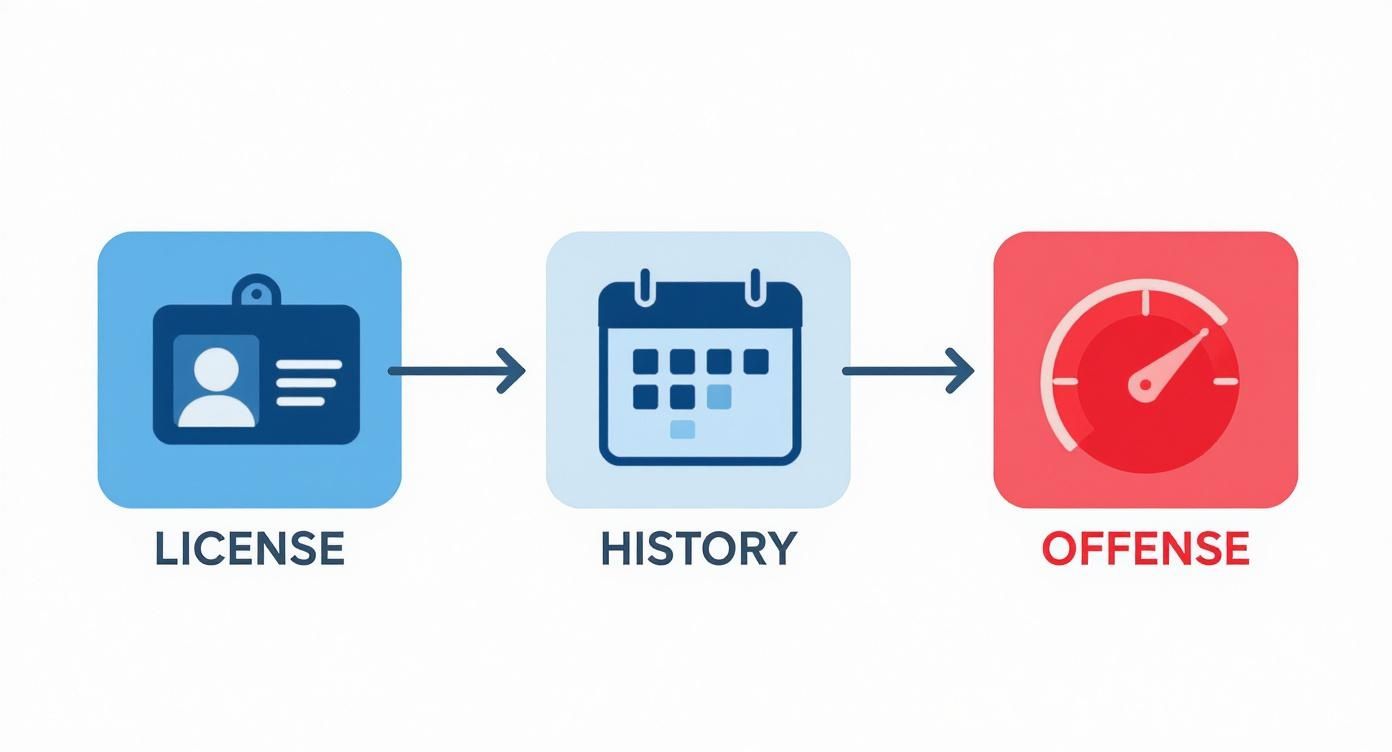
As you can see, the court doesn't grant these requests automatically. It will review your license type, past driving history, and the specific offense before considering your petition.
Making the Formal Request
First, you must formally request deferred adjudication. This is not something the court will offer automatically. The request typically must be made to the court clerk or judge on or before the appearance date listed on your ticket. Missing this deadline will likely result in losing your opportunity to seek a deferral.
When you make the request, the court will require you to enter a specific plea—a crucial legal step.
Important Note: To qualify for deferred adjudication, you must plead either "nolo contendere" (no contest) or "guilty." A plea of "no contest" is common; it means you are not admitting wrongdoing but are agreeing not to fight the charge, allowing the judge to proceed.
This plea enables the judge to defer a finding of guilt and place you on a probationary period instead. It’s a procedural requirement you must meet to achieve the goal of dismissal.
Understanding the Financial Obligations
Agreeing to deferred adjudication comes with upfront costs. While you avoid the long-term financial pain of a conviction (like higher insurance premiums), you will have to pay standard court costs plus a special expense fee. The total amount is often similar to, and sometimes slightly more than, the original ticket fine.
It helps to think of this payment not as a fine, but as an administrative fee for participating in the program. You are paying for the opportunity to have the violation dismissed from your public record. If you fail to pay these fees on time, the agreement will be voided, and the ticket will likely go on your record as a conviction.
Fulfilling Your Deferral Conditions
Once the court approves your request and you've paid the fees, your deferral period officially starts. This is the most critical phase. During this probationary term, your primary responsibility is to follow all of the judge's rules precisely.
The conditions are designed to demonstrate that you are a responsible driver. They almost always include:
- Avoiding New Violations: This is the golden rule. You cannot get another traffic ticket of any kind during the deferral period. A new citation is the quickest way to have your deferred status revoked, which would result in a conviction for the original ticket.
- Completing a Defensive Driving Course: Many courts will order you to take a state-approved defensive driving course. You will be given a deadline, often 30 to 90 days, to complete it and submit proof to the court.
- Paying All Fines and Fees: Ensure every penny is paid by the due date assigned by the court.
These deadlines are not suggestions. Some programs, for example, require you to register within 21 days of getting the ticket and finish any required online traffic school course within 28 days. You can explore detailed program requirements to see just how strict these timelines can be. Missing a single deadline for your driving course certificate or a final payment can undo all your hard work.
This is where an attorney can be invaluable. We manage these deadlines for you, ensuring every box is checked on time so you can focus on driving safely.
So, What’s the Catch? Weighing the Pros and Cons
A deferred adjudication offer can feel like a lifeline, providing a clear path to prevent a minor mistake from damaging your driving record. However, like any legal agreement, it’s not without its trade-offs. It’s a tool with significant benefits but also requires you to meet specific obligations.
Making the right decision means looking at the complete picture—balancing the immediate requirements against the long-term victory of a clean record. For most drivers, the advantages make it a much better choice than simply paying the ticket.
The Clear Advantages of Deferred Adjudication
The biggest reason to consider deferred adjudication is its impact on your future. Successfully completing the agreement provides major protections that a conviction would immediately take away.
The Major "Pros" Include:
- Your Ticket Gets Dismissed: This is the ultimate goal. A dismissal means the offense does not result in a guilty verdict on your public driving record.
- No Points on Your Driving Record: The Texas points system can lead to license suspension and costly annual fees. A dismissal from deferred adjudication keeps your record point-free.
- Your Insurance Rates Stay Put: A clean record is your best defense against premium hikes. Since insurance companies won't see a conviction, you can avoid the steep rate increases that almost always follow a traffic violation.
These benefits work together to protect you from a chain reaction of negative consequences that can easily cost you hundreds, if not thousands, of dollars over the next few years.
The Potential Downsides and Considerations
While the benefits are substantial, deferred adjudication isn't a magic wand. It comes with upfront costs and strict rules that you must follow. Think of it as a contract with the court where you must hold up your end of the bargain.
Potential "Cons" to Weigh:
- Higher Upfront Costs: This often surprises people. You will have to pay court costs plus a special expense fee, which can add up to more than the original ticket fine. You are essentially paying for the privilege of keeping the violation off your record.
- A Strict Probationary Period: During the deferral period, which is typically 90 to 180 days, you are under scrutiny. Your sole job is to remain completely ticket-free.
- The Risk of a Second Ticket: This is the biggest gamble. If you receive another moving violation during your probation, the deal is terminated. The court will almost certainly find you guilty of the original ticket, and you’ll still have to deal with the new one. It’s a harsh “two-for-one” penalty.
- Administrative Hoops: The court may also require you to complete a defensive driving course by a specific deadline, which means more of your time and an additional fee.
Think of it this way: Deferred adjudication is an investment in your driving record. You pay more upfront—both in money and in careful driving—to protect a far more valuable long-term asset: a clean slate.
Comparing Your Options: Deferred Adjudication vs. Paying the Ticket
To truly understand what’s at stake, it helps to compare the two main choices side-by-side. The difference in outcome between completing a deferral and simply paying the ticket is stark.
| Outcome | Deferred Adjudication | Paying the Ticket (Conviction) |
|---|---|---|
| Record Status | Dismissed No conviction on your public record. | Conviction Shows up on your public driving record. |
| License Points | Zero No points are added to your license. | Points Added Points accumulate, moving you closer to suspension. |
| Insurance Impact | Minimal Rates are unlikely to increase. | High Rates will almost certainly go up. |
| Upfront Cost | Higher You pay court costs and special fees. | Lower You only pay the original fine. |
Ultimately, choosing a deferred adjudication traffic ticket is a strategic decision. Is the higher upfront cost and the need for perfect driving worth the long-term protection? For most people, the answer is a resounding yes. An experienced attorney can help you weigh these pros and cons for your specific situation, ensuring you choose the path that best protects your license and your finances.
What Happens If You Violate the Deferral Agreement
A deferred adjudication agreement is a deal you make with the court, and it comes with one major condition: you must uphold your end of the bargain. The probationary period is a test of your commitment to safe driving, and the court pays close attention.
It is crucial to understand how high the stakes are. A single misstep can undo all your hard work and leave you in a much worse position than when you started.
The most common violation is getting another traffic ticket during the deferral period. However, failing to complete a required defensive driving course on time or missing the payment deadline for your court fees also constitutes a violation.
The Immediate Legal Consequences
Once the court is notified of a violation, the prosecutor will likely file a "motion to adjudicate guilt." This is a formal request for the judge to revoke your deferred status and find you guilty of the original traffic ticket. When that happens, the protective shield of your agreement disappears.
The judge will then enter a conviction for that first ticket, and it will be placed on your public driving record. The very outcome you worked to avoid becomes a reality, triggering a chain reaction of negative consequences.
- Conviction on Your Record: The original charge is no longer eligible for dismissal and now lives on your record as a formal conviction.
- Points on Your License: The Texas Department of Public Safety will add points to your license due to the conviction.
- Insurance Rate Hikes: Your insurance provider will almost certainly see the new conviction and raise your premiums, often for several years.
- State Surcharges: Depending on the offense and your driving history, you could now be liable for annual surcharges from the state.
In short, you lose every single benefit of the deferred adjudication. You will face the full consequences of the first ticket plus the separate penalties for the new violation.
A violation doesn't just reset the clock; it often results in a "two-for-one" penalty. You get the conviction for the original ticket and still have to resolve the new citation, which now comes with its own fines, court costs, and potential for more points.
How an Attorney Can Still Help
Receiving notice that you’ve violated your agreement can be disheartening, but it doesn't have to be the end of the road. This is a critical moment where having a skilled attorney is more important than ever. You do not have to face the court alone, and there may still be ways to mitigate the damage.
An experienced Houston DWI lawyer can intervene on your behalf. We can appear at the hearing on the motion to adjudicate and present arguments to the judge or prosecutor. It is sometimes possible to negotiate a new arrangement or explain extenuating circumstances that led to the violation. Even in a worst-case scenario, an attorney can work to minimize the final penalties and protect your driving privileges as much as possible.
A violation of a deferred adjudication traffic ticket agreement is a serious matter, but it is a challenge we are equipped to handle. Our role is to step in, assess the situation, and build the strongest possible defense to protect your rights and your future. If you find yourself in this situation, the most important step is to seek legal help immediately.
How a Traffic Lawyer Can Turn the Tables in Your Favor

Dealing with the court system for a traffic ticket is often a stressful and confusing process filled with legal jargon, deadlines, and paperwork. You don't have to navigate it alone. Partnering with an experienced traffic ticket attorney transforms a confusing ordeal into a managed, strategic defense.
First and foremost, a lawyer removes the administrative burden from your shoulders. We handle the communication with the court, file all documents correctly and on time, and ensure no procedural deadlines are missed. This peace of mind allows you to focus on your life while we handle the legal complexities.
Negotiating from a Position of Strength
Beyond managing paperwork, a skilled lawyer acts as your professional negotiator. We have spent years in the local courts, which means we know the prosecutors, understand judicial tendencies, and are familiar with what arguments are most effective. This insider knowledge gives us a powerful advantage to negotiate better terms than you could likely secure on your own.
Our goals are simple and effective:
- Shorter deferral periods: We can often make a strong case to reduce the length of your probation, helping you put the ticket behind you faster.
- Lower fines and court costs: In many cases, financial penalties are negotiable. We know how to identify these opportunities and argue for a reduction.
- Waiving extra requirements: Depending on the circumstances, we might be able to have conditions like a defensive driving course waived, saving you time and money.
These adjustments can make a significant difference in the cost and convenience of your deferred adjudication traffic ticket agreement. Our focus is always on achieving the best possible outcome for you.
An experienced attorney is your advocate in a system that can often feel impersonal. We ensure your side of the story is heard and that you are treated as a responsible person who made a one-time mistake, not just another case number.
Your Shield When Things Get Complicated
Having a lawyer in your corner is absolutely critical if complications arise. For example, if you accidentally violate the terms of your agreement, an attorney who is already familiar with your case is a massive advantage. We can step in immediately to perform damage control and argue to prevent your deferred status from being revoked.
Our firm is built on defending Texans from charges that can impact their future. We serve as your strategic shield, removing the anxiety and uncertainty from the legal process. Our job is to protect your rights, minimize consequences, and help you walk away with a clean driving record.
A single traffic ticket does not have to define your future. Let us help you navigate this with confidence. We invite you to contact The Law Office of Bryan Fagan, PLLC for a free consultation to discuss your specific situation. We're here to listen and build a plan to protect your record.
Common Questions About Deferred Adjudication in Texas
When you're dealing with a deferred adjudication traffic ticket, many practical questions can arise. Getting clear, accurate answers is essential for feeling confident about your next steps. Here are some of the most common things Texas drivers ask us about this option.
Can Any Traffic Ticket Be Deferred?
Not quite. While deferred adjudication is an excellent tool for common moving violations—like a routine speeding ticket or failure to stop at a stop sign—Texas law prohibits it for certain offenses.
You are generally not eligible if you:
- Hold a Commercial Driver’s License (CDL), even if you were in your personal vehicle.
- Were ticketed for driving 25 mph or more over the speed limit.
- Received the ticket in a construction zone while workers were present.
- Are accused of illegally passing a stopped school bus.
These rules are quite rigid, and courts rarely make exceptions. A brief consultation with an attorney can confirm whether your specific ticket is eligible.
Does It Show Up On My Driving Record?
This is the most important question, and the answer is why deferred adjudication is so valuable. If you successfully complete the deferral period, the ticket is dismissed. That means it will not appear as a conviction on your public driving record—the one your insurance company checks.
However, it's important to know that the court maintains a confidential record of the deferred disposition. This record is not accessible to the public, including employers or insurers. It is primarily used by law enforcement and prosecutors to determine eligibility for future deferrals. For all practical purposes that affect your insurance rates and public record, your slate remains clean. After the required waiting period, you may even be able to clear your criminal record with an expunction.
Is It Cheaper to Just Pay the Ticket?
Upfront, it might seem so, but in the long run, the answer is a firm no. The court costs and fees for deferred adjudication are typically a bit higher than the original ticket fine. However, it is essential to look at the bigger picture.
Paying the ticket is an admission of guilt. That conviction goes on your record and can cause your insurance premiums to skyrocket for the next three to five years. A single ticket can easily cost you hundreds, even thousands, in higher insurance payments over time. Think of deferred adjudication as a one-time investment to avoid those significant long-term financial penalties.
What if I Miss My Court Date?
Missing your court date is a serious mistake. If you fail to appear, the court will likely issue a warrant for your arrest and may charge you with a new offense for "Failure to Appear." This escalates a simple traffic ticket into a much larger legal problem and almost guarantees you will not be offered deferred adjudication. If you have missed a court date, your first call should be to an attorney to address the warrant and protect your rights.
Facing a traffic ticket is stressful, but you don’t have to figure it out alone. At The Law Office of Bryan Fagan, PLLC, our team is here to answer your questions and build a strategy to keep your driving record clean. Reach out today for a free, no-obligation case evaluation at https://texasduilawfirm.com.