
A DWI arrest can be overwhelming—but you don’t have to face it alone. Even if your case was dismissed or you were found not guilty, the arrest record can haunt you for years, creating roadblocks to jobs, housing, and your peace of mind. In Texas, a record expungement—legally known as an expunction—is a powerful court order that permanently destroys every single record of a specific arrest.
What does that mean for you? It means you can legally deny the arrest ever happened. It’s a true clean slate, and our team is here to help you achieve it.
Your Path to a Clean Slate in Texas
A DWI arrest can be completely overwhelming, but you don't have to let it define your future. Even if your case was dismissed or you were found not guilty at trial, the arrest itself remains a public record. This digital footprint can cast a long, unfair shadow, limiting your opportunities for years to come.
Fortunately, Texas law provides a clear path forward through the expungement process.
Understanding what an expungement actually does is the first real step toward reclaiming your life. This isn't just about hiding a record; it's about making it disappear entirely. When a judge signs an Expunction Order, every government agency holding a record of your arrest is legally required to destroy it. This includes the arresting police department, the court clerk, and the Texas Department of Public Safety.
How an Expungement Restores Your Future
Think of an expungement as a legal reset button. The benefits are immediate and life-changing. Once your record is officially expunged, you gain the ability to:
- Legally deny the arrest: On job applications, housing forms, and loan documents, you can confidently and legally check "no" when asked about prior arrests.
- Pass background checks: That old arrest will no longer show up on public or private background checks, opening doors to careers that were previously off-limits.
- Pursue professional licenses: Many licensing boards demand a clean criminal history. An expungement removes that potential barrier to achieving your professional goals.
- Restore your peace of mind: Perhaps the most important benefit of all—you no longer have to live with the anxiety that a past mistake could surface at the worst possible moment.
An expunction is more than just a legal procedure; it’s a tool for restoring your reputation and ensuring that a single event doesn't define the rest of your life. It allows you to move forward without the weight of an old arrest holding you back.
Expungement vs. Sealing a Record
It’s absolutely crucial to understand the difference between an expungement and an order of nondisclosure, which is often called "sealing" a record. While both offer relief, they are fundamentally different legal tools.
An expungement destroys the record entirely. For all intents and purposes, it ceases to exist.
An order of nondisclosure, on the other hand, just seals the record from public view. This means most private employers and landlords won't see it, but law enforcement, government agencies, and certain licensing bodies can still access the information.
For example, if you successfully completed deferred adjudication for a certain offense, you might be eligible to have your record sealed but not expunged. However, if your DWI case was dismissed outright, you may qualify for the more powerful remedy of a full expungement. Figuring out which path is right for your specific situation is a critical part of the process, and an experienced Houston DWI lawyer can give you the strategic guidance you need.
The journey to a clean slate can feel complicated, but with the right legal partner, it is an attainable goal. At The Law Office of Bryan Fagan, PLLC, we are dedicated to helping Texans navigate the expungement process with confidence. We believe everyone deserves a second chance, and we have the experience to help you secure it. If you're ready to leave the past behind and build a brighter future, we invite you to contact us for a free consultation to discuss your case.
Confirming Your Eligibility for Expungement
Before filing any paperwork, the absolute first step is determining if you qualify for a record expungement in Texas. The law is incredibly specific about who is entitled to this fresh start. Attempting to file without confirming your eligibility can waste time, money, and hope on a petition that is destined to fail.
The good news? Many people who assume they're stuck with a criminal record are often eligible. Texas law is designed to give a second chance to those unfairly burdened by an arrest that never led to a conviction.
This decision tree gives you a quick visual on how to start thinking about your own situation.
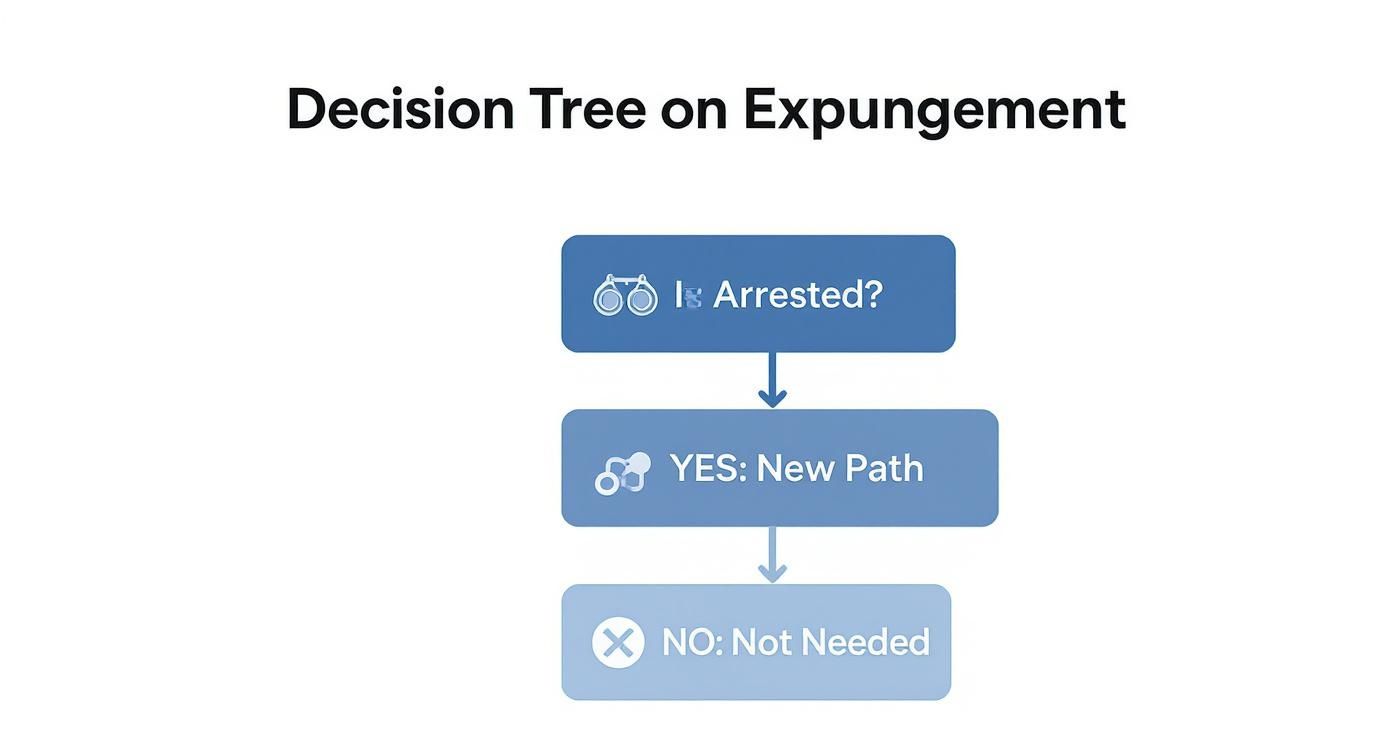
As the chart shows, this entire process kicks off with an arrest record you want gone. It’s a powerful legal tool, but it's meant for people who’ve already been through an encounter with the justice system and came out without a conviction.
Common Scenarios That Qualify for Expungement
So, how do you know if you have a shot? Your case will likely need to fit into one of these common situations. If it does, you have a solid foundation for filing a Petition for Expunction.
- Your Case Was Dismissed: This is the most frequent path to expungement. A prosecutor might dismiss your charges for various reasons—insufficient evidence, a key witness recanting, or your successful completion of a pretrial diversion program. For example, if you were arrested for a first DWI in Texas and your Houston DWI lawyer got the case thrown out, you are very likely eligible.
- You Were Found Not Guilty (Acquitted): If you took your case to trial and a judge or jury declared you "not guilty," you have an absolute right to an expungement. An acquittal is the court’s way of saying the state failed to prove its case, and the law agrees you shouldn't have to carry that arrest on your back forever.
- You Were Arrested but Never Formally Charged: Sometimes, the police make an arrest, but the District Attorney's office decides not to pursue the case. If the statute of limitations for that crime has expired, you can get that arrest record wiped clean. This prevents a "dead-end" arrest from haunting your future.
- You Received a Pardon: While less common, if the Governor of Texas grants you a pardon for the offense, that also opens the door to getting your record expunged.
These pathways are the legal system's way of making things right for people who were pulled into the system but never actually found guilty of a crime.
What About Deferred Adjudication?
This is where things get tricky and often cause confusion. Successfully completing a deferred adjudication program does not automatically make you eligible for an expungement for most offenses. This is a critical distinction.
While an expungement completely destroys the record, cases resolved with deferred adjudication typically qualify for an order of nondisclosure, which only seals it from public view. It's a huge difference in what employers, landlords, and licensing agencies can see.
An order of nondisclosure is still a fantastic outcome, but it isn't the same as the total destruction an expungement provides. A key conversation to have with your attorney is understanding whether is deferred adjudication a conviction for your specific goals.
Expungement vs. Nondisclosure at a Glance
To clear up any confusion, it's helpful to see the two options side-by-side. Both are valuable legal tools for cleaning up a criminal record in Texas, but they achieve very different results. This table breaks down the core differences so you can understand which one might apply to your situation.
| Feature | Expungement (Expunction) | Order of Nondisclosure (Sealing) |
|---|---|---|
| Record Status | Destroyed. All records are physically destroyed. | Sealed. Records are hidden from the general public. |
| Legal Status | You can legally deny the arrest ever occurred. | You generally don't have to disclose the arrest to most employers. |
| Who Can See It | Nobody. The record is gone for good. | A limited list of government and licensing agencies can still see it. |
| Typical Eligibility | Arrests that led to dismissal, acquittal, or no charges. | Successful completion of deferred adjudication probation. |
| Effectiveness | Complete removal. The most thorough solution. | Limited access. Hides the record from public background checks. |
Knowing the difference between wiping a record away and just hiding it is fundamental. An expungement is the ultimate goal, but a nondisclosure is still a powerful tool for getting your life back on track if that's the path available to you.
Finally, some good news. As of 2025, Texas has made significant reforms to its expunction laws under Chapter 55A of the Code of Criminal Procedure. These changes expanded eligibility and even introduced automatic expungements for certain dismissed or acquitted cases, easing the burden on individuals to start the process themselves.
Making sure you're eligible is the first, and most important, win on the journey to clearing your name. If you think your situation fits one of these scenarios, it’s time to take the next step.
Alright, you've confirmed you're eligible for a record expungement in Texas. That’s a huge win, but it’s just the first step. Now comes the legal process—a series of specific steps, deadlines, and paperwork. While it may seem intimidating, think of it as a clear roadmap. With a strategic legal partner guiding you, you can navigate it with confidence.
A DWI arrest can feel like a crushing weight, but you don't have to carry it alone. The expungement process is methodical, and the key to success is having a solid plan. Your focus now shifts from if you can get an expungement to how you’re going to get it done.

Preparing and Filing the Petition for Expunction
Everything starts with one critical legal document: the Petition for Expunction. This isn't just a form you fill out; it's a formal, sworn request to the court that lays out the legal reasons why you’re entitled to have your records destroyed. Getting this document exactly right is non-negotiable. Even a small error can lead to frustrating delays or, worse, an outright denial.
To draft the petition, your attorney will gather specific information about your case. Precision is key. This usually includes:
- Your Personal Details: Full name, date of birth, driver’s license number, and social security number.
- Arrest Information: The exact date of the arrest, the offense you were charged with (like DWI), and the arresting agency (e.g., Houston Police Department or Harris County Sheriff's Office).
- Case Details: The cause number (or case number) and the specific court that handled your case (for instance, Harris County Criminal Court at Law No. 5).
Once the petition is drafted and signed, it gets filed with the district court in the county where the arrest happened. This single action is what officially kicks off the legal proceedings.
Identifying and Notifying Government Agencies
This is one of the most critical parts of the process and a common area for costly mistakes. Your petition must list every single government agency that might have a record of your arrest. If you miss one, they won't get the court's order, and they won't destroy your records.
Your attorney will track down and list agencies like:
- The arresting police department or sheriff's office.
- The county or district attorney's office that prosecuted the case.
- The clerks for the district and county courts.
- The Texas Department of Public Safety (DPS).
- Any other agency involved, such as a crime lab or pretrial services office.
After filing, each of these agencies must be formally notified. This legal step, called "service," gives them a chance to respond or object to your expungement. While objections are rare if your eligibility is clear, the procedure must be followed precisely.
The Court Process and Waiting Periods
Once all the agencies have been served with your petition, a mandatory waiting period begins—typically at least 30 days. This gives them time to file a response. The District Attorney's office will review your petition to make sure you qualify. If they agree that you meet all the legal requirements and don't file an objection, the judge can often sign the Final Order of Expunction without you ever stepping foot in a courtroom.
However, if the DA does object or the judge has questions, a court hearing will be scheduled. This is where your attorney will present your case, explain why Texas law entitles you to an expunction, and argue for the judge to grant it. Having a Houston DWI lawyer who can confidently advocate for you is invaluable at this stage.
The goal of the hearing is simple: to prove to the court that you satisfy all the statutory requirements for expungement. A well-prepared petition and strong legal representation make this a straightforward matter in most eligible cases.
Recent legislative changes have made a real impact on expungement requests in Texas. Since the 2025 reforms rolled out, counties like Dallas and Tarrant have reported they’re processing petitions more efficiently, which has shortened waiting times and boosted approval rates. While we're still waiting on exact statewide data, reports from the Department of Public Safety show they’re working hard to integrate electronic records and improve the accuracy of criminal histories—a crucial element for reliable expunctions. You can dig deeper into these efforts in the state's latest criminal history data reports.
After the Judge Signs the Order
Getting that signed Expunction Order in your hands is a huge moment of victory. This legal document is the official command that sets the final stage in motion. The court clerk will then send certified copies of the order to every single agency you listed in your petition.
Once they receive the order, those agencies are legally required to destroy their records of your arrest. They can't just seal or hide them; they have to be permanently deleted or obliterated. It's not an instant process—agencies usually have between 60 and 180 days to comply—but the order guarantees that your slate is wiped completely clean. A diligent attorney will follow up to make sure every agency has complied, confirming your fresh start is truly secure.
Understanding Waiting Periods and Special Cases
When you're trying to put a DWI arrest behind you, timing is everything. A successful record expungement in Texas hinges on following the state's mandatory waiting periods. Rushing to file your petition is one of the fastest ways to get it denied, forcing you to start the whole frustrating process over again.
These timelines aren't just arbitrary rules; they're tied directly to the statute of limitations for the crime you were arrested for. Essentially, the law makes you wait until the state can no longer legally prosecute you for that specific incident before you're allowed to ask a judge to destroy the records.
Calculating Your Eligibility Window
Here’s a common mistake people make: the clock for your waiting period starts ticking from the date of your arrest, not the day your case was dismissed or resolved. Getting this date wrong can throw off your entire timeline.
The specific waiting period you face depends entirely on the type of offense.
- Class C Misdemeanors: You'll need to wait 180 days from the arrest date.
- Class A & B Misdemeanors: The waiting period is one year from the arrest date. Since a first-time DWI is usually a Class B misdemeanor, this is the timeline most people need to follow.
- Felonies: For more serious felony charges, you must wait three years from the arrest date.
There is one major exception to all of this. If you went to trial and were found not guilty (acquitted) or if you received a pardon, there is no waiting period. You can file your Petition for Expunction right away. For a deeper dive into these crucial dates, check out our guide to the Texas DWI expungement timeline.
Waiting periods aren't suggestions; they are strict legal requirements. Confirming the exact start and end dates for your eligibility window is one of the most important steps an experienced Houston DWI lawyer will take to protect your case.
Special Circumstances and Unique Cases
While the timelines above cover most situations, some cases come with their own unique set of rules that can change the expungement process.
For instance, juvenile records operate under a completely different system. While they are separate from adult criminal records, they can still follow a person into adulthood. Texas law has specific ways to seal or expunge juvenile records, but the eligibility requirements and timelines are distinct from the adult system.
Another difficult situation is when an arrest happens because of identity theft—someone else used your name and information. The law provides a clear path to expungement to clear the innocent victim’s name. It's a process designed to correct the record and remove the unfair burden of an arrest that was never yours to begin with.
Ultimately, the Texas expunction system tries to balance offering people a second chance with ensuring public safety, which is why the rules are so strict. Successfully navigating these timelines and special conditions is where professional legal guidance becomes so important. An attorney can verify the statute of limitations for your charge, calculate your exact filing date, and make sure your petition is set up for success from day one.
Life After a Successful Expungement

Holding a signed Expunction Order from a Texas judge is a monumental victory. That single piece of paper represents your freedom from a past mistake and the beginning of a truly fresh start. But the journey isn't quite over.
Understanding what happens next is key to fully embracing the clean slate you've worked so hard to achieve.
The court order is a powerful legal directive, but it needs to be sent out and followed. The court clerk is responsible for distributing certified copies of the order to every single state and local agency you listed in your petition. This is the official command for them to permanently destroy all records related to your arrest.
Confirming Your Record Has Been Destroyed
Once the order is out, a compliance period begins. Agencies typically have between 60 to 180 days to locate and completely obliterate your records. This isn't just a matter of hitting "delete" on a computer file; it involves destroying physical paperwork, digital entries, and any other trace of the arrest.
A crucial part of our service at The Law Office of Bryan Fagan, PLLC is the follow-up. We don't just assume every agency has complied. We proactively contact them to verify that the expunction order was received and, more importantly, executed correctly. This verification process ensures that no forgotten file or overlooked database entry comes back to haunt you years down the road.
What if an agency fails to comply? They are in violation of a court order. In that rare event, we can file a motion to hold them in contempt of court, which forces them to complete the process. This diligence provides the ultimate peace of mind, knowing your record is gone for good.
Your Renewed Rights and How to Use Them
With a successful record expungement in Texas, your rights are fundamentally restored. The most powerful right you gain is the ability to legally deny the arrest ever happened. This is not just advice; it is a right granted to you by Texas law.
This means when you encounter questions about your past on critical applications, you can answer with confidence:
- Job Applications: When asked, "Have you ever been arrested?" your legal and truthful answer is "No."
- Housing and Rental Agreements: You can honestly deny any history of arrest without fear of being dishonest.
- Professional Licensing Boards: For most professional licenses, you are no longer required to disclose the expunged arrest.
- Loan and Financial Applications: The arrest cannot be used against you in financial matters.
The purpose of an expunction is to restore you to the position you were in before the arrest. Legally, the event is treated as if it never occurred, and you are entitled to move forward accordingly.
Navigating Future Background Checks
So what happens the next time an employer runs a background check? The expunged arrest simply won't be there. Private background check companies pull their data from public records maintained by government agencies. Since those agencies were ordered to destroy their files, there is nothing for the background check company to find.
However, be aware that some private data brokers may have old, outdated information in their databases. This is where it gets tricky. If you ever encounter a situation where an expunged record appears on a private check, you have the right to dispute it. By providing a copy of your Expunction Order, you can legally compel them to remove the inaccurate information.
A DWI arrest can be an overwhelming experience, but it does not have to be a life sentence. Securing an expungement is the final step in closing that chapter and protecting your future. If you are ready to pursue a clean slate and need a strategic advocate to guide you, The Law Office of Bryan Fagan, PLLC is here to help. We offer free consultations to evaluate your case and explain your options.
Call us today to take the first step toward your new beginning.
Common Questions About Texas Expungements
Thinking about getting your record expunged is a huge step, and it’s completely normal to have questions. The process can feel overwhelming, but once you understand the details, you will feel more confident about moving forward.
We have provided clear, direct answers to some of the most common questions we hear from clients just like you.
How Much Does an Expungement Cost in Texas?
The total cost depends on the county where the arrest occurred and the complexity of your case. Generally, you can expect court filing fees, which typically range from $250 to $500. In addition, there are smaller fees for formally serving notice to all the state agencies holding a copy of your record. Attorney fees will also be part of the final cost.
While it is a financial investment, the long-term return can be priceless. A clear record opens doors to better jobs, housing, and professional licenses that may have been out of reach. It is an investment in your future. During a free case evaluation, we can provide you with a clearer estimate of the costs involved.
Can a DWI Charge Be Expunged in Texas?
Yes, but only under very specific conditions. You are typically eligible for a full expungement if your DWI case ended in one of the following ways:
- The prosecutor dismissed the case entirely.
- You went to trial and were found not guilty (acquitted).
- You were accepted into and successfully finished a pretrial diversion program.
If you were convicted or received deferred adjudication for the DWI, a true expungement is not an option. However, you might be eligible for an order of nondisclosure, which seals the record from public view. It’s a crucial difference, and you can learn more in our detailed guide on whether a DWI can be expunged in Texas.
How Long Does the Expungement Process Take?
From the day we file the petition to the moment the judge signs the order, you can expect the process to take approximately three to six months. Once the petition is filed, all government agencies involved have a mandatory 30-day window to respond or object. If no one contests it, the judge can often sign the order without a formal hearing.
If an agency objects and a hearing is required, that could add a few more weeks to the timeline. After the Expunction Order is signed, it can take another 60 to 180 days for every agency to locate and destroy their copies of your record. An experienced Texas DWI attorney helps keep the process moving as efficiently as possible.
An Expunction Order isn't a polite request—it's a legal command from a judge. Every agency listed must obey it and permanently destroy your record.
What Happens if an Agency Fails to Destroy My Record?
Every agency listed in the Expunction Order is legally required to comply. If they fail to do so, they can be held in contempt of court. A critical part of our service is following up with each agency—the DPS, the county clerk, the arresting police department—to obtain written confirmation that they have complied with the judge's order.
If we discover an agency has not complied, we take immediate action by filing a motion to enforce the order with the court. This diligence ensures your record is truly gone, giving you the peace of mind that your fresh start is secure.
An old arrest record shouldn’t get to define the rest of your life. At The Law Office of Bryan Fagan, PLLC, we are dedicated to helping people like you navigate the expungement process with confidence and strategic guidance. If you’re ready to put the past behind you for good, reach out to us today for a free, confidential consultation. Let's talk about getting you the clean slate you deserve.