
A DWI arrest can be overwhelming, but you don't have to face it alone. Understanding your options is the first step toward protecting your future, and one of the most important legal pathways you might hear about is deferred probation—a crucial opportunity to keep a permanent DWI conviction off your record.
Think of it this way: the court is giving you a chance to prove the arrest was a one-time mistake. If you hold up your end of the bargain and meet all the court's requirements, the case against you gets dismissed. This guide will walk you through what deferred probation is, how it works, and whether it could be the right strategic choice for your case.
Your First Step After a Texas DWI Arrest
A DWI arrest can throw your entire future into question, but you don't have to figure it out alone. One of the most critical goals after an arrest is to find a solution that protects your criminal record. This is where deferred probation becomes a vital part of your defense, offering a powerful alternative to a standard conviction.
Deferred probation isn't a conviction; it's a chance. It's a formal agreement between you and the prosecution, negotiated by your lawyer and approved by a judge. When you accept it, you agree to follow a specific set of court-ordered rules for a certain period.
Understanding the Core Concept
At its heart, deferred probation is a legal arrangement where you plead "guilty" or "no contest," but the court intentionally pauses before making an official finding of guilt. Instead of convicting you, the judge places you on community supervision (probation) with a list of conditions you must follow.
The whole point is to show the court that this incident was an isolated error in judgment, not a reflection of who you are. Successfully completing all the terms proves you're committed to responsible behavior, which in turn leads the court to dismiss the original charge. You can learn more about how this differs from regular probation by reading this guide on probation vs. deferred disposition.
A successful deferred probation means you were never formally found guilty of the DWI. This is the single most important distinction and the reason it's a primary goal for many first-time DWI cases in Texas.
What Does This Mean for You?
Choosing this path means you're signing up for strict supervision and a list of non-negotiable requirements. It's a serious commitment that demands discipline and focus, but the payoff is huge. Instead of carrying the lifelong weight of a DWI conviction, you get the chance to move on with a clean slate.
Let's break down what this option usually involves. This table gives you a quick, scannable look at the key components of a typical deferred probation agreement for a Texas DWI.
| Component | What It Means for You |
|---|---|
| Plea | You will enter a plea of "guilty" or "no contest" to the charge. |
| Finding of Guilt | The judge defers (or delays) finding you guilty. You are not convicted. |
| Probation Period | You'll be supervised for a set period, often 12-24 months. |
| Conditions | You must follow strict rules like reporting to an officer, counseling, and drug/alcohol testing. |
| Ignition Interlock | You will likely be required to install an ignition interlock device on your vehicle. |
| Successful Completion | If you follow all rules, the judge dismisses the case. No conviction appears on your public record. |
| Violation | If you break the rules, the judge can find you guilty and sentence you, potentially up to the maximum penalty. |
Ultimately, this path allows you to earn a dismissal, which is a massive win for your future. Here's a summary of the pros and cons you'll need to weigh with your attorney:
- No Formal Conviction: This is the biggest benefit. The charge gets dismissed, preventing a permanent criminal record for this offense.
- Strict Conditions: You’ll have to follow specific rules, like regular check-ins, mandatory classes, and possibly using an ignition interlock device.
- Waiving a Trial: By accepting this deal, you give up your right to fight the DWI charge in front of a jury.
Figuring out what deferred probation is and whether it's the right move for you is a critical conversation to have with an experienced Houston DWI lawyer. It requires a careful look at the evidence against you, whether you're eligible, and what your long-term goals are.
How Deferred Probation Actually Works
So, you know what deferred probation is, but what does the process actually look like from start to finish? An arrest is disorienting, and the legal journey that follows can feel overwhelming. The good news is that the path has clear, predictable steps. Let's walk through exactly what you can expect, from the first day in court to the final dismissal of your case.
Think of the whole thing as a contract between you and the court. Your job is to hold up your end of the bargain by following every single rule. If you do, the court will hold up its end by dismissing the charge. It’s a demanding process, but the payoff is huge: a chance to keep a conviction off your permanent record.
The Initial Step: The Plea Agreement
The path to deferred probation starts with a step that feels completely backward: entering a plea of "guilty" or "no contest." This is often the most stressful part for our clients. It feels like you're admitting defeat right out of the gate, but it's a necessary legal move.
Pleading guilty in this specific situation does not mean you are being convicted.
Instead, that plea is what gives the judge the power to defer—or put off—a finding of guilt. By accepting your plea but not entering a final conviction, the court essentially hits the pause button on your case. This is when they place you on community supervision, which is the official legal term for probation. It’s a strategic move your attorney negotiates to get you this second chance instead of heading to trial or accepting a straight conviction.
Navigating the Probationary Period
Once you're on deferred probation, you’re in the main event: the supervision period. This is where you prove to the court that you're committed to staying on the right track. This period usually lasts anywhere from 12 to 24 months, and during that time, you have to follow a list of court-ordered conditions to the letter.
These rules aren't random; they're designed to promote rehabilitation and keep the public safe. But make no mistake, violating even one of them can unravel the entire deal.
Here are some of the most common conditions you can expect:
- Regular Check-Ins: You'll have to report to a probation officer on a set schedule, either in person or by phone.
- DWI Education Courses: Completing a state-approved DWI education program is almost always required.
- Ignition Interlock Device (IID): Most people on DWI deferred probation must install an IID on their vehicle. This device requires you to provide a breath sample to prove you're sober before the car will start.
- Abstain from Alcohol and Drugs: This is non-negotiable. You cannot consume alcohol or use illegal drugs, and you will be subject to random urine or breath tests to ensure you're complying.
- Pay Fines and Fees: All court costs, fines, and monthly probation fees must be paid on time.
- Community Service: A judge will likely order you to complete a certain number of community service hours.
This infographic breaks down the deferred probation journey from the initial plea to the final dismissal.
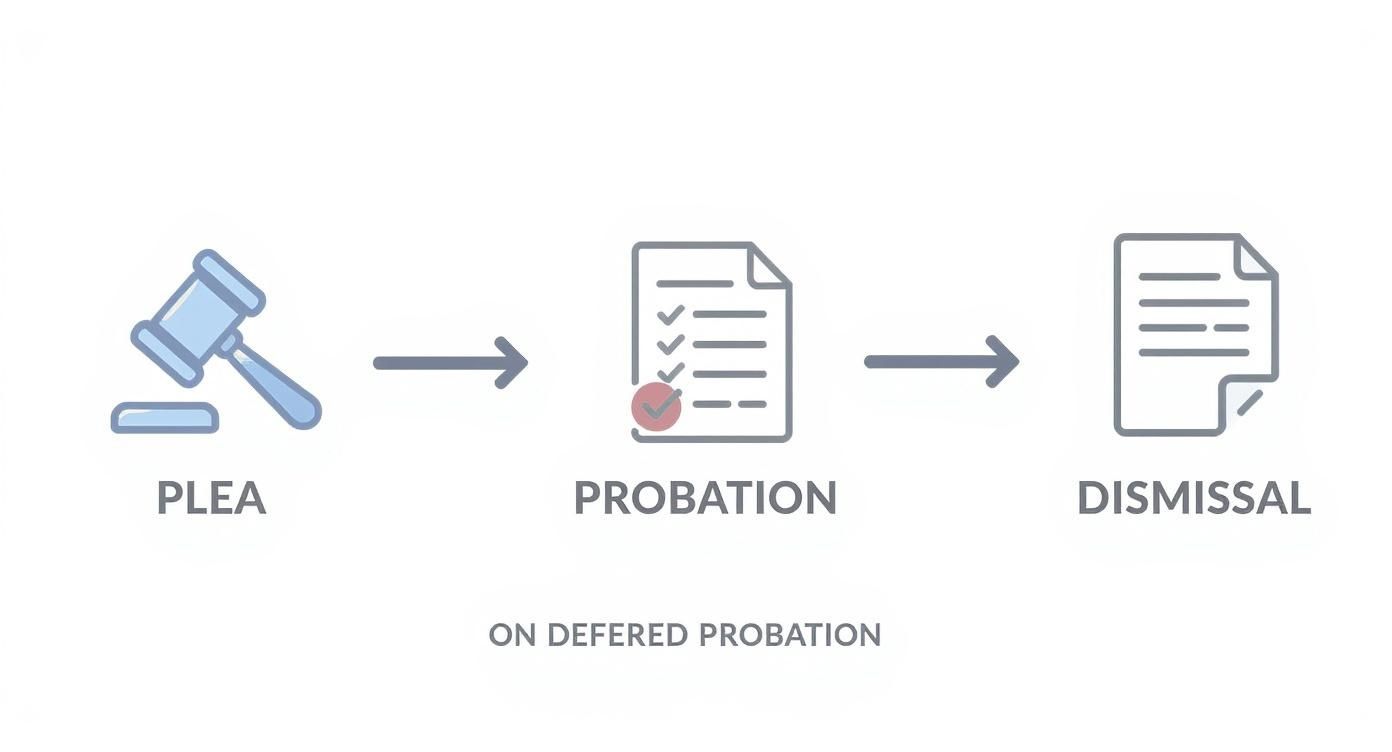
As you can see, everything hinges on getting through that middle phase—the probation period—without any slip-ups.
The Two Possible Outcomes
When your probation term ends, your case will go one of two ways. The outcome is determined entirely by how well you followed the court's rules.
The choice is stark: one path leads to a clean slate, while the other leads directly to a criminal conviction. There is no middle ground.
1. Successful Completion and Dismissal
This is the goal. If you follow every rule, pay every fine, finish every class, and stay out of trouble, you've successfully completed deferred probation. Your attorney will then file the paperwork to prove it, and the judge will dismiss the DWI charge against you. You are never formally convicted. Even better, you eventually become eligible to file for an Order of Non-Disclosure, which would seal the arrest record from public view.
2. Violation and Conviction
If you break any condition—fail a drug test, miss a meeting with your probation officer, or get arrested for something new—the prosecutor can file a "Motion to Adjudicate Guilt." This is where that initial guilty plea comes back into play. Because you already pleaded guilty, you've given up your right to a trial on the DWI facts. The judge can find you guilty on the spot and sentence you, which could mean fines and even jail time up to the maximum allowed for that offense. This is why perfect compliance isn't just a suggestion; it's essential.
Determining Your Eligibility for Deferred Probation
While deferred probation can feel like a lifeline, it’s a specific legal tool that isn’t available in every Texas DWI case. The law draws some pretty clear lines about who qualifies. Understanding these rules is the first step in setting realistic expectations and building a solid defense strategy with your Texas DUI attorney.
Think of deferred probation as a middle ground—somewhere between a conviction and a full dismissal. It’s a chance to plead "guilty" or "no contest," but the judge holds off on entering a final conviction. If you successfully complete the probation terms, the case is dismissed, and you avoid having a DWI conviction on your permanent record.
Of course, the only way to know for sure if you qualify is to have a skilled DWI lawyer dig into the unique details of your case. They know how to negotiate this outcome with prosecutors and can tell you if it's a real possibility.
Who Is Typically Eligible?
In Texas, deferred probation is generally reserved for people facing their very first DWI charge. The system sees it as an opportunity for someone who made a one-time mistake to prove it won't happen again. The ideal candidate is someone with a clean record who isn't likely to re-offend.
When deciding whether to offer this path, prosecutors and judges look at several factors. They'll consider the specific details of your arrest, your criminal history (or lack thereof), and how committed you seem to be to making things right.
An experienced DWI attorney knows how to frame your story in the best possible light. They can highlight your strong community ties, steady job, and clean background to argue that you are the perfect candidate for deferred probation.
For many people, this option is a key part of the first-time DWI offender programs in Texas, which are designed to focus on rehabilitation instead of just punishment. These programs are built on the idea that a single mistake shouldn't ruin your entire future.
Factors That Can Make You Ineligible
Just as some factors make you a good candidate, others can automatically disqualify you from getting deferred probation for a DWI. Texas law is very strict on these points, leaving almost no wiggle room in certain situations.
It's crucial to know these disqualifiers from the start. If deferred probation is off the table, you and your attorney can immediately pivot to other defense strategies.
Here are the most common deal-breakers:
- You held a Commercial Driver's License (CDL) when you were arrested. This is a hard-and-fast rule, and it doesn't matter if you were driving a commercial truck or your personal car.
- Your Blood Alcohol Concentration (BAC) was 0.15 or higher. A BAC is a measure of alcohol in your system. A BAC this high elevates the charge to a more serious DWI, and the law explicitly bans deferred probation in these cases.
- The DWI involved an accident with serious injury or death. These situations are typically charged as much more severe felonies, like Intoxication Assault or Intoxication Manslaughter, where deferred isn't an option.
- You have a prior DWI conviction. Deferred probation is almost exclusively for a first DWI in Texas.
If any of these apply to your case, it's even more critical to connect with a DWI attorney right away. Even if deferred probation isn't an option, a great lawyer can still fight the charges, challenge the evidence, and work to get you the best possible outcome.
Deferred Probation Compared to Regular Probation
Understanding the distinction between deferred probation and regular (or "straight") probation is one of the most important parts of your DWI defense. While they might sound similar, their impact on your future couldn't be more different.
Getting this choice right is crucial, and it's a decision you and your Houston DWI lawyer will make together.
Imagine regular probation as a sentence that starts after you’ve been found guilty. The conviction is immediate and permanent. In contrast, deferred probation is like being given a clear path to prevent the conviction from ever happening in the first place.
The Impact On Your Criminal Record
The single biggest difference between these two paths is what happens to your criminal record. This distinction is the primary reason why fighting for deferred probation is often a top priority for a first DWI in Texas.
With regular probation, you are formally convicted of a DWI. That conviction goes on your permanent criminal record immediately and will show up on background checks for employment, housing, and professional licenses for the rest of your life. It’s a final judgment of guilt.
Deferred probation works in the opposite way. You are never formally convicted. If you successfully complete all the court-ordered conditions, the judge dismisses the case entirely. While the arrest record still exists, you can later petition for an Order of Non-Disclosure to seal it from public view. This keeps your public record clean of a DWI conviction.
What Happens If You Violate The Terms
The consequences of a violation also differ significantly between the two types of probation. While any violation is serious, the legal process that follows is not the same. Understanding this can help you appreciate the risks and responsibilities that come with each option.
Here’s the breakdown:
- Violation on Regular Probation: If you violate the terms, the judge can revoke your probation and sentence you to jail time. However, you are entitled to a hearing where the prosecutor must prove you violated the terms. The sentence can be up to the maximum originally allowed for the offense.
- Violation on Deferred Probation: A violation here is often more severe. Because you already entered a "guilty" or "no contest" plea, the prosecutor files a "Motion to Adjudicate Guilt." The judge can then find you guilty on the spot and sentence you immediately, often with little room for argument. You forfeit your right to a trial on the original DWI charge.
The core difference is this: on regular probation, you fight about the violation. On deferred probation, a violation can lead directly to a conviction and sentencing without any further debate on your guilt or innocence in the original DWI case.
To get a deeper understanding of the rules involved, you can learn more about the specific conditions and consequences of DWI probation in Texas.
Deferred Probation vs Regular Probation A Clear Comparison
Making an informed decision requires seeing the differences side-by-side. Use this table to quickly grasp the critical distinctions between deferred probation and regular probation in a Texas DWI case.
| Key Difference | Deferred Probation | Regular (Straight) Probation |
|---|---|---|
| Finding of Guilt | The judge delays finding you guilty. | You are found guilty from day one. |
| Criminal Conviction | No conviction if you successfully complete the terms. | Yes, a permanent conviction is on your record. |
| Outcome on Success | The case is dismissed. | You complete your sentence, but the conviction remains. |
| Record Sealing | Eligible for an Order of Non-Disclosure to seal the arrest. | Not eligible to seal the conviction record. |
| Violation Result | Judge can find you guilty and impose a sentence immediately. | Judge can revoke probation and impose jail time after a hearing. |
Ultimately, deferred probation offers a chance at a complete dismissal—an opportunity to truly move past a DWI arrest without a conviction shadowing your future.
Weighing the Benefits and Drawbacks
Deciding whether to accept a deferred probation offer is one of the most critical strategic moments in your DWI case. This isn't a simple "yes or no" choice. It’s a calculated risk you need to weigh carefully with your Houston DWI lawyer, because while it offers a clear path to protecting your future, it also demands perfect discipline and comes with heavy consequences if you slip up.
You have to understand the balance of power here. You are essentially trading your constitutional right to a trial for a chance to earn a dismissal from the court. Before making that trade, you need to see the entire picture—both the huge upsides and the very real dangers. This perspective is the only way you and your attorney can figure out if this is the right move for you.
The Powerful Benefits of Deferred Probation
The number one reason deferred probation is the top goal for most people facing a first DWI in Texas is the opportunity to avoid a criminal conviction. This is a complete game-changer for your future.
A DWI conviction leaves a permanent stain on your public record, triggering a cascade of problems that can follow you for years. It can get in the way of job opportunities, applications for professional licenses, housing, and even your educational goals.
Here are the key advantages:
- No Permanent DWI Conviction: If you successfully finish everything the judge asks, the case is dismissed. Legally speaking, you were never convicted of the DWI, which keeps your public criminal record clean of this offense.
- Avoiding Jail Time: Deferred probation is an alternative to being locked up. For most first-time DWI offenders, it means serving your sentence in the community under supervision, not behind bars.
- A Path to Sealing Your Record: After you complete deferred probation and wait out a mandatory period, you can petition for an Order of Non-Disclosure. This legal tool seals the arrest record from public view, giving you an even greater level of privacy and a true fresh start.
At its core, this path gives you a structured chance to prove your DWI arrest was a one-time mistake, allowing you to move on without the lifelong weight of a criminal conviction.
The Significant Drawbacks and Risks
While the benefits sound great, the drawbacks are just as serious and demand a hard look. Agreeing to deferred probation is not a get-out-of-jail-free card; it's a strict contract with the court that has zero tolerance for mistakes. You have to know the risks before you sign on the dotted line.
When you accept this deal, you're making a crucial trade-off. You get the shot at a dismissal, but you give up some fundamental rights to get it.
The biggest drawback is that you waive your right to a trial by jury. Once you accept deferred probation, you can't go back and fight the case. You can't argue your innocence or challenge the evidence. You are admitting responsibility, and the only question left is whether you can follow the court's rules.
Here are the primary risks to consider:
- Waiving Your Right to a Trial: You give up your chance to fight the DWI charges in court. If you and your lawyer think the evidence against you is weak or that your rights were violated during the arrest, this is probably not the best path.
- Strict and Demanding Conditions: The terms of probation are not negotiable and can feel very intrusive. You can expect things like random drug and alcohol tests, mandatory counseling, an ignition interlock device in your car, and regular meetings with a probation officer. These requirements will impact your daily life, work schedule, and personal freedom for anywhere from 12 to 24 months.
- Severe Consequences for a Violation: If you violate any condition—even something that seems minor—the prosecutor can file a Motion to Adjudicate Guilt. Because you already pleaded guilty, the judge can find you guilty right then and there and sentence you up to the maximum punishment allowed by law, including jail time. There’s no second chance to argue the facts of the original DWI.
Deciding on deferred probation requires a deep dive into the evidence against you, the strength of your potential defense, and your personal ability to live under a microscope and follow strict rules. This is a conversation where the strategic guidance of an experienced attorney isn't just helpful—it's essential.
Life After Successfully Completing Probation

Finishing your deferred probation is a massive achievement. You followed every rule, met every requirement, and earned the dismissal you worked so hard for. But while the criminal charge is officially gone, there's one final, critical step to truly put this chapter behind you.
Many people are surprised to learn that even after a judge dismisses the case, the record of the arrest remains visible on your background check. It doesn’t just vanish. This means a potential employer, landlord, or licensing board could still see you were once arrested for DWI, leading to tough questions and lost opportunities.
Fortunately, Texas law provides a powerful tool to solve this exact problem.
Sealing Your Record with an Order of Non-Disclosure
The key to clearing your name for good after deferred probation is an Order of Non-Disclosure. This is a court order that effectively seals your arrest record from public view, making it confidential. It legally directs government agencies and private background check companies to stop reporting it.
An Order of Non-Disclosure isn't the same as an expunction, which completely destroys the record. Instead, it "seals" it. This prevents private entities like employers from seeing it, though law enforcement and certain state agencies can still access it under specific circumstances.
Getting this order is the difference between having an old arrest follow you around for years and moving forward with a truly clean slate.
The Process for Getting Your Record Sealed
Obtaining an Order of Non-Disclosure involves filing a petition with the court, but you can't do it the day your probation ends. Texas law requires a waiting period to make sure you stay on the right track.
- Waiting Period: For most DWI misdemeanors, you must wait two years from the date your probation was successfully completed and the case dismissed.
- Petitioning the Court: Once that waiting period is over, your attorney can file a formal Petition for an Order of Non-Disclosure with the same court that handled your original case.
- Court Approval: A judge will review the petition to confirm you meet all the legal requirements. If everything is in order, the judge signs the order, and the process of sealing your record begins.
This final step is absolutely essential for protecting your reputation and your future. To learn more about the specifics, check out our comprehensive Texas DWI record sealing guide, which provides a detailed roadmap. Our firm is committed to helping you not just resolve your case, but also secure your long-term success.
Common Questions About Deferred Probation
If you're facing a DWI arrest, your head is probably swimming with questions. It's completely normal. To help bring some clarity, let's walk through some of the most common concerns our clients bring to us about deferred probation in Texas.
Can I Get Deferred Probation for a Second DWI in Texas?
This is a big one, and the answer is almost always no. In Texas, deferred probation is a tool reserved almost exclusively for first-time DWI offenders.
The legal system views a second DWI much more seriously, and prosecutors are extremely unlikely to offer this kind of second chance again. If this isn't your first offense, an experienced DWI lawyer will need to explore every other possible defense strategy for your case, because deferred probation is likely off the table.
Does Deferred Probation Show Up on a Background Check?
This question has a two-part answer, and the timing is everything.
While you are actively serving your deferred probation term, the arrest and the pending charge will absolutely show up on a background check. It looks like an open, unresolved case to anyone who runs your record.
But what about after? Once you successfully complete all the requirements and the judge dismisses your case, the initial arrest record still exists. The good news is that you may be eligible to petition the court for an Order of Non-Disclosure. This is a powerful legal step that seals the record from the public and most private employers, effectively wiping it clean from the background checks most people will ever see.
What Happens If I Violate My Deferred Probation?
Violating the terms of your probation is a critical mistake with immediate and severe consequences. The moment you slip up, the prosecutor will file a document called a Motion to Adjudicate Guilt.
Remember, to get deferred probation in the first place, you had to plead "guilty" or "no contest." That means if you violate probation, you've already given up your right to a trial on the original DWI charge.
The judge can then find you guilty on the spot and move straight to sentencing. That sentence can include the maximum penalties allowed by law for your DWI offense, including steep fines and jail time. This is why following every single rule isn't just a suggestion—it's a requirement.
A DWI arrest can feel like the world is crashing down, but you don't have to navigate it alone. The skilled attorneys at the Law Office of Bryan Fagan, PLLC are here to protect your rights and build a strategic defense aimed at minimizing the consequences. For a free, confidential consultation to discuss your case and explore your options, contact us today at https://texasduilawfirm.com.