
A DWI arrest can be overwhelming, but you don't have to face it alone. If you're staring at a dashboard device, waiting for it to let your car start, you probably have two questions running at once, what is this thing, and what does it mean for my case? In Texas, that device is often a deep lung device, which is the everyday way people describe an ignition interlock device. It's not just a machine in your car, it can become part of your bond, your probation, and your ability to keep driving while your case moves forward.
What a Deep Lung Device Means in Texas DWI Cases
You may first notice the device when you are trying to get to work, drop off your kids, or handle a normal errand. You blow into the handset, nothing happens, and suddenly your day is tied to a legal condition you did not expect to manage on your own. That is usually the moment people realize the deep lung device is really a Texas court-ordered ignition interlock breath test, not just a piece of car equipment.
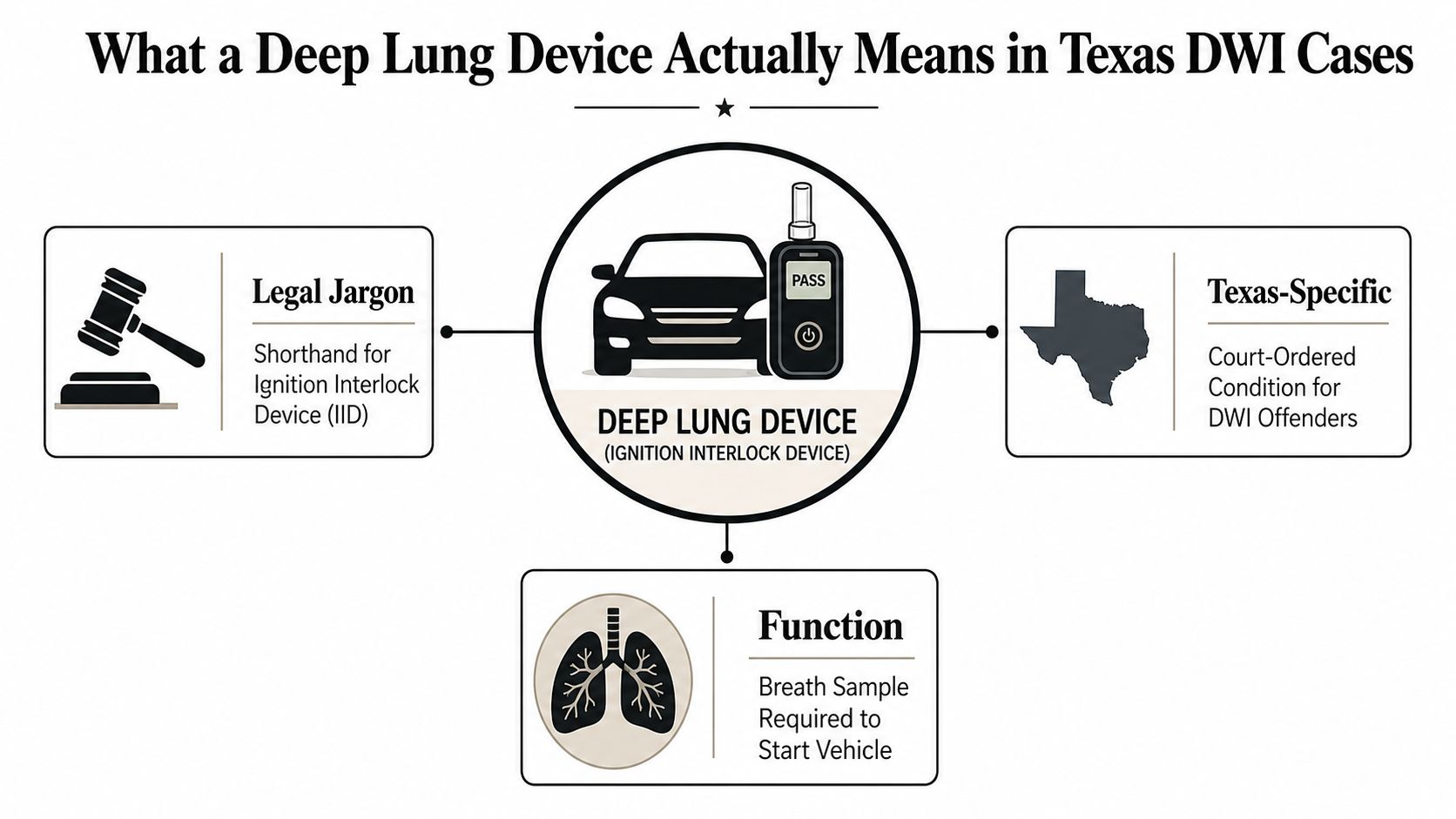
In plain English, a deep lung device texas case is one where the court uses the device to check whether alcohol is in your breath before the engine will start. Texas policy describes it as making vehicle operation impractical when alcohol is detected in the driver's breath, and the law can require installation on the vehicle owned by or most regularly driven by the defendant. In Texas DWI practice, the phrase “deep lung device” is common shorthand for the ignition interlock device, or IID.
Why people confuse the term
The confusion makes sense. A lot of drivers think of anything with a mouthpiece as a “breath test,” but the device in your car is not the same thing as the evidentiary breath machine used at the station. One controls whether the car starts, the other is used as evidence in the case. If you want a plain-language overview of when Texas requires one as a condition of driving, Ignition Interlock Devices in Texas DWI Cases is a useful reference point.
Practical rule: the device in your car is a compliance condition, and that matters because compliance issues can become evidence later.
That distinction matters because a defense lawyer does not just ask, “Did the device beep?” We ask what happened, when it happened, who maintained the device, and whether the State can prove the event means what they say it means. In a real Texas DWI case, those questions can shape bond terms, probation terms, and how aggressively the State pushes the charge.
How a Deep Lung Device Works and Why Texas Uses It
The device functions as a gatekeeper for the ignition. You give a breath sample, it checks for alcohol, and if the reading is too high, the engine will not start. In Texas practice, the device may stop the car from starting if the measured breath alcohol concentration is 0.030 or above.
The parts people actually deal with
A typical setup includes a mouthpiece, a handheld unit, and a sensor connected to the vehicle. Some systems also require a rolling retest while you are driving, which means the device can ask for another breath sample after the car is already moving. That catches a lot of drivers off guard, because they assume the test happens only once. It does not. The device may also store a data log, which is one reason defense lawyers pay close attention to maintenance records and download reports.
Texas uses the IID because the State views it as a public-safety tool, not just a punishment. The order can also tie into the rules that affect when a person may drive after an arrest, as explained in a driver's guide to Texas implied consent laws. Texas legal explanations also note that an order is usually supposed to be installed within 30 days after the order is entered.
That timing matters when you are trying to get your life organized after an arrest. A missed deadline can create a second problem on top of the DWI charge itself. If you are already dealing with bond terms, a Houston DWI lawyer or Texas DUI attorney will usually look at the device condition alongside the rest of the case, not in isolation.
The State treats the device like a safety measure, but in court it still has to hold up like evidence.
The legal reason Texas uses it
Texas does not rely on the IID because it is perfect. Texas relies on it because judges and DPS can supervise it, and because the device creates a measurable record of compliance. That is why the device sits at the crossroads of punishment, monitoring, and license restrictions, rather than existing as a simple add-on. A driver in a first DWI in Texas case can end up dealing with the device even before the criminal case is over, depending on the order entered.
Texas Statutes and DPS Rules That Control the Device
Texas law gives judges and probation officers specific ways to require an IID, and those rules are not limited to repeat offenders. State policy analysis explains that an IID can be ordered as a condition of bond for repeat offenders, and probation conditions can also require it for repeat offenders, first offenders with a BAC of 0.15 or higher, and first offenders under age 21. The practical point is simple, the device can appear early in the case and stay attached to the case for a while.
What the rules look like in practice
A Texas legal source explains that defendants usually have 30 days to install the device after an order, and the device may stop the engine if the breath reading hits 0.030 or higher. Texas also has a formal DPS administrative process for ignition-interlock devices, which shows the State is actively supervising how these devices are handled.
| Texas Deep Lung Device Thresholds and Deadlines | ||
|---|---|---|
| Trigger | Threshold or Deadline | Source |
| Repeat offenders | IID may be required as a bond condition | State policy analysis |
| First offender with high BAC | IID may be required when BAC is 0.15 or higher | State policy analysis |
| Installation after order | Usually 30 days | Texas legal source |
| Breath cutoff | May prevent starting at 0.030 or above | Texas legal source |
| Medical breath limitation | Reduced 1.2-liter sample allowed for diminished lung capacity | Texas Administrative Code |
A small but important rule appears in the Texas Administrative Code. For an IID user with diminished lung capacity, the rules allow a reduced minimum breath sample of 1.2 liters. That matters because not every missed blow means the same thing. Some drivers have medical limitations, and Texas recognizes that in the rule itself.
If you are sorting out implied consent issues at the same time, a plain explanation of the law is available at A Driver's Guide to Texas Implied Consent Laws. For drivers charged under the statute itself, Texas DWI Defense Lawyer is the relevant practice page for a case under Texas Penal Code 49.04.
The key point is simple. These are not random instructions from a vendor. They are DPS-supervised rules with legal consequences, and that gives a defense attorney room to examine whether the order, installation, calibration, or alleged violation was handled correctly.
Your First 15 Days After a DWI Arrest
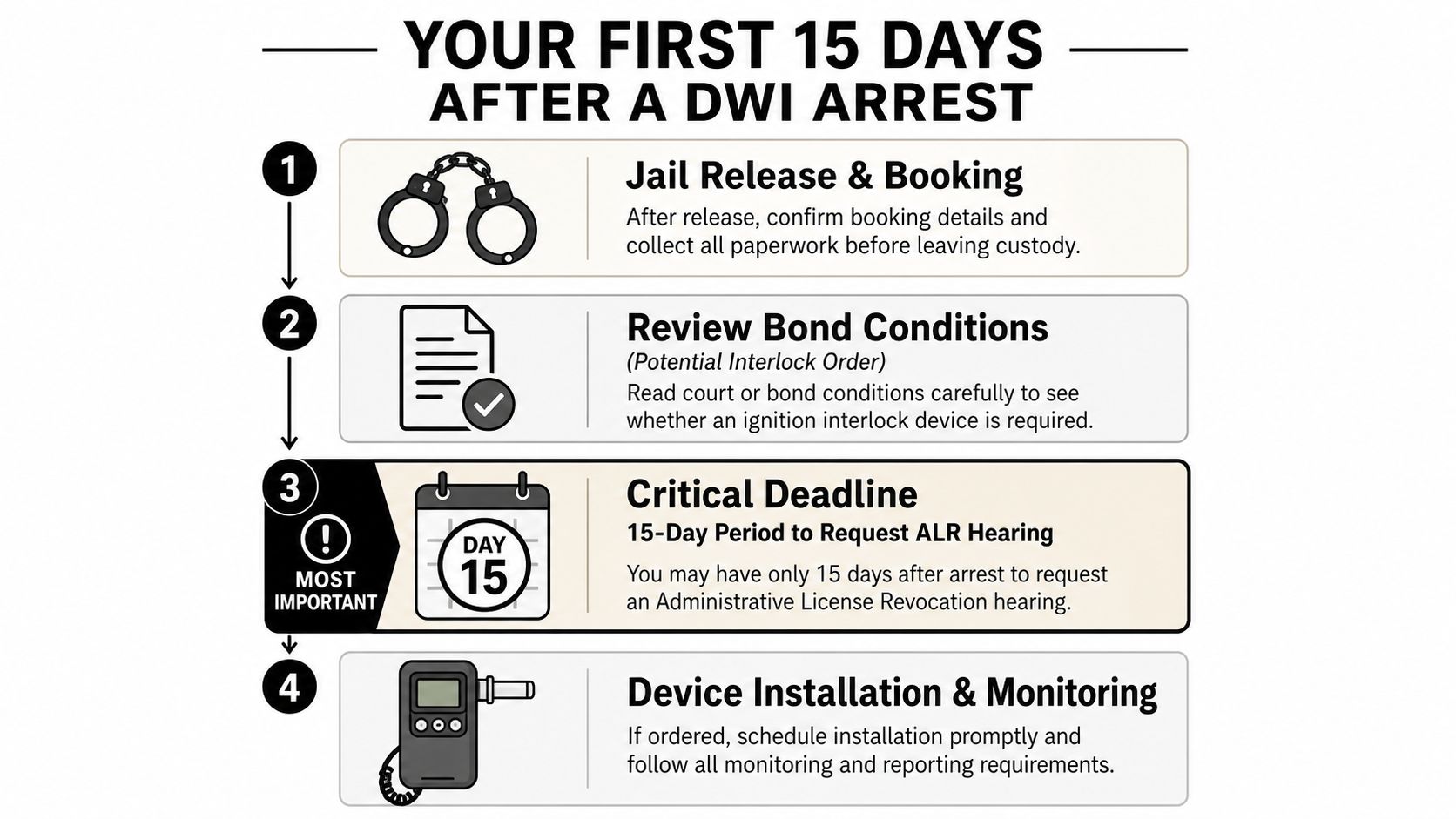
The first two weeks after a DWI arrest often feel like a blur, especially when bond paperwork, court conditions, and license issues all arrive at once. Once you are released from jail, an interlock order can show up before you have had time to make sense of the arrest. Texas law also gives you a short window to request an ALR hearing, so the deadline starts running right away after the arrest.
What happens first
After the arrest, you will usually receive paperwork that includes a temporary driving permit and a notice tied to the DIC-25 form. If you are released on bond, read every condition closely, because the court may require an interlock before the criminal case is finished. Missing a bond term can create a new problem while the DWI case is still pending.
The ALR hearing is an administrative license hearing, not the criminal trial. A hearing at the State Office of Administrative Hearings decides it. That hearing matters because it is often the first place your lawyer can fight for your driving privilege and challenge whether the State handled the stop, the arrest, and the warnings the way it claims.
The questions that can matter most
The hearing is about proof, not frustration. The State has to show the stop, the arrest, and the warnings were handled properly.
A defense lawyer will often focus on these issues:
- Reasonable suspicion for the stop, meaning the officer needed a lawful reason to pull you over.
- Probable cause for the arrest, which is the legal basis for taking the case from a stop to a DWI arrest.
- Implied consent warning, which should be read correctly before chemical testing is requested.
- Breath test procedure, including whether the machine and operator followed the required process.
The hearing can stop or shorten a suspension if the State's proof is weak. That is why the 15-day deadline should not be missed. If you are already worried about a DWI license suspension, this is the first deadline your Texas DWI lawyer will look at.
The days after an arrest also set up the later fight over the interlock itself. If the device later records a missed blow, a failed start, or a strange reading, those records can become part of the defense picture. Maintenance logs matter for that reason, and a resource like DUI Intoxilyzer Maintenance Records shows why service and calibration records can become a pressure point in a Texas DWI case.
Reliability Problems That Open the Door to Defense
Prosecutors often talk about the deep lung device as if it produces a clean, final answer. Real life is messier than that. A breath device can react to alcohol that is not coming from recent drinking, and those events matter once a violation is written down and treated like proof. Mouthwash, hand sanitizer, bakery items, and other alcohol sources in the environment can all affect a reading, especially when the timeline is unclear or the device log leaves gaps.
Where the device can go wrong
The device can also have technical problems. Calibration drift can change how the machine reads breath samples over time, and sensor saturation after a very high reading can raise questions about what happened next. Temperature and humidity inside a vehicle can affect performance too, and the rolling retest adds another layer because the driver has only a short window to comply.
A defense lawyer does not just say the device is wrong. We ask for the records that show whether it was serviced, calibrated, and maintained the way the State claims. Maintenance records matter because they show whether the State can trust the machine enough to use it against you. A close look at DUI Intoxilyzer Maintenance Records helps explain why service and calibration history often become a pressure point in a Texas DWI defense.
Medical and practical issues matter too
Texas also recognizes diminished lung capacity through the 1.2-liter reduced sample rule in the Administrative Code. That is not a loophole. It shows the law expects some drivers to have legitimate breath limitations. If your medical condition affected the test, the device event should be reviewed in that context, not treated like a clean failure.
- Request the device log: It can show what the machine recorded and when.
- Demand calibration records: They help show whether the device was reading accurately.
- Subpoena maintenance history: A service trail can expose recurring issues.
- Use expert review when needed: A qualified witness can explain why the readout does not mean what the State says it means.
The point is not to pretend the device never works. The point is that the device is evidence, and evidence can be challenged. Once a deep lung device is treated that way, it stops being a black box and becomes something a lawyer can cross-examine like any other piece of proof.
Defense Strategies That Move the Needle
A defense in a Texas DWI case starts with the ALR hearing, but it does not end there. The same facts that affect your license can also shape the criminal case, especially when the State relies on breath evidence and interlock violations to create pressure. A lawyer who handles fight DWI Texas cases will usually separate the stop, the warnings, the test, and the paperwork, because one weak point can change the whole case.
Three layers of defense
The first layer is the ALR hearing, where the questions are whether the stop was lawful, whether the arrest was supported, and whether the implied consent warning was given correctly. The second layer is pretrial motions to suppress, which asks the judge to keep evidence out when police obtained it unlawfully or failed to follow required procedure. The third layer is trial defense, where the lawyer cross-examines the officer and checks whether the State can explain the device records, observation period, and breath testing process without contradictions.
Refusal cases matter too. Many drivers do not realize that refusing a breath test can trigger its own automatic suspension under Texas implied consent rules, even when the State still has to prove the underlying DWI. That is why the refusal analysis and the device analysis often belong in the same file, even if the driver made those choices at different moments.
Where the pressure points usually are
A defense team may challenge:
- Reasonable suspicion and probable cause, because the case can weaken if the stop or arrest was shaky.
- Operator certification, because the person running the machine should be properly qualified.
- Maintenance and calibration proof, because unreliable records can undercut the device result.
- Chain of custody and event documentation, because a report without context can be misleading.
Breath-test disputes often turn on the paper trail, not just the number on the printout. A close look at accuracy of breathalyzers helps show why machine results can be challenged when the surrounding records do not fit together. In the right case, a motion to suppress can keep unreliable evidence out, and that can change how the prosecutor evaluates your case.
A weak record is not the same thing as a strong case, even when the State says the device “worked.”
A Texas DWI attorney can also compare the interlock record to the officer's report, which is where inconsistencies often show up. If the officer says you refused, but the device log shows a different sequence, that is not a small detail. It is a defense issue.
Your Next Steps and How a Texas DWI Lawyer Helps
If a deep lung device is part of your case, the safest next move is practical and immediate. Ask for the ALR hearing within the deadline, keep every record tied to the stop and the device, and do not drive on a suspended license. Then get legal help quickly, because the sooner a lawyer reviews the paperwork, the better the chance of finding an error in the stop, the order, or the device record.
A client usually feels pressure from two sides at once. The criminal case can affect fines, jail exposure, and probation, while the device can affect daily driving and license status. A lawyer helps sort out those pieces before they blur together.
A simple roadmap
- Act on the ALR deadline immediately: The hearing request has to be made on time.
- Save every paper and text: Bond paperwork, warning forms, device notices, and service receipts can matter later.
- Avoid new violations: A suspended-license problem can make the case harder, not easier.
- Get a case review: A lawyer can look at the device data, the officer's report, and the license issue together.
A Houston DWI lawyer or Texas DUI attorney can help you understand whether the interlock order came from bond, probation, or a license restriction, and that distinction changes how the case is defended. The same point matters in first-time cases, repeat offenses, and underage drivers, because the legal path depends on where the State placed the device requirement. If you are still sorting out the basics, first-time DWI defense and ALR hearing resources can help you understand what happens next.
Texas drivers also need to look beyond the arrest day. The device can affect work schedules, family routines, and the way you use your vehicle, so the case has legal and practical consequences at the same time. A defense strategy should address the criminal charge, the administrative suspension, and the interlock condition together, because each part can affect the others. If expunction or later record relief becomes possible in your case, that issue belongs in the broader defense plan too.
A DWI arrest is overwhelming, but you do not have to face it alone. An experienced Texas DWI lawyer can challenge the deep lung device, the underlying stop, and every piece of evidence the State is relying on. The Law Office of Bryan Fagan, PLLC represents clients in Houston, Dallas–Fort Worth, Austin, San Antonio, and surrounding counties, and you can ask for a free consultation to talk through your options before the deadlines close in.
A CTA for Law Office of Bryan Fagan, PLLC.