
A DWI arrest can be overwhelming, but you don't have to face it alone. If you hold a commercial license, the worry hits fast. You're not just thinking about court, you're thinking about routes, dispatch, bills, and whether one stop just put your whole career at risk.
For a commercial driver DWI Texas CDL case, the stakes are different because the law treats your driving privilege as part of your livelihood. A simple mistake, a misunderstood test result, or a rushed decision after arrest can snowball into a long loss of work. The good news is that the process has clear pressure points, and once you know where they are, you can start protecting yourself.

Your Career Is on the Line a DWI Arrest for a CDL Holder
The first phone call after a DWI arrest can feel unreal. One minute you're on your way home, and the next you're trying to make sense of a license seizure, a court date, and a stack of papers you didn't plan for. If you drive commercially, that shock is doubled because your case is about more than a criminal charge. It's about whether you can keep earning a living.
A CDL holder doesn't have the luxury of treating this like an ordinary traffic matter. Texas CDL rules are tied to federal standards, and those rules can affect your commercial privileges even when the arrest happened in a personal vehicle. That's why a calm, organized response matters more than panic.
Practical rule: the first priority is not guessing what will happen. It's identifying which deadlines are already running and which facts the state will try to use against your license.
A driver in this position usually needs two things right away, a clear explanation and a defense plan. That includes understanding the lower BAC threshold, the administrative hearing process, and the way a DWI can affect both your criminal record and your CDL. The DWI and Commercial Drivers (CDL) in Texas page is a useful starting point if you want a focused overview of why these cases are treated so seriously.
The image at the top reflects a real concern many drivers have, the fear that one arrest might cost years of hard work. That fear is understandable. It's also why the right next step is to slow the process down, identify your deadlines, and put a defense in place before the state does the same.
Why a DWI Is Different for Texas CDL Holders
Texas holds commercial drivers to a tighter standard because the law views a CDL as a safety-sensitive credential. When you're operating a commercial motor vehicle, the BAC limit is 0.04%, which is half the 0.08% limit used for non-commercial drivers, and federal rules require a 1-year CDL disqualification for a first DWI conviction or test refusal, with a lifetime disqualification for a second offense (Texas DWI impact on CDL). That difference matters because the state does not need the same margin for error that it would have in an ordinary passenger-vehicle case.
Just as a pilot is held to a stricter standard than a passenger due to the inherent responsibility of the role, a CDL holder faces similar heightened expectations. Texas law addresses the additional risk commercial vehicles present, resulting in a lower threshold and more severe consequences.
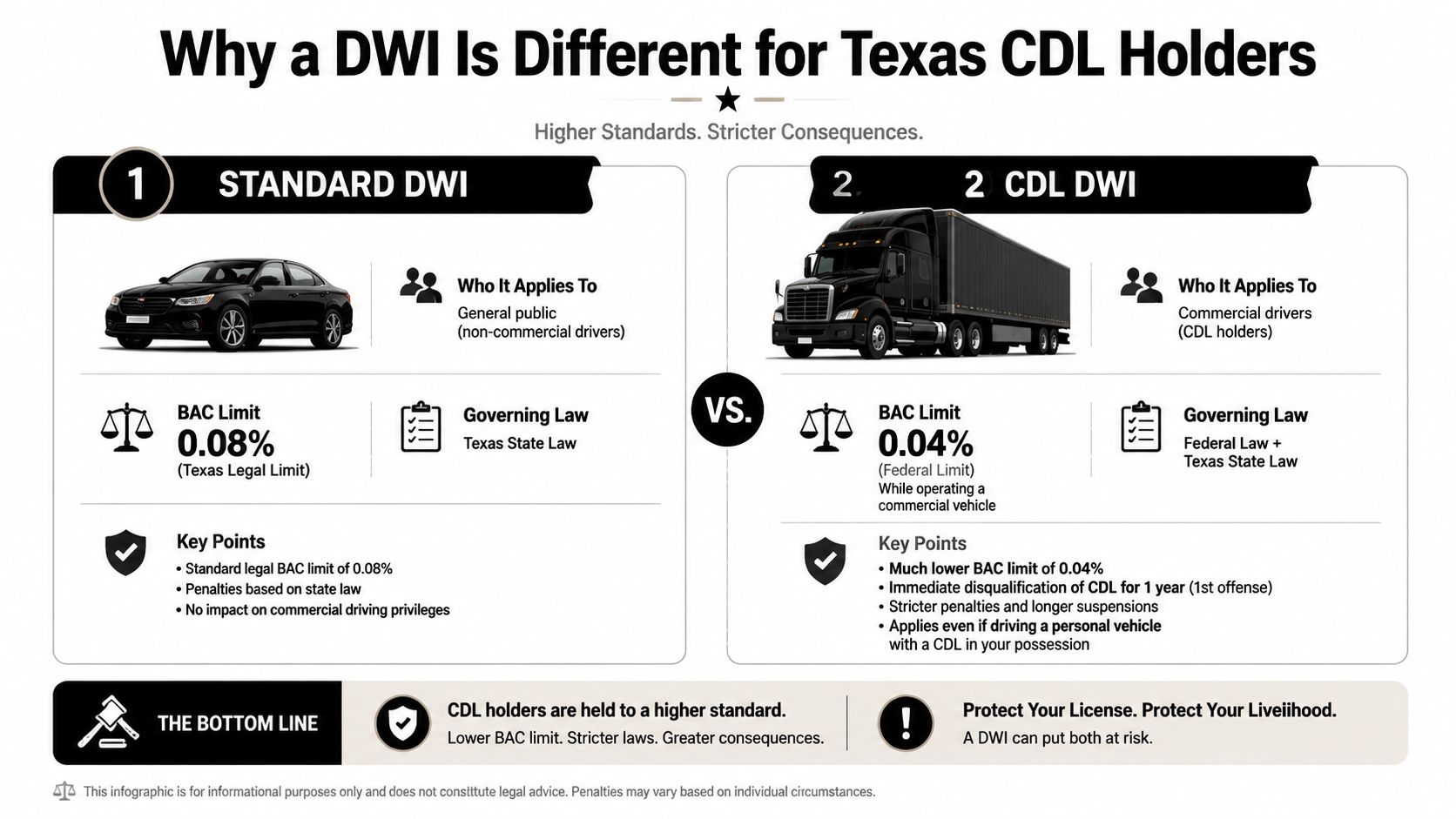
The lower threshold is especially important because the case can turn on a small number. In a CDL matter, that makes the testing process far more sensitive. A breath sample, a blood sample, or a timing issue can change the entire result.
A common misunderstanding is that your CDL is only at risk if you were driving the rig. That's not true. Texas treats a CDL-holder DWI in a personal vehicle as a CDL-disqualifying event, and that's one reason these cases need to be defended aggressively from the start. Even a stop after dinner, while driving your own truck or car, can have consequences far beyond the criminal courtroom.
The commercial threshold also changes how you think about evidence. What might look close to normal in a standard DWI case can be critical when the line is much lower. That's why testing accuracy and timing matter so much in a Texas commercial driver DWI Texas CDL defense.
Criminal Penalties vs CDL Disqualification
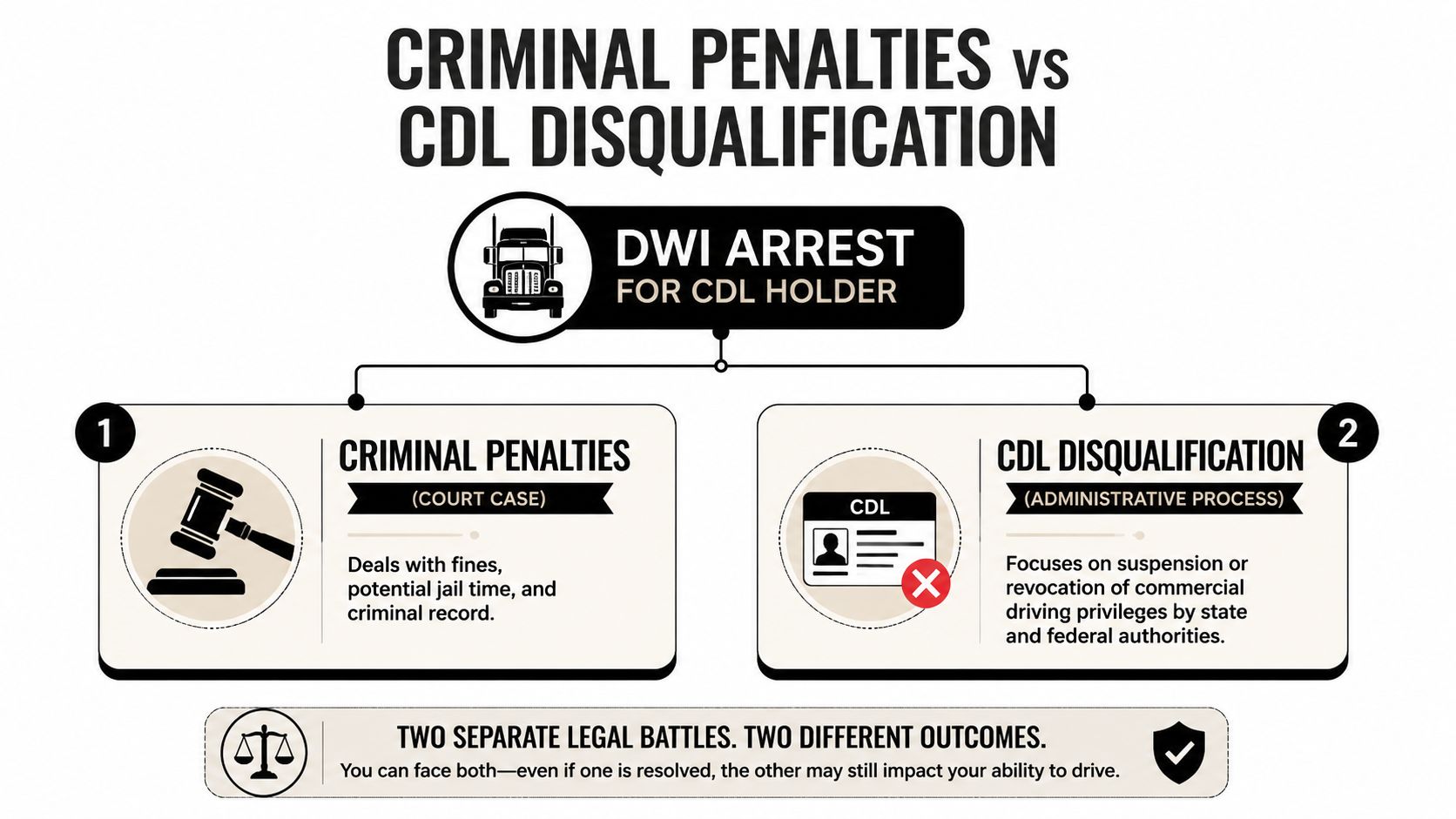
A lot of drivers think there's one case after arrest. There are two. The criminal case is handled in court, and the CDL consequence is handled through licensing rules and administrative action. Those tracks overlap, but they're not the same thing.
The court case can bring the usual DWI penalties, like fines, probation, and possible jail exposure. The administrative case is about your commercial privilege. Texas DPS imposes a one-year CDL disqualification for a first DWI-related CDL offense, and that period increases to three years if the driver was transporting hazardous materials that require placards. A second DWI offense can lead to lifetime CDL disqualification (Texas criminal defense group).
Two separate battles
The criminal case asks whether the state can convict you. The CDL process asks whether you should keep the legal right to drive commercially. Those are not interchangeable questions. You can win one and still lose the other if the deadlines or evidence go against you.
A CDL driver can be cleared in one forum and still face a serious licensing consequence in the other. That's why every move has to be coordinated.
The distinction matters even more because CDL consequences can follow a DWI in a personal car. In other words, the state is not just looking at what vehicle you were in. It's also looking at your status as a commercial driver and the event that triggered the case. That's where many drivers get blindsided.
If you're trying to fight DWI Texas charges, the first strategic step is to stop thinking in one-track terms. Your defense has to address both the court case and the license consequences at the same time. That's true whether you're dealing with a first DWI in Texas or a repeat allegation that could trigger harsher treatment.
Your First 15 Days The Critical ALR Hearing Deadline
The clock starts fast after a Texas DWI arrest. For a commercial driver, timing is not a side issue. Texas administrative rules make the deadline especially important because a driver generally has 15 days from notice to request an ALR hearing, and missing that deadline can trigger an automatic disqualification that becomes effective on the 40th day after service of notice (Texas Impaired Driving Plan).
What the ALR hearing does
The ALR, or administrative license revocation, hearing is separate from the criminal case. Its purpose is narrow, but the stakes are huge. It's where the state's administrative action against your driving privilege is challenged. If the request is made on time, you preserve your chance to contest that action instead of letting it take effect automatically.
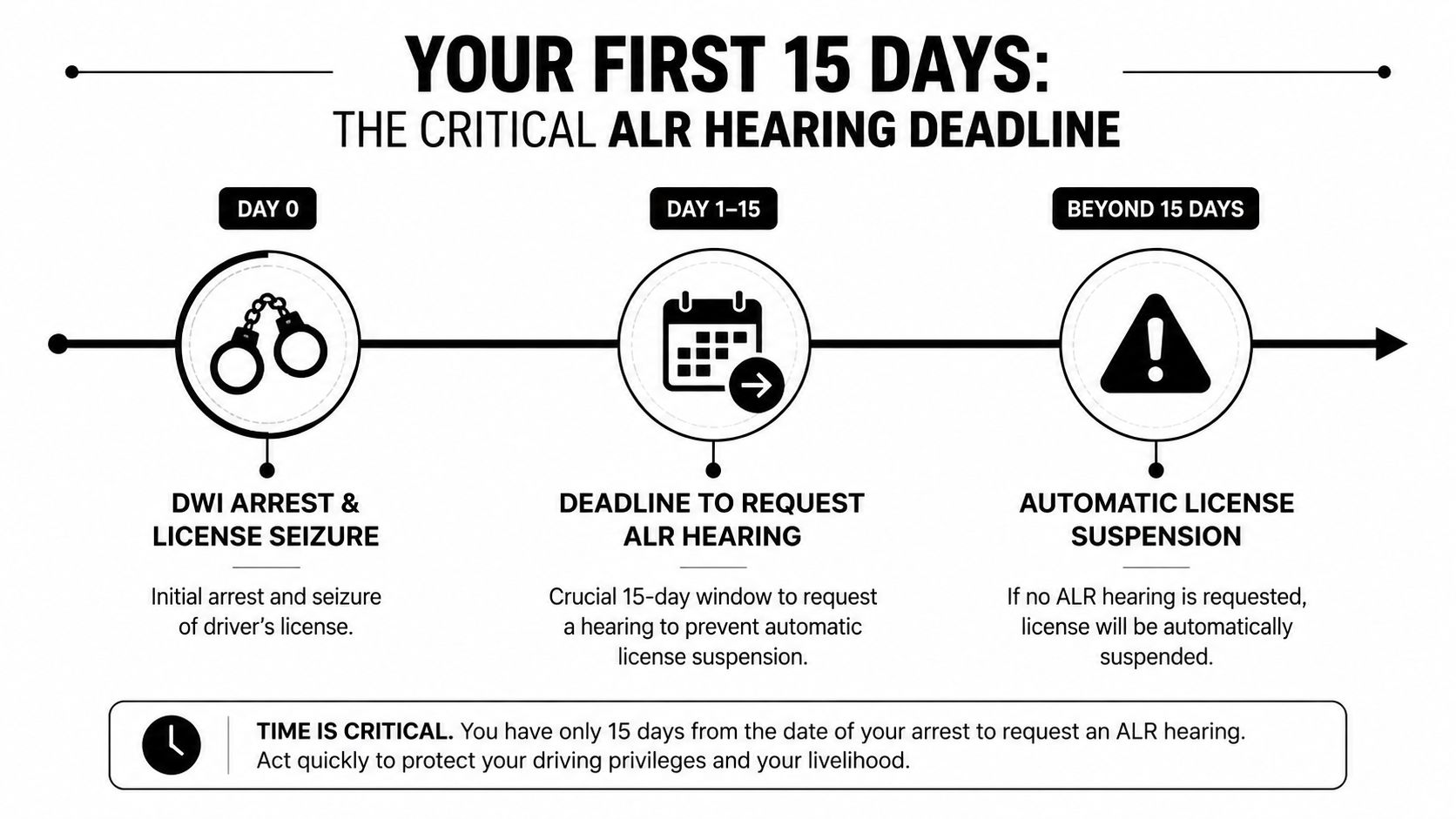
The point is simple. If you wait, the state can move forward without your input. If you act quickly, you give your lawyer a chance to challenge the stop, the warning, the test request, and the paperwork that follows. That can matter a great deal when your job depends on staying licensed.
Practical rule: don't treat the ALR deadline as paperwork. Treat it like the first defense move in the case.
A Texas DUI attorney can file the hearing request, track the service date, and make sure a missed notice doesn't become a missed opportunity. The process guide at Texas ALR hearing process guide is a helpful reference if you want to understand the basic structure of that hearing. You can also use the hearing itself to begin building the record for later court challenges.
The video below gives another visual overview of how these cases can unfold.
Employer Reporting DOT Testing and Your Job
Your arrest doesn't stay in the courtroom. For commercial drivers, it can affect dispatch, compliance, and future hiring. Employers in transportation are often required to look closely at driving records, and a DWI-related event can become part of that review.
The employment issue becomes sharper after a conviction or a license action. The practical reality is that a DWI can show up where employers check your record, and that can change how carriers view your reliability. If you're trying to protect your job, you need to know what information might surface and how your employer's policies fit into the picture.
DOT testing and return-to-duty issues
DOT-related consequences can involve drug and alcohol testing requirements, and some drivers may need to complete a substance abuse professional, or SAP, process before returning to safety-sensitive work. That's not a criminal penalty, but it can still affect when and how you get back behind the wheel. For drivers who work under federal safety rules, this can become just as disruptive as the court case itself.
The employer side is also where communication matters. You do not want to make careless statements to a supervisor or recruiter before you understand the legal consequences. The wrong admission can complicate both the job issue and the defense.
Keep your reporting factual and limited until your lawyer has reviewed the case. Short, accurate communication is safer than guesses or explanations.
If you're dealing with questions from management or HR, the page on DWI and Employers, Public and Private in Texas can help you think through the difference between workplace policy and criminal defense. That distinction matters because your employer may act on information before your court case is resolved.
The important thing is not to assume your career is already over. A DWI arrest can create serious friction, but the outcome depends on what happens next. In many cases, the best way to protect your job is to defend the underlying case hard enough that the administrative and employment fallout has less to stand on.
How a Houston DWI Lawyer Can Defend Your CDL
A strong defense starts by challenging the state's assumptions. In a commercial driver case, the numbers matter, but so do the facts that created those numbers. Because the CDL case can be lost on alcohol concentration alone without proving the same level of impairment required in a standard DWI, defense issues like testing accuracy, calibration, chain of custody, and timing of the sample become especially important (Texas DPS CDL disqualifications).
Where the defense pressure points usually are
A lawyer will usually start with the stop. If the officer lacked a lawful reason to pull you over, the evidence may be vulnerable. Then comes the testing process. Breath and blood results are only as reliable as the procedures behind them, and in a CDL case the difference between a passing and failing number can be especially narrow.
The field sobriety test is another common issue. These tests are subjective, and the conditions around the stop matter. Fatigue, road conditions, lighting, medical issues, and nerves can all make the results less reliable than they appear in a report.
A defense lawyer may also review the paperwork and the machine records, looking for gaps that weaken the state's case. That includes the officer's training, the timing of the sample, and whether the state can connect the evidence to you in a way that holds up in court. For repeat cases or more serious allegations, the defense can also involve deeper review of the prior history the state is using.
The most important evidence is often not what the state says in the report. It's what the report leaves out.
For a commercial driver, this kind of review is not academic. It affects whether you keep driving, whether your employer keeps you on, and whether a short-term mistake becomes a long-term career problem. A Houston DWI lawyer who handles these cases regularly can coordinate the criminal defense and the ALR strategy at the same time.
When the case calls for broader DWI defense work, the firm's Felony DWI in Texas practice page may also be relevant, especially if the facts involve prior incidents or more serious exposure. The point isn't to guess the result. It's to force the state to prove every part of its case.
The Law Office of Bryan Fagan, PLLC also handles commercial-driver DWI defense, and that matters because CDL cases require attention to both the arrest facts and the licensing consequences. In a case like this, the defense is built step by step, not by hoping the problem goes away.
Next Steps to Protect Your Livelihood
If you're holding a CDL, the main takeaways are clear. Texas uses a lower 0.04% BAC standard for commercial driving, the state can treat a DWI as both a criminal case and a licensing problem, and the 15-day ALR deadline can make or break your chance to fight back. Those are not small details. They're the pressure points that shape the outcome.
The good news is that a DWI arrest is not the end of the road. The state still has to follow the rules, prove its case, and respect the deadlines that protect your rights. A careful defense can challenge the stop, the testing, the paperwork, and the administrative action that threatens your CDL.
If you're looking at a DWI license suspension, or you need help with a first DWI in Texas, the safest move is to get legal help now, while the facts and deadlines are still in play. An attorney can help you request the hearing, evaluate the evidence, and build a plan that protects your work as much as possible.
Contact Law Office of Bryan Fagan, PLLC for a free consultation if you're facing a commercial driver dwi texas cdl case. A lawyer can review your arrest, explain your options, and help you take the next step to fight DWI Texas with a defense strategy aimed at protecting your license, your record, and your livelihood.