
A DWI arrest can be overwhelming, but you don't have to face it alone.
If you've just been told your case is a felony, your mind probably went straight to the worst possibilities. That reaction is normal. What matters next is understanding which facts drive a felony DWI defense Texas case, because the label on the arrest report is only the starting point, not the ending.
A calm, early response can change the whole case. The state still has to prove its theory, and in felony DWI cases, that often turns on records, testing, deadlines, and procedure, not just what happened on the roadside.
When a Texas DWI Becomes a Felony
You might be sitting at home after an arrest, replaying every second of the stop. The officer said “felony,” and now everything feels heavier. The first question is simple, what makes the charge a felony in Texas?
In Texas, a DWI usually becomes a felony because of repeat conduct or serious injury or death. Texas law treats a DWI as a felony in four main situations, a third or subsequent DWI, a DWI with a child passenger under 15, intoxication assault, and intoxication manslaughter. Texas guidance also explains that prior convictions never “wash out,” so older convictions can still be used to enhance a new case Texas felony DWI guide.
Why the charging theory matters
The charging theory shapes everything that follows. A case built as a third-offense felony is fought differently from a case involving a child passenger or an injury crash, because the State has to prove different facts and different records. That is why a defense lawyer has to look at the State's theory from the start, not just the arrest report.
The earliest conversations with a Texas DUI attorney should focus on the exact enhancement theory. If the State relies on prior convictions, the defense has to examine whether those priors are legally usable and whether the State can prove them with certified records. That question often decides whether a case stays in felony territory or falls apart as an enhancement theory. A useful overview of those issues is in this discussion of felony enhancement in Texas DWI cases, and it matches what defense lawyers look at when they review old judgments, fingerprints, and booking records.
A practical example helps. Two people can both be arrested for DWI in Texas, but only one may face felony exposure because of prior convictions or a child passenger. The road stop is the same. The legal consequence is not.
Practical rule: don't let anyone talk about your case as if the felony label is automatic. In Texas, the felony theory has to be built and proved.
If you want a plain-English overview of enhancement issues, the page on Felony DWI in Texas: Third Offense and Child Passenger covers the basic felony triggers in a factual, straightforward way.
What the Law Says About Felony DWI in Texas
A felony DWI charge in Texas does not all turn on the same rule. The State has to choose a legal theory, and each theory brings its own proof problems. A defense lawyer looks there first, because the weak point is often in the way the State tries to prove the case, not just in the arrest itself.
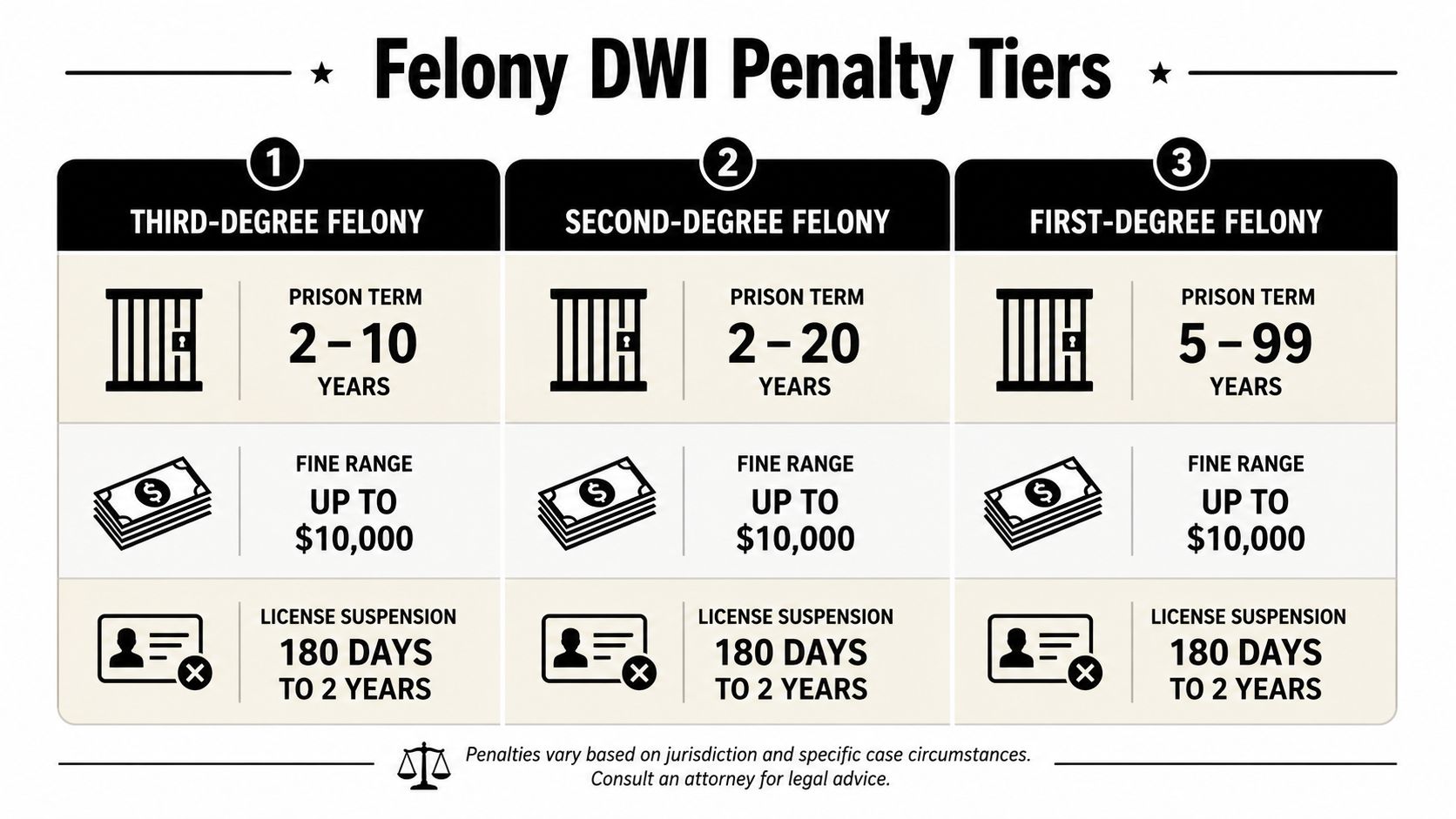
The four felony triggers
Texas treats a DWI as a third-degree felony when the person has two or more prior DWI convictions under Texas Penal Code §49.09(b). The usual punishment range is 2 to 10 years in prison and a fine of up to $10,000 Texas Penal Code overview. A DWI with a child passenger under 15 is charged as a state-jail felony under §49.045.
The other felony theories are tied to harm. Intoxication assault and intoxication manslaughter are separate offenses that come into play when someone is injured or killed. Texas penalty guidance describes intoxication manslaughter as a second-degree felony with 2 to 20 years, and an enhanced case can reach first-degree felony punishment of 5 to 99 years felony DWI penalties. For a plain-English breakdown of punishment ranges, see Texas DWI penalties.
The prior-conviction issue matters a lot. The State cannot point to an old DWI arrest and call the new case a felony. It has to prove the earlier convictions in a way the court can legally use, usually through certified records, and that proof can decide whether the case stays a felony or loses its enhancement theory.
A plain way to read the charge
If the paperwork says third offense, the State is saying your prior record changes the new DWI into a felony. If it says child passenger, the focus is on who was in the vehicle. If it involves a crash, the question shifts to injury or death and the punishment that follows.
That same basic framework is what the page on Felony DWI in Texas: Third Offense and Child Passenger explains in a straightforward way.
The law gives the State its labels. The defense job is to test whether the State can prove every part of the label it chose.
Felony DWI Penalties You Could Be Facing
A felony DWI case feels terrifying because the punishment range is wide, and the State knows it. The better way to read it is step by step, because the number on the charging paper is only part of the story. The other part is whether the State can prove the prior convictions, the extra facts that raise the charge, and the deadlines that affect both the license case and the criminal case.
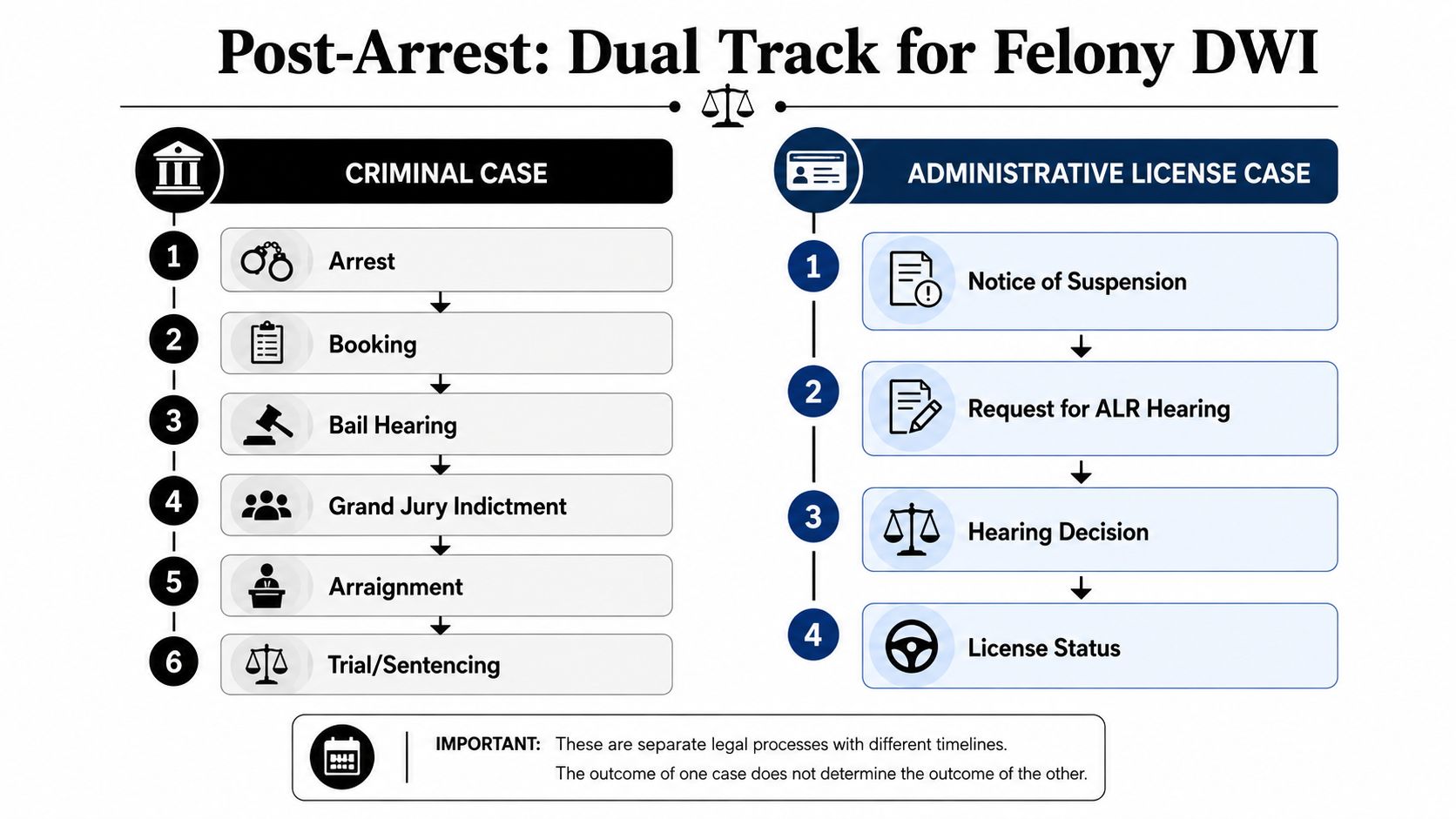
What each felony tier can mean
A third-degree felony DWI under Texas law generally carries 2 to 10 years in prison and a fine up to $10,000 Texas Penal Code overview. That is the range commonly associated with the term “felony DWI,” but it is only one category.
A state-jail felony for a child passenger DWI is serious in a different way, because the punishment tier changes with the facts of the stop Texas felony DWI guide. A second-degree felony intoxication manslaughter case can bring 2 to 20 years, and an enhanced version can reach a first-degree felony range of 5 to 99 years felony DWI penalties.
A person looking at those ranges usually wants one clear answer, but Texas felony DWI law works more like a set of doors. The charge the prosecutor picks depends on prior convictions, who was in the vehicle, or whether the case involves injury or death. If the State opens the wrong door, or cannot prove the facts needed to keep it open, the punishment exposure changes with it.
Why conviction rates matter in real life
The punishment range is only one side of the story. Texas DPS says its quarterly DWI reporting tracks arrests, convictions, prior DWI history, and recidivism, which shows how central repeat-offender patterns are to enforcement Texas DPS reporting. In the statewide 2020 data cited by DPS, Texas recorded 83,088 DWI charges, with 33,476 guilty pleas, 23,258 convictions on the original charge, 10,302 convictions on a different charge, 6,771 dismissals, and 3,275 releases with no charge.
Those numbers do not predict your case. They do show that many cases are resolved before trial, and the early work often decides whether the State keeps the felony theory or has to retreat to a lesser result. That is where prior-conviction proof, bond conditions, and the 15-day deadline for the license case start shaping the pressure on both sides.
The State also has to prove the old case correctly, not just point to a past arrest and call the new case a felony. Certified records, matching identifiers, and the way the prior judgment is presented can decide whether the enhancement holds or falls away. For a plain-English overview of the punishment side, see Texas DWI penalties.
What Happens After a Felony DWI Arrest
A felony DWI case splits in two right away, one track in criminal court and one track with DPS over the driver's license.
The two-track process
The criminal case starts moving through booking, bond, arraignment, motions, plea talks, and possibly trial. The license case runs on its own schedule, and that separation catches a lot of people off guard. A court date does not pause the license deadline.
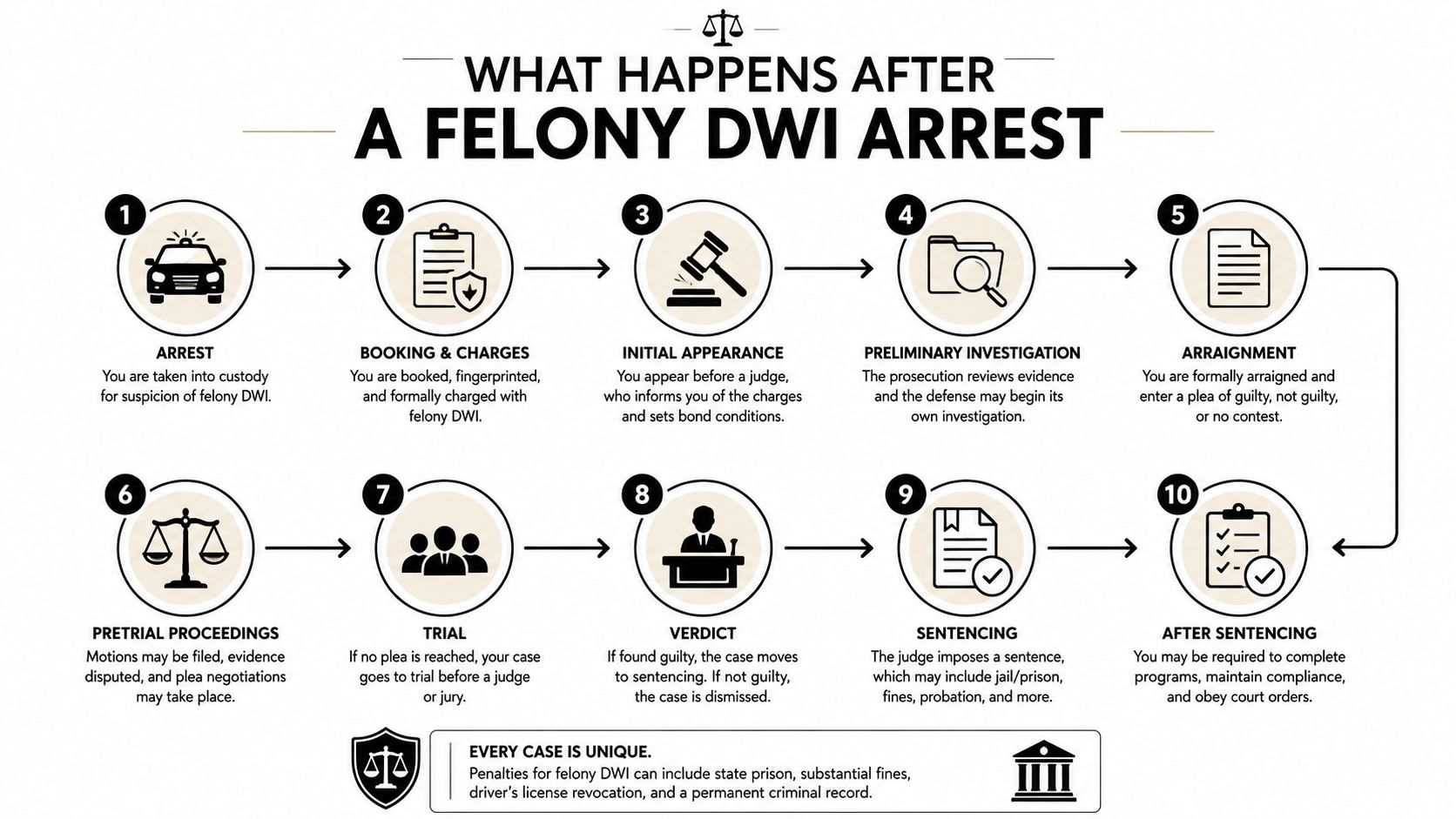
The first administrative deadline often matters more than people expect. Texas guidance says you must request the ALR hearing within 15 days to contest the license suspension, and if that deadline is missed, DPS can suspend the license automatically ALR and bond guidance. That short window can shape the pressure on both cases before the criminal court has even held a meaningful hearing.
Bond and early leverage
Felony bond is usually set case by case, not by a simple misdemeanor schedule, and the amount can be much higher depending on the charge and the person's record ALR and bond guidance. For a family, that can mean the difference between keeping a job, arranging childcare, and being able to sit down with a lawyer in time to prepare.
Early defense work is not just about getting out of jail. It is about protecting the record, saving video, asking for hearing dates, and keeping defense options open before the case hardens. That matters in a DWI license suspension case because a missed administrative deadline can create pressure in the criminal case long before trial.
A good attorney also looks at the driver's status, since commercial drivers and out-of-state motorists can face separate problems from the same arrest. If that applies to you, the license strategy needs to start immediately, not after the criminal case has gone quiet.
The State also has to prove the prior convictions in a usable way. A past arrest is not enough, and a felony theory can still fail if the records are incomplete, the identifiers do not match, or the judgment is not presented correctly. For a broader overview of how lawyers challenge these cases, see how lawyers beat DWI cases in Texas.
Defense Strategies That Can Beat a Felony DWI
Felony DWI defense is won in the details. The people who get into trouble are often the ones who assume the State's file is solid because the charge sounds serious.
Where the defense starts
The first question is whether police had a lawful reason to stop the car. A stop without reasonable suspicion can lead to suppression of evidence, and without evidence, the State's case can weaken quickly. The next question is probable cause for the arrest, because an arrest without proper cause can also create suppression issues.
Then comes the science. Field sobriety tests are not magic. They're a mix of balance, instruction, stress, medical issues, surface conditions, and officer interpretation. Breath and blood testing can also be challenged for accuracy, collection problems, warrant issues, and chain-of-custody gaps.
Practical rule: a good defense lawyer doesn't ask only, “Did you fail the test?” The lawyer asks, “Was the test fair, reliable, and legally obtained?”
The enhancement fight is different
There's another battle that gets overlooked, and it matters a lot in felony cases. If the State is using prior convictions to enhance the charge, the defense should check whether those priors are the right kind of convictions, whether they were certified properly, and whether they count for enhancement. That issue can affect both exposure and bargaining power.
A Texas lawyer who routinely handles these cases may also use discovery, suppression motions, and ALR hearings to force the State to show its work. That's where a firm like the Law Office of Bryan Fagan, PLLC can fit naturally, since it handles DWI court defense, ALR work, and the records issues that come up when a felony theory is built on priors and testing.
The page on how lawyers beat DWI cases in Texas lays out some of the same defense themes in a practical format.
Collateral Consequences CDL Holders Professionals and Visitors Need to Know
A felony DWI doesn't stay in the criminal court file. It can follow you into your job, your license, and your future applications, which is why the defense has to look beyond jail and fines from the first meeting.
CDL holders and licensed professionals
If you hold a commercial driver's license, the risk is bigger than a normal DWI license issue. A CDL holder often depends on driving for income, so a suspension or conviction can hit work right away. The same is true for people with professional licenses, like nurses, teachers, lawyers, and medical professionals, where a criminal case can trigger separate board questions.
Immigration and out-of-state consequences
Immigration status also matters. A felony conviction can create problems tied to pending benefits, work authorization, or future naturalization issues, so the defense should know about that before any plea discussion starts. Out-of-state drivers have another problem, because a Texas felony DWI can travel back to the home state and create consequences there too.
If your case touches more than one state, the lawyer should plan for that early. Texas may be the arrest state, but it won't be the only place that cares about the result.

The questions you should ask right away
- Will this affect my CDL or professional license? If your work depends on a credential, the defense plan has to account for that.
- Do I have immigration concerns? If the answer is yes, your attorney should know before any plea strategy is discussed.
- What happens if I'm from another state? Your lawyer should think about reporting, reciprocity, and the ripple effect of a Texas conviction.
Those issues are why a Houston DWI lawyer should look at the whole picture, not just the criminal docket. A felony DWI case is often also a career case, a parenting case, or an immigration case.
How a Skilled Defense Firm Can Help and What to Do Next
A strong defense firm does the work that's easy to miss when you're scared and tired. It requests the right records, challenges the stop and the tests, watches the ALR deadline, and pushes back when the State leans on priors that may not hold up.
In the first 48 hours, do three things. Get your paperwork together, write down what happened while it's still fresh, and contact a lawyer who handles felony DWI cases regularly in Texas courts. If you have a CDL, a professional license, or immigration concerns, say that immediately.
A case like this can also connect to broader planning, including ALR hearings, first-time DWI issues, and expunction or record-sealing questions later on. The right defense plan looks at today's charge and tomorrow's consequences at the same time.
If you're trying to fight DWI Texas and you want a sober, practical review of your situation, don't wait for the case to define itself.
The Law Office of Bryan Fagan, PLLC helps Texans challenge felony DWI charges, license problems, and related criminal cases with a strategy built around the facts of your arrest. If you need a Texas DUI attorney who can look at the stop, the tests, the priors, and the ALR deadline together, visit Law Office of Bryan Fagan, PLLC and request a free consultation.