 Skip to content
A DWI arrest can be overwhelming, especially if you were trying not to drive.
You may have pulled into a parking lot, shut the night down, and decided to wait for a ride. You may have been asleep in your car. You may have thought staying parked was the responsible choice. Then an officer knocked on the window, asked questions, and suddenly you were arrested for DWI anyway.
That kind of charge leaves people stunned. They keep coming back to the same question: Can you get a DWI without driving in Texas? In many situations, yes. But that does not mean the State automatically has a strong case.
In these cases, the fight usually turns on details. Where were you sitting? Where were the keys? Was the engine running? What did you tell the officer? Was the car positioned in a way that suggested recent movement, or was it plainly being used as temporary shelter? Those facts matter because prosecutors often rely on circumstantial evidence, not direct proof of driving.
If you've been arrested in this kind of situation, the right response is not panic. It's strategy. A Houston DWI lawyer or Texas DUI attorney should look at both sides of the case: whether the State can prove you were operating the vehicle, and whether it can prove you were intoxicated under Texas law. Both issues can be challenged.
A DWI Arrest Is Overwhelming Especially When You Weren't Driving
Many individuals who end up in this situation weren't trying to test the law. They were trying to avoid making a worse mistake.
A common version goes like this. Someone leaves a bar, realizes they shouldn't drive, and decides to sit in the car while calling a friend or rideshare. Another person pulls over because they feel unsafe to continue. Someone else falls asleep in a parking lot with the heater on. Then police arrive, and the situation shifts from a safety decision to a criminal charge.
That shock is real. So is the frustration. You may feel like the system is punishing you for not driving.
What matters now: an arrest is the start of a case, not the end of one.
In practice, non-driving DWI cases are often more fact-sensitive than road-stop cases. The officer usually didn't watch a vehicle weaving through traffic. Instead, the State has to build a story from fragments: your location in the car, what the vehicle was doing, what you said, and what the officer claims to have observed.
That also means these cases can have weaknesses.
Why these cases feel so confusing
People hear "DWI" and think of a moving car, flashing lights, and a roadside stop. When that didn't happen, the charge feels illogical. The confusion gets worse when officers use terms that sound broader than everyday language.
The legal issue isn't always whether you were seen driving down the road. It often becomes whether the prosecution can convince a court that you had enough control over the vehicle to count as operating it while intoxicated.
Why you shouldn't assume the case is unbeatable
A parked-car DWI is serious, but it isn't automatic. The State still has to prove its case. If the facts show caution instead of control, or presence instead of operation, that can change the defense posture significantly.
If this is your first DWI in Texas, you also need to think beyond the criminal charge itself. Your driver's license, your job, your insurance, and your record may all be affected. The sooner a lawyer starts preserving evidence and examining the officer's report, the better your position usually is.
Understanding Operating vs Driving Under Texas Law
The key legal word in these cases is operating, not driving.
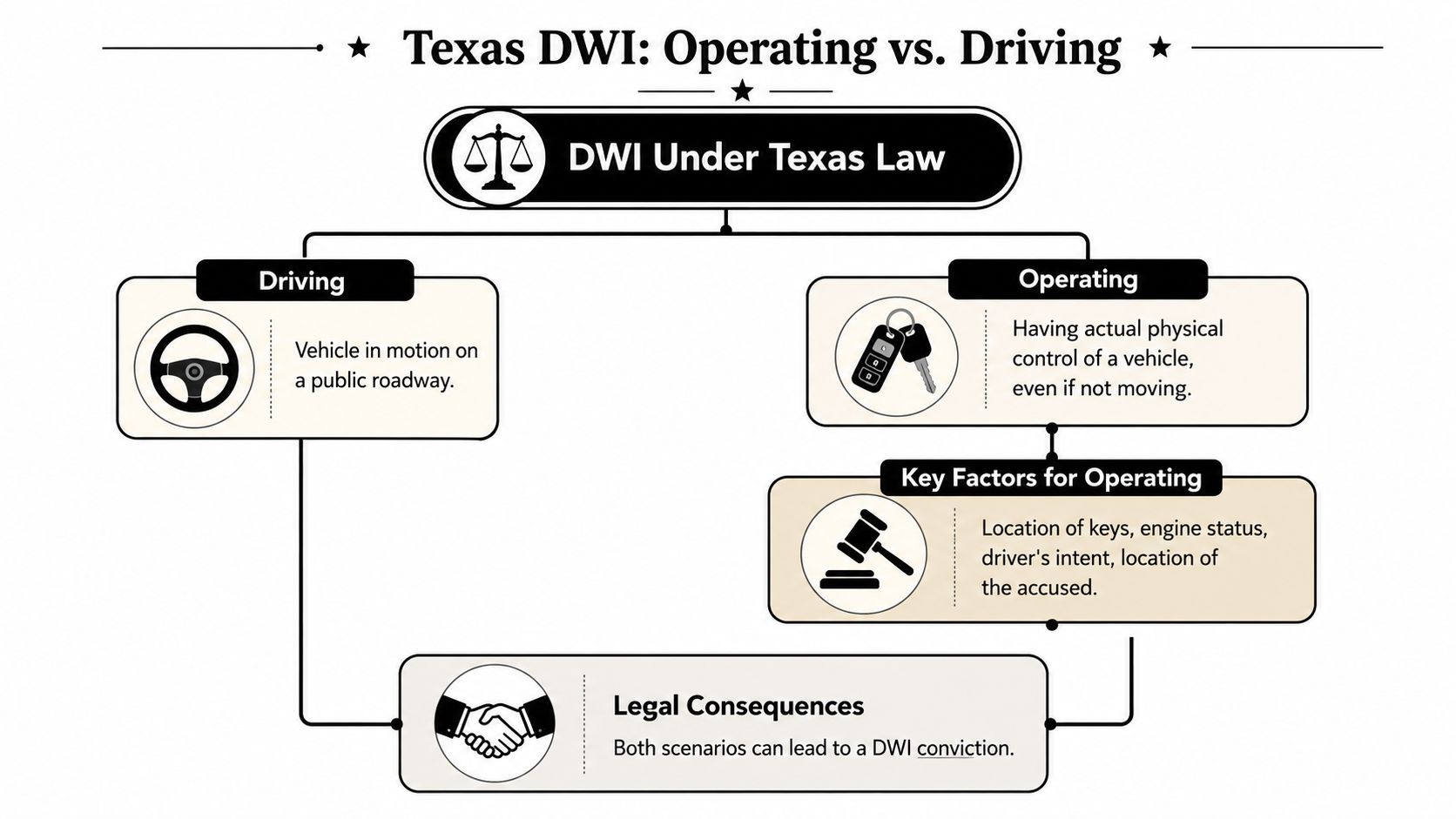
Texas law does not require an officer to witness the vehicle moving before a DWI charge is possible. The issue is whether the person was operating a motor vehicle in a public place while intoxicated. Texas practice materials note that a person can be charged even when not driving at the moment of police contact, and that shifts the State's burden toward circumstantial proof such as the person's position in the driver's seat, key location, engine status, admissions, and vehicle placement, as explained in this discussion of Texas DWI charges without observed driving.
What operating usually means in real life
Think of it this way. Driving usually means the car is moving. Operating is broader. It focuses on whether you exercised actual control over the vehicle in a way connected to its use.
That is why parked-car cases happen. A prosecutor may argue that a person in the driver's seat, with the keys accessible and the engine on, had immediate control over the vehicle even if the officer never saw the tires turn.
That doesn't mean every person found in a car is guilty. It means the argument shifts.
Presence is not the same as operation
This distinction is where many defenses begin. Being inside a vehicle isn't automatically enough. The State still has to prove more than simple presence.
A defense lawyer will look closely at facts that point away from control:
- Seat position: Were you in the back seat or passenger seat rather than behind the wheel?
- Vehicle condition: Was the engine off?
- Key location: Were the keys put away rather than in your hand or in a ready-to-use position?
- Context: Were you using the car as shelter while waiting for a sober ride?
A strong defense often asks a simple question: did the facts show actual control of the vehicle, or only that you were inside it?
Why this matters for anyone searching can you get a DWI without driving Texas
Regarding the question, can you get a DWI without driving Texas, you're really asking a more precise legal question. You're asking whether the State can turn your contact with a parked car into proof of operation.
Sometimes prosecutors can. Sometimes they overreach. The difference often comes down to details that seem small at first but matter a great deal in court.
Common Scenarios That Lead to a Non-Driving DWI
These arrests usually come from a handful of repeat fact patterns. The risk is not equal across all of them.
Texas-focused sources note that sleeping in the driver's seat, being in the vehicle with the engine on, or otherwise being in actual physical control can lead to arrest even without observed driving. They also point out a major practical issue: these cases are often won or lost on officer observations and circumstantial proof rather than BAC alone, as discussed in this article about parked-car DWI risk in Texas.
The most vulnerable scenarios
A person asleep in the driver's seat with the engine running is usually in a tougher spot. The same is true if the car is stopped in a lane of traffic, angled awkwardly on a shoulder, or positioned in a way that makes the officer suspect recent driving.
Another common problem is statements. If you told the officer, "I pulled over because I knew I shouldn't keep driving," that may have been honest and responsible, but it can also supply the State with evidence of recent operation.
Situations that may reduce risk
Other facts tend to weaken the State's operation theory. A person in the back seat, with the engine off, and keys stored away looks different from someone upright behind the wheel with the vehicle running.
That doesn't make the situation risk-free. It does give the defense more to work with.
For a closer look at one of the most common fact patterns, see this discussion of sleeping in your car and DWI risk in Texas.
Non-Driving DWI Risk Factors
| Factor | High-Risk Indicator Supports "Operation" | Lower-Risk Indicator Weakens "Operation" Claim |
|---|---|---|
| Your location | In the driver's seat | In the passenger seat or back seat |
| Engine status | Engine running | Engine off |
| Keys | In ignition, hand, or immediately available for use | Put away, less connected to immediate vehicle use |
| Vehicle placement | In roadway, shoulder, or odd position suggesting recent travel | Parked in a lawful space consistent with waiting |
| Statements to police | Admission that you drove or were about to leave | No admission of recent or intended driving |
| Overall scene | Facts suggest active control of the car | Facts suggest shelter, waiting, or sleeping only |
The practical trade-off people miss
People often ask whether moving to the back seat helps. In many cases, yes, it may help because it gives the defense a better argument that you were not in actual control of the vehicle. But no single fact guarantees safety.
For example, the back seat may help, but if the engine is running and your statements suggest an intent to drive soon, the prosecution may still push hard. On the other hand, even being in the driver's seat does not end the case if the rest of the evidence is weak.
The lesson is practical, not perfect. If your goal is to avoid a DWI allegation while staying safe, facts that separate you from immediate vehicle control usually put you in a better position than facts that keep you ready to drive.
How Police and Prosecutors Build Their Case
When there is no moving-stop evidence, police and prosecutors build a DWI case by connecting circumstances.

They look for facts that suggest both operation and intoxication. On the operation side, they may focus on key location, seat position, engine status, your statements, and where the vehicle was found. On the intoxication side, they look at your appearance, your speech, your coordination, and any chemical test.
A useful overview of the proof issues appears in this article on what evidence prosecutors use in Texas DWI cases.
How intoxication is alleged
Texas uses two distinct intoxication pathways. A person may be accused based on an alcohol concentration of 0.08 or more, or based on a claimed lack of normal use of mental or physical faculties due to alcohol, drugs, or a combination of substances, as described by the Dallas Police explanation of Texas DWI laws.
That matters because a non-driving DWI case does not rise or fall only on a breath number. If an officer reports slurred speech, bloodshot eyes, poor coordination, or poor performance on field sobriety tests, the prosecutor may still pursue the case. If drugs are suspected, a blood test may be used because breath testing will not detect many controlled substances.
Key terms you should understand
- BAC means blood alcohol concentration. In a DWI case, it refers to the alcohol concentration used in chemical testing.
- Field sobriety tests are roadside physical and divided-attention exercises officers use to claim signs of impairment.
- Implied consent means Texas drivers are deemed to have consented to requested breath or blood testing under certain circumstances after a DWI arrest. Refusing a requested test can trigger separate driver's license consequences.
- Administrative license suspension refers to the license action handled apart from the criminal case. In Texas DWI matters, this process is commonly addressed through the ALR system.
Officer observations often sound stronger on paper than they were in real life. That's one reason video, body camera footage, dispatch timing, and witness accounts matter so much.
A short video can help you understand how these proof issues play out in actual DWI investigations.
Where these cases often become contestable
The prosecution must link the dots in a convincing way. A person can be intoxicated but not operating. A person can be in a car but not impaired. A blood result can show presence of a substance without resolving when it was consumed or whether it caused impairment at the relevant time.
That is where a defense lawyer starts pressing on assumptions.
Strategic Defenses for a Texas Non-Driving DWI Charge
These cases are often defensible because the State usually has to infer too much.
Attack the operation theory
The first defense question is direct. Can the prosecution really prove you were operating the vehicle, or only that you were in it?
If you were sleeping in the back seat, waiting for a ride, or using the vehicle for shelter with facts that separate you from active control, those details matter. The defense may also use call logs, text messages, rideshare activity, parking receipts, or witness testimony to show your intent was to stay put, not to drive.
Defense focus: if the evidence supports caution rather than control, the State's operation argument may weaken quickly.
Challenge the officer's contact and investigation
Not every police encounter is legally clean. A lawyer may review why the officer approached the vehicle, how the contact escalated, what questions were asked, and whether any search, detention, or arrest was supported by the facts.
Body camera footage can be critical here. So can dispatch records and timestamps. Sometimes the report sounds polished, but the video tells a less certain story.
Push back on impairment evidence
Field sobriety tests are often presented as neutral science. In practice, they depend heavily on officer interpretation and on conditions that may have nothing to do with intoxication.
Fatigue, anxiety, medical issues, poor footwear, injury, and roadside conditions can all affect performance. The same is true when the State relies on generalized signs such as red eyes or unsteady balance. Those observations may sound persuasive until they are examined carefully.
Chemical testing can also be contested. A blood or breath result may raise questions about timing, procedure, causation, or whether the result proves impairment rather than mere presence.

Build the case around the facts that help you
A good defense is not just about criticizing the State. It is also about affirmatively organizing the facts that show what really happened.
That may include:
- Your safer choice: You stopped instead of continuing to drive.
- Your physical location: You placed yourself away from the driver's controls.
- Your lack of intent: You were waiting, sleeping, or arranging transportation.
- Your conduct with police: You were cooperative, but your words may have been taken out of context.
For people trying to fight DWI Texas charges, early case work matters. Some clients hire private counsel immediately. Others start by gathering records, preserving screenshots, and requesting all paperwork. The Law Office of Bryan Fagan, PLLC handles DWI defense work that includes reviewing stop legality, chemical testing issues, ALR matters, and trial preparation.
Why early strategy matters
If you wait too long, useful evidence can disappear. Surveillance video may be overwritten. Witnesses may become harder to reach. Your own memory of key details may fade.
That is especially important in non-driving DWI cases because the case often turns on context. Context is easiest to preserve early.
Your Next Steps After a DWI Arrest in Texas
After an arrest, the next few days matter. You need a plan.
Step one: keep every document
Save your citation, bond paperwork, towing records, notice of suspension, bail conditions, and any paper the officer handed you. Screenshot rideshare records, calls, texts, and location history if they help explain why you were parked and not driving.
Don't rely on memory alone. Small details often matter later.
Step two: act quickly on your license issue
Many people focus only on the criminal charge and miss the separate driver's license problem. In Texas, that process is often called an Administrative License Revocation, or ALR, matter. This is the proceeding tied to license consequences after a DWI arrest.
An ALR hearing gives your lawyer a chance to challenge parts of the State's case early. It can also provide useful testimony and records before the criminal case moves further. If you're dealing with a potential DWI license suspension, quick action matters.
For a practical checklist, review this guide on what to do immediately after a Texas DWI arrest.
Step three: prepare for what happens next
Your case may involve several stages:
Release and bond conditions
You may have reporting rules, travel limits, alcohol-monitoring conditions, or instructions not to violate new laws.License process
This is separate from the criminal prosecution and needs attention right away.Court dates and evidence review
Your lawyer obtains reports, video, test records, and other evidence, then evaluates legal challenges and defense themes.Negotiation or trial preparation
Depending on the facts, the case may move toward dismissal efforts, charge reduction discussions, deferred adjudication options in appropriate cases, or trial.
If you're worried about a first DWI in Texas, don't assume the only outcome is a conviction. The case has to be examined, not surrendered.
Step four: don't try to explain the case alone
Many people hurt their defense by trying to talk their way out of the charge after the arrest. Don't contact witnesses to pressure them. Don't post about the case online. Don't guess about legal terms with the court or the officer.
Speak with an attorney who handles these cases and understands how non-driving DWI allegations are built and challenged.
If you were arrested in a parked car, after sleeping in your vehicle, or in any situation where you weren't driving at the moment police arrived, you may still have defenses worth asserting right away. A free consultation can help you understand your exposure, protect your license, and start building a strategy for the criminal case. Contact Law Office of Bryan Fagan, PLLC to request a free, confidential case evaluation and discuss the next step with a Texas DWI defense team.

