
Yes, you can get a DWI on private property in Texas, and a first offense can bring fines up to $2,000, 72 hours to 180 days in jail, and a driver's license suspension for up to one year. If the State claims your BAC was 0.15 or higher, the charge can be filed as a Class A misdemeanor with fines up to $4,000 and up to one year in jail.
A DWI arrest can feel unreal when it happens in a place you assumed was off-limits to police scrutiny. Maybe you were in your apartment complex, a store parking lot, or a friend's driveway. You weren't flying down I-10. You weren't on a freeway. Now you're asking the same question nearly everyone asks in this situation: how can this even be legal?
The answer is frustrating, but it also gives you a real path to fight back. Texas law uses broad terms like public place and operation, and those same gray areas that let officers make arrests also create strong defense opportunities. If you want to know whether you can get a DWI on private property in Texas, you also need to know where the State's case is weak.
A DWI Arrest Can Happen Anywhere Even on Private Property
You pull into your apartment complex after dinner and drinks. You're almost home. A patrol car rolls in behind you, lights up, and suddenly you're doing field sobriety tests next to the curb where you park every night. Or you decide not to drive any farther, so you sit in your car in a shopping center lot to sober up. An officer knocks on the window. A few minutes later, you're under arrest.
That shock is real. It is commonly assumed that “private property” means protection. In Texas DWI law, that assumption gets people in trouble.
The State doesn't focus first on who owns the land. It focuses on whether the place was legally treated as public and whether you were legally considered to be operating the vehicle. Those are not simple questions, and that matters in your favor.
Practical rule: If you were arrested on private property, don't assume the case is open and shut. These cases often turn on small facts about access, control, and police conduct.
A lot of anxious callers tell me the same thing: “I wasn't even on a road.” That may be true, but it doesn't end the analysis. It starts it. A skilled Houston DWI lawyer or Texas DUI attorney looks hard at where the arrest happened, how the officer approached you, whether the area was open to the public, and whether the State can really prove operation.
Why your case may be stronger than you think
Private-property DWI cases often look straightforward in the police report. They usually aren't. Officers and prosecutors still have to prove every legal element. If the lot, driveway, or roadway wasn't a public place under Texas law, that's a serious problem for the prosecution. If you were not operating the vehicle, that's another.
Start from that mindset. An arrest is not a conviction. You may have defenses that don't exist in a typical roadside stop on a public highway.
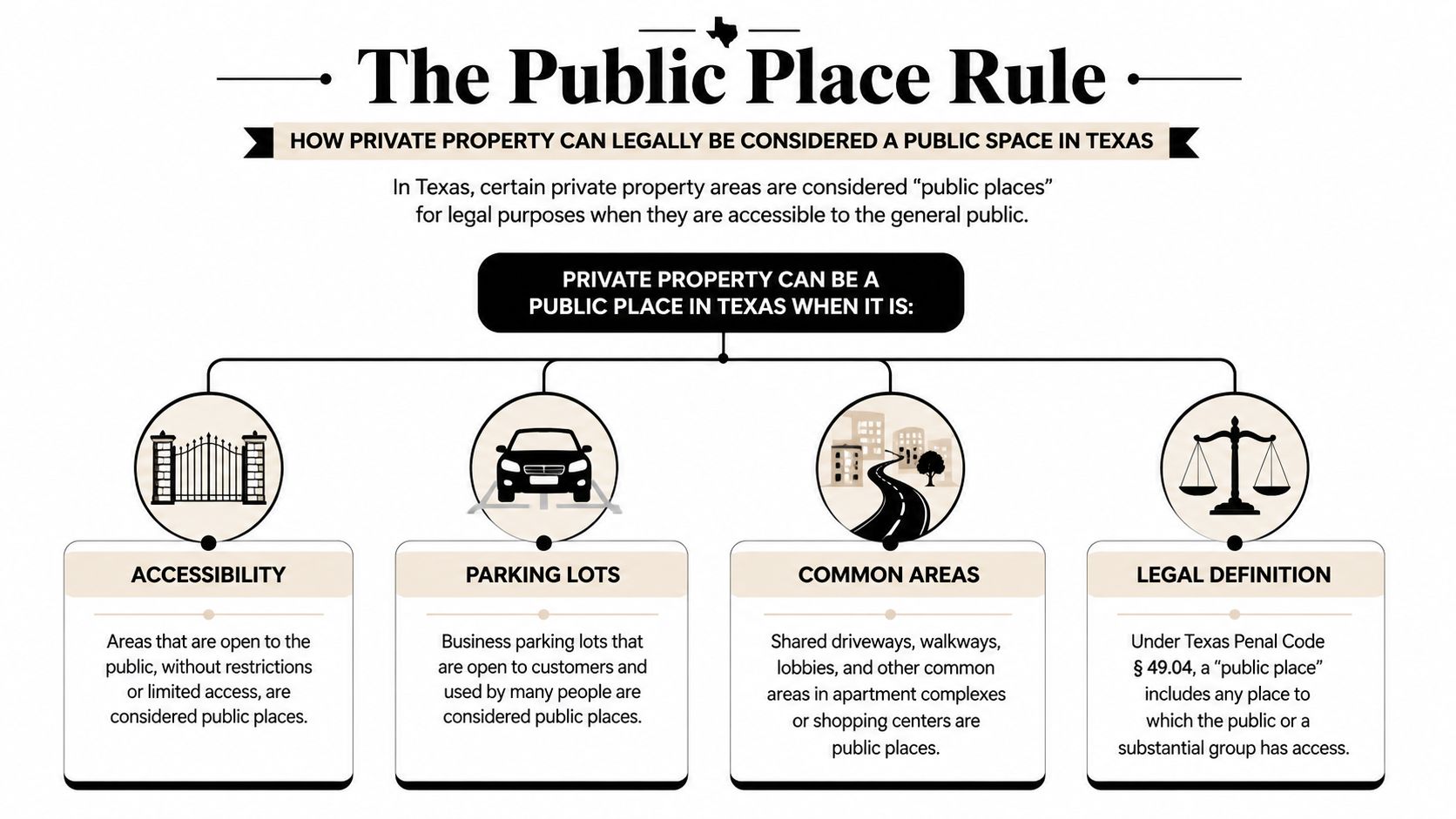
The 'Public Place' Rule Why Private Property Is Not Always Private
Texas Penal Code Section 49.04(a) defines DWI as operating a motor vehicle in a public place while intoxicated, and Texas courts have broadly interpreted that term to include private property that is accessible to the public, such as parking lots and apartment complexes, as discussed in this explanation of private-property DWI law in Texas. The same source explains that a first-time conviction can carry fines up to $2,000, 72 hours to 180 days in jail, and a driver's license suspension for up to one year, while a case involving BAC over 0.15 can be charged more severely with fines up to $4,000 and up to one year in jail.
That's the key point. Ownership is not the test. Accessibility is.
A grocery store parking lot is private property. So is an apartment complex lot. So is the driveway in front of many businesses. But if the public can enter and use the area, courts often treat it as a public place for DWI purposes. That's why asking “Was it private property?” is only the first question. The better question is, “Who could access it, and how restricted was it?”
Accessibility matters more than title
Texas courts have treated places as public when they are open to customers, visitors, residents, guests, delivery drivers, or other members of a substantial group. That can include:
- Apartment complex roads and lots because residents, guests, and service workers commonly enter them
- Shopping center parking lots because the public is invited to drive and park there
- Commercial driveways because customers and vendors use them
- Open private roads when there is no real barrier to entry
By contrast, a restricted area gives the defense more room to work.
Public place versus truly private area
| Location Example | Typically Considered a 'Public Place'? | Reasoning |
|---|---|---|
| Apartment complex parking lot | Usually yes | Residents, guests, and visitors can access it |
| Shopping center parking lot | Usually yes | Public is invited onto the property |
| Restaurant or bar parking area | Usually yes | Open to customers and regular traffic |
| Shared private road in a residential development | Often yes | Used by a substantial group, not just one owner |
| Gated community roadway with guest access | Often yes | Access may still be broad enough for court scrutiny |
| Private driveway open to visitors | Possibly yes | Invitees and regular users may support public-access arguments |
| Fenced backyard | Usually no | Not generally open to public access |
| Private ranch behind a locked gate | Usually no | Stronger evidence of restricted entry |
| Area marked with clear no-trespass signs and blocked access | Strong defense argument | Restriction undermines the public-place element |
A place can be privately owned and still count as a public place under Texas DWI law.
Why this ambiguity helps the defense
Many strong cases are built on this point. The State may say the area was public because people could enter it. Your defense may show the opposite. Gates, key-code access, posted restrictions, fencing, property layout, witness testimony, photos, and surveillance footage can all matter.
That's why I tell clients not to reduce the issue to a slogan. “Private property” doesn't automatically win the case. But it also doesn't automatically lose it. The details often decide everything.
Common Scenarios for DWI Arrests on Private Land
Some private-property arrests happen exactly where you'd expect. Others happen when a person is trying to avoid making a worse decision. That's one reason these cases deserve careful, fact-specific defense work.
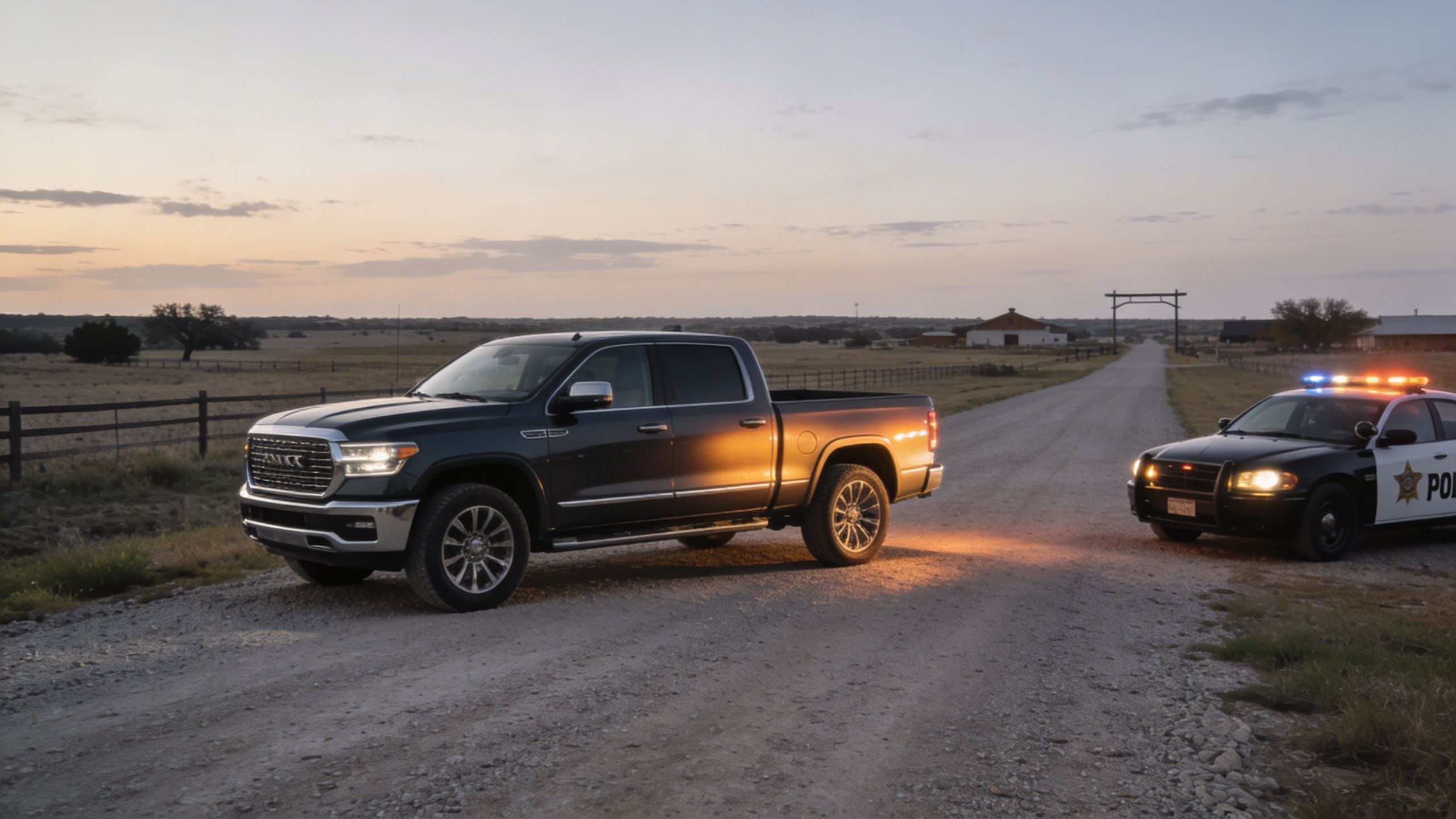
Texas courts interpret operation broadly. They can treat a person as operating a vehicle even if the car is not moving, based on actual physical control. In Rawlings v. State, keys in the ignition while sleeping in a private driveway were enough, and this discussion of parked-car and private-property DWI law notes that 12% of 2024 DWI convictions involved non-driving scenarios on private property. The same source states that underage DWI on private land can trigger an automatic 60-day suspension plus an AIP course.
Your apartment complex is not a safe zone
You drive into your complex after a night out. An officer sees you turn wide, clip a curb, or stop awkwardly. The lot feels private because you live there. Legally, it may still be treated as a public place because residents, visitors, food delivery drivers, maintenance workers, and others have access.
That doesn't mean the State wins. It means your lawyer needs to examine access points, signage, patrol justification, and what the officer observed before initiating contact.
Sleeping it off in a parking lot can still lead to charges
A lot of people think sleeping in the car is the responsible move. Morally, that may be true. Legally, it can still create exposure if you were in the driver's seat with access to the keys and controls.
That issue turns on operation. Texas prosecutors often argue that if you had the ability to drive, you were operating. That's why parked-car cases are so fact-dependent. Seat position, key location, engine status, timeline, and intent all matter. If that sounds like your situation, read more about DWI in a parked car under Texas law.
Moving a vehicle at a private gathering
This one catches people off guard. You're at a party. Someone asks you to move a car a short distance in the driveway or across a private lot. You aren't out on the road. You barely moved. You still get arrested.
Here, prosecutors try to prove two things:
- Access to the area by others
- Control over the vehicle while intoxicated
Even a short movement can be enough if the area qualifies as a public place. Even no movement can be enough if the State can sell a broad operation theory. Those are exactly the kinds of assumptions a defense lawyer should attack.
If the facts show you were trying not to drive, that fact matters. It just needs to be developed and presented the right way.
Penalties for a DWI on Private Property Are Just as Severe
Many people think a DWI on private land will be treated like a lesser mistake. Texas does not give you that break. If the State treats the location as a public place, the penalties are the same as they would be for a stop on a road.
According to this review of private-property DWI penalties and consequences in Texas, first-offense fines can reach $2,000, jail time can range from 72 hours to 180 days, and a license suspension can last up to one year. The same source states that a BAC of 0.15 or higher can increase the fine to $4,000 and increase exposure to up to one year in jail. It also notes that enhanced charges apply for child passengers, that Dallas County recorded 2,275 DWI-related crashes in recent data, and that Texas averages 65 alcohol-related crashes daily.
Criminal penalties hit first
If this is your first DWI in Texas, the case is usually filed as a misdemeanor, but that should not reassure you too much. Misdemeanor does not mean minor. It can still affect your record, your job, your insurance, and your ability to move forward cleanly.
If the prosecutor alleges a high BAC, the charge can be more serious. If a child passenger was involved, the case gets more dangerous fast. If you have prior history, the stakes rise even more and the room for error gets smaller.
Administrative penalties can start before court is over
A lot of people focus only on the criminal case and miss the license problem. That's a mistake. A DWI arrest often triggers a separate license case through the Administrative License Revocation, or ALR, process.
Here are the key terms you need to know:
- BAC means Blood Alcohol Concentration. It is the alcohol level the State claims was found through breath or blood testing.
- Implied consent means that by driving in Texas, you are considered to have agreed to provide a breath or blood specimen under certain lawful circumstances after a DWI arrest.
- Administrative license suspension means DPS can try to suspend your license through an administrative process that is separate from your criminal court case.
- Field sobriety test means roadside physical or divided-attention tests officers use to claim impairment, such as balance and eye-movement testing.
The hidden costs are often worse than the fine
A DWI conviction can create problems long after court ends. Employment screens, housing applications, professional licensing reviews, and custody disputes can all become harder. For CDL holders and licensed professionals, the charge can threaten far more than a weekend in jail.
That's why I never tell people to treat a private-property DWI as technical or minor. It is serious. But serious is not the same as hopeless.
The smartest response is immediate action. Delay helps the State. Early defense work helps you.
How to Fight a Texas DWI Charge on Private Property
Private-property cases often take an interesting turn. The same ambiguity that allowed the arrest can become the reason the case weakens. In my view, these are some of the most defensible DWI cases when the lawyer digs into the facts instead of accepting the police report at face value.
Defense practitioners have noted that approximately 15% to 20% of DWI arrests in metro areas like Houston occurred in private lots during 2023 to 2025, and a strong defense often starts with a motion to suppress focused on lack of public access or lack of operation. That same source explains that CDL holders face an automatic 1-year disqualification under 49 CFR §383.51, and that counsel should request an ALR hearing within 15 days.

Challenge the public-place element
If the State can't prove the location was a public place, the case has a major problem. This is often the first angle to examine.
A good defense investigation may focus on:
- Physical barriers such as locked gates, fencing, entry controls, or restricted-access points
- Property warnings like no-trespass signs or private-use notices
- Actual use showing the area was limited to a narrow group rather than the public
- Photos and video that reveal layout, visibility, and access restrictions better than a written report ever could
A lot can turn on details that seem small. Was the gate open all night? Did visitors come and go freely? Was the area shared by many people, or was it limited to one household or a controlled set of users? Those facts matter.
Attack the operation theory
This is the second major pillar. Texas uses a broad idea of operation, but broad does not mean unlimited. The State still has to prove more than your mere presence near a steering wheel.
If your case involves a parked vehicle, your lawyer should examine whether you intended to drive, whether the keys were accessible, whether the engine was on, where you were sitting, and what the timeline shows. In some cases, keys in the ignition alone can be insufficient if the surrounding facts do not support actual operation with intent to drive. A focused motion to suppress evidence in a DWI case can be the right tool when police or prosecutors stretch these facts too far.
Don't ignore probable cause and testing issues
Some of the strongest defenses are not about private property at all. They are about police procedure. Even if the location qualifies as public and the State alleges operation, the arrest still has to be lawful.
Look closely at these points:
Initial contact
Why did the officer approach you in the first place? If there was no lawful basis, later evidence may be vulnerable.Field sobriety testing
Parking lots, gravel, sloped pavement, bad lighting, and traffic distractions can affect performance. A field sobriety test is not a magic machine. It's an officer's interpretation.Breath or blood evidence
Machine maintenance, sample handling, timing, and chain-of-custody issues all matter. If the State's science is sloppy, that should be exposed.Officer credibility
Video sometimes contradicts the report. That happens more than people think.
A private-property DWI case should never be defended with one argument alone. The best results usually come from stacking multiple legal weaknesses together.
Clear recommendations if you want to fight DWI Texas charges
Do these things right away:
- Stop talking about the facts to friends, coworkers, or on social media
- Write down the timeline while it's fresh, including key location details, gate access, who was present, and where the keys were
- Preserve photos and video from the property if they exist
- Act fast on the license issue because the ALR deadline comes quickly
- Tell your lawyer everything even facts you think are embarrassing or minor
If you want to fight DWI Texas charges effectively, speed matters. Evidence disappears. Video gets overwritten. Witnesses forget details. Delay diminishes your advantage.
The DWI Process After an Arrest on Private Property
The process feels chaotic when you're living through it, but it becomes more manageable once you break it into steps. What happened on private property still feeds into two separate tracks: the criminal case and the license case.
Step one after arrest
After arrest, you're usually taken for booking. That means law enforcement records your information, processes the charge, and handles release conditions. You may be released on bond, which is the amount or condition required to secure your release while the case is pending.
Soon after, you'll have court settings that may include an arraignment or other early appearance. That is where the charge is formally addressed and the case begins moving through the court system. Later stages often include pre-trial hearings, where the judge handles legal issues, scheduling, motions, and evidence disputes.
If you need a broader walkthrough, review what happens after a DWI arrest in Texas.
The license case is separate from the criminal case
A lot of clients don't realize this until it's almost too late. Your DWI license suspension issue is not the same as your criminal prosecution. The Department of Public Safety handles the administrative side. The criminal court handles the charge itself.
Administrative License Revocation becomes critical. An ALR hearing is your chance to challenge the attempted suspension of your driver's license. It can also give your lawyer an early opportunity to question the officer under oath and learn useful facts about the case.
If you miss the deadline to request the ALR hearing, you can lose leverage before the criminal case really begins.
Implied consent and chemical testing
Texas uses the doctrine of implied consent. In plain English, if you drive in Texas, the law treats that as your prior agreement to submit to breath or blood testing in certain DWI situations. That does not mean the police can ignore procedure. It means refusal can trigger administrative consequences, and consent issues need to be analyzed carefully.
BAC stands for Blood Alcohol Concentration. Prosecutors use BAC results to argue intoxication, especially when they claim a level of 0.15 or higher. But the number on paper is not the whole case. Timing, test administration, and the circumstances around collection all deserve review.
A short video can help make that process easier to follow:
What your lawyer is doing during this stage
While you're trying to keep your life moving, your attorney should be doing several things at once:
- Requesting records from law enforcement, DPS, and prosecutors
- Reviewing video from body cam, dash cam, and property surveillance
- Evaluating motions to suppress evidence or challenge legality of the stop and arrest
- Preparing for ALR and criminal hearings at the same time
- Assessing outcomes such as dismissal, reduction, deferred adjudication where available, or trial
Terms people often confuse
Here's the simple version:
- Field sobriety test is the roadside test battery officers use to build probable cause
- ALR hearing deals with your license, not your guilt
- Bond gets you out while the case is pending
- Pre-trial hearing is where legal fights often begin
- Trial is where the State has to prove the charge beyond a reasonable doubt
This process can feel heavy, especially if it's your first DWI in Texas. Still, the best way through it is structure, deadlines, and a defense plan built early.
Take the First Step to Protect Your Future Contact Us Today
If you came here asking can you get a DWI on private property in Texas, the answer is yes. But the more important answer is this: these cases are often more defensible than people realize.
The State still has to prove that the location was a public place and that you were operating the vehicle under Texas law. In many private-property cases, those points are exactly where the prosecution stretches the facts. That stretch creates opportunities for a smart defense.
You do not need to figure this out alone while worrying about your job, your license, your record, or your family. You need a clear review of what happened, what the officer can prove, whether the stop and arrest were lawful, and what can be done right now to protect your position.
If you're worried about a DWI license suspension, a high BAC allegation, a parked-car arrest, or the impact on a professional license or CDL, move quickly. The early decisions matter. So do the early deadlines.
The right legal strategy can include challenging the location, challenging operation, attacking probable cause, contesting field sobriety testing, fighting breath or blood evidence, and pushing hard in both the criminal case and the administrative case. That's how you put pressure back on the State.
You are not stuck with the officer's version of events. You are not required to accept the worst-case outcome. You can fight the charge, and you can start today.
If you're facing a private-property DWI, talk with Law Office of Bryan Fagan, PLLC for a free, confidential consultation. Our team helps Texans in Houston, Dallas-Fort Worth, Austin, San Antonio, and surrounding communities build a strategic defense from the start, including ALR hearings, first-time DWI cases, parked-car arrests, and expunction-related options when available. We'll help you understand your rights, your deadlines, and the strongest path forward.