
A DWI arrest can be overwhelming, but you don't have to face it alone.
One minute, you're heading back to the dock after a day on a Texas lake. The next, a game warden is asking questions, watching how you move, and telling you that you're under arrest for boating while intoxicated in Texas. Individuals in that situation typically aren't considering statutes or procedure. They're thinking about their driver's license, their job, their family, and whether this is going to follow them for years.
That stress is real. So is the confusion. Many people assume a BWI is “just a boating ticket” or that it only affects boating privileges. That's a costly misunderstanding. A BWI case can affect your criminal record and your ability to drive, and the state often builds these cases from evidence that deserves close scrutiny.
If you're searching for answers after a BWI arrest, the key point is simple. An arrest is not a conviction. A Houston DWI lawyer or Texas DUI attorney should start by separating what the officer alleged from what the state can prove. That difference is where many strong defenses begin.
A Day on the Water Ends with an Arrest What Now
A BWI arrest usually starts with a normal day. You may have been fishing, pulling kids on a tube, or heading in before sunset. Then law enforcement makes contact, asks whether you've had anything to drink, and the tone changes fast. By the time you're off the water, you may be dealing with handcuffs, towing issues, bond questions, and a flood of worry about what comes next.

What most people worry about first
For new clients, the first concerns are usually practical:
- Your license: Can you still drive to work?
- Your record: Will this stay on a background check?
- Your court date: What happens if you miss something important?
- Your family: How do you explain this at home?
Those are the right questions. The legal system can feel impersonal, but your case has immediate real-world consequences. That's why the first days after an arrest matter.
Practical rule: Don't treat a BWI arrest like a minor citation. It's a criminal case, and early decisions can affect both the court case and your license situation.
What to do in the first days
Start by gathering what you can while events are still fresh. Save any paperwork you received. Write down where the stop happened, what the officer said, whether you were asked to do field tests, whether a breath or blood sample was requested, and who else was on the boat. Small details often become important later.
Then get legal advice before you start explaining yourself to anyone else. Casual statements to officers, insurance representatives, or even friends by text can create problems. A strategic defense begins with preserving facts, identifying deadlines, and avoiding preventable mistakes.
If this is your first DWI in Texas or first BWI allegation, take a breath. You are not the first person to be in this position, and there is a process for fighting back.
What Legally Constitutes a BWI in Texas
A common BWI fact pattern goes like this: the game warden approaches after a long afternoon on the lake, sees a cooler, notices you look unsteady stepping onto the dock, and starts asking who was driving the boat. That moment matters because being on a boat after drinking is not, by itself, the legal test. The state must prove intoxication and must prove you were operating the vessel.
The two ways the state tries to prove intoxication
Under Texas law, intoxication in a BWI case usually gets charged in one of two ways. Prosecutors may argue you lost the normal use of your mental or physical faculties because of alcohol, a drug, or a combination of substances. Or they may rely on an alcohol concentration of 0.08 or higher, as described in this Texas boating while intoxicated law discussion.
That legal definition sounds straightforward on paper. On the water, the proof is often less clean.
A field sobriety test is a series of divided-attention, balance, and eye-tracking exercises officers use to claim impairment. In a highway DWI case, jurors are used to hearing about those tests. In a BWI case, I often examine whether the setting made those observations less reliable in the first place.
Why on-the-water testing can be misleading
Boating affects the body differently than standing on dry land. After hours in the sun, wind, and chop, a person can appear tired, off-balance, dehydrated, or glassy-eyed without being legally intoxicated. Officers may still write those signs down as evidence of impairment.
That is one of the first defense angles to evaluate.
If the stop happened after you had been moving around on a vessel, stepping onto a dock, or adjusting to stable ground, the officer's balance observations may deserve a hard look. The same is true for eye clues, coordination, and delayed responses. Those details can matter when the state is trying to turn a rough on-the-water impression into proof beyond a reasonable doubt.
Operating the vessel still matters
The second part of the case is just as important. The state must show that you were operating the watercraft, and that issue is often more contested than people expect.
Actual physical control is the point many online guides skip. In practice, it can decide the case. If several adults were aboard, if the boat was drifting or anchored, if you were seated away from the helm, or if another person had been handling navigation, the prosecutor still has to tie operation to you with actual evidence. Presence is not operation.
That distinction is why I tell clients not to assume the case is over because they had been drinking. The key question is narrower: what can the state prove about your condition and your control of the boat at the relevant time?
For a broader look at charge levels in intoxication cases, Felony DWI in Texas: Third Offense and Child Passenger explains when a Texas DWI becomes a felony. You can also review how Texas classifies intoxication offenses and punishment ranges in this guide to Texas DWI penalties and offense levels.
Texas BWI Penalties Explained
A BWI case can follow you long after the boat is back on the trailer. In Texas, the exposure is not limited to time on the water. A conviction can mean jail, fines, and consequences for your driver's license.
What a first BWI can bring
A first BWI is generally charged as a Class B misdemeanor. That means a case with real criminal exposure, including mandatory jail time of 72 hours to 180 days, fines up to $2,000, and a driver's license suspension ranging from 90 days to one year. If the state alleges a BAC of 0.15% or higher, the charge can be filed as a Class A misdemeanor, which raises the possible punishment to up to one year in jail and a fine up to $4,000.
That last point catches clients off guard. A boating case can affect your ability to drive a car. I make sure clients understand that early, because the risk analysis changes once you realize this is not just a ticket from a day at the lake.
Texas BWI penalties at a glance
| Offense Level | Jail Time | Fine | Driver's License Suspension |
|---|---|---|---|
| First-time BWI Class B misdemeanor | 72 hours to 180 days | Up to $2,000 | 90 days to one year |
| BWI with BAC of 0.15% or higher Class A misdemeanor | Up to one year | Up to $4,000 | Can affect driving privileges as part of the case consequences |
Other financial and case-level risks
The criminal sentence is only part of the problem. A conviction may also bring added costs tied to keeping driving privileges, court requirements, and insurance fallout. For many clients, those practical consequences hit harder than the fine.
The charge can also get more serious fast if the facts involve an injury or other aggravating circumstances. That is one reason I do not treat BWI cases as minor or routine. Early decisions matter, especially before the state locks in its version of who was operating the vessel and what condition that person was in.
Why the penalty chart is only the starting point
Penalty ranges tell you the ceiling. They do not tell you whether the state can prove the case.
That distinction matters in BWI cases because punishment only becomes the main issue if the prosecution can first prove intoxication and operation. In many files, the primary fight is over actual physical control. Was the boat underway, idling, anchored, drifting, or already tied off. Who was at the helm. Who had access to the controls. Was there reliable evidence tying operation to you at the relevant time. Being present on a boat after drinking is not the same thing as proving BWI beyond a reasonable doubt.
For a broader look at offense levels and sentencing exposure in intoxication cases, see this guide to Texas DWI penalties and offense classifications.
The BWI Stop and Chemical Test Process
A BWI investigation often feels rushed from the client's side and structured from the officer's side. Understanding the sequence helps you spot where legal issues can arise.
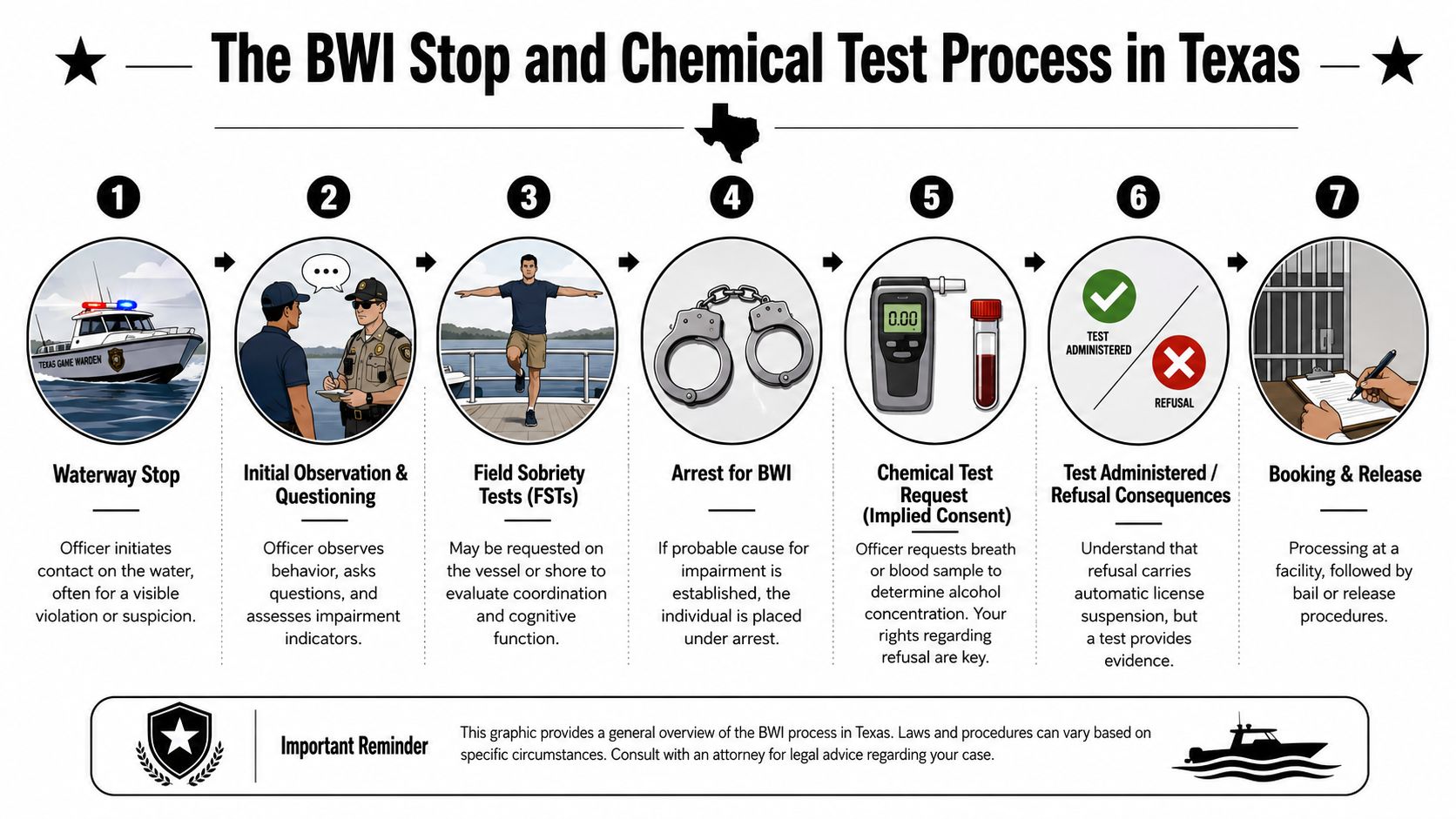
The basic sequence on the water
A typical case follows a pattern:
- Initial stop or contact: A game warden or officer approaches the vessel.
- Observation and questioning: The officer asks basic questions and looks for signs of impairment.
- Field testing: You may be asked to perform coordination or eye tests.
- Arrest decision: If the officer believes there is probable cause, you're arrested.
- Chemical test request: You may be asked for a breath or blood sample.
- Booking and release: The case moves ashore into the jail and court system.
Each step matters. If the initial stop was improper, if the officer's observations were weak, or if the testing process wasn't handled correctly, those issues can become part of the defense.
What implied consent means
Implied consent means that by operating a vehicle or vessel in Texas, you are considered to have agreed in advance to provide a breath or blood specimen if you are lawfully arrested under intoxication laws. That does not mean every request is valid. It means refusal can carry separate consequences.
An administrative license suspension is a license penalty handled by the state through an administrative process, separate from the criminal prosecution. It's not the same as being convicted in court.
Refusal has its own consequences
Under Texas implied consent law for boating, refusing a chemical test triggers an administrative license suspension of 180 days for a first refusal and two years for a second refusal, as outlined in this overview of Texas DWI laws.
That's why the chemical test decision is such a high-pressure moment. Taking the test gives the state evidence. Refusing the test can create a separate license problem. Neither path is simple, which is why these cases need individualized analysis.
If your case involves a forced blood draw or questions about warrant procedure, Texas DUI blood draw warrant law is worth reviewing.
The chemical test issue is rarely just about “pass” or “fail.” It's often about whether officers followed the rules before, during, and after the request.
What Happens in Court After a BWI Arrest
Once you're off the water, your case splits into two tracks. One involves your driver's license. The other is the criminal case itself. That division confuses many first-time clients because both tracks move on different schedules and have different rules.
The first steps after release
After arrest, you may be booked, processed, and released on bond. Bond is the condition that allows release while the case is pending, often with requirements to appear in court and follow specific rules. The first court appearance is commonly called an arraignment, where the charge is formally presented and a plea is entered.
For many people, this part feels more stressful than the arrest because it becomes real. You're checking court dates, fielding questions from family, and trying to figure out whether this is a temporary disruption or a major life problem. The answer usually depends on how quickly and strategically the case is handled.
The license case and the criminal case move separately
A BWI arrest can trigger an ALR hearing, meaning an Administrative License Revocation proceeding. In this proceeding, you challenge the state's effort to suspend your driving privileges. It is separate from whether you're ultimately found guilty or not guilty in criminal court.
That distinction matters. A person can be fighting the license case while also defending the criminal allegation. Evidence developed in one setting may affect strategy in the other.
Many clients think the criminal court date is their first chance to fight back. It often isn't. The license side of the case may require action much sooner.
What your attorney does during this phase
A lawyer usually starts by obtaining reports, video, testing records, and witness information. Then the work turns to examining probable cause, the basis for the stop, how the officer described your conduct, and whether the state can connect you to operation of the vessel.
Negotiations may happen early, but strong negotiations usually depend on preparation. Prosecutors take defenses more seriously when they know the file has been examined line by line and trial issues have already been identified.
For a fuller roadmap of hearings, motions, negotiation, and trial settings, The Texas DWI Court Process From Arrest to Resolution walks through what to expect at each stage.
How to Fight a Texas BWI Charge
A BWI case is not something you “explain away.” It's something you test. The state has to prove each legal element with admissible evidence. That gives the defense multiple places to push back.

The actual physical control issue
One of the most useful and most overlooked defense angles is actual physical control. In a road case, control is often obvious. In a boat case, it may not be. The prosecution must prove operation, not just presence on the vessel.
As noted in this analysis of Texas Penal Code 49.06, defenses can focus on evidence such as the location of the keys, the boat's position, or the person's seating relative to the helm. That matters in common situations like these:
- You were a passenger: Someone else was handling the boat.
- The boat was stationary: The engine wasn't in use, or the vessel was anchored or tied off.
- You weren't at the controls: Your location on the boat didn't match the officer's theory of operation.
That isn't a loophole. It's the state's burden of proof.
Other common pressure points in a BWI defense
The next layer of defense often includes challenges like:
- The stop itself: Did the officer have a lawful reason to make contact or extend the investigation?
- Field sobriety testing: Were the tests reliable under boating conditions, or did motion and disorientation make the results questionable?
- Chemical evidence: Was the sample lawfully requested, lawfully obtained, and properly handled?
- Statements: Did officers obtain incriminating statements in a way that can be contested?
A focused defense strategy often combines several of these points rather than relying on one.
A short video can help frame how defense strategy works in intoxication cases:
If you need a broader overview of defense options in these cases, how to fight a DWI charge in Texas outlines the kinds of issues attorneys examine when building a defense.
How a Houston DWI Attorney Protects Your Future
The hours after a BWI arrest often do the most damage. Before the first court date, the state starts building its file, officers finish reports, and key evidence can disappear unless someone moves quickly to preserve it.
A Houston DWI attorney protects your future by treating the case as two problems at once. One is the criminal charge. The other is the threat to your driver's license and the practical fallout that can reach your job, insurance, and professional reputation. Both need attention early.
Good defense work is specific. Your lawyer should examine whether the state can prove operation or actual physical control of the boat, not just intoxication and presence on the vessel. That issue can change the direction of a case. A person can be on board, have been drinking, and still leave the state with proof problems if the facts do not clearly show who was operating or controlling the boat at the relevant time.
The attorney should also review the officer's timeline, statements attributed to you, body camera or marine video, witness accounts, field sobriety testing, and any breath or blood evidence. In many cases, the best result comes from early pressure on weak points in the file rather than waiting to react in court.
That also means handling the license suspension side promptly, including the ALR process, while preparing the criminal defense on a separate track.
In practice, lawyers protect clients by requesting records, preserving video, challenging unsupported assumptions in the report, identifying suppression issues, and negotiating from a position of preparation. Trial readiness matters. Prosecutors value a case differently when they know the defense has tested the proof and is prepared to contest whether the client was ever in actual physical control of the boat. The Law Office of Bryan Fagan, PLLC handles DWI-related defense, including administrative license hearings and criminal court representation, for Texans facing allegations like these.
For anyone dealing with a first DWI in Texas, a BWI allegation, or an accusation built on unclear proof, the goal is simple. Act fast, protect your options, and build the defense around the facts that matter most.
If you were arrested for boating while intoxicated in Texas, do not wait to learn later that your license, record, and court strategy needed attention sooner. Request a free consultation with Law Office of Bryan Fagan, PLLC for a confidential case evaluation. You can get clear answers, a practical defense plan, and guidance on the next steps to protect your future.