
A DWI arrest can be overwhelming, but you don’t have to face it alone.
If you've landed on a page like this, you're likely in a familiar position. You’ve been released from jail or are trying to help a spouse, child, or employee. Your mind is racing. You’re worried about your license, your job, your record, and what happens next in court.
The first important point is simple. An arrest is not a conviction. In Texas, many DWI cases are not nearly as strong as they first appear. A case can weaken at the very beginning with the traffic stop, then weaken again with roadside testing, and weaken even further if video, paperwork, or lab handling doesn’t match the officer’s claims. One crack can spread through the entire case.
That is what makes a DWI case weak in Texas. Often, it’s not one dramatic mistake. It’s a chain of smaller procedural flaws that affect everything that came after them.
You’ve Been Arrested for DWI in Texas What Now?
The hours after an arrest are often the hardest. You may be holding a bond sheet, trying to remember what the officer said, and wondering whether you should just plead guilty to “get it over with.” That urge is common. It’s also where people make avoidable mistakes.
A Texas DWI case usually starts moving on two tracks at once. One track is the criminal case in court. The other is the administrative license suspension, often called the ALR process. That stands for Administrative License Revocation. It is the separate process that can affect your driving privileges even before the criminal case is finished.
Here are the terms people usually need explained right away:
- DWI means driving while intoxicated. In Texas, the state can try to prove intoxication through alleged loss of normal mental or physical faculties, or through a blood alcohol concentration reading.
- BAC means blood alcohol concentration.
- Field sobriety test means the roadside balance and attention exercises officers use to claim impairment.
- Implied consent means that by driving in Texas, you are considered to have agreed to provide a breath or blood specimen if an officer lawfully requests one after a DWI arrest, subject to Texas procedures and consequences for refusal.
- Administrative license suspension means the DPS process that can suspend your license apart from the criminal case.
Practical rule: Your case should be evaluated from the first minute of the stop, not just from the test result at the station.
The first days matter. A lawyer will usually want to review the reason for the stop, the officer’s report, any bodycam or dashcam footage, the testing records, and the deadline to challenge the license suspension. If you had a first DWI in Texas, that early review can be especially important because first-offense cases often turn on procedural details rather than dramatic evidence.
A calm, strategic review often changes the tone of the case. What feels hopeless on the night of the arrest may look very different once someone checks whether the officer followed the rules.
The Foundation Cracks Problems with the Traffic Stop
You are driving home, an officer turns on the lights, and ten minutes later the entire case starts building from that first decision to pull you over. In many Texas DWI cases, that first step matters more than people realize. If the stop was not legally supported, every piece of evidence that followed can become harder for the state to use.
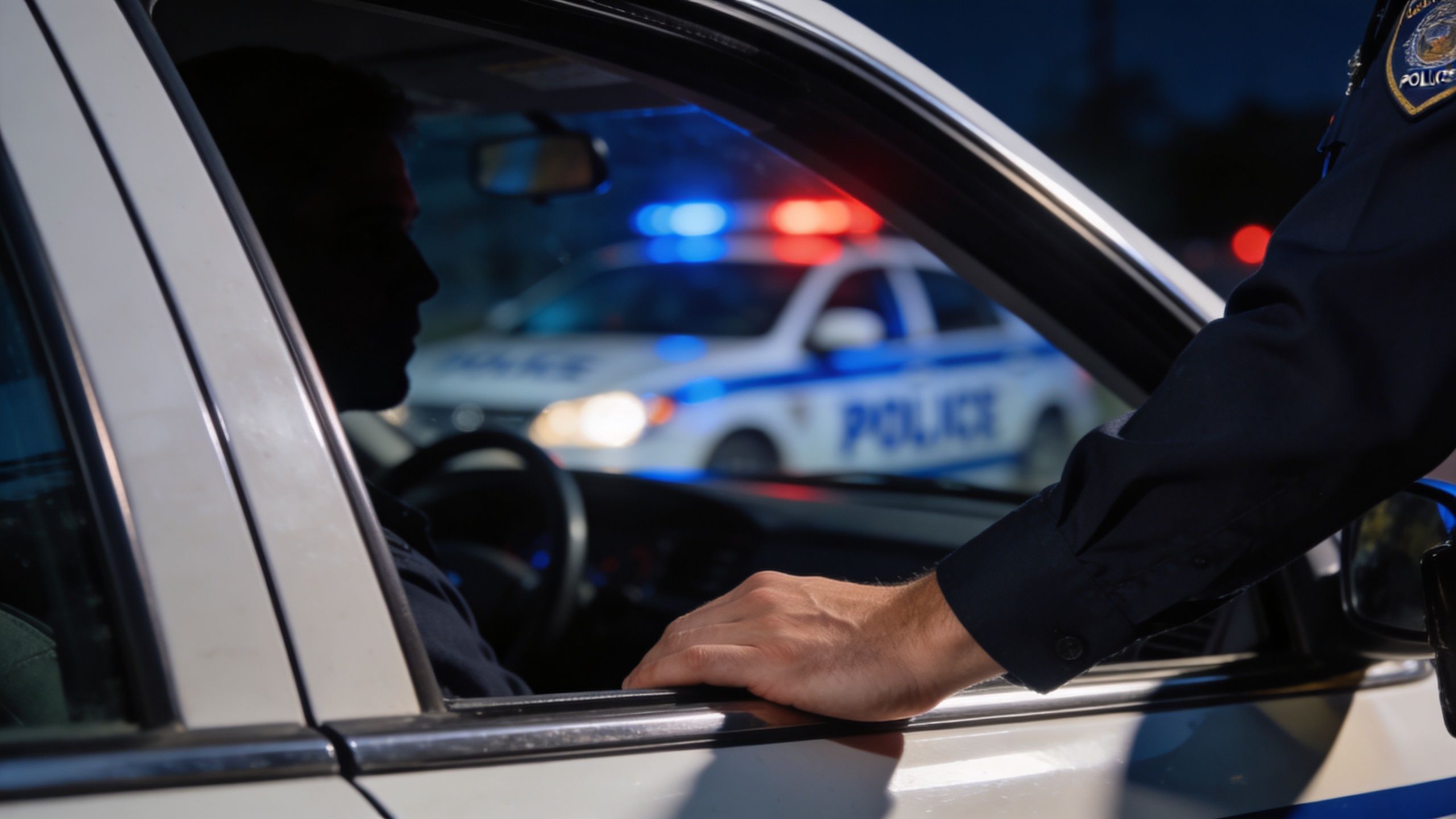
Reasonable suspicion and probable cause in plain English
These two terms get used together, but they do different jobs.
Reasonable suspicion is what usually allows an officer to start the stop. The officer needs specific, articulable facts suggesting a traffic violation or other offense.
Probable cause is the stronger standard that usually matters later, especially when the officer decides to arrest or seek certain evidence.
A house needs a foundation before you can trust the walls and roof. A DWI case works the same way. The stop is the foundation. If that foundation is weak, the rest of the case can shift with it.
| Legal standard | What it usually applies to | Plain-English meaning |
|---|---|---|
| Reasonable suspicion | Starting the stop | The officer observed facts that justified pulling you over |
| Probable cause | Arrest and further action | The officer had enough facts to reasonably believe an offense occurred |
When the stop is unlawful, the defense may argue that later evidence should be excluded under the fruit of the poisonous tree doctrine. That issue can affect roadside statements, field sobriety testing, chemical testing, and the arrest itself.
Common weak points in the stop
This part of the case often comes down to something very simple. Did the officer see what the report claims the officer saw?
That question sounds small. It is not.
A weak stop often starts with a gap between the written report and the objective record. The report may say you were weaving across lanes, but the dashcam shows ordinary movement within a lane. The officer may describe a clear traffic violation, but the video never captures one. A caller may report a possible drunk driver, yet the officer does not confirm any bad driving before making the stop.
Here are common examples defense lawyers look for:
- The driving description is vague. Phrases like “acting suspicious” or “unable to maintain lane” need facts behind them.
- The video does not match the report. A claimed wide turn, near collision, or failure to signal may be missing from the footage.
- The stop relied on a tip alone. Anonymous or unverified tips can raise problems if the officer did not observe enough independent facts.
- The claimed violation is legally thin. Some driving behavior may look unusual without giving legal grounds for a stop.
That is where a case can begin to unravel. If the reason for the stop becomes doubtful, the prosecutor has a harder time treating everything after the stop as reliable and admissible.
Why one weak stop can affect the entire case
A traffic stop is not an isolated event. It is the starting point for everything that follows.
For example, an officer claims you drifted, pulls you over, then says your speech sounded slurred, asks you to step out, conducts roadside tests, and later obtains a breath sample. If the original stop lacks reasonable suspicion, the defense can challenge the chain from the first link forward. One crack at the beginning can spread through the rest of the case.
That cause-and-effect structure is what people often miss.
The issue is not just whether the officer made a technical mistake. The issue is whether the government had the legal right to begin the encounter that produced the later evidence. If the answer is shaky, the defense gains room to file motions, limit what the jury sees, and pressure the state to reassess the case.
If you want a clearer sense of what officers are supposed to observe before stopping a driver, this guide on reasonable suspicion examples in Texas DWI stops is a useful reference.
A weak stop can turn a case that looks strong on paper into a case with major proof problems. That is why experienced DWI defense often begins with the first minute of the encounter, not the final test result.
Questioning the Evidence Field Sobriety and Chemical Tests
Many people assume the state’s evidence is scientific from start to finish. In reality, a lot of it depends on human judgment, strict procedures, and careful recordkeeping. If any of those pieces break down, the evidence becomes easier to challenge.
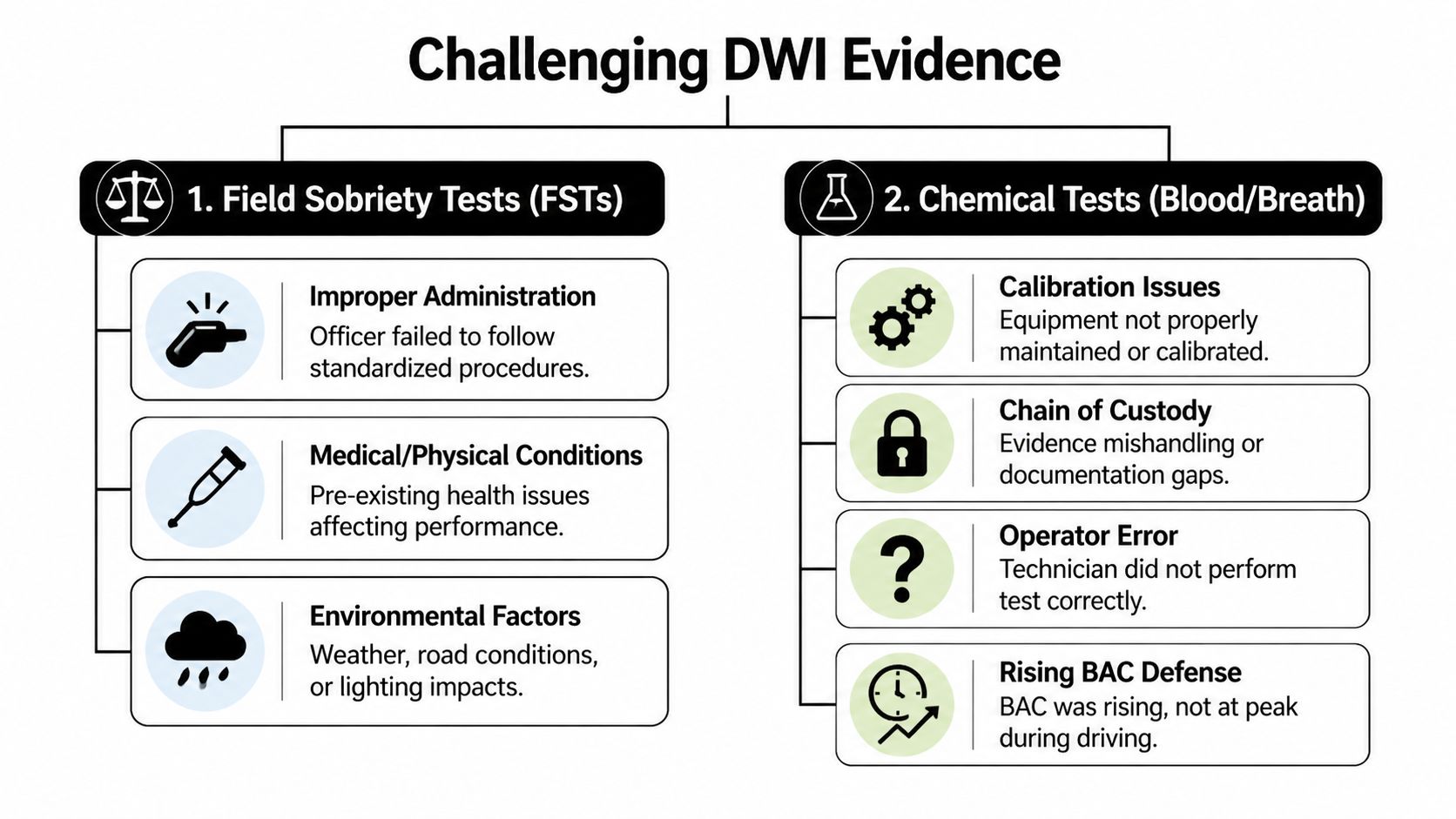
Field sobriety tests are not simple pass or fail exams
A field sobriety test sounds more precise than it is. These tests are really divided-attention exercises. The officer asks you to listen, remember directions, balance, and perform physical tasks while being watched for “clues.”
That creates room for error.
A person can struggle for reasons that have nothing to do with alcohol. Nerves, age, fatigue, injury, uneven pavement, poor lighting, and confusing instructions all matter. So do shoes, weather, and traffic rushing by on the shoulder.
A defense lawyer looks closely at questions like these:
- Were the instructions clear
- Did the officer demonstrate the test correctly
- Was the surface level and safe
- Did the officer ask about injuries or medical issues
- Did the report match the video
If the answer to several of those questions is no, the state’s confidence in the roadside tests should drop.
For a closer look at how these challenges work, see this page on how to challenge field sobriety test results in Texas.
Breath tests depend on procedure, not just the machine
People often call every breath device a breathalyzer. In court, what matters is not just the machine but the process around it.
Breath testing requires careful operation. If the officer or operator doesn’t follow the required steps, the result can be attacked. One common issue is the observation period before the test. The purpose is to reduce the risk that something in the mouth or body affects the reading.
Other common concerns include:
| Evidence issue | Why it matters |
|---|---|
| Observation problems | The operator may not have watched the person as required before testing |
| Calibration and maintenance | A poorly maintained device can produce unreliable results |
| Operator error | Even a working machine can produce questionable evidence if used incorrectly |
| Interfering substances | Belching, mouth alcohol, or other issues can affect interpretation |
Implied consent often confuses people. In Texas, implied consent means that by driving, you’re considered to have consented to provide a specimen when lawfully requested after a DWI arrest. It does not mean every request is beyond challenge. The arrest, the warning process, the testing steps, and the paperwork still matter.
Blood tests can look strong and still be vulnerable
Jurors often think blood evidence is unbeatable because it feels medical and precise. But blood evidence has a different weakness. It passes through many hands.
The defense may examine:
- labeling
- storage
- transport
- chain of custody
- the draw procedure
- lab documentation
If any link in that chain is unclear, the prosecutor may have trouble proving the sample was handled properly from start to finish.
Blood evidence often wins cases only when the government can prove who handled the sample, how it was stored, and whether each step was documented correctly.
The “rising BAC” issue
Timing matters. A test taken later does not always prove what your BAC was while you were driving. Alcohol can absorb over time. That creates what defense lawyers often call a rising BAC argument.
The idea is straightforward. A person may test higher at the station than they were at the time of driving. That doesn’t automatically defeat the case, but it can weaken the link between the number and the actual driving behavior.
Why evidence challenges often work together
Weak DWI evidence usually isn’t isolated. A shaky field sobriety test can make an arrest look rushed. A rushed arrest can make a breath request look questionable. A questionable arrest can make the chemical result more vulnerable.
That cause-and-effect pattern is the key lesson.
A weak case may look like this: the stop reason is thin, the roadside tests were done on poor footing, the officer’s instructions were muddled, and the breath process has record gaps. None of those details should be viewed alone. Together, they can create reasonable doubt and a stronger bargaining position.
If you’re trying to fight DWI Texas charges, careful review matters most. The state may present a stack of papers and a test result. Your defense asks whether those papers, that machine, and that process deserve the confidence the prosecutor wants from the court.
The Officer’s Conduct and Your Constitutional Rights
A DWI case is not only about what the officer found. It is also about how the officer got it.
Police have rules they must follow. When they ignore those rules, the defense can ask the court to keep certain evidence out. That can change the case dramatically, especially if the prosecution relies heavily on your statements or on consent that was never clear.
Miranda and custodial questioning
People often think officers must read Miranda warnings the moment they walk up to a car. That’s not how it works.
Miranda rights generally become important when you are both in custody and being interrogated. If an officer begins asking incriminating questions after that point without proper warnings, your answers may be challenged.
People often talk too much after an arrest, and this can have significant consequences. They try to explain where they were, what they drank, whether they’re tired, or why they were driving oddly. Those statements can later appear in the police report as admissions.
A defense attorney will ask:
- When were you effectively in custody?
- What questions were asked before warnings?
- Did the officer continue questioning after the situation became custodial?
- Does the video match the report?
Consent must be real, not just pressured
Another common point of confusion is consent. Officers may ask to search, ask for a specimen, or ask you to perform tests in a way that feels more like a command than a choice.
That doesn’t automatically make the evidence inadmissible, but it creates issues worth examining. Courts look at whether consent was voluntary and whether the officer’s words and conduct were accurate and lawful.
A rushed roadside scene can create these problems:
| Officer action | Defense concern |
|---|---|
| Ambiguous instructions | You may not have understood what was being requested |
| Pressure or intimidation | The court may question whether consent was voluntary |
| Incomplete documentation | The prosecutor may struggle to prove the step was lawful |
| Report inconsistencies | Credibility becomes a central issue |
Your constitutional rights are not technical loopholes. They are enforceable limits on what the government can do.
Reports, omissions, and credibility
Sometimes the weakness is not dramatic. It’s in what the officer left out.
If the report is sparse, internally inconsistent, or at odds with the video, the officer’s credibility suffers. Prosecutors prefer neat cases with clean documentation. They become more cautious when the paperwork leaves open questions about when events occurred, what instructions were given, or why the arrest happened when it did.
That is one reason a Texas DUI attorney often spends so much time reading reports line by line. A missing detail may not sound important to you at first. In court, it may become the point that makes the judge question the entire sequence.
Using Dashcam and Bodycam Footage to Your Advantage
You are sitting in my office saying, “The officer wrote that I was weaving, stumbling, and slurring.” Then we pull the video. Your car stays in its lane. Your walk looks steady. The audio is muddy, and the officer talks over you. That kind of moment can change the direction of a DWI case.
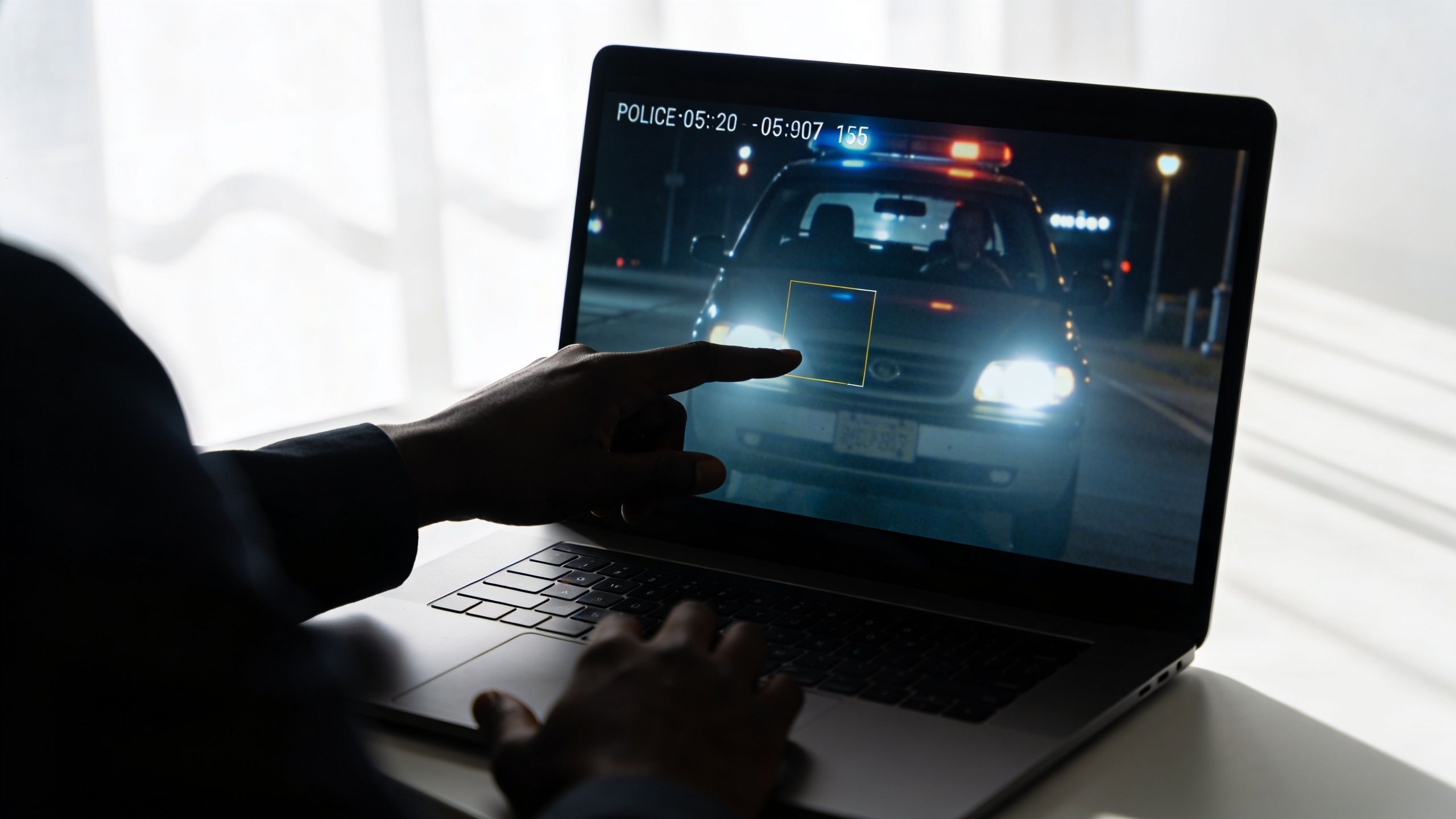
Video matters because it lets the judge, prosecutor, and jury see the stop for themselves instead of relying only on a written summary prepared after a fast-moving roadside encounter. A police report is one version of events. Footage is the closest thing we have to replaying the scene.
That replay can expose a crack at the very beginning of the case and then widen it. If the driving shown on dashcam does not match the stated reason for the stop, the prosecution has a foundation problem. If bodycam footage also shows clear speech, steady movement, or confusing instructions during roadside testing, the weakness spreads from the stop into the officer’s observations and then into the arrest decision itself.
What lawyers look for in the footage
A careful video review works like reviewing a chain link by link. If one link is weak, the links attached to it may weaken too.
We often examine:
- The driving before the stop. Does the video show the lane violation or other conduct described in the report?
- The timing of the stop. Did the officer decide to pull you over before any clear violation appears on camera?
- The first conversation. Does your speech sound slurred, or does it sound normal for a person under stress on the side of the road?
- The testing conditions. Are the field sobriety tests being done on gravel, a slope, poor lighting, or near traffic noise?
- The officer’s instructions and demonstrations. Were they clear enough for a sober person to follow correctly?
- Your balance, posture, and coordination. Do your movements match the officer’s written description?
Small differences matter here. If an officer writes that you failed to follow instructions, but the bodycam shows overlapping commands or an incomplete demonstration, the issue is no longer just your performance. The issue becomes whether the test was administered in a fair and reliable way.
The same is true for appearance. A report may use phrases like “bloodshot eyes” or “unsteady balance,” but video sometimes shows something more ordinary: fatigue, nerves, wind, headlights in the face, or a person standing on an uneven shoulder trying to do unfamiliar tasks while being watched. For a closer look at how lawyers use this evidence, this article on dashcam footage in Texas DUI cases explains why the footage often becomes a central part of the defense.
Why footage can affect the whole case
Video rarely helps in only one place.
It can challenge the reason for the stop, the officer’s descriptions, the quality of the field sobriety testing, and the timing of the arrest. That cause-and-effect pattern is what makes footage so useful in DWI defense. One weak point can create doubt about the next point, and then the next.
A prosecutor may still argue that the officer saw things the camera did not capture. Sometimes that is true. Cameras have limits. Angles are imperfect, audio drops out, and lighting can be poor. But those limits cut both ways. If the State wants the court to trust a report over the recording, it has to explain the mismatch.
Here is a short explanation of how footage can affect the case in practice:
When the footage supports the defense, the case becomes harder for the State to present as simple and straightforward. Instead of asking everyone to accept the officer’s conclusions at face value, the court has to examine what the camera shows, what it does not show, and whether the written report overstates what happened. That is often where reasonable doubt begins to grow.
Special Considerations for CDL Holders and Out-of-State Drivers
A Texas DWI arrest can split into two problems before you ever get to trial. One track is the criminal case. The other is your driving privilege. For commercial drivers and people licensed in another state, that second track can start affecting work, travel, and insurance almost immediately.
CDL holders need to think about the ALR case right away
If you hold a commercial driver’s license, timing matters from day one. The Administrative License Revocation, or ALR, case has its own deadline. In Texas, the hearing must be requested within 15 days of receiving notice.
That deadline matters because the license side of the case can move on a different schedule than the criminal charge. A prosecutor may still be sorting through reports and lab records while a commercial driver is already dealing with employment pressure, company policy, or questions about driving status.
Federal regulations also create separate risks for CDL holders. Under Federal Motor Carrier Safety Administration rules, disqualification consequences can apply to commercial driving privileges after certain alcohol-related offenses. The key point for a driver is practical, not theoretical. Waiting for criminal court to sort everything out can be a costly mistake if the license issue is left untouched.
A CDL case often works like a house with two entry doors. If you secure only one, the other is still open. The criminal case may have weaknesses, but you still need an immediate plan for the ALR side.
Two questions usually need answers at the same time:
- Are there weaknesses in the stop, investigation, or testing that can weaken the criminal case?
- Has the license case been addressed quickly enough to protect your ability to work?
Why CDL cases require a faster response
Commercial drivers usually cannot afford to take a wait-and-see approach.
A missed hearing request does not become less serious because the State later has proof problems. In fact, this is one of the clearest examples of how a small procedural step can shape the whole case. If the deadline is missed, you may lose an early chance to challenge the officer’s basis for the stop or arrest under oath. If that hearing is requested on time, it can preserve options, expose weak testimony, and give the defense useful information early.
That cause-and-effect pattern matters in DWI cases. A weak stop can affect the arrest. A weak arrest can affect the license case. Pressure on the license case can also affect how the broader defense is planned.
Out-of-state drivers face more than a Texas court date
Drivers from outside Texas often assume the case will stay local. It usually does not work that way.
Your home state may receive notice of the Texas arrest or final outcome and decide what to do under its own rules. That can mean separate license consequences, added paperwork, or problems renewing or clearing your driving record back home. The court process can also be harder to manage from another state, especially if travel, scheduling, and required appearances become part of the equation.
Out-of-state cases can still be weak cases. Distance does not fix the State’s proof. It sometimes exposes its gaps. A file may contain sloppy identification details, unclear notes about who was driving, or chain-of-custody questions with blood evidence. If those pieces do not fit neatly together, the problem can spread from one part of the case to the next.
Common pressure points include:
- interstate reporting and home-state licensing consequences
- chain-of-custody issues with blood evidence
- weak documentation about operation, identity, or jurisdiction
- travel and scheduling problems that require early planning
Small errors matter even more here
For CDL holders and out-of-state drivers, a procedural flaw can do more than create an argument for trial. It can change how the case is handled from the start.
If the stop was weak, that may help both the criminal defense and the license defense. If the paperwork is incomplete, that may affect credibility, negotiations, and administrative hearings at the same time. If the testing process was not documented correctly, the State may have trouble presenting the case as clean and straightforward.
That is why these cases deserve quick, careful review. The stakes are different, but so are the opportunities. A single crack in the State’s case can still spread. For drivers whose job or home-state license is on the line, finding that crack early matters.
How a Strategic DWI Attorney Builds Your Defense
You get home after a DWI arrest and the case can feel finished before it has even started. The officer wrote the report. The State has a test result or plans to get one. A court date is coming.
That first impression is often misleading.
A DWI case is built in layers, like a house. If the first layer is uneven, the problems do not stay in one place. A weak reason for the stop can affect what the officer was allowed to ask and do next. A rushed arrest can affect how later evidence is viewed. If the video does not match the report, that inconsistency can spread to the State’s whole theory of the case.
A strategic defense lawyer starts there. The goal is not to make broad arguments and hope one lands. The goal is to trace the chain, step by step, and see where it breaks.
A good defense follows the State’s sequence
Texas DWI cases usually look orderly on paper. Stop. Investigation. Arrest. Testing. Report. License suspension. Prosecutors often present that sequence as if each step naturally proves the next one.
A defense lawyer tests whether that is true.
If the officer did not have a lawful reason to stop the car, later evidence may become harder for the State to use. If the detention grew longer without a legal basis, the roadside investigation may be vulnerable. If instructions for field sobriety tests were unclear, the results may carry less weight. If blood or breath procedures were sloppy, the chemical evidence may stop looking scientific and start looking questionable.
That cause-and-effect review is where defenses are built.
What a strategic case review usually covers
A careful review often includes:
- The stop. What specific facts did the officer rely on before activating the lights?
- The detention. Did the encounter expand beyond the original reason for the stop in a lawful way?
- The roadside investigation. Were field sobriety tests explained, demonstrated, and scored correctly?
- Your statements. Did the officer respect your rights during questioning?
- The breath or blood evidence. Was the sample handled, recorded, and tested in a reliable way?
- The reports and video. Do the written claims match what the camera shows?
- The license case. Was the ALR hearing requested before the deadline passed?
Each item matters on its own. More importantly, one weakness can create pressure on the next item in line.
What legal representation actually does
A dedicated DWI defense firm handles the practical work that can expose those weak points. That includes requesting videos and records, reviewing police reports line by line, checking whether deadlines were met, preparing for the ALR hearing, and identifying where the State may be assuming facts it still has to prove.
That work is often less dramatic than people expect. It is also where real progress happens.
For example, a lawyer may compare the timeline in the report to the bodycam video and notice the officer claimed signs of intoxication before any meaningful conversation took place. Or the video may show divided-attention instructions given poorly, which can make field sobriety conclusions less persuasive. Or the stop itself may rest on a traffic violation that the footage does not clearly support. Once one part of the record stops making sense, the prosecutor has a harder time presenting the case as clean and straightforward.
Questions to ask before hiring a Houston DWI lawyer
Ask direct, practical questions.
- Will you obtain and review dashcam and bodycam footage?
- How do you evaluate whether the stop was legal?
- Do you handle ALR hearings as part of the defense?
- How do you challenge field sobriety tests and chemical evidence?
- Will you review officer training records, maintenance records, or chain-of-custody documents when the case calls for it?
The answers matter. A lawyer who can explain the process clearly is usually better prepared to test the State’s proof carefully.
Why strategy matters, even in unusual cases
Some DWI files do not fit the usual pattern. The driver may live out of state. The identification details may be messy. The paperwork may leave gaps about timing, operation, or who handled a blood sample. Those are not side issues. They can become pressure points that affect negotiations, hearings, and trial preparation all at once.
A strategic lawyer looks for those case-specific weaknesses early instead of treating every DWI arrest like it should end the same way.
Law Office of Bryan Fagan, PLLC handles DWI defense matters that may include ALR hearings, first-time DWI cases, and challenges to evidence tied to the stop, roadside investigation, and chemical testing process.
A DWI case often appears strongest on the day of arrest, before anyone has gathered the footage, checked the paperwork, compared the report to the video, or examined whether each step legally supports the next. Once that review begins, the picture often changes.