 Skip to content
A DWI arrest can be overwhelming—but you don’t have to face it alone. When you’re pulled over and the officer starts asking questions, things can get confusing fast. One of the first terms you’ll hear is "BAC," but what does that number actually mean for you?
In Texas, the short answer is that the legal Blood Alcohol Concentration (BAC) limit is 0.08% for most drivers over 21. But that number is just the beginning of the story. The law has different rules for commercial drivers and anyone under 21, and understanding which limit applies to you is the first step in protecting your rights after a DWI arrest.
Texas DWI Laws and Your Blood Alcohol Concentration
A DWI arrest is an overwhelming experience, but you don't have to navigate it alone. The legal system is filled with complex terms, and "BAC" is one of the most important. Simply put, Blood Alcohol Concentration (BAC) is a measurement of the percentage of alcohol in your bloodstream. Law enforcement uses this number as a key piece of evidence to prove you were intoxicated.
Texas operates under a "per se" intoxication law. This means if your BAC is at or above the legal limit, the law automatically considers you intoxicated, regardless of whether you felt drunk or impaired. For example, just like a speed limit, going over the legal BAC of 0.08% is, by itself, enough to trigger a DWI offense.
Understanding the Different BAC Limits in Texas
While 0.08% is the standard for most adults, Texas law sets much stricter limits for certain drivers. It’s critical to know which category you fall into because the penalties and legal strategies change dramatically.
Here’s a clear overview of the legal BAC limits that apply to different drivers across Texas.
Texas Legal BAC Limits at a Glance
| Driver Category | Legal BAC Limit | Key Consideration |
|---|---|---|
| Drivers 21 and Over | 0.08% | This is the standard "per se" limit for most adults. |
| Commercial Drivers (CDL Holders) | 0.04% | This lower limit applies whether you're in your commercial truck or your personal car. |
| Drivers Under 21 | Any Detectable Amount | Texas has a Zero Tolerance policy, meaning even a trace of alcohol can lead to a DUI. |
As you can see, the rules aren't one-size-fits-all. A BAC that might be legal for a standard driver could cost a truck driver their career.
Understanding these distinctions is vital. The evidence needed to convict you and the defenses available will depend on the specific limit that applies to your case. It’s also important to remember that the tests used to measure your BAC—whether it's a breath or blood test—are not infallible. These machines make mistakes, and the procedures can be flawed.
Many people wonder if they even have to take a test in the first place. You can learn more about whether you can refuse a breathalyzer in Texas and what happens if you do. An experienced DWI lawyer knows how to scrutinize every detail of your stop, from the initial traffic violation to the BAC testing procedure, to build a defense that protects your future.
How Texas Law Applies Different BAC Limits to Drivers
When people hear “DWI,” the number that usually comes to mind is 0.08%. While that’s the most common legal limit in Texas, it's a mistake to think it applies to every driver in every situation. Texas law is incredibly specific, setting different standards based on your age and the type of driver's license you hold.
Knowing which category you fall into is the first step in any DWI defense. A single beer can lead to vastly different legal outcomes for different people. For an adult out to dinner, it might be perfectly fine. For a commercial truck driver, that same beer could end their career. And for a college student under 21, it could mean an instant license suspension.
Standard Limit for Adult Drivers Over 21
For the vast majority of drivers in Texas—those aged 21 and older with a standard driver's license—the law is what you’d expect. You are considered legally intoxicated if your Blood Alcohol Concentration (BAC) hits 0.08% or higher.
This is what’s known as the "per se" intoxication standard. It means the prosecution doesn't have to prove you were swerving or failing field sobriety tests. If they have a valid chemical test showing a BAC of 0.08% or more, they can charge you with DWI based on that number alone.
But here’s a critical catch: you can still be arrested for DWI even if your BAC is below0.08%. If an officer believes you have lost the “normal use of your mental or physical faculties,” that’s enough to make an arrest. The BAC number is just one piece of the puzzle.
A Stricter Standard for Commercial Drivers
The rules get much tougher for anyone holding a Commercial Driver's License (CDL). Your livelihood depends on that license, and both Texas and federal law hold you to a much higher standard.
For a CDL holder, the legal BAC limit is just 0.04%.
This isn't just when you're driving an 18-wheeler, either. The 0.04% limit applies to CDL holders 24/7, even when they are off the clock and driving their personal car, truck, or motorcycle. A DWI conviction, even one from your personal vehicle, can trigger a commercial license suspension of at least one year for a first offense, effectively putting you out of a job.
Zero Tolerance for Drivers Under 21
Texas has a hard-and-fast Zero Tolerance policy when it comes to underage drinking and driving. For any driver under the age of 21, it is illegal to operate a vehicle with any detectable amount of alcohol in their system.
This means a BAC as low as 0.01%—the equivalent of a few sips of beer for some—is enough to trigger a Driving Under the Influence (DUI) charge, which is a Class C misdemeanor for minors.
This infographic breaks down how the legal BAC limits in Texas create a clear hierarchy based on driver type.
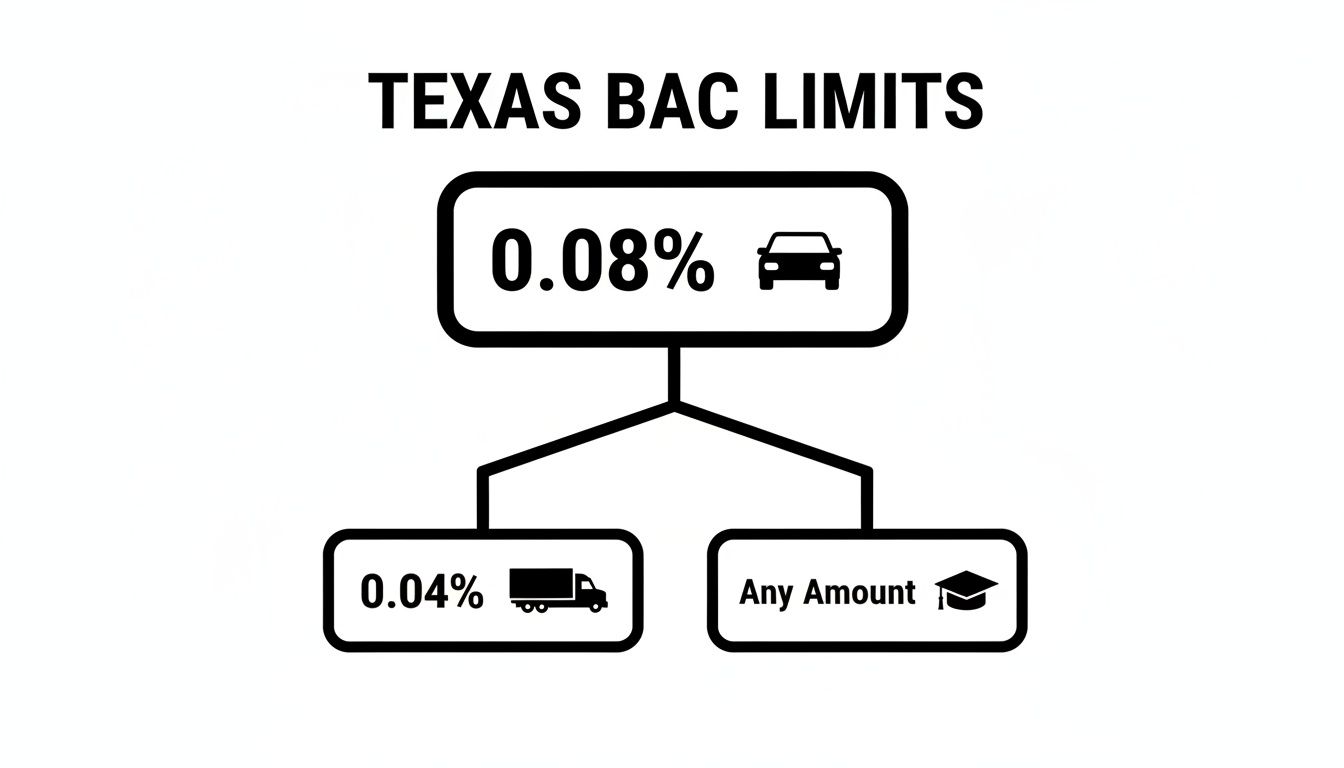
As you can see, while 0.08% is the baseline, the rules become significantly stricter for commercial drivers and minors. This reflects the different levels of responsibility and risk that Texas law assigns to each group.
The penalties for an underage DUI are designed to send a strong message and can be life-altering for a young person. They often include:
- Fines up to $500
- A driver's license suspension of 60 days or more
- Mandatory alcohol awareness courses
- Community service
These consequences can interfere with a young person's ability to get to school or work and saddle them with a criminal record. For a deeper dive into these rules, check out our Texas DUI alcohol limits guide. Knowing which law applies to you or your child is the first step toward building a smart, effective defense.
How Your BAC Is Measured and Why the Results Can Be Challenged
After a traffic stop, an officer's suspicion is just that—a suspicion. To build a DWI case, they need evidence, and that usually comes in the form of a Blood Alcohol Concentration (BAC) number. This number seems scientific and final, but the truth is, the methods used to obtain it are filled with potential flaws.
Understanding how these tests work is the first step toward understanding how they can be successfully challenged. In Texas, police will typically ask for one of two chemical tests: a breath test or a blood test. Each has its own procedures and, more importantly, its own set of weaknesses a skilled attorney knows how to find.
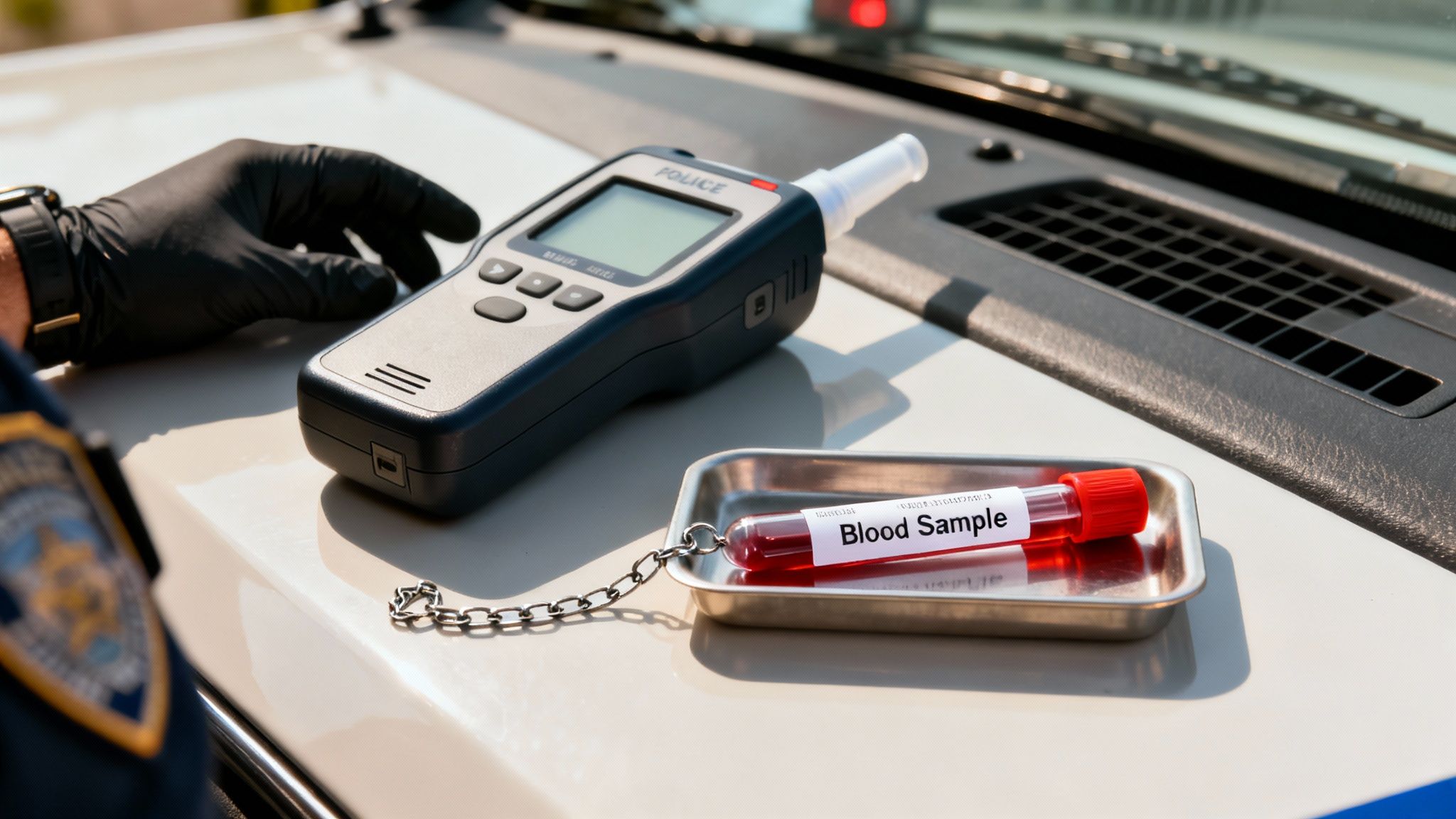
Breath Tests: The Intoxilyzer 9000
The breath test is the most common method used by law enforcement, often administered on a machine like the Intoxilyzer 9000. It’s critical to understand that this machine does not directly measure the alcohol in your blood.
Instead, it captures air from deep in your lungs, measures the alcohol vapor in that sample, and then uses a built-in mathematical formula—the "partition ratio"—to estimate your BAC. This conversion is a major point of vulnerability. It assumes every person's body is the same, which is not scientifically accurate.
A breathalyzer offers an indirect measurement that relies on averages and assumptions. Your unique physiology, medical conditions, or even the food you ate can throw off the result, making the final number less of a hard fact and more of a calculated guess.
A strategic defense attorney will immediately investigate several key areas to question the machine's reading:
- Improper Calibration: Was the Intoxilyzer maintained and calibrated correctly? We can review the machine’s logs, which often reveal a history of errors or missed service dates.
- Officer Error: Was the officer certified to operate the device? Did they follow the strict, step-by-step protocol, or did they cut corners?
- Medical Conditions: Issues like acid reflux (GERD), diabetes, or even being on a keto diet can produce chemicals in your breath that trick the machine into giving a false positive.
- Contamination: Mouthwash, breath spray, or even residue from some foods can contaminate a sample. This is why officers are required to observe you for a full 15-minute waiting period—a step that is frequently skipped.
Fighting these results requires a deep knowledge of the science and regulations. You can learn more about how we challenge breathalyzer results in Texas in our detailed guide.
Blood Tests: The "Gold Standard" That Can Tarnish
Prosecutors often refer to blood tests as the "gold standard" because they directly measure alcohol in the blood. While more direct than a breath test, the process is far from foolproof. It's a complex chain of events with plenty of room for human error.
From the moment the needle enters your arm until a lab technician analyzes the sample, a mistake at any point can corrupt the sample and make the final result completely unreliable.
Common Defenses Against Blood Test Evidence
An experienced DWI lawyer doesn't just see a number; they see a process that must be scrutinized. We meticulously examine every single step to show a judge or jury why the prosecution's BAC number can't be trusted.
Here are some of the most common ways we challenge blood test evidence:
- Improper Blood Draw Procedure: The person drawing your blood must be qualified (like a phlebotomist or nurse). They also must clean the site with a non-alcoholic antiseptic. Using a common alcohol swab is an immediate source of contamination.
- Breaks in the Chain of Custody: The prosecution must prove, without a doubt, that the blood sample was properly sealed, labeled, transported, and stored. Any gap in this "chain of custody" compromises the sample's integrity.
- Sample Fermentation or Contamination: Blood is an organic substance. If the vial isn't prepared with the correct amount of preservative and anticoagulant, the blood can begin to ferment, creating its own alcohol and artificially inflating the BAC.
- Lab Errors and Faulty Equipment: The sophisticated machines used to test blood must be perfectly calibrated and maintained. We can subpoena the lab's records to look for a history of malfunctions or procedural violations by the lab technicians.
A DWI charge based on a BAC reading can feel difficult to beat, but it's not. That number is only as good as the people and equipment that produced it. At The Law Office of Bryan Fagan, we know exactly where to look for the mistakes that can make all the difference in your case.
Texas DWI Penalties Explained
When you're arrested for a DWI in Texas, you're not just fighting one legal battle; you're fighting two at the same time. On one hand, you have the criminal charge, where a conviction could mean jail time, massive fines, and a permanent mark on your record. On the other, there's a swift, separate fight with the Texas Department of Public Safety (DPS) just to keep your driver's license.
It’s an overwhelming situation, but understanding what you're up against is the first step toward reclaiming control. While the penalties are severe, they are not set in stone. The right legal strategy can help protect your future.
Fighting a War on Two Fronts
The moment of your arrest, two clocks start ticking on two completely different legal processes. It’s critical to understand that these cases operate independently.
- The Criminal Case: This plays out in criminal court, where a prosecutor tries to prove beyond a reasonable doubt that you were driving while intoxicated. The stakes are incredibly high, with potential outcomes ranging from a dismissal to a conviction that carries life-altering penalties.
- The Administrative License Revocation (ALR) Case: This is the civil process handled by the DPS, and it’s all about your driver's license. If you blew over 0.08% or refused a test, the state automatically begins the process to suspend your license. This moves quickly, with its own strict deadlines separate from your criminal court dates.
You have to fight both of these battles strategically.
The Escalating Penalties for a Texas DWI
In Texas, the consequences for a DWI conviction become more severe with each offense. What starts as a misdemeanor can escalate into a felony, which could strip you of fundamental rights like owning a firearm.
Here’s a breakdown of the potential criminal and administrative penalties you could be facing.
Texas DWI Penalties by Offense
| Offense Level | Potential Jail Time | Maximum Fines | License Suspension Period |
|---|---|---|---|
| First Offense (Class B Misdemeanor) | 72 hours to 180 days | Up to $2,000 | Up to 1 Year |
| Second Offense (Class A Misdemeanor) | 30 days to 1 year | Up to $4,000 | Up to 2 Years |
| Third Offense or More (3rd Degree Felony) | 2 to 10 years in state prison | Up to $10,000 | Up to 2 Years |
These penalties don't include other costs, like annual DPS surcharges (up to $2,000 a year for three years), probation fees, and mandatory ignition interlock device installation. The financial and personal toll can be staggering.
The 15-Day Deadline You Absolutely Cannot Miss
While your criminal case may move slowly through the court system, the fight for your driver’s license starts immediately. This is because of Texas’s implied consent law. The moment you drive on a Texas road, you have legally consented to give a breath or blood sample if lawfully arrested for DWI.
If you refuse the test or fail it, the officer will take your license and give you a temporary driving permit. From that moment, you have only 15 days to request an Administrative License Revocation (ALR) hearing.
This hearing is your one and only chance to stop the automatic suspension of your license. If you miss this tiny window, your license will be suspended—usually starting 40 days after your arrest.
Requesting the ALR hearing does more than just give you a shot at saving your license. It’s a powerful strategic tool. It forces the arresting officer to testify under oath, giving your attorney a golden opportunity to lock down their story and find weaknesses we can use to fight your criminal case. Don’t let this critical deadline slip away.
How to Fight a Breath Test Result
Seeing a BAC number over the legal limit can make you feel like the case is already lost. But that number is far from the end of the story. A BAC reading is just one piece of evidence, and like any evidence, it can be questioned, challenged, and ultimately defeated in court.
An experienced Houston DWI lawyer doesn’t just see a number; we see a scientific process full of potential human and mechanical errors. Every single step, from the moment you were pulled over to the final lab analysis, offers an opportunity to build a powerful defense.
A reading above 0.08% doesn't automatically mean you are guilty. It is simply the starting point for our investigation into the procedures the state is trying to use against you.
Challenging Breath Test Evidence
Breathalyzer machines, like the Intoxilyzer 9000 used across Texas, are not foolproof. To produce a reliable result, they require strict maintenance, precise calibration, and flawless operation by a certified officer.
We meticulously scrutinize every detail of a breath test to uncover errors that can render the results invalid. Our goal is to show the judge or jury that the number the prosecution is banking on isn't trustworthy.
Common strategies we use to challenge breath tests include:
- Improper Machine Maintenance: We subpoena the machine’s full maintenance and repair logs. These records often reveal a hidden history of malfunctions, missed calibration checks, or recurring error codes that raise serious doubts about the device's accuracy.
- Lack of Officer Certification: The officer operating the device must be properly trained and certified. We verify their credentials and training records to ensure they followed every step of the required protocol.
- Violation of the 15-Minute Observation Period: This is a key detail. Before you provide a sample, the officer is required to observe you for 15 minutes to ensure you don’t burp, vomit, or put anything in your mouth that could contaminate the sample. This critical step is often rushed or ignored.
A breathalyzer doesn't directly measure the alcohol in your blood. It measures the alcohol in your breath and then uses a fixed mathematical formula to estimate your BAC. This conversion process is vulnerable to countless outside factors, from your diet to certain medical conditions.
Questioning the Reliability of Blood Tests
Prosecutors often call blood tests the "gold standard" of BAC testing, but they're only as reliable as the chain of people who handle the sample. A blood test creates a long "chain of custody," and a single weak link anywhere in that chain can compromise the entire process.
A skilled attorney knows exactly where to look for those weak links. We examine every step, from the needle in your arm to the test tube in the lab, to ensure your rights were protected and the science was sound.
Common Defenses Against Blood Test Results
To fight a DWI in Texas effectively, your lawyer must be ready to challenge the science behind the state's case head-on. We regularly use several key strategies to dismantle the prosecution's blood test evidence.
- Challenging the Chain of Custody: We track your blood sample’s journey from start to finish. Was it properly sealed, labeled, and stored at the right temperature? Any unaccounted-for time or sloppy handling can lead to the evidence being thrown out.
- Improper Blood Draw: The person who drew your blood must be qualified and use a non-alcoholic sterilizing agent. Using a standard alcohol swab is a common mistake that directly contaminates the sample.
- The Rising BAC Defense: Alcohol takes time to be absorbed into your bloodstream. We can often argue that while your BAC may have been over the limit at the time of the test—which could be an hour or more after you stopped driving—it was actually below the legal limit when you were behind the wheel.
- Lab Errors and Contamination: The vials used for blood draws contain precise amounts of preservatives. If the tube is expired or improperly stored, the blood can ferment, creating its own alcohol and falsely inflating the BAC reading.
A DWI charge is serious, but it is rarely hopeless. With the right legal team digging into the evidence, you can aggressively challenge the state's case and fight to protect your future.
What to Do Immediately After a DWI Arrest
The minutes and hours after a DWI arrest are a blur of confusion and anxiety. It's completely normal to feel overwhelmed, but what you do next is critical. This is the moment to take decisive steps to protect your future. You don’t have to go through this alone.
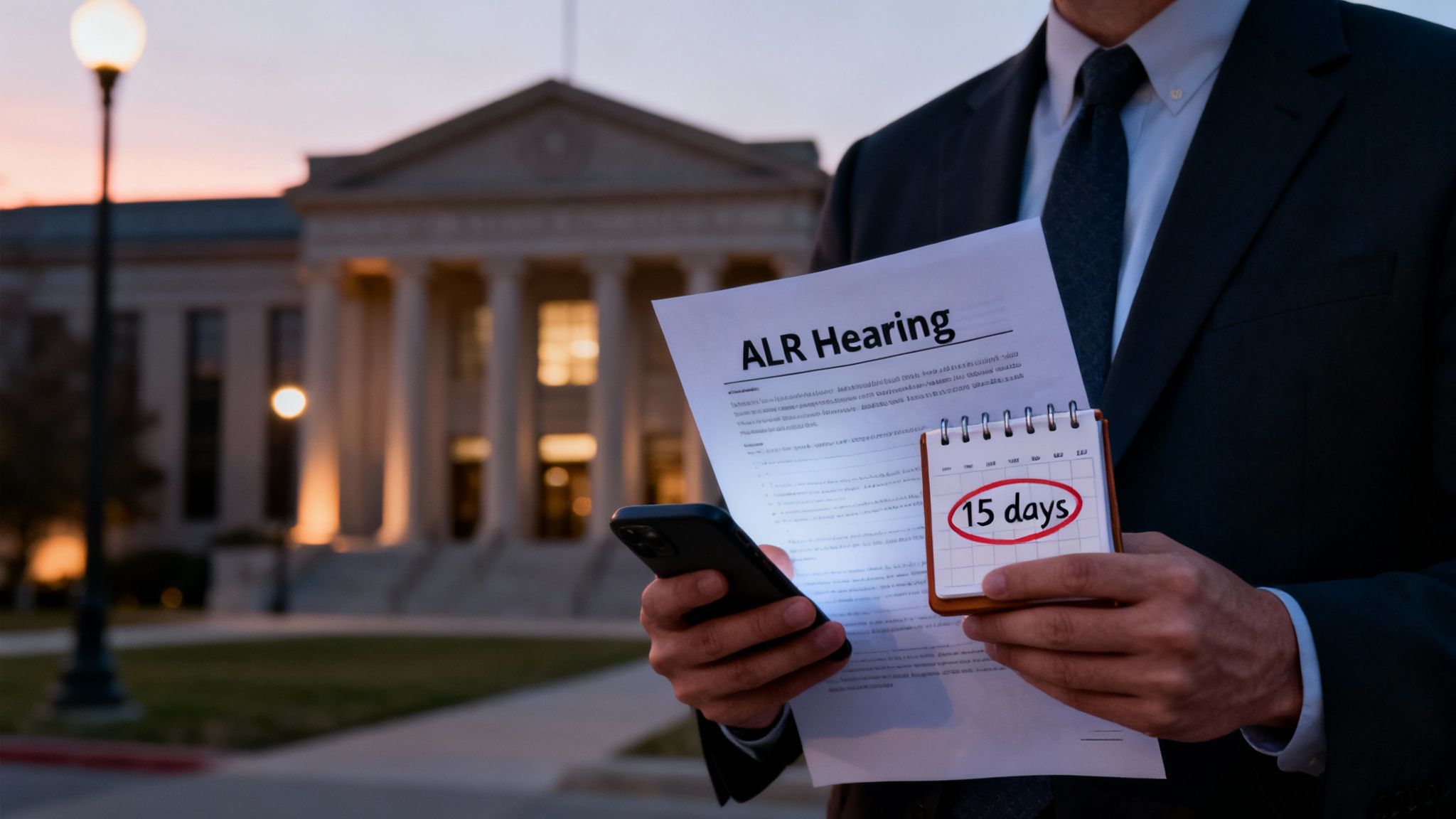
Your most urgent priority is a deadline that catches many people by surprise. When the officer took your driver's license, they should have handed you a piece of paper that serves as a temporary permit. On that form is a critical notice: you have only 15 days from the date of your arrest to request an Administrative License Revocation (ALR) hearing.
The 15-Day ALR Hearing Deadline
This deadline is non-negotiable. If you fail to formally request that hearing within the 15-day window, the Texas Department of Public Safety (DPS) will automatically suspend your driver’s license. That suspension typically begins 40 days after your arrest. Filing this request is your one and only shot at challenging the immediate DWI license suspension.
An ALR hearing is more than just a chance to keep your license. It's a powerful strategic tool. It forces the arresting officer to testify under oath long before your criminal trial, locking in their story and giving your attorney a golden opportunity to find weaknesses in the state's case against you.
Build Your Defense from Day One
While the ALR hearing is your most time-sensitive task, there are other crucial steps you need to take right away to start building a strong defense. The most important piece of evidence at this moment is your own memory, and it fades quickly.
Your Immediate Action Plan:
- Write Down Everything: As soon as possible, write down every single detail you remember about the arrest. Where were you? What time was it? What did the officer say? What questions did they ask? Document any field sobriety tests they had you perform. No detail is too small.
- Preserve All Paperwork: Hold on to every single document the police gave you. This includes the temporary license permit, any bond paperwork, and all citations. These papers contain vital information for your case.
- Secure Your Release: Your first priority is to focus on posting bond to get out of jail. You can't effectively fight for your rights from behind bars.
Contact a Houston DWI Lawyer Immediately
The single most important step you can take is to call an experienced Texas DUI attorney without delay. The legal system moves incredibly fast, and those deadlines are unforgiving. You need a professional in your corner who understands both the criminal court process and the separate administrative fight to save your license.
A DWI arrest can feel like your world is falling apart, but it's really just the beginning of a legal fight—a fight you can win. At The Law Office of Bryan Fagan, PLLC, we are here to provide the strategic, aggressive defense you need and the guidance you deserve. Contact us today for a free, confidential case evaluation. Let’s start protecting your future right now.
Got Questions About Texas DWI Laws? We Have Answers.
When you're facing a DWI arrest, the legal jargon can feel overwhelming. It’s natural to have questions. Below, we’ve answered some of the most common ones we hear to give you the straightforward information you need.
What is "implied consent" in Texas?
In Texas, “implied consent” means that by getting a driver’s license, you have legally agreed to provide a breath or blood sample if you are lawfully arrested for DWI. Refusing the test doesn't stop a DWI charge. Instead, it triggers an automatic driver's license suspension. The officer will then likely obtain a warrant to take a blood sample, sometimes by force.
What is a field sobriety test?
A field sobriety test (FST) is a set of physical and mental exercises an officer uses at the roadside to gauge impairment. The three standardized tests are the Horizontal Gaze Nystagmus (eye test), the walk-and-turn, and the one-leg stand. These tests are notoriously subjective and difficult to perform even when sober. You have the right to politely refuse to take them.
What is an administrative license suspension?
An administrative license suspension (or ALR) is a civil penalty separate from your criminal DWI case. The Texas DPS will automatically suspend your license if you fail a chemical test (BAC of 0.08% or higher) or refuse one. You have only 15 days from your arrest to request an ALR hearing to challenge this suspension.
Can I get a DWI if my BAC is under 0.08%?
Yes. While 0.08% BAC is the legal limit for being "per se" (automatically) intoxicated, you can still be arrested for DWI if an officer believes you have lost the "normal use of your mental or physical faculties" due to alcohol or drugs. This can be based on your driving, your performance on field sobriety tests, or other observations.
How long does a DWI stay on your record in Texas?
A DWI conviction in Texas is permanent. It will follow you for the rest of your life, showing up on background checks for jobs, housing, and loans unless you can get it expunged or sealed. This is why it's so critical to fight your DWI Texas charge from day one. For some first DWI in Texas offenses, sealing the record might be an option, but it's not available in every case.
A DWI charge feels like the end of the world, but it doesn’t have to be. At The Law Office of Bryan Fagan, PLLC, we believe one mistake shouldn’t define your future. We will dig into every detail of your case to build a defense that protects your rights and your freedom. Our experienced Houston DWI lawyers are ready to fight for you.
For a free, confidential consultation to discuss your case, contact us today for a free, confidential case evaluation or visit our website.

