
A DWI arrest can be overwhelming — but you don’t have to face it alone. After the initial shock wears off, understanding what happens next in court can help you regain a sense of control. The first major step in the legal process is a court date called a formal arraignment.
Let's be clear about one thing right away: a formal arraignment is not a trial. Think of it as the official kickoff for your court case. It’s the first time you will appear before a judge where the DWI charges are read aloud, and you are asked to enter your plea. This procedural hearing is a critical first step in building a strong defense.
Your First Court Date After a DWI Arrest

Stepping into a Texas courtroom can be a daunting experience. However, the formal arraignment is mostly a procedural hearing designed to get the legal ball rolling. The purpose is to ensure you officially know the exact charges filed against you and to get your initial plea on the record.
This first appearance is a critical moment, and having an experienced Houston DWI lawyer at your side makes all the difference. Your attorney is there to protect your rights from day one and prevent you from making common mistakes that could negatively impact your case down the road.
What to Expect at Arraignment
While the details can vary between courts, the formal arraignment itself is usually quick and straightforward. It’s not about arguing evidence or proving your innocence—it's all about procedure. Here’s what typically happens:
- Formal Reading of Charges: The judge or prosecutor will state the specific DWI offense the state is pursuing.
- Entering a Plea: You'll be asked how you plead: “guilty,” “not guilty,” or “no contest.” In nearly every DWI case, the only strategic move is to plead “not guilty.” This forces the state to prove its case against you.
- Confirming Legal Counsel: The judge will verify that you have a lawyer. If you don't, they will ask if you plan to hire one or if you need the court to appoint one (if you qualify).
- Setting Future Dates: Before you leave, the court will set deadlines for filing motions and schedule your next hearing date.
With the right legal strategy, this initial hearing isn't just a formality—it's the first real step in building your defense. It sets the stage for your attorney to start gathering evidence, identifying weaknesses in the prosecution's case, and fighting for the best possible outcome. For a full rundown of what to do right after an arrest, take a look at our guide on what to do after a DWI arrest to make sure you're fully prepared.
The True Purpose of a Formal Arraignment
To most people, a "formal arraignment" sounds like just another confusing court date on a long list of legal hurdles. But it’s far more than a simple formality. It’s a critical constitutional safeguard, one designed to protect your rights from the very beginning.
Think of it as the official kickoff for your legal defense. This is the moment the whistle blows and the game plan you’ve built with your attorney finally gets put into motion. It’s not the time to argue evidence or prove your innocence—instead, it's the strategic starting point where the entire trajectory of your DWI case begins to take shape.
Your Constitutional Protections at Arraignment
The entire arraignment process is built on the foundation of your constitutional rights. The Sixth Amendment to the U.S. Constitution guarantees every defendant the right to be formally notified of the charges they face. This isn't just a suggestion; it's a core principle of due process. You can learn more about the legal framework of arraignment on Wikipedia.org.
This hearing serves a dual purpose that many facing a Texas DWI charge underestimate. First, it prevents the state from holding you indefinitely without telling you exactly what you’re accused of. Second, it forces the prosecution to officially present the charges, laying its cards on the table.
Key Takeaway: The formal arraignment is not a trial to determine guilt or innocence. It is a protective hearing that ensures you are fully aware of the allegations and gives you the opportunity to formally begin your defense with a "not guilty" plea.
During this hearing, a few key things must happen to meet the standards of due process. These steps are designed to protect you and set the stage for a fair fight.
Your Texas DUI attorney will be there to make sure every step is handled correctly, shielding you from procedural missteps. Here’s what you can expect:
- Formal Reading of DWI Charges: The court will read the official criminal complaint aloud, detailing the specific DWI offense you are charged with under Texas law.
- Explanation of Potential Penalties: The judge is required to inform you of the range of possible consequences if you are convicted, including fines, jail time, and a potential DWI license suspension.
- Setting of Bail or Bond Conditions: The court will review and either set or confirm the conditions of your release. This could involve bail amounts or specific requirements like installing an ignition interlock device.
By officially kicking off the criminal proceedings, the arraignment triggers your attorney's ability to demand evidence from the prosecution—a process known as "discovery." This is when your Houston DWI lawyer can formally request police reports, body cam footage, breath or blood test maintenance records, and all the other evidence needed to start building a powerful defense to fight your DWI in Texas.
Arraignment vs. Preliminary Hearing Explained
After a DWI arrest, the courthouse can feel like a maze of unfamiliar terms and procedures. It’s easy to get lost. Many people mix up the formal arraignment with another critical step called a preliminary hearing. While they both happen early in your case, they serve completely different purposes.
Understanding this difference is key to seeing how your defense strategy starts to take shape from day one.

Think of it this way: a preliminary hearing is like a filter. Its only job is to answer one question: does the State have enough evidence to even justify moving forward with the charges? This hearing, sometimes called a probable cause hearing, forces the prosecutor to show a judge they have a legitimate reason to believe a crime was committed and that you were the one who committed it.
The formal arraignment, on the other hand, is the official starting whistle for the main event in trial court. It only happens after a judge has found probable cause. This is where you are formally told about the charges against you and enter your official plea—which should always be "not guilty" at this stage.
The Strategic Importance of Each Hearing
Here in Texas, the distinction between these two hearings isn't just a technicality; it's a critical fork in the road for your defense. Each stage serves a fundamentally different purpose in protecting your rights.
This is where having a skilled DWI lawyer immediately makes a difference. At a preliminary hearing, your attorney gets the first real chance to attack the core of the State's case.
They can challenge the prosecutor's evidence by questioning things like:
- The legality of the traffic stop that started it all.
- The way the officer conducted the field sobriety tests.
- The validity of the breath or blood test results, which determine your BAC (Blood Alcohol Concentration).
By raising these issues early, a sharp attorney can sometimes get evidence thrown out. In the best-case scenario, they can convince the judge there isn't enough evidence to proceed, potentially getting the entire case dismissed before it ever gets off the ground.
For a deeper look into these initial challenges, you can check out our guide on the Omnibus DWI hearing in Texas.
Preliminary Hearing vs. Formal Arraignment at a Glance
To make it even clearer, let's break down the key differences between these two crucial court proceedings in a Texas DWI case.
| Aspect | Preliminary Hearing | Formal Arraignment |
|---|---|---|
| Purpose | To determine if the State has enough evidence (probable cause) to proceed with the case. | To formally inform you of the charges and for you to enter an official plea ("not guilty"). |
| When It Occurs | Shortly after the arrest, before the case is formally accepted by the trial court. | After probable cause is found, marking the official start of the criminal court case. |
| Key Question | "Is there enough evidence to continue?" | "Do you understand the charges and how do you plead?" |
| Attorney's Goal | To challenge the State's evidence and potentially get the case dismissed for lack of probable cause. | To enter a "not guilty" plea, protect your rights, and set the stage for discovery and future motions. |
Understanding this table helps you see how each hearing is a distinct battleground with its own rules and objectives. While one is about screening the evidence, the other is about officially starting the fight.
Understanding Your Rights and Plea Options

Knowing your rights isn't just about feeling more comfortable in a courtroom; it's the very foundation of your entire defense strategy. A formal arraignment is a critical moment where some of your most important constitutional rights are put on display. Understanding them ahead of time empowers you to make smart decisions and prevents you from accidentally giving up ground to the prosecution.
Walking into court is intimidating for anyone, but you are not without legal protection. The law is designed to give you specific rights at this stage to make sure the process is fair.
Your Core Rights at a Texas Arraignment
From the second your case is called, the Constitution acts as your shield. An experienced Houston DWI lawyer's main job is to make sure those rights are protected and respected by everyone in the room.
Here are the key rights you have at your formal arraignment:
- The Right to Be Informed of the Charges: You have an absolute right to know exactly what the State of Texas is accusing you of. The judge will read the charges aloud or summarize them so there’s no confusion.
- The Right to Counsel: You have the right to have an attorney by your side, representing you. If you can't afford one, the court is required to appoint one for you. This is non-negotiable, as your lawyer is your guide and your advocate through this maze.
- The Right to Remain Silent: Your Fifth Amendment right protects you from incriminating yourself. You don’t have to answer questions or make any statements that could be twisted and used against you. Your attorney should be doing all the talking.
These aren't just helpful suggestions; they are legal requirements that form the bedrock of a fair and just proceeding.
Your arraignment is the first real chance you have to assert your rights. Having a skilled attorney with you ensures you don’t accidentally waive any of them, which could permanently sabotage your defense.
Understanding Your Three Plea Options
The whole point of a formal arraignment boils down to one thing: entering a plea. The judge will look at you and ask how you plead to the DWI charge. In Texas, you have three choices, and the one you make has immediate and long-term consequences for your case.
- Guilty: A guilty plea is a total admission to the crime. It essentially ends your case right there and moves you directly to sentencing. By pleading guilty, you give up your right to a trial and any chance to challenge the evidence against you.
- No Contest (Nolo Contendere): This plea is a little different. You're not admitting you did it, but you're also not fighting the charges. The court will find you guilty anyway and move on to sentencing, just like a guilty plea. For a DWI case, its practical effect is almost identical to pleading guilty.
- Not Guilty: This is the most powerful and strategic move you can make. It's not a claim that you're factually innocent. Instead, it’s a formal declaration that you are forcing the State to prove its entire case against you beyond a reasonable doubt.
Pleading "not guilty" is the standard, correct choice in virtually every DWI case. This plea keeps all your legal options on the table, gives your attorney the time needed to demand and analyze the prosecution’s evidence, and allows you to start building a real defense. To see how this first step fits into the bigger picture, you can learn more about how DWI plea deals work in Texas and understand why that initial "not guilty" plea is so vital.
A Step-By-Step Guide to Your Arraignment Hearing
Walking into a courtroom for the first time is intimidating. Most people’s only frame of reference is what they’ve seen in movies, but a formal arraignment hearing is nothing like a chaotic TV drama. It’s a structured, predictable, and usually brief process.
Knowing exactly what’s going to happen can take a huge amount of the anxiety off your shoulders. With a Houston DWI lawyer at your side, it’s a manageable first step in building your defense. Let's walk through what a typical Texas DWI arraignment looks like from the moment your name is called.
The Key Players and Courtroom Setting
First, let's set the scene. In the courtroom, there are a few key people you’ll see. The judge runs the show, making sure all the rules are followed. The prosecutor is the lawyer representing the State of Texas, and your defense attorney is there for one reason: to represent you. You, the defendant, are central to the hearing, but your lawyer will be doing all the talking.
When the court calls your case, you and your attorney will walk up to the bench, which is the large desk where the judge sits. The atmosphere is formal, so respectful conduct is a must—that means no talking unless you’re asked to, and always addressing the judge as "Your Honor."
The Sequence of Events
The hearing itself moves quickly and follows a standard script. It’s not a trial and there won't be any surprises.
Here’s the play-by-play of what you can expect:
- Case Called: The judge or a court officer (the bailiff) will announce your name and case number.
- Identification: The judge will simply ask you to state your name for the court record to confirm you are the person named in the paperwork.
- Charges Read: The judge will either read the official DWI charges filed against you or give a quick summary.
- Rights Confirmed: The judge will make sure you understand your basic constitutional rights, like your right to have an attorney.
- Plea Entered: This is the most important part of the hearing. Your attorney will step forward and formally enter a plea of "not guilty" on your behalf.
- Next Steps Scheduled: Finally, the judge will set deadlines for the next steps in your case and give you your next court date.
This formal arraignment is your first official court appearance where the charges are laid out. It is absolutely critical that you attend this hearing; missing it will almost certainly result in a warrant for your arrest. For a deeper dive into this crucial step, you can learn about the arraignment process on shuttleworth-law.com.
Life After the Arraignment: What Comes Next
Pleading "not guilty" isn't just a formality—it’s the action that officially kicks off the next phase of your defense. The end of the arraignment isn’t an ending at all; it’s the starting pistol for your attorney's real work.
Immediately after the hearing, your case enters what’s known as the discovery phase. This is a legal process where your attorney formally demands that the prosecutor hand over every single piece of evidence they have against you. This includes police reports, body and dashcam videos, breathalyzer maintenance logs, and any blood test results.
This evidence is the raw material your lawyer will use to build your defense strategy. They'll go through everything with a fine-toothed comb, looking for weaknesses, police mistakes, or violations of your rights. Based on what they find, they’ll begin drafting and filing pretrial motions to challenge evidence and build the strongest possible defense for your future court dates. This is how a clear roadmap to fighting your case begins to take shape.
Common Questions About DWI Arraignments in Texas
Even after you get a handle on the process, you probably still have practical questions about your formal arraignment. Facing the court system for the first time can bring up a ton of "what ifs," but getting clear, straight answers is the best way to regain your confidence and feel ready for what's next.
Here are some of the most common questions our clients ask about this critical first hearing.
Do I Have to Personally Attend My DWI Arraignment in Texas?
For most misdemeanor DWI cases in Texas, the answer is often no. An experienced attorney can usually appear on your behalf by filing a special document called a "waiver of arraignment." This is a huge advantage. It saves you the stress of the hearing itself, the time you'd have to take off work, and the hassle of traveling to the courthouse.
Your lawyer handles all the procedural steps, enters the standard "not guilty" plea for you, and gets the ball rolling on gathering evidence from the prosecution. However, if you're facing more serious felony DWI charges, your personal appearance is almost always mandatory. It's crucial to confirm the specific requirements for your case directly with your attorney.
What Should I Wear if I Have to Go to My Arraignment?
If you do have to show up in person, remember that how you present yourself matters. Your clothes should send a clear message: you respect the court and are taking these proceedings seriously.
- Recommended Attire: Business casual is your safest bet. Think slacks and a collared shirt or a conservative blouse or dress.
- What to Avoid: Stay far away from jeans, shorts, sandals, hats, or any t-shirts with graphics or slogans.
- What to Bring: Make sure you have your driver's license or another form of ID, along with any specific documents your lawyer told you to bring.
- Final Check: Your phone needs to be completely silenced. Better yet, just leave it in your car. A phone ringing in court can get you a fine or have your device confiscated.
The goal is to look composed, respectful, and prepared.
This flowchart breaks down the simple, three-step flow of a typical arraignment hearing.
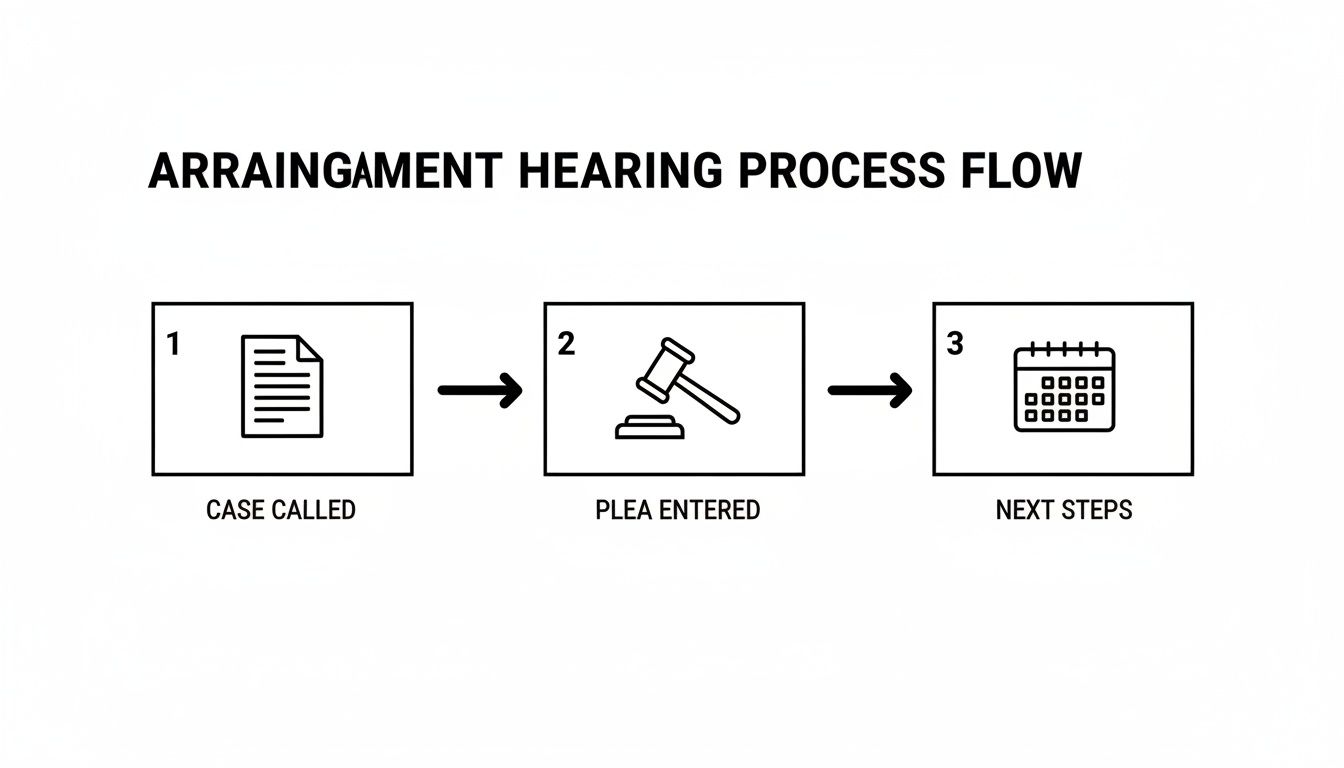
As you can see, the hearing is a structured, procedural event. It’s designed to officially kick off your case, not to decide if you're guilty.
What Happens if I Miss My Formal Arraignment Date?
Missing your formal arraignment date is a very serious mistake with immediate, severe consequences. The judge will almost certainly issue a bench warrant for your arrest.
This means any future interaction you have with law enforcement—even a minor traffic stop—could land you in custody. On top of that, if you're out on bond, your failure to appear will likely cause the bond to be forfeited. The bail bond company will then come after you to recover their money. It creates a brand new, significant legal problem and makes it much harder for your attorney to negotiate on your behalf.
If you even think you might miss your court date, you must contact your Houston DWI lawyer immediately.
Will a Plea Deal Be Offered at the Arraignment?
It is extremely unlikely that any final plea bargain will be on the table at your formal arraignment. This hearing happens way too early in the legal process.
At this stage, your defense team hasn't even received or reviewed the state's evidence—a process known as "discovery." Without digging into the police reports, body camera footage, and breath or blood test results, it's impossible to know the strengths and weaknesses of the prosecutor's case or to pinpoint powerful defense strategies.
The "not guilty" plea entered at the arraignment is what buys your attorney the time they need to conduct this vital investigation to fight your DWI in Texas.
Navigating a DWI charge in Texas requires a strategic and experienced legal partner from the very beginning. At the Law Office of Bryan Fagan, PLLC, our team is dedicated to protecting your rights, clarifying the complex court process, and building a powerful defense tailored to your case. Don't face the legal system alone. Contact us today for a free, confidential consultation to discuss your case by visiting us at https://texasduilawfirm.com.