 Skip to content
A DWI arrest can be overwhelming — but you don’t have to face it alone. One minute you're driving, the next you're in handcuffs, and your mind is racing with questions about what comes next. It’s a moment that leaves you feeling powerless and uncertain about your future.
At The Law Office of Bryan Fagan, PLLC, our goal is to restore that control. This guide will provide clear explanations of Texas DWI laws, define the key terms you need to know, and help you take the first step toward building a powerful legal defense. An experienced Houston DWI lawyer can start protecting your rights today.
What Does "Intoxicated" Actually Mean in Texas?
When you hear "DWI," you probably think of drunk driving. But in Texas, the legal definition of "intoxicated" is much broader than just alcohol. The Texas Penal Code gives prosecutors three different ways to prove you were "intoxicated," and they only need to prove one of them to secure a conviction. Understanding these definitions is the first step toward building a strong defense strategy.
Legally, a person is considered intoxicated if they:
- Lack the normal use of their mental faculties because of alcohol, a drug, a controlled substance, or any combination.
- Lack the normal use of their physical faculties for the same reasons.
- Have a Blood Alcohol Concentration (BAC) of 0.08% or higher.
This is critical: you can be arrested and charged with a DWI even if your BAC is below the legal limit. If a police officer simply believes your ability to drive safely is impaired by any substance—including a legal prescription from your doctor—they can make an arrest.
Mental and Physical Impairment
The first two definitions are subjective, meaning they rely on the arresting officer's personal opinion and observations. The officer will look for things like slurred speech, fumbling for your license, or swaying. They'll also use your performance on field sobriety tests against you.
But these signs can have perfectly innocent explanations. Are you slurring your words, or are you just tired? Are you unsteady on your feet, or are you nervous about being pulled over on the side of a busy road? These are the kinds of questions a skilled Texas DUI attorney will ask to challenge the officer's assumptions.
The 0.08 BAC Standard
The third definition is the one everyone knows—the 0.08% BAC limit. This is the "per se" legal limit, meaning that if your BAC is at or above this number, you are considered intoxicated by law, no matter how well you think you were driving.
For commercial drivers, that limit is even stricter at 0.04%. And for anyone under 21, Texas has a zero-tolerance policy, so any detectable amount of alcohol can lead to a Driving Under the Influence (DUI) charge.
To help you keep these terms straight, here’s a quick rundown of the legal language you'll hear in your case.
Key Definitions in a Texas DWI Case
Navigating a DWI charge means learning a new language filled with legal and technical terms. This table breaks down the most important concepts you need to know right away.
| Term | What It Means for You |
|---|---|
| Intoxication | The legal state of being impaired. It can be proven by loss of faculties or a BAC of 0.08% or more. |
| BAC | Blood Alcohol Concentration. The percentage of alcohol in your bloodstream. It's the prosecution's scientific evidence. |
| Mental Faculties | Your ability to think clearly, make judgments, and remember things. An officer will use your conversation as evidence. |
| Physical Faculties | Your ability to control your body—balance, coordination, and reflexes. This is what field sobriety tests claim to measure. |
| Per Se Limit | The BAC level (0.08%) at which you are legally considered intoxicated, regardless of whether you felt impaired. |
Understanding these definitions is the foundation of your defense. An arrest is just the beginning of the story, not the end.
A DWI charge is not a conviction. An experienced attorney can scrutinize every piece of evidence—from the traffic stop to the chemical test results—to identify weaknesses in the prosecution's case and fight for your rights.
Texas law enforcement takes DWI charges incredibly seriously, and for good reason. Impaired driving poses a huge risk to public safety. In fact, Texas is considered a 'high-range' state for alcohol-related driving fatalities, with an estimated 1,699 deaths in 2023 involving drivers with a BAC of 0.08% or higher. You can read more about the state's efforts in the 2025 Texas Impaired Driving Plan.
At The Law Office of Bryan Fagan, PLLC, we know both the science and the law behind these charges. We’re here to build the strategic defense you need to protect your future.
Navigating the DWI Arrest Process in Texas
The moment red and blue lights flash in your rearview mirror, a clock starts ticking. It’s the beginning of a process that can feel disorienting and frankly, terrifying. Understanding what happens during a DWI stop and arrest is the first step toward protecting yourself. This isn't just a traffic ticket—it's the start of a serious legal battle where every decision you make matters.
It all begins with a traffic stop. An officer can’t just pull you over for no reason; they need reasonable suspicion that you’ve broken some kind of law. This could be something as simple as speeding, failing to signal, or weaving between lanes. Once you’re pulled over, the officer will approach your window and start asking questions while looking for anything that suggests you might be impaired.
The Officer's Observations and Field Sobriety Tests
During that initial interaction, the officer is building a case against you. They’re trained to notice specific signs they associate with intoxication, like red eyes, the smell of alcohol, or fumbling for your license. Of course, things like allergies, fatigue, or simple nervousness can cause these same signs, but the officer will note them as potential evidence.
If the officer suspects you’ve been drinking, they’ll likely ask you to get out of your car to perform Standardized Field Sobriety Tests (SFSTs). These are a set of physical and mental exercises supposedly designed to gauge your coordination and ability to follow directions.
The three standardized tests used across Texas are:
- Horizontal Gaze Nystagmus (HGN) Test: The officer moves a pen or a finger back and forth, watching your eyes for an involuntary jerking motion.
- Walk-and-Turn Test: You’re asked to walk nine steps, heel-to-toe, down a real or imaginary line, pivot, and walk nine steps back.
- One-Leg Stand Test: The officer instructs you to stand on one foot for about 30 seconds while counting out loud.
Here's the most important thing to know: you are not legally required to perform these tests in Texas. These tests are notoriously subjective and incredibly difficult for almost anyone to perform perfectly, especially on the side of a dark road with traffic rushing by. Politely refusing these tests is your right.
Field sobriety tests are not truly "tests" you can pass. They are evidence-gathering exercises designed for you to fail. Every wobble, misstep, or moment of confusion is ammunition the prosecutor will use against you.
Chemical Tests and Implied Consent
Whether you attempt the field sobriety tests or refuse them, the officer's next move is usually to request a chemical test to measure your Blood Alcohol Concentration (BAC). This is typically a breathalyzer test on the spot or a blood draw at a station or hospital.
This brings us to Texas's implied consent law. The moment you get a Texas driver's license, you automatically agree to provide a breath or blood sample if you are lawfully arrested for DWI.
However—and this is a big however—you still have the right to refuse the chemical test. Refusing isn't a get-out-of-jail-free card. It comes with its own immediate consequence: an automatic civil penalty known as an Administrative License Revocation (ALR). For a first-time refusal, this means a DWI license suspension for 180 days. You can find a complete walkthrough of the legal steps in our guide to Texas DWI arrest procedures.
This simple diagram breaks down the three things a prosecutor must prove to convict you of DWI.
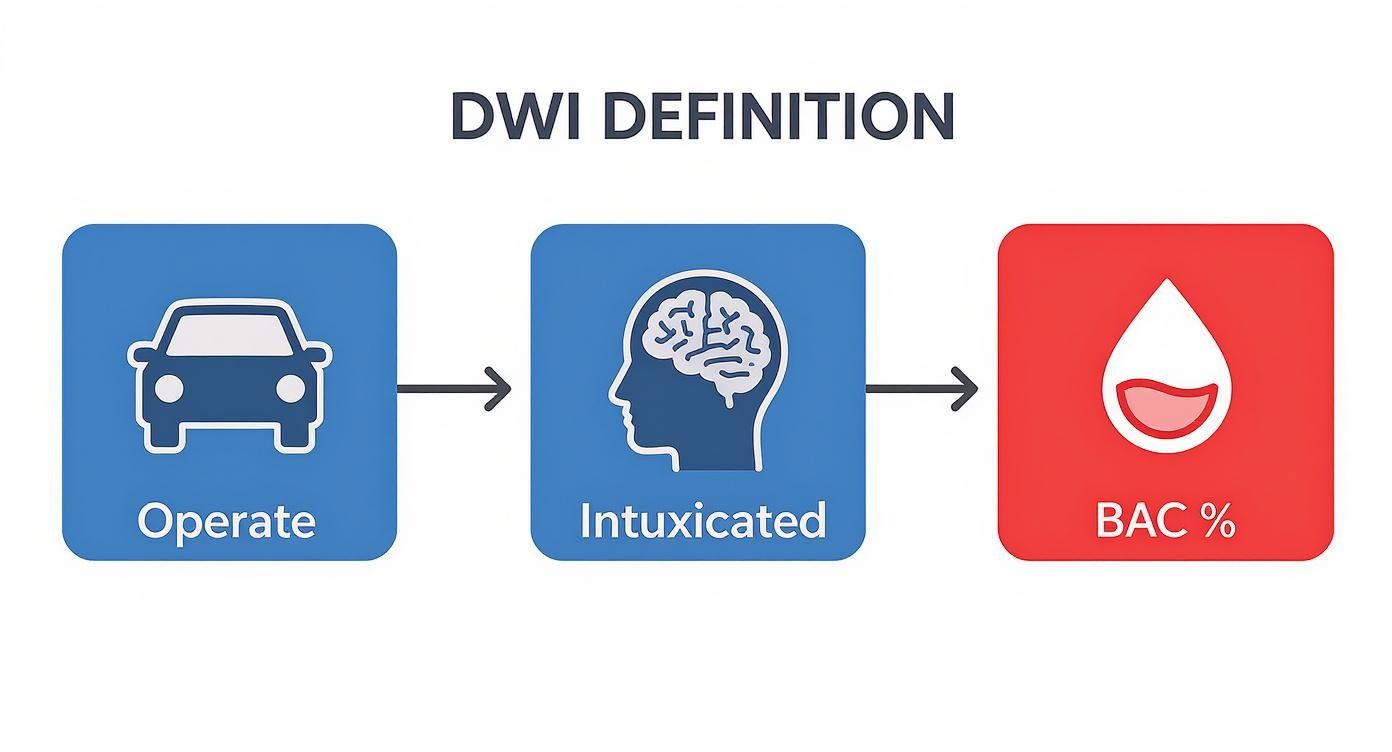
As you can see, the state has to connect the dots: you were operating a vehicle, you were legally intoxicated, and (if they have it) your BAC was over the legal limit.
The Arrest and Booking Procedure
If the officer believes they have probable cause—a higher legal standard than the "reasonable suspicion" needed to pull you over—they will place you under arrest. You’ll be handcuffed, searched, and taken to a police station or county jail to be booked.
During the booking process, your mugshot and fingerprints will be taken, and your personal information will be collected. Your personal items are inventoried and held until you're released. From there, you'll wait to see a magistrate judge, who will formally state the charges against you and set your bond.
This entire ordeal, from the flashing lights to the jail cell, is designed to build the state's case. But it's also where your defense begins. A skilled DWI attorney can challenge every single step of this process, questioning the legality of the traffic stop, the way sobriety tests were administered, and the accuracy of any chemical test results.
Understanding Texas DWI Penalties
A DWI charge brings a range of potential penalties that can impact your freedom, your finances, and your future. Knowing exactly what you're up against is the first step toward building a successful defense. Texas law outlines a clear ladder of consequences, and a good attorney's job is to fight for a dismissal, get the charges reduced, or secure the absolute minimum penalties for your case.
The severity of the penalty depends on your prior record and the specific details of your arrest. A first DWI in Texas is usually a Class B misdemeanor, but the charges can escalate quickly. Repeat offenses or certain aggravating factors can elevate the charge to a felony, which comes with much harsher outcomes.
Penalties for a First DWI Offense
For most people, a first-time DWI is their first and only interaction with the criminal justice system. While it's still a very serious charge, the penalties for a first DWI in Texas are the lightest within the state's DWI framework.
If convicted, you could be facing:
- Jail Time: A minimum of 72 hours, up to 180 days in county jail.
- Fines: A fine of up to $2,000.
- License Suspension: Your driver’s license could be suspended for 90 days to one full year.
- Annual Surcharges: You may have to pay the Texas Department of Public Safety (DPS) an annual fee of up to $2,000 for three years just to keep your license.
In addition, a judge can also order probation, mandatory DWI education classes, community service, and the installation of an ignition interlock device on your car.
Consequences for a Second DWI Offense
A second DWI conviction is where the state really starts to crack down. The charge is elevated to a Class A misdemeanor, and all penalties become significantly steeper. The courts see a second offense not as a mistake, but as a pattern of behavior, and the punishments are meant to reflect that.
A conviction for a second DWI can lead to:
- Jail Time: A mandatory minimum of 30 days, with a maximum of one year in county jail.
- Fines: The maximum fine doubles to $4,000.
- License Suspension: Your license can be suspended for a much longer period, from 180 days all the way up to two years.
- Ignition Interlock Device: At this stage, having an ignition interlock device installed is often mandatory, not optional.
The long-term impact on your finances and personal life also grows with a second conviction, making a strategic legal defense more critical than ever.
Facing a Third DWI or More
A third DWI charge is where the stakes skyrocket. In Texas, a third DWI is automatically a third-degree felony, regardless of how much time has passed since your last conviction. A felony on your record is a life-changing event that follows you forever, impacting your right to vote, own a gun, and find good employment.
The penalties for a felony DWI are severe:
- Prison Time: Between two and 10 years in a Texas state prison—not county jail.
- Fines: A fine of up to $10,000.
- License Suspension: Your driver’s license can be suspended for up to two years.
- Mandatory Conditions: You'll almost certainly face extensive probation, substance abuse treatment, and the required use of an ignition interlock device.
A felony conviction is a life-altering event. The goal of a strong legal defense is to challenge every aspect of the state's case to prevent that outcome, fighting to get the charge reduced or dismissed entirely.
To make these differences clearer, let's break down the potential penalties side-by-side.
Texas DWI Penalties at a Glance
This table gives you a quick look at how the consequences escalate with each subsequent offense.
| Offense Level | Potential Jail Time | Maximum Fine | License Suspension |
|---|---|---|---|
| First Offense | 72 hours to 180 days | Up to $2,000 | 90 days to 1 year |
| Second Offense | 30 days to 1 year | Up to $4,000 | 180 days to 2 years |
| Third Offense (Felony) | 2 to 10 years in prison | Up to $10,000 | Up to 2 years |
As you can see, the jump from a misdemeanor to a felony is massive. The difference between a few months in jail and a decade in prison is why it is so important to fight DWI Texas charges.
What Are Enhanced DWI Offenses?
Sometimes, certain circumstances—what the law calls "aggravating factors"—can make a DWI charge much more serious, even if it's your first offense. These enhancements trigger tougher penalties right out of the gate because the situation is seen as a greater danger to the public.
Common enhancements include:
- High BAC: If your Blood Alcohol Concentration (BAC) was 0.15% or higher, a first-time DWI is automatically elevated from a Class B to a Class A misdemeanor. This means you face the same penalties as a second DWI.
- DWI with a Child Passenger: If you're arrested for DWI with a child under 15 years old in the car, the charge is immediately a state jail felony. This comes with up to two years in a state jail and a fine of up to $10,000.
- Intoxication Assault: If you cause serious bodily injury to someone else while driving intoxicated, you can be charged with Intoxication Assault, a third-degree felony.
- Intoxication Manslaughter: If a drunk driving accident results in a death, the charge becomes Intoxication Manslaughter. This is a second-degree felony, punishable by up to 20 years in prison.
The state takes these offenses incredibly seriously, and for good reason. Texas has a tragic history with drunk driving, with over 1,000 deaths reported in 2024 from alcohol-related crashes. You can learn more about TxDOT's "Drive Sober. No Regrets." campaign and its mission to prevent these losses.
Facing these potential penalties is overwhelming, but remember: an arrest is not a conviction. With an experienced Houston DWI lawyer fighting for you, you can protect your rights and work to minimize these life-altering consequences.
How to Protect Your Driving Privileges
Beyond the criminal charges, a DWI arrest kicks off a second, more immediate threat that runs on a completely separate track: the loss of your driver’s license. This civil process is called an Administrative License Revocation (ALR), and it’s a critical battle you have to fight right away.
What you do in the first couple of weeks will decide whether you keep your driving privileges.
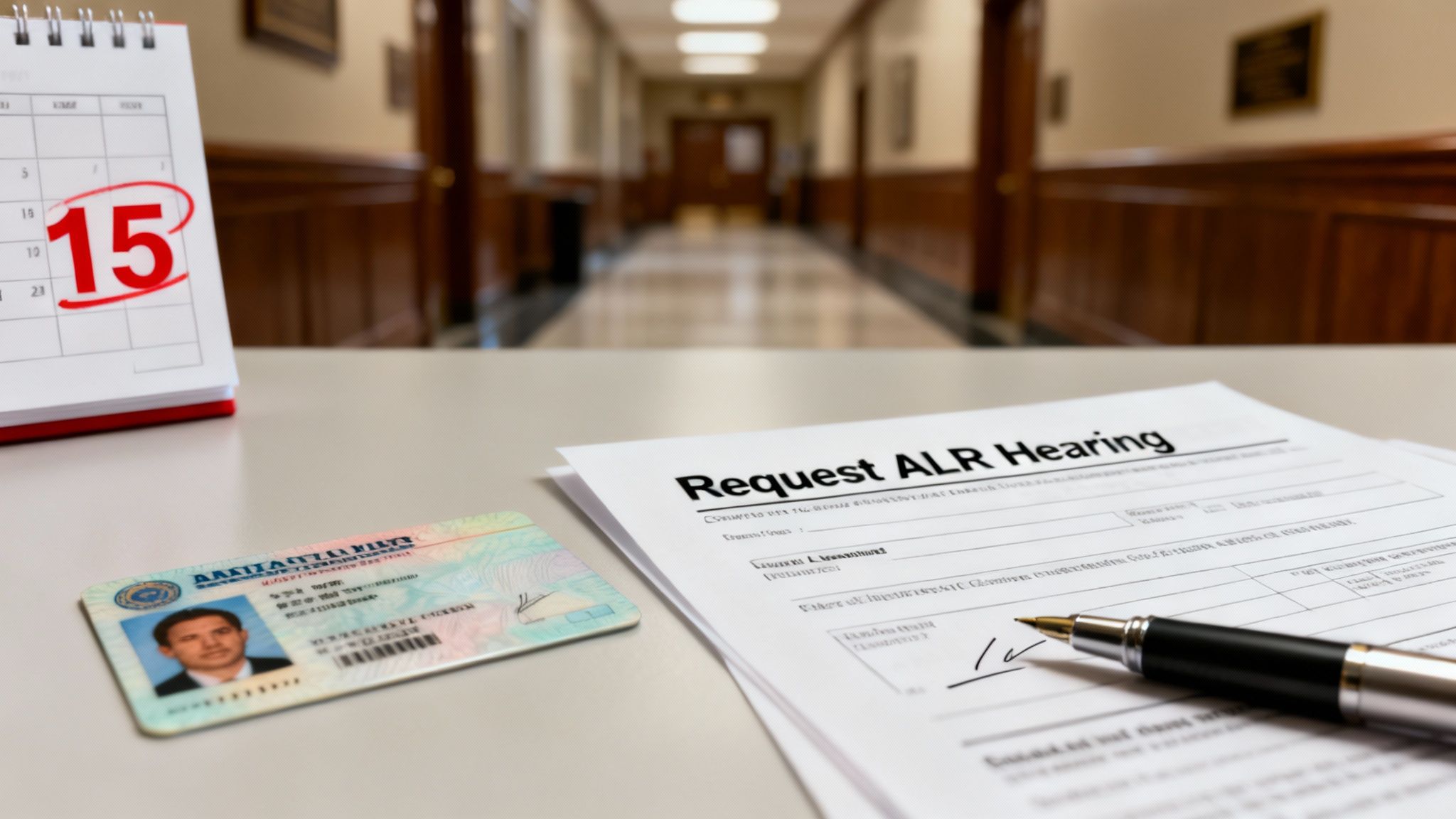
The moment you’re arrested, a countdown clock starts ticking. You have only 15 days from the date of your arrest to formally request an ALR hearing with the Texas Department of Public Safety (DPS). Miss this deadline, and your license will be automatically suspended on the 40th day after your arrest. No extensions, no second chances.
Understanding the ALR Process
It’s crucial to understand that the ALR process is entirely separate from your criminal DWI case. It’s an administrative proceeding, not a criminal trial, and it focuses on one specific question: did the officer have the right to suspend your license?
A license suspension gets triggered in one of two ways:
- Chemical Test Refusal: You refused to provide a breath or blood sample after being lawfully arrested.
- Chemical Test Failure: You provided a sample that showed a Blood Alcohol Concentration (BAC) of 0.08% or higher.
For a first offense, refusing the test leads to a 180-day suspension. Failing it results in a 90-day suspension. This is an automatic penalty unless you step up and challenge it by requesting that ALR hearing.
Why the ALR Hearing Is a Strategic Advantage
Requesting an ALR hearing does more than just give you a shot at saving your license. It gives your defense attorney a powerful, unique opportunity to gather critical evidence for your criminal case. This hearing is often the first—and only—chance we get to question the arresting officer under oath before a criminal trial ever begins.
At the hearing, we can challenge the weak points in the state’s case, including:
- Did the officer have reasonable suspicion to pull you over in the first place?
- Was there probable cause to make an arrest?
- Were you properly warned about the consequences of refusing a chemical test?
- If you did take a test, was the equipment calibrated and operated correctly?
The testimony we get from the officer can be used to poke holes in their story and build leverage for your criminal defense. Think of it as a strategic "dress rehearsal" that can expose cracks in the prosecution's case long before you ever set foot in a criminal courtroom. If you’re worried about what happens next with your license, our firm has a detailed guide on how to get your license back after suspension that can provide more clarity.
The ALR hearing is not just about your license; it's a critical strategic tool. By challenging the administrative suspension, we can gather invaluable intelligence and testimony that can be used to dismantle the criminal case against you.
Handling the ALR process is one of the most important first steps after a DWI arrest. Our team at The Law Office of Bryan Fagan, PLLC, will file the request on your behalf to ensure that 15-day deadline is met. We will then represent you at the hearing, fighting to protect your ability to drive while simultaneously building the foundation for a strong defense in your criminal case. You don’t have to navigate this complicated process alone.
Building a Strong Defense to Fight a DWI Charge
The single most important thing to remember after a DWI arrest is this: an arrest is not a conviction. It’s easy to feel like the fight is already over, but the truth is, it’s just beginning. A powerful, strategic defense starts to take shape the moment you decide to fight back with an experienced DWI attorney. Building this defense means looking past the initial shock and taking purposeful action.
Many people assume that if their breath or blood test comes back over the 0.08% limit, their case is unwinnable. That’s simply not true. Every DWI case is made up of multiple layers, and a skilled lawyer knows how to peel them back one by one to find the weaknesses in the prosecutor’s story. The goal is to challenge every piece of their evidence, from the reason they pulled you over to the accuracy of the final chemical test.
Challenging the Initial Traffic Stop
The entire DWI case rests on one critical foundation: the legality of the traffic stop. A police officer can't just pull you over on a hunch; they must have reasonable suspicion that you violated a traffic law. This could be something as obvious as speeding or as minor as a broken taillight.
If the officer did not have a valid reason to stop your vehicle, then any evidence they collected after that point—including the field sobriety tests and chemical test results—could be thrown out of court. A successful challenge to the stop can cause the entire case to fall apart.
Questioning Field Sobriety Test Administration
As we’ve covered, the Standardized Field Sobriety Tests (SFSTs) are notoriously subjective and difficult to perform under perfect conditions, let alone on the side of a busy road at night. An effective defense involves putting the officer’s administration of these tests under a microscope.
We start by asking a few key questions:
- Were the instructions given correctly? Officers must follow a strict, standardized script when explaining the tests. Any deviation can make the results unreliable.
- Did the officer consider other factors? Things like medical conditions, physical limitations, fatigue, and even the weather can all impact your performance on these tests.
- Was the testing environment appropriate? Uneven ground, poor lighting, and flashing lights from passing cars can make it nearly impossible for a completely sober person to "pass."
These tests are designed to gather evidence to use against you, but a sharp defense attorney can turn that same evidence into a powerful tool for your defense.
Remember, a DWI charge is a prosecutor’s story about what happened. A strong defense presents a counter-narrative, one grounded in facts, science, and your constitutional rights, challenging the state's version of events at every turn.
Attacking Breath and Blood Test Results
Chemical tests, like breathalyzers and blood draws, often feel like undeniable scientific proof. In reality, they are far from perfect. The results are only as reliable as the people and procedures used to obtain and analyze them.
A Houston DWI lawyer can challenge these results on several grounds:
- Improper Breathalyzer Calibration: Breathalyzer machines require regular, documented maintenance and calibration to stay accurate. If the machine used in your case wasn't properly maintained, its readings are questionable.
- Rising BAC Defense: Your Blood Alcohol Concentration can continue to rise for some time after your last drink. It’s possible your BAC was below the legal limit while you were driving but rose above 0.08% by the time you were tested at the station.
- Breaks in the Chain of Custody: For blood tests, the sample must be properly collected, stored, and transported in a very specific way. Any mistake or undocumented step in this "chain of custody" can contaminate the sample and make the results inadmissible in court.
Successfully challenging the chemical evidence is often the key to dismantling the prosecution's case. For a deeper dive into these strategies, you can explore our guide on how to fight a DWI in Texas.
Impaired driving remains a huge public safety issue. Data from 2014 to 2023 shows that over 37% of Texas traffic fatalities involved impaired driving, with crashes peaking between 2 a.m. and 3 a.m. on weekends. You can find more insights on Texas traffic safety data and trends. This intense focus on safety means prosecutors pursue DWI cases aggressively, which makes having a robust defense absolutely essential.
At The Law Office of Bryan Fagan, PLLC, we meticulously investigate every detail of your arrest. We don’t just accept the police report at face value; we challenge it. A DWI charge can feel like the end of the road, but with the right legal team, it's just the beginning of your fight.
Your Pressing DWI Questions, Answered
After a DWI arrest, your mind is racing. The uncertainty is often the worst part. You have urgent questions, and you need clear, direct answers to figure out what comes next. Let's tackle some of the most common concerns we hear every day.
What Is the Difference Between a DWI and a DUI in Texas?
This is a huge point of confusion for many people. In Texas, these aren't just different names for the same thing—they apply to different age groups and have different consequences.
- DWI (Driving While Intoxicated): This is the charge for adults 21 and over. You can be charged with DWI if you've lost the normal use of your mental or physical faculties or if your Blood Alcohol Concentration (BAC) is 0.08% or higher. A first-time offense is typically a Class B misdemeanor.
- DUI (Driving Under the Influence): This charge is specifically for minors (anyone under 21). Texas has a zero-tolerance policy for underage drinking and driving. That means a minor can be hit with a DUI for having any detectable amount of alcohol in their system. A first-offense DUI is a Class C misdemeanor.
While a DUI might seem less severe than a DWI, any alcohol-related driving offense can cast a long shadow over a young person's future.
Can I Get a DWI Expunged from My Record in Texas?
Yes, but it's not easy. An expunction is the best-case scenario for clearing your record—it completely erases the arrest and case, as if it never happened. But in Texas, you only get that chance if your DWI case ended in one of these specific ways:
- You were found "not guilty" at trial (an acquittal).
- The prosecutor formally dismissed the case against you.
- You completed a special pretrial program that specifically allows for expunction upon success.
If you were convicted, you might have another option: an order of nondisclosure. This doesn't erase the record, but it seals it from the public. This means most employers, landlords, and the general public cannot see it. Figuring out which path you qualify for requires a close look at your case details—something a skilled DWI attorney can help you with.
Should I Refuse the Breathalyzer Test?
This is probably the single most critical decision you'll make during a DWI stop, and there's no simple "right" answer. It's a strategic trade-off, and you have to make the call in a high-pressure moment.
Here's the deal: under Texas's implied consent law, refusing to give a breath or blood sample comes with an immediate penalty. You're facing an automatic DWI license suspension of 180 days for a first-time refusal. That happens whether you're guilty or innocent.
However, refusing the test also denies the prosecution its most powerful piece of evidence: a hard number that says you were over the limit. Without that BAC number, it becomes much tougher for them to prove you were intoxicated beyond a reasonable doubt in criminal court.
Deciding whether to blow is a legal calculation, not just a simple "yes" or "no." Your choice creates ripples that affect both your driver's license and your criminal defense strategy.
Giving a sample hands the State powerful evidence, but it also gives your lawyer scientific data they can challenge. The best move really depends on the specifics of your stop, which is a key reason why having a lawyer's guidance is so important.
What Should I Do Immediately After a DWI Arrest?
The first 24-48 hours are absolutely crucial. What you do—and don't do—can set the tone for your entire case. Your priorities need to be crystal clear.
- Call an Experienced DWI Defense Attorney. This is job number one. Don't discuss your case with anyone until you've spoken to a lawyer who knows how to defend against these charges.
- Request Your ALR Hearing. This is a time-sensitive, use-it-or-lose-it deadline. You have only 15 days from the day you were arrested to request a hearing to fight the automatic suspension of your driver's license. Your lawyer can handle this for you and even use the hearing to start building your defense.
- Write Down Everything You Remember. As soon as you can, grab a pen and paper or open a note on your phone. Write down every single detail about the traffic stop, the arrest, and any tests you took. Memories fade fast, and a tiny detail you remember now could be the key to helping you fight a DWI in Texas later on.
A DWI charge is a serious fight, but you don't have to go it alone. Taking these immediate steps puts you back in control and starts the process of protecting your future.
At The Law Office of Bryan Fagan, PLLC, we understand the stress and confusion you're feeling. Our team is here to offer the strategic defense and straightforward guidance you need to navigate this process. We will protect your rights, challenge the evidence, and fight for the best possible outcome for your case. Contact us today for a free, confidential consultation. Your defense begins now.

