
A DWI arrest can be overwhelming, but you don’t have to face it alone.
If you were arrested in Texas and started searching what is a wet reckless charge, you’re not confused. You’re doing what most smart people do. You’re trying to figure out whether there’s a way to avoid a full DWI conviction and protect your license, your job, and your record.
The problem is that most of what you’ll find online talks about California, Florida, or some other state. That advice can point you in the wrong direction. Texas handles these cases differently.
Here’s the direct answer. Texas does not have a formal wet reckless charge. If you’re hoping to plead a DWI down to “wet reckless” because you saw that term elsewhere, that exact option isn’t on the table in Texas. But that does not mean you’re stuck with a DWI conviction.
Texas prosecutors and defense lawyers still negotiate. They just use Texas-specific paths, not the out-of-state label you searched for. In the right case, that can mean a reduction to reckless driving or another lesser offense such as obstruction of a highway. Those outcomes can make a major difference.
Practical rule: Stop focusing on the name “wet reckless.” Focus on whether the evidence in your case creates leverage for a reduction.
That bargaining power often comes from the same issues that matter in any solid DWI defense. Was the traffic stop legal? Did the officer have probable cause? Were the field sobriety tests done correctly? Was the BAC, or blood alcohol concentration, result reliable? Did a refusal trigger an administrative license suspension case that needs to be fought separately?
You need Texas answers, not internet folklore. If your goal is to fight DWI Texas style, protect your license, and avoid the worst long-term damage, you need to understand what the law allows here and how plea bargaining really works.
Facing a DWI Arrest You Are Not Alone
It is 2 a.m. You are home from jail, your car may still be impounded, and the paperwork in front of you makes one thing clear. This case can affect your license, your job, and your record fast. Do not treat it like a ticket you can clear up later.
If you have been arrested for a first DWI in Texas, you might be searching for a shortcut term like “wet reckless” because you want a result that does less damage than a DWI conviction. That instinct makes sense. The problem is that the phrase points many Texas drivers toward bad assumptions and out-of-state advice.
What you need right now is a strategy grounded in Texas practice.
What you are really trying to figure out
When you ask what is a wet reckless charge, the questions are practical:
- Can my DWI be reduced? You need to know whether the prosecutor might agree to a lesser offense.
- Can I keep my license? You are worried about a DWI license suspension and whether you can still get to work, school, or your family obligations.
- Can I limit the fallout? You want to reduce the harm to your record, insurance costs, and career.
Those are the right questions to ask after an arrest.
They also point to the bigger truth. In Texas, the label matters less than the outcome. If a reduction is possible, it usually comes through Texas-specific plea options and weaknesses in the State’s evidence, not through the phrase “wet reckless.” You also need a clear picture of the penalties for a Texas DWI conviction before you decide whether to fight, negotiate, or do both.
Terms that matter in the first few days
A few legal terms will shape your decisions immediately:
- BAC: Blood alcohol concentration. This is the alcohol level measured in a breath or blood test.
- Field sobriety test: Roadside exercises officers use to claim impairment. These tests are subjective and often challenged.
- Implied consent: Texas treats drivers as having agreed to provide a breath or blood sample after a lawful DWI arrest. A refusal can trigger separate license consequences.
- Administrative license suspension: The license case tied to the arrest and testing issue, separate from the criminal prosecution. In Texas, lawyers usually call this the ALR, or Administrative License Revocation, process.
A DWI arrest creates two cases at once. One threatens your criminal record. The other threatens your ability to drive.
That is why waiting to “see what the prosecutor offers” is a mistake. Good outcomes usually come from early case review, fast action on the license issue, and a defense built around the facts of the stop, the testing, and the officer’s paperwork.
You do not need to panic. You do need to get organized and get advice from someone who handles Texas DWI cases every day. A seasoned Houston DWI lawyer or Texas DUI attorney should be looking for pressure points the State cannot explain away, then using those facts to push for the best result available.
Understanding the Wet Reckless Myth in Texas
In states like California, “wet reckless” usually means a reckless driving plea bargain tied to an alcohol-related driving case. That’s why the phrase keeps showing up in search results. It’s a real concept elsewhere.
In Texas, it isn’t.
Texas does not recognize wet reckless as a formal charge
Texas lacks a formal “wet reckless” charge equivalent to states like California or Virginia, and that gap causes confusion for drivers who search the term and get mostly out-of-state explanations, as noted in this discussion of Texas-specific alternatives under Transportation Code §545.401.

That point matters because people often assume the name of the plea bargain is the opportunity. It’s not. The opportunity is the reduction itself.
Texas law is tougher and more specific. A DWI case in Texas is prosecuted under Texas Penal Code §49.04. A true wet reckless plea, as people use that term elsewhere, isn’t built into the Texas system. In fact, Texas law forbids deals that let a defendant plead to that lesser alcohol-related reckless charge in place of DWI.
What Texas prosecutors may do instead
Even though Texas doesn’t offer formal wet reckless pleas, plea bargaining is still a major part of DWI practice. Depending on the facts, a prosecutor may agree to reduce the case to another offense, including:
- Reckless driving: Under Texas Transportation Code §545.401, this is a separate offense based on driving with willful or wanton disregard for safety.
- Obstruction of a highway: In some cases, prosecutors use this or another reduced charge instead of DWI.
- Other negotiated outcomes: The exact path depends on the county, the facts, and the weaknesses in the State’s evidence.
Many defendants get tripped up. They think “Texas has no wet reckless” means “Texas has no reduction options.” That’s false.
The label doesn’t control your outcome. The evidence does.
Why the misconception is dangerous
If you rely on generic web advice, you may miss the specific Texas strategy. You might plead guilty too early. You might fail to challenge the stop, the video, or the breath test. You might also overlook whether a reduced non-DWI offense could put you in a better position for record cleanup later.
A Texas DWI case needs a Texas defense plan. That starts with dropping the myth and looking hard at what the prosecutor can be pressured to offer.
DWI Penalties vs a Reckless Driving Plea in Texas
You got arrested for DWI, and now someone tells you to “ask for a wet reckless.” In Texas, that advice misses the mark. What matters here is whether your lawyer can push the case toward a reduction such as reckless driving or obstruction of a highway, because the penalty gap between a DWI conviction and a reduced plea can be substantial.
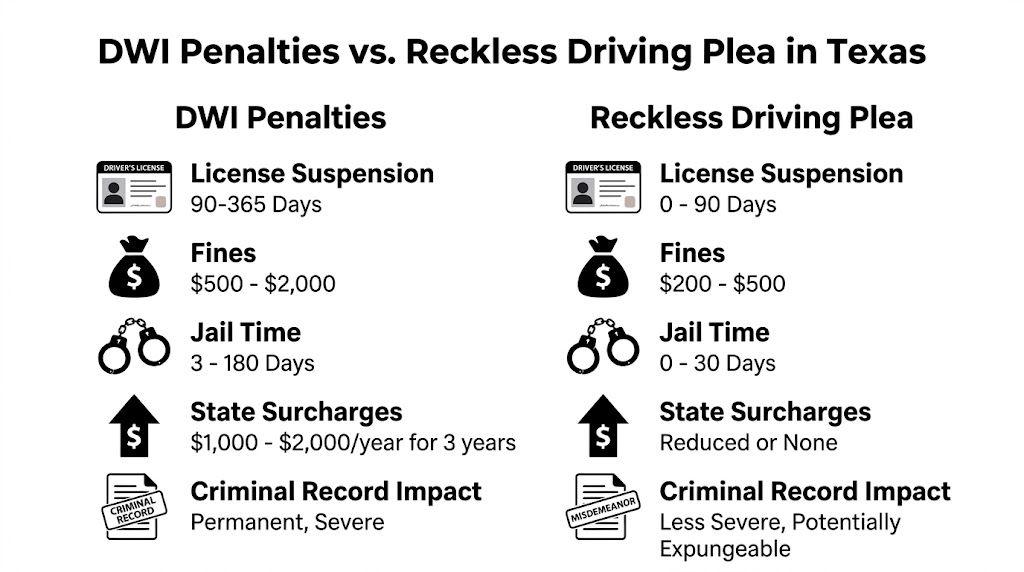
Texas First DWI vs Reckless Driving Plea
| Penalty | First-Time DWI (Class B Misdemeanor) | Reckless Driving Plea (Class B Misdemeanor) |
|---|---|---|
| Jail exposure | A first DWI carries meaningful jail risk under Texas first-offense DWI penalties | Reckless driving usually brings lower punishment exposure than a DWI |
| Fine exposure | A DWI can bring a significantly higher fine | Reckless driving typically involves a lower fine range |
| License consequences | A DWI can trigger DWI-specific license problems | A reduced non-DWI plea may avoid some DWI-specific consequences |
| Ignition interlock | Interlock can become part of the case, depending on the facts and the court | A reckless driving plea often puts you in a better position on interlock issues |
| Insurance impact | Insurance fallout after a DWI is often severe | Reckless driving can still raise rates, but it usually lands differently than a DWI |
| Future case risk | A DWI conviction creates serious problems if you are arrested again | A reduced plea may still matter later, but it is usually better than a DWI conviction on your record |
What those terms mean in real life
The labels matter because the practical consequences are different.
- Ignition interlock device (IID): A breath-testing device installed in your car. If the device does not get a clean sample, the car does not start.
- Administrative license suspension: The separate license case that can follow a failed or refused breath or blood test, apart from the criminal prosecution.
- Insurance fallout: Carriers often treat a DWI as a high-risk event. That can mean much higher premiums, fewer coverage options, or both.
A reckless driving plea is still a misdemeanor. Do not treat it like a free pass. Treat it like damage control.
Why this comparison matters
Clients usually ask the wrong question. They ask whether a reduced plea is “good.” The right question is whether it is better than a DWI conviction, given the evidence, the county, your job, and your record.
For many Texas drivers, the answer is yes. A reduction can mean less exposure in court, fewer DWI-specific consequences, and a better position when you apply for jobs, deal with insurance, or explain the case later. That is why experienced Texas DWI defense focuses on pressure points in the State’s case. The stop. The field sobriety tests. The blood draw. The video. The paperwork. Those details are what give a prosecutor a reason to offer something better than a straight DWI conviction.
Bottom line: In Texas, the smart comparison is not “wet reckless versus DWI.” It is DWI conviction versus the best realistic non-DWI resolution your lawyer can get.
The Long-Term Impact on Your Record and Career
You apply for a job six months from now. HR runs the background check. The case you thought was behind you is now the first thing they want explained.
That is why charge reduction matters.
In Texas, people often ask about a “wet reckless” because they are trying to avoid the long shadow of a DWI conviction. The label is wrong here, but the concern is right. What stays on your record, what you must disclose, and what an employer or licensing board sees can shape your options for years.

Background checks and professional risk
A DWI conviction creates a harder conversation than a non-DWI result. That is the practical truth. Employers may view it as a substance-related driving offense. Licensing agencies may see it as a reporting issue. If your work depends on judgment, mobility, or public trust, the stakes rise fast.
The pressure is different depending on your job:
- Licensed professionals: Nurses, doctors, pilots, teachers, and other credential holders may face disclosure duties to a board, an employer, or both.
- CDL holders: Your income can be tied directly to your driving status and your insurability.
- Corporate employees: Promotions, travel, company vehicle access, and internal compliance reviews can all be affected.
- Students and early-career professionals: Internship offers, graduate programs, and first-job opportunities can tighten after a flagged background check.
A reduction to reckless driving or another non-DWI offense does not erase the case. It often puts you in a better position to explain it and limit the damage. That distinction matters practically.
Insurance and driving record consequences
Insurance companies also make sharp distinctions. A DWI usually hits harder than a reduced non-DWI resolution. Higher premiums can last for years, and some drivers end up shopping for new coverage because their current carrier changes the terms or declines to renew.
That cost adds up. Month after month.
A reduced plea can lessen that fallout, even though it will not make the event disappear from your driving history. If you have just been arrested and want to avoid early mistakes that make the long-term picture worse, review this Texas DUI post-arrest checklist before you make statements, miss deadlines, or ignore the license side of the case.
Here’s a helpful overview of the issues many drivers face after an arrest:
Expunction and record-cleanup possibilities
Texas law is particularly important. The myth is “wet reckless.” The crucial question is whether your lawyer can position the case for an outcome that leaves you with better cleanup options later.
A DWI conviction is usually far harder to clear than a dismissal or certain reduced charges. Some Texas plea bargains, including outcomes such as obstruction of a highway in the right case, may create a better record posture than a straight DWI conviction. That is one reason rushed pleas are expensive. You are not just choosing a sentence. You are choosing what follows you afterward.
Ask the six-year question, not just the six-day question. What will this look like on a job application, a license renewal, an insurance form, or a professional disclosure statement?
If your career depends on a clean record or a credible explanation, you should treat the end result of the case as a long-term strategy decision, not a short-term inconvenience.
How to Strategically Pursue a DWI Charge Reduction
You get arrested for DWI, start searching for “wet reckless,” and assume that is the target. In Texas, that mindset can waste time. The primary goal is to push the case toward a Texas reduction that is available, such as reckless driving or, in the right facts, obstruction of a highway.

Prosecutors reduce DWI cases for one reason. They see risk in taking your case to trial.
Build bargaining power before discussing a plea
A good defense starts with the proof, not with asking for mercy. If the State’s evidence has holes, your lawyer has something real to work with in plea talks. If the evidence goes unchallenged, the prosecutor has no reason to offer a better result.
Focus on the pressure points that matter:
Challenge the stop
If the officer did not have a lawful reason to pull you over, the case may weaken fast.Examine the field sobriety tests
These tests are subjective and often poorly administered. Fatigue, nerves, medical conditions, footwear, weather, and unclear instructions can all affect performance.Scrutinize the BAC evidence
BAC means blood alcohol concentration. Breath and blood testing can be attacked for machine issues, collection problems, contamination, chain-of-custody gaps, or bad interpretation.Compare the video to the reports
Police reports often sound cleaner than the footage looks. Body cam and dash cam can expose exaggeration, missed details, or inconsistent observations.
This is how reductions happen in Texas. A lawyer builds trial pressure, then uses that pressure to pursue a result short of a DWI conviction.
What makes a reduction more realistic
Texas does not offer a formal wet reckless plea. What you are really pursuing is a negotiated outcome that cuts the damage. In some cases, that means reckless driving. In others, it may mean a different non-DWI resolution depending on the facts, the county, and the weaknesses in the State’s proof. This guide to Texas DWI plea bargain options and reduced-charge strategies explains how those outcomes are typically approached.
Some cases are better positioned for that kind of result:
- Weak legal basis for the stop
- Problems with breath, blood, or field testing
- First-time arrest with no aggravating facts
- No crash, no injury, and no bad statements
- Video that does not match the officer’s conclusions
A borderline case creates room to negotiate. A sloppy investigation creates even more.
The real role of a Houston DWI lawyer
A strong Houston DWI lawyer or Texas DUI attorney does more than ask for a deal. They file suppression issues, press the State on proof problems, test the officer’s credibility, and make the prosecutor confront the risk of losing.
That is the strategic point many drivers miss. You do not chase a mythical Texas wet reckless charge. You build a case for a real Texas reduction that protects your record as much as possible.
Your First Steps After a Texas DWI Arrest
The first few days after arrest matter more than many understand. You can damage your case quickly by waiting, oversharing, or missing deadlines.
Follow this checklist immediately
Use this short list and stick to it:
- Request help fast: Talk to a qualified DWI defense lawyer as soon as possible.
- Protect the license case: Review a Texas DWI post-arrest checklist and make sure you address the ALR deadline immediately.
- Stop talking about the facts: Don’t explain the stop to friends, coworkers, or on social media.
- Write down what happened: Record the timeline while your memory is still fresh. Include where you were, what the officer said, whether you took field tests, and whether any video may exist.
- Keep every document: Bond papers, tow information, notice of suspension, and court dates all matter.
Understand the ALR hearing
The ALR, or Administrative License Revocation hearing, is the separate proceeding that deals with your driving privileges. In this hearing, the State tries to suspend your license based on the arrest and testing issue, apart from the criminal court case.
If you ignore it, you can lose your chance to challenge the suspension.
What happens after arrest
The process usually unfolds in stages:
Booking and release on bond
You’re arrested, processed, and released with conditions and court instructions.License suspension notice and ALR issue
This starts the clock on the separate license fight.Criminal court setting
Your lawyer obtains reports, video, test records, and other evidence.Defense review and strategy
The case may move toward suppression, negotiation, dismissal efforts, or trial preparation.
The worst move after a DWI arrest is passive waiting. The best move is early, organized defense.
If this is your first DWI in Texas, don’t assume the least painful path is an immediate plea. Sometimes the better result comes from pushing back early and hard.
Frequently Asked Questions About DWI Plea Bargains
Can a reckless driving plea be expunged from my record in Texas
Sometimes, but not automatically. The answer depends on the exact charge, the final disposition, and your eligibility under Texas law. Some negotiated reductions create much better record-cleanup options than a DWI conviction. That’s one reason the precise wording of a plea matters so much.
Is a reduction possible on a second DWI
It can be harder, but hard is not the same as impossible. Second-offense cases carry more risk and usually get tougher scrutiny from prosecutors. Whether a reduction is realistic depends on the facts, the evidence problems, and the county handling the case.
How does a reckless driving plea affect a CDL
CDL holders need to be extremely careful. Even if a non-DWI resolution sounds better, any moving violation or alcohol-related driving matter can still threaten commercial driving status and employment. If you hold a CDL, your defense has to be built around job protection from day one.
Should I accept the first plea offer
Usually, no. Early offers often arrive before the defense has gathered all the useful evidence. A plea should be evaluated only after your lawyer reviews the stop, testing, reports, video, and license consequences.
Is a wet reckless the same as reckless driving in Texas
No. In Texas, “wet reckless” is not a formal charge. What people usually mean is a negotiated reduction from DWI to another offense, often reckless driving or another lesser charge.
If you were arrested and you’re trying to figure out your real options under Texas law, get clear answers from a team that handles these cases every day. Law Office of Bryan Fagan, PLLC offers free consultations for Texans facing DWI charges, license suspension issues, and plea bargain decisions. If you need a strategic Houston DWI lawyer or Texas DUI attorney to review your case, explain your next move, and help you fight for the best outcome, reach out now for a confidential case evaluation.