
A DWI arrest in Texas can be overwhelming—but you don’t have to face it alone. An arrest is not a conviction. The first step toward taking back control and protecting your future is to understand exactly what you’re up against, from potential fines and license suspensions to jail time under Texas law.
Your Guide to Navigating a Texas DWI Charge

Right now, you are likely feeling uncertain about your career, your finances, and your freedom. The legal system is a confusing maze, but you don’t have to find your way through it alone. We created this guide to bring clarity to a chaotic situation and give you the knowledge you need to build a strong defense.
We will break down the specific penalties for DWI offenses in Texas, covering everything from a first-time misdemeanor to the most serious felony charges. Getting a clear picture of what’s at stake is crucial. You are not just fighting a criminal case; you are also in a separate, urgent battle to save your driver's license in an Administrative License Revocation (ALR) hearing, which moves on a much faster timeline.
DWI Arrests Are Common Across Texas
If you are facing a DWI charge, you are far from alone. Thousands of Texans are charged every single year, a process that disrupts lives and creates immense stress. Harris County, for instance, is consistently an epicenter for DWI charges, with 12,022 cases in 2022 and 11,985 in 2023. Dallas County isn’t far behind, seeing 6,832 charges in 2023 alone. These numbers show just how widespread this issue is. You can discover more insights about DWI trends in Texas on shawnbrownlaw.com.
At The Law Office of Bryan Fagan, PLLC, we believe that a well-informed client is an empowered one. Understanding the system is the foundation of a successful defense strategy.
This guide will help you understand:
- The specific penalties tied to different DWI offenses.
- The critical deadlines you absolutely cannot miss to protect your license.
- How an experienced Houston DWI lawyer can challenge the state's case against you.
Our goal is to replace uncertainty with solid knowledge, giving you the tools to build a formidable defense.
Penalties for a First DWI in Texas

If this is your first DWI arrest, it’s natural to feel overwhelmed about what happens next. An arrest can be jarring, but understanding the specific penalties you face is the first step toward building a solid defense and taking back control of your life.
In Texas, a first DWI is typically charged as a Class B Misdemeanor. While it is a misdemeanor, it’s a serious offense with consequences that reach far beyond a simple ticket.
The criminal justice system can feel intimidating, but remember, you have rights that need defending. The penalties are significant, impacting your freedom, finances, and ability to drive. However, it's critical to know these are the potential maximums, not what is set in stone. A skilled Houston DWI lawyer can work to minimize these consequences or even seek a dismissal of the charges.
Standard Penalties for a First DWI Conviction
When you're facing a first-time DWI charge, Texas has a standard set of penalties. These include the possibility of jail, hefty fines, and losing your driving privileges. It’s also important to realize that these penalties can become more severe if aggravating factors are involved, such as having a high Blood Alcohol Concentration (BAC).
Here’s a straightforward breakdown of what a conviction for a first DWI in Texas can mean:
- Jail Time: A conviction comes with a mandatory minimum of 72 hours in jail, with a maximum sentence of up to 180 days.
- Fines and Surcharges: The court can impose a fine of up to $2,000. On top of that, the state levies annual surcharges on your driver's license for three years, which can add thousands more to the total cost.
- DWI License Suspension: You’re looking at an automatic driver's license suspension that can last anywhere from 90 days to a full year.
The penalties listed are just the baseline for a standard first-time offense. If police found an open container in your vehicle or your BAC was 0.15 or higher, the charge is elevated to a Class A Misdemeanor, and these consequences become much more severe.
Additional Court-Ordered Requirements
Beyond jail time and fines, a DWI conviction brings a list of other mandatory requirements that will impact your day-to-day life. These are court-ordered conditions you must complete. Failing to comply will only lead to more legal trouble.
One of the most common requirements is installing an Ignition Interlock Device (IID). This device is a breathalyzer wired into your car's ignition. You must provide a clean breath sample for the car to start, and you are responsible for all installation and monthly monitoring fees.
Other common conditions the court might impose include:
- DWI Education Program: You will almost certainly be ordered to complete a 12-hour DWI education course.
- Community Service: A judge may require you to perform between 24 and 100 hours of community service.
- Probation: Instead of sending you to jail, a judge might sentence you to probation (often called "community supervision"). This involves regular check-ins with a probation officer and following a strict set of rules.
Understanding these potential outcomes is the first step in creating a defense strategy aimed at protecting your future. A proactive legal defense can make all the difference.
When a DWI Charge Becomes a Felony
Most people assume a DWI is a misdemeanor. While that’s often true for a first offense, certain situations can elevate the charge to a felony. This isn't just a small step up—it’s a life-altering leap into a completely different legal reality.
A felony conviction means potential prison time, crushing fines, and losing fundamental rights, such as owning a firearm or voting. If you're facing a felony DWI charge, the prosecutor believes aggravating factors are in play that justify a much harsher punishment. This is where the fight for your future truly begins.
Repeat DWI Offenses
One of the most common ways a DWI becomes a felony is having prior convictions on your record. Texas takes a "three strikes" approach, and a third charge is where the penalties skyrocket.
A third DWI charge, no matter how much time has passed since the last one, is automatically filed as a third-degree felony. The jump from a misdemeanor second offense to a felony third is staggering.
Here’s what you’re up against with a third-degree felony DWI:
- Prison Time: A conviction can land you in a Texas state prison for 2 to 10 years.
- Hefty Fines: Fines can reach up to $10,000.
- Lengthy License Suspension: You could lose your driver’s license for up to two years.
This is not a battle you should ever face alone. To get a better sense of the stakes and strategies involved, you can learn more about defending a third DWI offense in Texas in our detailed guide.
DWI With a Child Passenger
The law is especially strict when a child’s safety is involved. If you are arrested for DWI with a passenger under the age of 15 in your vehicle, the charge is automatically elevated to a state jail felony.
This rule applies even if it’s your very first DWI offense. The presence of a minor is the trigger. A conviction for this offense carries 180 days to two years in a state jail facility, plus a fine of up to $10,000.
A felony conviction doesn't just mean prison and fines. It creates a permanent criminal record that can prevent you from owning a firearm, limit your job opportunities, and even affect your right to vote.
Intoxication Assault and Manslaughter
When an impaired driver causes an accident that hurts or kills someone, the charges become the most serious DWI-related offenses under Texas law. The consequences are severe, and the prosecution is relentless.
-
Intoxication Assault: If your driving causes an accident that results in "serious bodily injury" to another person, you’ll be charged with Intoxication Assault. This is a third-degree felony, putting you at risk of up to 10 years in prison and a $10,000 fine.
-
Intoxication Manslaughter: If that accident leads to someone’s death, the charge is Intoxication Manslaughter. This is a second-degree felony, punishable by 2 to 20 years in prison and a fine of up to $10,000.
These cases are incredibly complex and are prosecuted with maximum aggression. The state's tough stance is fueled by tragic statistics. Texas has one of the highest rates of drunk driving fatalities in the country. A powerful legal defense from a skilled Texas DUI attorney is the only thing standing between you and a life-shattering outcome.
Navigating the Two Fronts of a DWI Case
The moment you're arrested for a DWI in Texas, the fight for your future begins on two separate fronts. This is a critical detail that catches many people off guard. You’re not just facing a criminal charge; you're also up against the Texas Department of Public Safety (DPS) in a civil battle to keep your driver's license.
Think of it this way: the criminal court is focused on proving a crime was committed, with penalties like fines and jail time on the table. The DPS, on the other hand, only cares about your privilege to drive. These two battles run on parallel tracks, each with its own rules, timelines, and objectives.
The Fight for Your Driver's License: The ALR Hearing
The civil side of this fight is called the Administrative License Revocation (ALR) process. This is not a criminal proceeding. It's an administrative action automatically triggered if you refuse a breath or blood test, or if you provide a sample showing a Blood Alcohol Concentration (BAC) of 0.08% or higher.
Here's the critical part: this process moves incredibly fast. From the moment of your arrest, a clock starts ticking. You have only 15 days to formally request an ALR hearing. If you miss that deadline, the DPS will automatically suspend your license, often for 90 to 180 days for a first offense. This happens regardless of whether your criminal case is eventually dismissed.
That tight 15-day window is why it’s so important to contact a DWI lawyer immediately. We can file the hearing request for you, ensuring you don't lose your only chance to save your license.
The infographic below shows just a few of the factors that can elevate a DWI charge, making the consequences on both the criminal and administrative fronts much more severe.
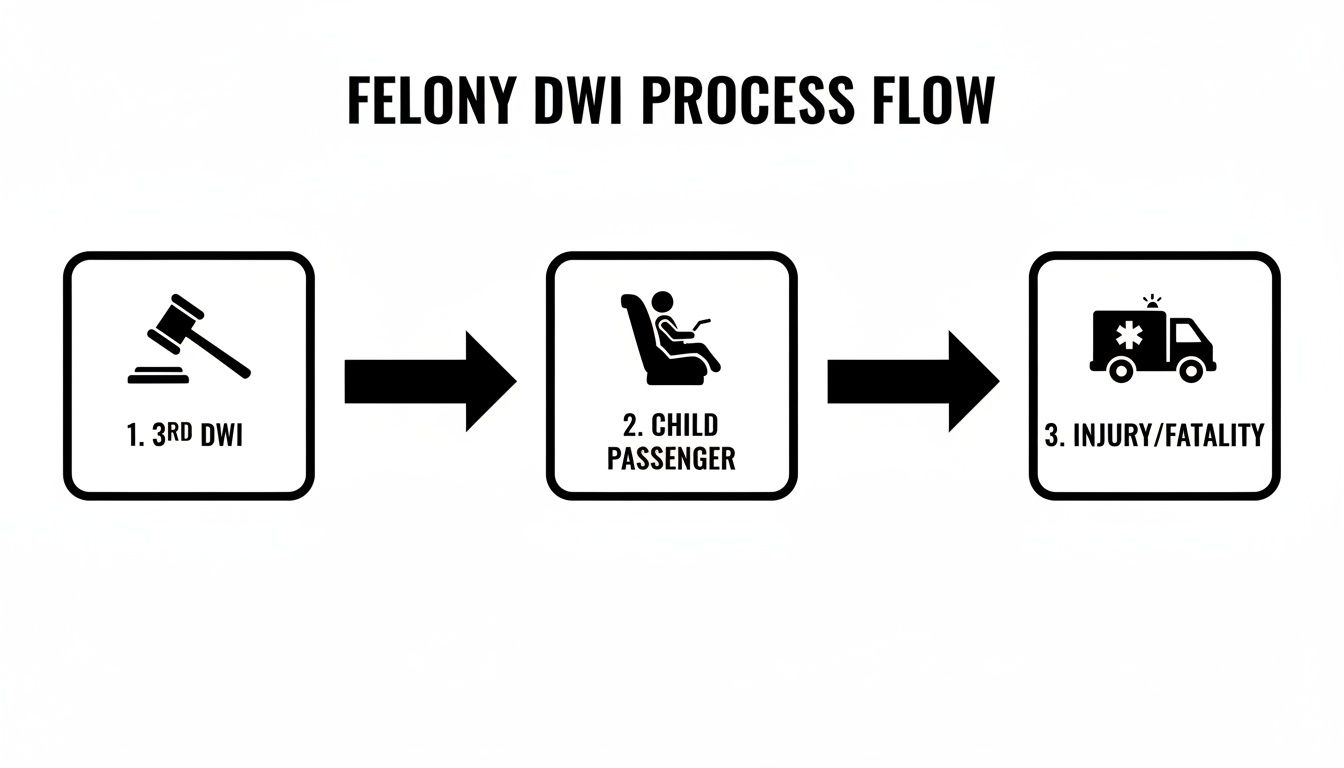
As you can see, factors like prior convictions or having a child in the car don't just raise the stakes in court—they also make the fight to protect your driving privileges that much tougher.
Understanding Implied Consent in Texas
So, how can the state suspend your license so quickly? The legal basis for the ALR process is a Texas law known as “implied consent.” In simple terms, this law states that by driving on a public road, you have already given your consent to a breath or blood test if an officer has probable cause to believe you're intoxicated.
You still have the right to refuse the test. However, that refusal comes with an immediate administrative consequence—it triggers the ALR process and the potential license suspension. It’s a trade-off: you can deny the police a key piece of evidence for their criminal case, but in exchange, you must immediately defend your license in a separate hearing.
Why the ALR Hearing Is So Important
Winning your ALR hearing is about much more than just avoiding a DWI license suspension. While keeping you on the road is the primary goal, this hearing offers a massive strategic advantage for your criminal case.
The ALR hearing is our first opportunity to question the arresting officer under oath. We can lock them into their story, expose weaknesses in their testimony, and gather invaluable information that we can use to build a stronger defense for your criminal case.
Think of the ALR hearing as a mini-trial. It's a dress rehearsal where we can challenge everything from the reason for the initial traffic stop to how the field sobriety tests were administered. You can learn more about how we approach these critical proceedings by reading about the State Office of Administrative Hearings in Texas on our website.
Because the timeline is so unforgiving and the stakes are so high, making the ALR hearing a top priority is essential to a successful DWI defense strategy.
The Hidden Consequences of a DWI Conviction
Most people think about the fines, community service, and potential jail time when they hear the term DWI. But the truth is, the penalties handed down in a courtroom are often just the beginning. The real, lasting damage from a DWI conviction happens quietly, long after your case is closed, affecting your job, your finances, and your future in unexpected ways.
These are what we call "collateral consequences"—the ripple effects that aren't spelled out in the Texas Penal Code but can be just as punishing. A DWI on your permanent record creates hurdles in nearly every part of your life. Understanding these hidden costs is the first step to realizing why you need to fight DWI Texas charges to protect your entire future, not just your driver's license.
Your Career and Professional Standing on the Line
For thousands of Texans, a DWI conviction is a direct threat to their livelihood. If your job requires you to drive a company vehicle or travel for work, even a temporary license suspension can make it impossible to perform your duties. Commercial drivers, sales representatives, and delivery drivers could find themselves unemployed overnight.
It gets even more complicated for licensed professionals. People in fields like nursing, aviation, real estate, and engineering are governed by professional boards with strict conduct rules. A DWI can trigger a disciplinary review, leading to suspension or even the complete revocation of a license you worked years to earn. To these boards, a DWI isn't just a traffic offense; it's a red flag about your judgment and reliability.
A DWI doesn't just put your license at risk—it puts your entire career on the line. One conviction can unravel years of dedication and hard work, threatening the very foundation you've built for yourself and your family.
The Financial and Personal Domino Effect
The financial pain of a DWI doesn't stop once court fines are paid. One of the biggest long-term costs is the massive spike in your auto insurance premiums. Insurers see a DWI as a huge risk, and they'll pass that risk back to you in the form of rates that can easily double or triple for years.
This new financial strain is just one piece of the puzzle. A criminal record follows you, creating obstacles in other critical areas of your life:
- Finding a Place to Live: Most landlords run background checks. A DWI conviction can be an automatic rejection, making it incredibly difficult to rent an apartment.
- Educational Roadblocks: Applying to college or for certain scholarships? A DWI might be a factor in the admissions process or your eligibility for financial aid.
- Immigration Woes: For non-U.S. citizens, a DWI can be devastating. It can lead to a denial of naturalization or, in some cases, even trigger deportation proceedings.
It's crucial to understand how a DWI conviction can affect your job prospects and every other aspect of your life. An experienced attorney can help you see the full picture and build a defense that protects you from these life-altering consequences.
A DWI isn't just a legal problem—it's a life problem. It creates a domino effect that can knock down everything you’ve worked for. That’s why a strategic defense isn't just about beating the charge in court; it's about protecting your long-term stability and future.
How a Strategic Defense Can Reshape Your Outcome
Getting arrested for DWI can feel like the end of the story. But in reality, it’s just the beginning of the legal process. The evidence the police gathered might seem unshakable, but it is often far from perfect. A proactive, strategic defense can expose cracks in the prosecution's case and completely change your outcome.
An arrest is not a conviction. Many people facing DWI charges feel pressured to plead guilty just to get it over with, assuming there’s no way to fight back. This is almost always a mistake. A thorough defense challenges every single piece of evidence and ensures your constitutional rights are protected at every turn.
The numbers back this up. An analysis of DWI charges in Texas shows that thousands of people achieved far better results by mounting a real defense. Critically, thousands of DWI charges are reduced to lesser offenses, and thousands more are dismissed entirely. This proves that fighting back works, especially when you have a skilled Houston DWI lawyer poking holes in the state’s evidence. You can discover more insights about these DWI defense statistics to see for yourself.
Questioning the Initial Traffic Stop
The entire DWI case is built on the initial traffic stop. An officer cannot just pull you over on a hunch; they must have reasonable suspicion that you have violated a traffic law. This is a crucial constitutional protection against random police stops, and it's the first place we look for a weakness.
If the officer cannot clearly state a legitimate reason for pulling you over—like speeding, weaving, or a broken taillight—then the stop itself may be unlawful. When that happens, any evidence collected after the illegal stop, including sobriety tests and breath or blood results, can be suppressed. This means the prosecutor cannot use it against you, which often forces a complete dismissal of the case.
Challenging Field Sobriety and Chemical Tests
The “evidence” used to prove you were intoxicated is highly technical and surprisingly prone to error. An experienced DWI attorney knows exactly what to look for—the subtle mistakes that can invalidate the entire result.
-
Field Sobriety Tests (FSTs): These roadside tests are notoriously unreliable. They must be administered under strict guidelines set by the National Highway Traffic Safety Administration (NHTSA). We scrutinize every detail: Did the officer give clear instructions? Was the test done on a level surface? Were your medical conditions, which could affect balance, taken into account? Any deviation can render the results meaningless.
-
Breath and Blood Tests: These chemical tests seem scientific and final, but they are far from it. A strong defense means digging into the details behind those numbers.
Your defense begins the moment you are pulled over. Every action the officer takes, from the reason for the stop to the administration of a breath test, must follow precise legal and scientific protocols. Any mistake is an opportunity for your defense.
Uncovering Procedural and Scientific Flaws
A winning DWI defense often boils down to exposing errors in police procedure or the science behind the tests. We do not just take the state's evidence at face value; we actively challenge its validity from every angle.
We start by asking critical questions:
- Breathalyzer Maintenance: Was the Intoxilyzer machine properly calibrated and maintained? We can subpoena the device’s maintenance logs to find a history of errors or malfunctions that could have produced a false high reading.
- Technician Qualifications: Was the person who administered your breath test or drew your blood certified to do so? You’d be surprised how often protocols are not followed.
- Chain of Custody: For blood tests, was the sample handled, stored, and transported according to strict procedures? Any break in this chain of custody can lead to contamination or degradation, making the result unreliable.
By showing how procedural errors and constitutional violations lead to flimsy evidence, we demonstrate that the state’s case often is not nearly as solid as it looks. An arrest is just the start—a powerful defense can redefine the ending.
Common Questions About Texas DWI Penalties
When you're facing a DWI charge, the questions come fast. Your freedom, finances, and future are all on the line, and you deserve clear, direct answers. Let's tackle some of the most common concerns we hear from clients.
This whole process can feel overwhelming and isolating, but you're not the first person to stand in these shoes. With the right information and a solid legal strategy, people successfully protect their futures, and you can too.
Can My DWI Charge Be Reduced to a Lesser Offense?
Yes, it is often possible to negotiate a DWI charge down to a less severe offense, like reckless driving. This outcome, known as a plea bargain, becomes a real possibility when your attorney finds significant weaknesses in the prosecutor's case against you.
What kind of weaknesses? An improper traffic stop, mistakes in how the field sobriety tests were administered, or problems with the chemical test evidence can create serious leverage. A skilled Houston DWI lawyer uses these flaws to show the prosecutor that their case isn't the slam dunk they thought it was, which can lead to a deal that helps you avoid the heavy penalties and lasting stigma of a DWI conviction.
What Is an Ignition Interlock Device and Will I Need One?
An Ignition Interlock Device (IID) is a breathalyzer wired directly into your car's ignition. Before the car will start, you have to blow into the device and provide an alcohol-free breath sample. The device will also prompt you for random re-tests while you're on the road to ensure you remain sober.
In Texas, judges frequently require an IID as a condition for getting out of jail on bond or as part of a probation sentence. It is mandatory for a first DWI if your blood alcohol concentration (BAC) was 0.15 or higher, and it's required for all second or subsequent DWI offenses. You are responsible for paying all costs for the device's installation and monthly monitoring.
How Long Does a DWI Stay on My Record in Texas?
This is a critical point: a DWI conviction stays on your criminal record permanently unless you take legal action to have it sealed or removed. It does not "fall off" after a few years. Your options for clearing your record depend entirely on the outcome of your case.
- Expunction: This is the best-case scenario. An expunction completely destroys the record of your arrest, as if it never happened. This is generally only an option if your case was dismissed or you were found not guilty at trial.
- Order of Nondisclosure: This is more like sealing the record. It hides the conviction from public view, though law enforcement agencies can still access it. This may be an option for some first-time offenders who successfully complete specific types of probation.
An experienced lawyer can review the specifics of your case to see if you are eligible for an expunction or nondisclosure and guide you through the complex process of clearing your name.
A DWI arrest is a serious challenge, but it is one you do not have to face by yourself. At the Law Office of Bryan Fagan, PLLC, our team is dedicated to defending your rights and working to minimize the impact on your life. We offer a free, confidential case evaluation to discuss your situation and explain your options. Contact us today to start building your defense. https://texasduilawfirm.com