 Skip to content
A DWI arrest can be overwhelming, but you don't have to face it alone.
If you're reading this after a late-night stop, a trip to jail, or a warning from the officer that your license is at risk, focus on one thing first. Refusing every sobriety test in Texas does not end the case. It changes the fight.
That matters. Texas treats roadside field sobriety tests very differently from chemical tests like breath or blood. One set is generally voluntary. The other falls under implied consent, which means Texas says licensed drivers have already agreed to chemical testing after a lawful DWI arrest. If you refused both, you're now dealing with two separate problems at the same time: a license case with the Texas Department of Public Safety, and a criminal DWI case in court.
The good news is that both can be challenged. A strong Houston DWI lawyer or Texas DUI attorney doesn't just react to the arrest. They pull apart the stop, the arrest, the warnings, the warrant, and the paperwork. That's how you protect your license, your record, and your position in court, whether this is your first DWI in Texas or not.
Your Rights During a Texas DWI Stop
The first minutes of a DWI stop matter more than many drivers realize. Officers are watching how you drive, how you answer questions, how you move, and whether you agree to testing. If you don't know your rights, it's easy to hand the State evidence it didn't have a minute earlier.
You do have rights. You still have to provide identification and comply with lawful safety instructions, but you don't have to turn the roadside encounter into a performance test against yourself.
What you can expect during the stop
Most DWI investigations follow a familiar pattern:
- The officer claims a reason for the stop.
- The officer asks questions about drinking, where you came from, and where you're going.
- The officer asks you to step out of the vehicle.
- The officer asks you to perform roadside tests.
- After arrest, the officer asks for a breath or blood sample.
Those last two steps are where people get trapped. They sound similar, but the law treats them differently.
Practical rule: Stay polite, stay calm, and don't volunteer explanations. Short, respectful answers usually protect you better than nervous talking.
The right question is not "Should I cooperate"
The better question is, what kind of test is the officer asking for?
A roadside balancing or eye exercise is not the same thing as a post-arrest breath or blood request. If you lump them together, you can make a bad decision for the wrong reason. Texas implied consent applies to chemical testing after arrest, not to every request made during the stop. If you want a clear explanation of that framework, review Texas implied consent law and what it means.
If you're searching for what happens if you refuse all sobriety tests in Texas, start here: you had rights at the roadside, but those rights came with consequences once the officer moved from investigation to arrest.
Field Sobriety Tests vs Chemical Tests Explained
The officer may ask for several "sobriety tests," but Texas law treats them in two very different categories. If you do not separate them in your mind, you can make a bad decision at the roadside.
A field sobriety test is a roadside coordination exercise. A chemical test is a breath or blood test used to measure alcohol or drugs. One is largely about giving the officer more observations. The other triggers Texas implied consent rules after arrest.
Field sobriety tests are voluntary roadside exercises
The common field tests are the Horizontal Gaze Nystagmus, Walk-and-Turn, and One-Leg Stand. Officers use them to collect "clues" they can later describe in a report, at an ALR hearing, and in court.
These tests work in the officer's favor. They are usually done at night, on uneven pavement, with traffic nearby, while you are stressed and being watched. That setting is not designed to produce fair results.
NHTSA's own validation studies show these tests are far from perfect. In the agency's study on the standardized field sobriety test battery, the Walk-and-Turn produced the correct decision 79% of the time, and the One-Leg Stand 83% of the time under test conditions, which means sober people can still be judged impaired. See NHTSA's SFST validation studies and training materials. That matters in real Texas cases, where age, fatigue, medical conditions, footwear, anxiety, and roadside conditions make the tests less reliable than they look on police body camera video.

Why refusal of roadside tests can be a smart defense decision
In Texas, roadside field sobriety tests are generally voluntary. Refusing them does not create the same automatic license penalty that comes with refusing a post-arrest breath or blood test.
That distinction matters strategically. If you refuse roadside tests, you may limit the officer's ability to stack up extra subjective evidence such as "missed heel-to-toe," "used arms for balance," or "started too soon." Those details often sound persuasive on paper even when they prove very little.
Common reasons sober drivers perform poorly include:
- Physical limitations: old injuries, back pain, knee problems, inner-ear issues, or neurological conditions
- Roadside conditions: gravel, sloped shoulders, poor lighting, flashing patrol lights, and passing traffic
- Ordinary human factors: fatigue, nerves, confusion, and uncomfortable clothing or shoes
If you want a closer look at the pros and cons, read this Texas guide to field sobriety test refusal.
Chemical tests are different, and the stakes are higher
A chemical test is usually requested after arrest. That is where Texas implied consent law takes over. By driving on Texas roads, you are treated as having agreed in advance to provide a breath or blood sample after a lawful DWI arrest.
You can still refuse. But refusal has an immediate cost. It opens the door to an Administrative License Revocation case, and in 2026 it often leads prosecutors to seek a blood draw warrant faster than drivers expect, especially with law enforcement practices shaped by recent laws such as HB 2342.
That is the trade-off. Refusing the chemical test may deny the State an easy breath result, which can help the defense in some cases. It also creates a license suspension fight and may push the officer to pursue a warrant for blood.
There is another underreported point here. Refusal cases are not automatic losses at the ALR stage. Drivers who timely challenge a refusal suspension often have real defenses, and refusal-based ALR suspensions are overturned at meaningful rates. That makes the post-refusal response just as important as the refusal decision itself.
Roadside field tests mainly give the officer more observations. Refusing a post-arrest breath or blood test affects the evidence, your license, and the State's next move.
A few key definitions
- BAC: Blood alcohol concentration, the alcohol measurement usually tied to breath or blood testing
- Implied consent: The Texas rule treating drivers as having consented to chemical testing after a lawful DWI arrest
- Field sobriety test: A roadside physical or eye test used to help an officer decide whether to arrest
- Administrative license suspension: A civil license penalty handled by DPS, separate from the criminal case
The First Consequence Administrative License Revocation
You leave jail assuming the case starts in criminal court. It doesn't. The first deadline usually hits your driver's license.
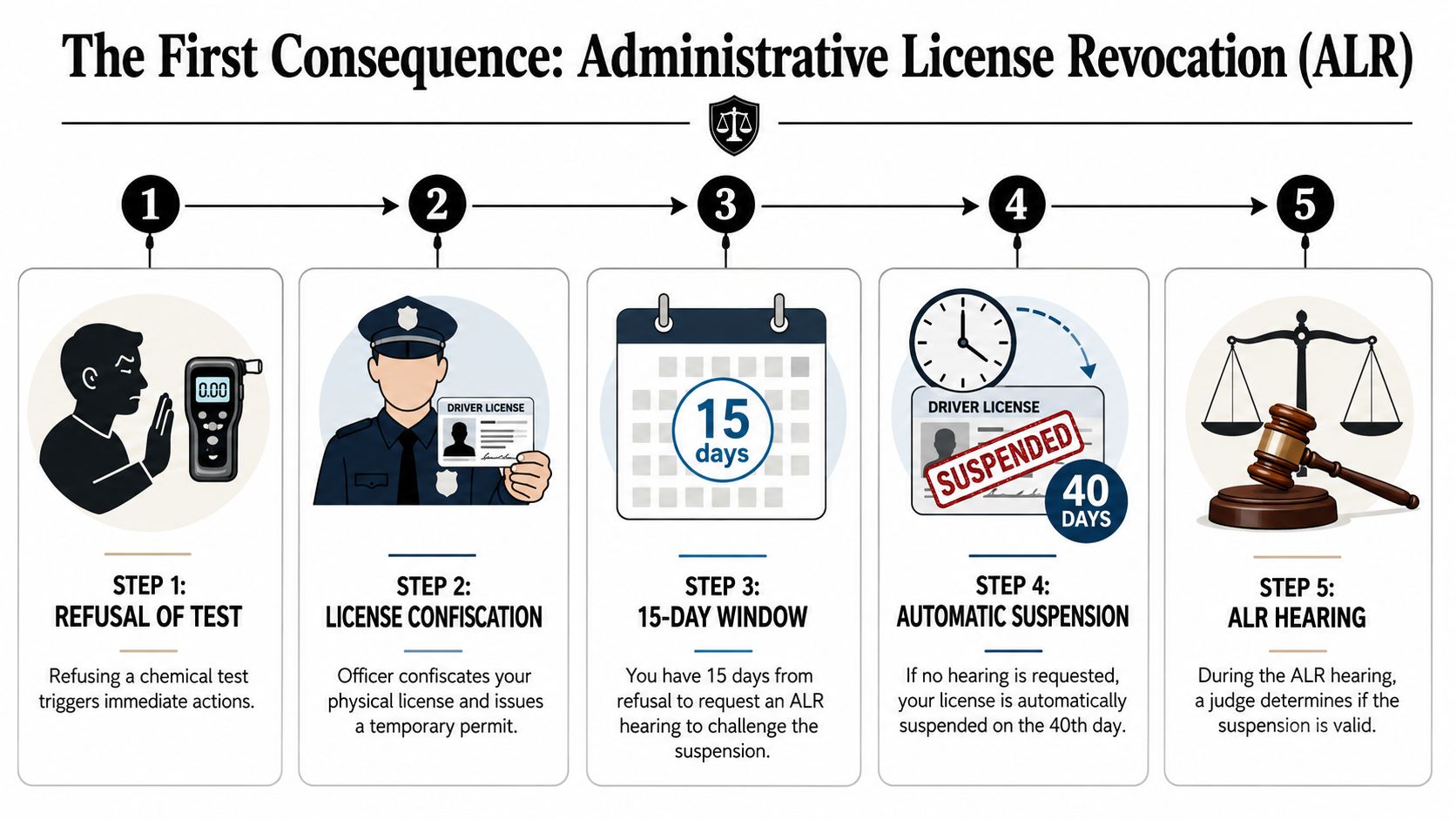
Texas uses an Administrative License Revocation, or ALR, to suspend a license after certain DWI test refusals or failures. This is a civil case handled by the Texas Department of Public Safety. It runs on its own track, separate from the criminal charge. That separation matters because a dismissal in criminal court does not automatically fix a license suspension.
What happens right after refusal
After a post-arrest refusal, the officer typically serves notice and starts the ALR case. For a first refusal, the suspension exposure is usually 180 days. If it is not your first alcohol-related enforcement contact, the stakes can rise fast.
This catches drivers off guard because the license case moves quickly and does not wait for the criminal case to sort itself out. In 2026, that speed matters even more. Refusal is a strategic choice, not a free pass. It may deny the State an easy breath number, but it also triggers a license fight immediately and can push officers toward a warrant-based blood draw faster than many people expect.
The deadline that matters most
You have 15 days from the arrest to request an ALR hearing. Miss it and the suspension usually goes through by default.
Requesting the hearing is the smart move. It keeps your options open, delays any automatic suspension, and gives your lawyer a chance to question the officer under oath. That testimony often becomes useful later because officers commit to a timeline, a reason for the stop, and the exact warning they claim they gave you.
If you want the step-by-step version, read the administrative license revocation process in Texas.
How the ALR process usually unfolds
Here is the usual sequence:
| Stage | What usually happens |
|---|---|
| Arrest and refusal | Officer serves notice and starts the license case |
| Short response window | You request the ALR hearing within 15 days |
| If no hearing is requested | Suspension takes effect automatically |
| ALR hearing | DPS must justify the suspension |
| After the hearing | The judge either upholds or overturns the suspension |
What DPS has to prove
At the hearing, DPS usually has to show four things:
- The stop: The officer had a lawful reason to detain you
- The arrest: The officer had probable cause to arrest for DWI
- The request: You were properly asked for a breath or blood sample
- The refusal: You refused after receiving the required warning
That may sound routine. It is not.
ALR hearings are won and lost on details. The body camera may not match the report. The statutory warning may be incomplete or poorly explained. The timeline may be sloppy. The arrest may rest on weak facts. A refusal case can also produce hearing issues that do not show up in a standard failed-test case, which is one reason refusal-based suspensions are challenged successfully more often than drivers are led to believe. In 2026, that underreported point deserves attention. A meaningful share of refusal suspensions are overturned at the hearing stage, and the figure often cited by Texas practitioners is about 42% when the case is contested.
Why this hearing is worth fighting
For many drivers, the ALR case creates the first real damage. It threatens your ability to get to work, pick up your kids, keep a professional license in good standing, or manage daily life.
Fight it. Do it early.
A refusal does carry trade-offs. Recent law enforcement practices shaped by laws such as HB 2342 have made warrant-based blood draws a more common next step after refusal in many Texas counties. That means the license hearing is not some side issue. It is one of the first places your lawyer can test the officer's story, pin down procedural mistakes, and build pressure points for the rest of the case.
Bottom line: If you refused, treat the ALR deadline as urgent. Fast action gives you a real chance to protect your license and improve the defense of the entire DWI case.
How Refusal Impacts Your Criminal DWI Case
You refuse the tests, expecting that to keep the State from getting a number. Then a few hours later, there is still a blood draw because the officer got a warrant. That is the actual trade-off in Texas in 2026.
Refusal can help your defense, but only if your lawyer moves fast and knows where to attack. It changes the evidence. It changes the prosecution's story. It also creates new places for the State to make mistakes.
Refusal changes the State's proof, not the State's effort
If you do not give a voluntary breath sample, the prosecutor loses the easiest version of the case. There is no simple breath result to put in front of a jury and call it proof. That matters.
What usually happens next is more important. Officers often respond to refusal by asking a judge for a blood draw warrant, especially after recent legal changes and county practices made warrant requests more routine. HB 2342 is part of that reality. Refusal no longer means the evidence search stops. It usually means the State has to work harder and follow more rules.
That can help you.
Every added step creates another point to examine. Was the affidavit specific, or just copied from a template? Did the officer describe facts showing probable cause? Did the timeline fit the video, dispatch records, and report? Did the judge sign a valid warrant before the blood draw happened?
The warrant process gives the defense real targets
A blood warrant is not self-proving. I treat it as a document to attack line by line.
Start with the stop. If the traffic stop was weak, everything after it gets harder for the State to defend. Then look at the arrest. An officer still needs enough facts to justify taking you into custody for DWI. Nervousness, late-night driving, or the odor of alcohol do not automatically carry that burden.
Next, examine the affidavit and blood draw procedure closely:
- Did the officer state concrete facts, not conclusions? "Subject appeared intoxicated" is weaker than actual observations.
- Did body camera footage match the affidavit? If the video undercuts the report, that matters.
- Did the officer omit favorable facts? Good balance, clear speech, or cooperative behavior can matter if they were left out.
- Was the blood draw handled correctly? Chain of custody, storage, and lab handling can all become defense issues.
Those issues do not win every case. They win enough cases that refusal remains a strategic choice worth serious analysis, not panic.
Prosecutors will argue refusal shows guilt
Expect that argument. They will tell the jury you refused because you knew the result would hurt you.
Your defense should answer that head-on. Refusal is a legal choice. People refuse for many reasons: confusion, distrust, bad advice from the roadside, fear of needles, or a simple decision not to help build the case against themselves. A refusal does not prove intoxication. It proves the person refused.
That distinction matters in trial, and it matters in negotiations. A prosecutor with no voluntary breath test and a vulnerable warrant case does not hold the same hand as a prosecutor with a clean, uncomplicated chemical result.
Refusal can improve leverage in the criminal case
This is the part many drivers miss. A refusal case often gives the defense more angles to work with than a straightforward failed-test case. The State may still end up with blood evidence, but now the case can involve warrant challenges, affidavit problems, suppression issues, and credibility fights between the report and the video.
That is why I do not treat refusal as automatic damage. I treat it as a case with sharper pressure points.
If you refused all tests, your criminal case may still involve blood evidence. It may also be more defensible than you think. The right move is to get the stop video, reports, warrant affidavit, blood records, and timeline under review immediately, then start attacking the weakest part of the State's chain of proof.
Refusal vs Failure A Comparison of Consequences
A client asks this all the time at the jail or the next morning. Did I make it worse by refusing?
Usually, no. You made it different.
Refusal and failure create different risks. A refusal case often brings a harder license fight at the start. A failed test gives the prosecutor the clean piece of evidence they want most: a number. In 2026, that trade-off matters even more because officers and prosecutors are using blood draw warrants more aggressively, and defense lawyers are challenging that process more aggressively too.
Texas DWI test refusal vs failure consequences
| Consequence | If You Refuse the Chemical Test | If You Fail the Chemical Test (BAC ≥ 0.08) |
|---|---|---|
| License suspension on a first offense | 180-day suspension under Texas implied consent law | 90-day suspension for a failed specimen under Texas Transportation Code § 524.022 |
| Type of evidence the State wants | The State may seek a warrant for blood and can use the refusal as evidence | The State already has a chemical result it will try to use directly |
| ALR case posture | Demands fast action to contest the refusal-based suspension | Still creates an ALR case, but the issue is the failed test result |
| Main defense focus | Stop, arrest, warnings, refusal procedure, warrant validity, and suppression issues | Breath or blood testing problems, stop, arrest, and officer procedure |
| Criminal court narrative | Prosecutor may argue refusal shows guilt | Prosecutor builds the case around the BAC result |
| Occupational driving issues | May require separate court action to keep driving | May require separate court action to keep driving |
The practical trade-off
Here is the blunt version. Refusal can hurt faster on the license side, but failure usually helps the State more in court.
That is why blanket advice from the internet is worthless. If you blow over the limit, the prosecutor starts with a direct chemical result. If you refuse, the State may still get blood through a warrant, especially after HB 2342 expanded warrant procedures. But that also creates more places to attack the case, including the affidavit, the timeline, the blood draw process, and whether the officer had probable cause.
There is another point drivers miss. Refusal cases are often better than they look at first glance. The ALR side is not automatic if you act quickly, and recent reporting on Texas refusal hearings shows meaningful overturn rates when those cases are challenged. That does not make refusal painless. It does mean the right response is immediate action, not panic.
My advice is simple. If you already refused, stop second-guessing that roadside decision and start working the case you now have. Get a lawyer involved fast, request the ALR hearing on time, and force the State to prove every step.
How to Fight a Texas DWI After Refusing All Tests
You refused the roadside tests, refused the breath test, and then heard the officer say he would get a warrant anyway. That is the moment many drivers assume the case is over. It is not over. A refusal case can be very defensible, but only if you move fast and attack the right issues.

Start with the ALR hearing immediately
Your first job is to request the ALR hearing before the deadline expires.
That hearing is not just about your license. It is your first chance to force the officer to commit to a story under oath, preserve testimony, and expose weak points early. In a refusal case, those weak points often involve probable cause, the arrest timeline, the warning procedure, and the warrant request.
Recent reporting on Texas refusal hearings has highlighted a meaningful overturn rate when drivers contest the suspension. The safest way to state that point is this: legal commentators citing Texas DPS refusal-hearing results have reported that a substantial share of refusal suspensions get overturned after a timely hearing request. The exact percentage should be verified against the underlying DPS records before anyone treats it as official DPS data.
That under-reported reality matters in 2026. Refusal creates pressure, but it also creates defenses. If you sit still, you lose them.
Key takeaway: Requesting the ALR hearing is your first strategic move, not a paperwork detail.
Attack the stop first
A weak stop can poison the whole case.
Your lawyer should get the video, compare it to the report, and pin down the reason for the stop. Officers often write the report in a way that sounds cleaner than the footage looks. If the lane violation was trivial, the speeding claim is unsupported, or the dash cam does not match the narrative, that matters.
Focus on these records:
- Dash cam and body cam footage
- Dispatch and CAD logs
- The offense report and probable cause affidavit
- Time stamps tied to the stop, arrest, refusal, and warrant request
One contradiction can change the case.
Then challenge probable cause for the arrest
Refusal cases often rise or fall on the officer's observations because there may be no breath result and no field test performance to point to. That pushes the State toward familiar phrases like bloodshot eyes, odor of alcohol, slurred speech, and poor balance.
Do not accept those phrases at face value. Compare each claim to the video, the audio, the medical history, the weather, the lighting, and your actual behavior. If the officer exaggerated, a judge or prosecutor needs to see it clearly.
Effective defense work pays off in these situations. The State still has to prove intoxication. It does not get a shortcut because you refused.
Blood warrants deserve close scrutiny
Many refusal cases now turn on the warrant process. Officers know refusal does not end the investigation, so they often move quickly for a blood draw warrant. Recent law changes have made that process faster in practice, but speed also creates mistakes.
Below is a short explanation of why this issue deserves attention:
A warrant challenge may focus on:
- A thin affidavit that recites generic intoxication clues without real detail.
- Boilerplate language that looks copied from case to case.
- Timeline gaps between the stop, refusal, arrest, and warrant submission.
- Problems with judicial review during rushed tele-warrant procedures.
- Collection or chain-of-custody issues after the warrant is signed.
If you discuss HB 2342 in this article, tie it to an official source such as the enrolled bill text or a Texas Legislature bill analysis, not to unsupported summaries. The practical point is simple. Faster warrant procedures do not make every warrant valid. They often give the defense more procedure to examine.
Stop talking after the arrest
Silence is still a defense tool.
Do not explain where you were. Do not estimate drinks. Do not argue about science, medication, or whether you "felt fine." Every extra sentence gives the prosecutor another quote to use.
Keep it simple:
- Do not answer drinking questions
- Do not volunteer medical explanations
- Do not try to persuade the officer
- Ask for a lawyer and stop talking
A refusal case is often about what the State can prove cleanly. Your statements should not help them patch holes.
Build the defense on two tracks
You need an ALR plan and a criminal-court plan at the same time.
| Track | Goal |
|---|---|
| ALR defense | Contest the suspension, question the officer early, and preserve testimony |
| Criminal defense | Suppress bad evidence, challenge the warrant and arrest, and push for dismissal or reduction |
That two-track approach is where the strategy of refusal really shows up. On the license side, the risk hits fast. On the criminal side, the State may have a harder road if the stop, arrest, warrant, or blood evidence has problems. That is the trade-off, and it needs a lawyer's attention right away.
If this is your first arrest, do not treat it like a routine ticket. If you hold a CDL, professional license, or travel across state lines for work, the consequences spread quickly. Get the hearing requested, get the evidence preserved, and make the State prove its case step by step.
Frequently Asked Questions About Sobriety Test Refusals
Can you refuse all sobriety tests in Texas
Yes. You can refuse roadside field sobriety tests and you can refuse a post-arrest breath or blood test. Those choices carry different consequences. Refusing field tests does not trigger a separate automatic suspension by itself. Refusing a chemical test usually starts the ALR process, and in 2026 it also sets up an immediate strategy question about whether the officer will seek a blood warrant.
Will refusing all tests keep me from being arrested
No.
An officer can arrest you based on driving facts, personal observations, statements, and other alleged signs of intoxication. Refusal may deny the State one piece of evidence, but it does not block an arrest.
If I refused, can police still take my blood
Yes. Officers often apply for a warrant after a refusal. Recent law changes, including HB 2342, make warrant procedure more important, not less, because the fight often shifts to whether police followed the rules, used reliable facts, and handled the draw properly.
What is BAC
BAC means blood alcohol concentration.
The State wants that number because it is simple to show a jury. A refusal case often forces the prosecutor to prove intoxication another way, unless police later get a valid blood draw.
What is administrative license suspension
It is the license case handled apart from the criminal DWI charge. In Texas, that usually means the Administrative License Revocation process through DPS. It moves on its own timeline, and it can still matter even if the court case improves later.
Do I only have one case after a refusal arrest
No. You usually have two fights at once.
- A DPS license case
- A criminal DWI case in court
Treat both seriously from day one. The license case can also give your lawyer early testimony and evidence that may help the court case later.
What if this is my first DWI in Texas
Take it seriously anyway. First cases often look smaller than they are. The actual risk is how fast a refusal case affects your license, insurance, employment, and future screening.
Early action matters. In refusal cases, the ALR hearing can be more than damage control. It can be a real chance to stop the suspension and lock in officer testimony while the facts are still fresh.
What about CDL holders
CDL holders face much harsher fallout because a license problem can become an income problem overnight. Texas law addresses disqualification consequences for certain alcohol-related conduct involving commercial drivers under Texas Transportation Code, Chapter 522, and federal commercial driver standards are set by the Federal Motor Carrier Safety Administration.
If you hold a CDL, do not treat a refusal like a minor licensing issue. Build your defense plan immediately.
What if I live in another state
Going home does not make a Texas refusal case disappear. Out-of-state consequences can follow through the driver license compact and related reporting rules. You can review the interstate framework through the Texas Department of Public Safety Driver License Compact page and the National Driver Register information from NHTSA.
Handle the Texas case early, before it starts affecting your home-state driving status.
Can refusal ever help the defense
Yes, sometimes.
The trade-off is straightforward. You accept a fast license risk, but you may deny the State a clean voluntary chemical test and force the case into weaker proof, warrant practice, and officer credibility. That trade can be worth it if your lawyer moves quickly. Refusal ALR cases also produce meaningful hearing opportunities, and refusals are overturned at notable rates when the defense presses the right issues.
Should I talk to the prosecutor before hiring counsel
No. That is a mistake.
Let a lawyer review the stop, arrest, statutory warnings, warrant paperwork, body cam, and blood records first. Prosecutors do not need your help fixing a weak case.
Can I still clear my record later
Possibly, depending on the result. Dismissals and certain favorable outcomes may open the door to record-clearing remedies. If that goal matters to you, raise it early so your defense strategy lines up with it from the start.

