 Skip to content
Failing a field sobriety test in Texas does not create an automatic criminal conviction or a separate statutory penalty by itself, but it often gives the officer enough probable-cause evidence to arrest you for DWI. If you later refuse a chemical test after arrest, Texas seeks a 180-day license suspension for a first refusal, and you have only 15 days to request an ALR hearing.
A DWI arrest can feel like your life changed on the side of the road. You're replaying the stop, the officer's instructions, and the moment they said you "failed." It is often assumed in that position that the case is already lost.
It isn't.
In Texas, the roadside test and the official legal consequences are not the same thing. That distinction matters. A field sobriety test is usually a tool officers use to build a case for arrest. The arrest then creates two separate problems you may need to fight: your driver's license issue and your criminal case.
When considering what happens if you fail a field sobriety test Texas, the practical answer is this: you need to act quickly, stay calm, and stop treating the roadside result like a final judgment. A Houston DWI lawyer or Texas DUI attorney should look at the stop, the arrest, the test conditions, and anything that happened after booking before you decide your options are limited.
Your Guide After a Texas Field Sobriety Test Failure
The first thing to know is that a roadside "failure" is not the end of your case. It is the start of a process. Police may treat it as a reason to arrest, but the prosecutor still has to prove a criminal case, and the State's evidence can be challenged.
Many new clients come in worried about the wrong issue. They focus on whether they stepped off the line, raised an arm for balance, or misunderstood part of the officer's instructions. Those details matter, but not because they automatically convict you. They matter because they become part of the officer's story about why the arrest happened.
What usually matters most in the first days
Your priorities should be simple and immediate:
- Protect your license: If chemical-test refusal is part of the case, the deadline to respond moves fast.
- Preserve evidence: Dashcam, bodycam, dispatch records, and booking videos can shape the defense.
- Avoid admissions: Don't explain the case to friends, coworkers, or on social media.
- Get legal guidance early: A lawyer can separate what feels damaging from what is useful to the State.
Practical rule: The roadside test may feel like the main event, but the most important work usually starts after the arrest.
Why this distinction helps your defense
Texas DWI cases often turn on procedure. Was the stop lawful? Did the officer give clear instructions? Were the test conditions fair? Did the officer move too quickly from suspicion to arrest? Those are legal questions, not gut-feeling questions.
This is also why experienced defense work is strategic, not reactive. A strong defense doesn't just argue that you were "fine." It tests each part of the State's proof and looks for weaknesses in how the case was built.
If this was your first DWI in Texas, that careful review can make a major difference in how the case moves forward. The same is true if you're already worried about a DWI license suspension, your job, or your ability to keep driving while the case is pending.
What Are Field Sobriety Tests in Texas
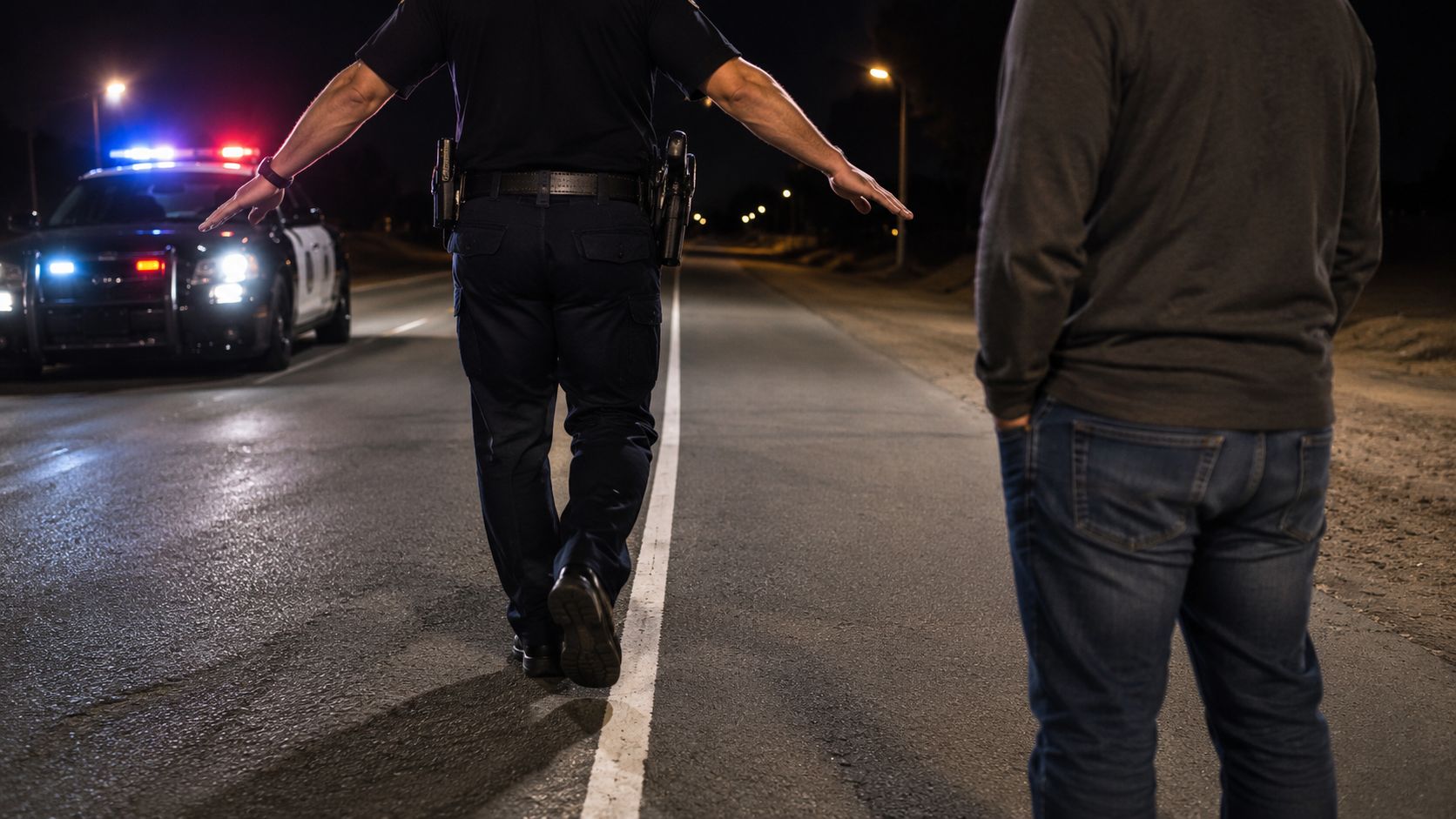
Field sobriety tests are roadside exercises officers use when they suspect impairment. In Texas, the three standardized tests commonly used are the Horizontal Gaze Nystagmus, Walk-and-Turn, and One-Leg Stand, and they are voluntary. A driver can refuse them without the automatic license penalty that comes with refusing a post-arrest breath or blood test, as explained in this discussion of Texas DUI and sobriety testing and in this overview of Texas roadside testing and voluntary field sobriety exercises.
The three tests officers usually use
The names sound clinical, but the setting usually isn't.
- Horizontal Gaze Nystagmus: The officer watches your eyes while you follow an object.
- Walk-and-Turn: You take instructed steps, usually heel-to-toe, turn, and return.
- One-Leg Stand: You balance on one leg while following the officer's directions.
These tests are presented as structured, but the roadside environment often isn't structured at all. You may be standing on gravel, uneven pavement, a sloped shoulder, or under flashing patrol lights while traffic passes nearby.
They are evidence-gathering tools, not neutral exams
Many drivers hear "pass or fail" and think of a school test. That's the wrong frame. These exercises are designed to help the officer decide whether to arrest and gather facts the prosecutor may later use.
That matters because the officer is not scoring a laboratory exam. The officer is observing and recording what they call "clues." If the officer thinks you swayed, misheard, stepped wrong, or used your arms for balance, those observations can become part of the report.
A field sobriety test in Texas is better understood as a roadside investigation tool than as a final measure of guilt.
Why voluntary matters
The legal value of "voluntary" is straightforward. You were not under a legal duty to perform these exercises in the first place. That doesn't mean refusing them guarantees you won't be arrested. It means the refusal itself does not carry the same automatic administrative consequence tied to a post-arrest chemical-test refusal.
This is one of the most important distinctions in any DWI defense. It shifts the question from "Did I fail?" to "How is the State trying to use this against me, and can that use be challenged?"
The Immediate Consequence Is Arrest Not Conviction
If an officer says you failed, the most likely immediate consequence is arrest. That is usually the key turning point in the encounter.
Texas field sobriety tests are voluntary, so failing one does not create an automatic conviction or license penalty by itself. Officers commonly treat a perceived failure as part of the probable-cause basis for a DWI arrest, then move to chemical testing after arrest under implied-consent rules, as discussed in this explanation of refusing field sobriety and breath tests in Texas.
What probable cause means in plain English
Probable cause means the officer believes there is enough evidence to make an arrest. It is not proof beyond a reasonable doubt. It is not a conviction. It is not the final answer to whether you were legally intoxicated.
That distinction often gets lost because the arrest is stressful and public. Handcuffs, transport, booking, fingerprints, bond conditions, and a court date make the situation feel final. Legally, it isn't final at all.
What often happens next
After arrest, the process usually moves in a familiar sequence:
- You are taken into custody.
- You are transported for booking or testing.
- The officer requests a breath or blood test.
- Your release conditions and court dates are set.
At that point, the case has moved beyond roadside observations. The State is now building a criminal file, and your defense needs to do the same.
The arrest tells you the officer thinks they have enough to proceed. It does not tell you the prosecutor can prove the case.
Key terms clients should understand
A few terms come up in nearly every DWI consultation:
- Field sobriety test: A voluntary roadside exercise used to look for signs of impairment.
- Implied consent: Texas law treats driving as consent to chemical testing after a lawful DWI arrest, subject to license consequences for refusal.
- BAC: Short for blood alcohol concentration. In many cases, the State looks for chemical-test evidence to support its allegations.
- Administrative license suspension: A license action handled outside the criminal case, often through the ALR process.
If you're trying to fight DWI Texas charges, the strategy begins not with panic over the roadside test, but with a careful review of what gave the officer grounds to arrest in the first place.
Fighting on Two Fronts The ALR Hearing and Criminal Case
A DWI arrest can launch two separate cases at the same time. One is about your driver's license. The other is about the criminal charge. They move on parallel tracks, and ignoring either one can cost you.
To visualize that split, look at the process below.

The ALR case
The Administrative License Revocation, or ALR, case is the civil process tied to your driving privileges. The major trap here is speed. For a first chemical-test refusal, the Department of Public Safety seeks a 180-day license suspension, and you have only 15 days from arrest to request an ALR hearing, as described in this guide to the Texas ALR hearing process and in this discussion of Texas field sobriety refusal and ALR consequences.
That deadline is easy to miss when you're dealing with bond, work, family questions, and court dates. But from a defense standpoint, the ALR hearing can be important for more than your license. It can also give your attorney an early look at the officer's version of events.
Here is a short overview from video if you prefer that format:
The criminal case
The criminal case is separate. In it, the State tries to prove DWI in court. It may involve charging documents, court appearances, evidence review, motions, negotiation, and possibly trial.
The criminal case asks different questions than the ALR case. Was the stop lawful? Was the arrest supported? Is the officer's testimony reliable? Should certain evidence be excluded? Can the charge be reduced, dismissed, or resolved on terms that protect your future?
Why acting early helps
The two-front nature of a DWI case is why delay hurts. A lawyer doesn't just show up on a court date and argue. Good defense work starts by locking down deadlines, gathering records, preserving video, and identifying weaknesses before they disappear.
- For the ALR side: Missing the request window can cost you the chance to contest the license action.
- For the criminal side: Early investigation often reveals problems with the stop, the report, or the officer's observations.
- For your daily life: Fast action can help you plan around driving, employment, and court obligations with less disruption.
If you were arrested after a roadside "failure," your focus should shift immediately from embarrassment to defense planning.
How a Skilled DWI Lawyer Fights a Failed FST
You are standing on the shoulder of the road, trying to follow directions from an officer, with traffic passing, lights flashing, and a camera running. Later, the report may reduce that entire scene to a single conclusion: failed.
That word matters less than people think.
A field sobriety test result is not the same as a chemical test result under Texas law. A roadside "failure" is usually evidence the officer uses to claim probable cause for an arrest. By contrast, a refused or failed breath or blood test can trigger different consequences. That distinction creates room to fight. A defense lawyer's job is to separate the officer's opinion from what the law requires.
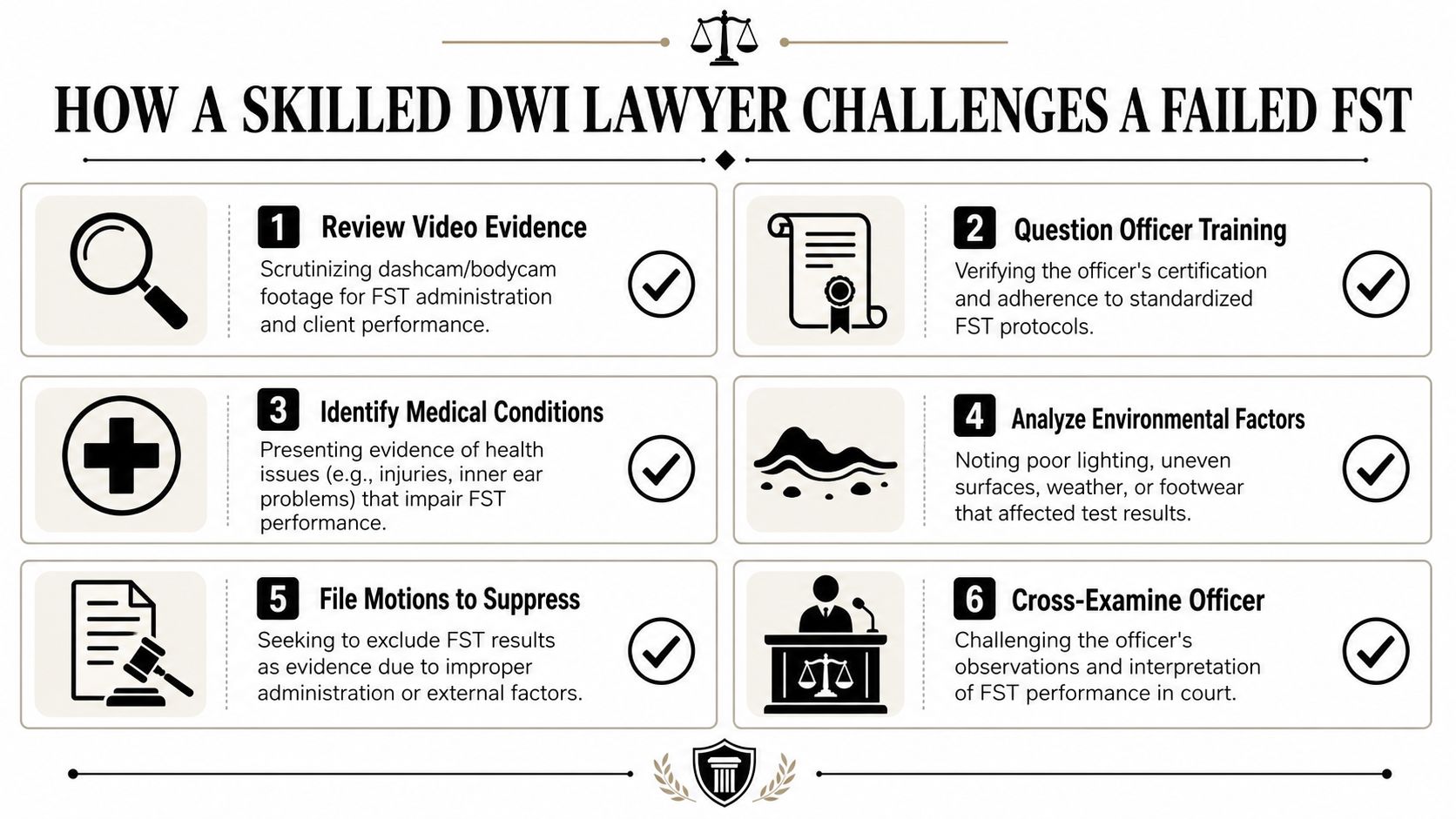
One of the first defense steps is to examine how to challenge field sobriety test results in Texas based on the facts of the stop, the officer's training, and the conditions on the roadside.
Where the defense usually starts
I do not treat "failed" as the end of the analysis. I treat it as the beginning of a checklist.
The useful questions are specific. Did the officer give clear instructions? Did the officer interrupt or rush the test? Was the surface uneven? Were your shoes, age, weight, injury history, anxiety, fatigue, or medical issues affecting balance and coordination? Does the bodycam show what the report claims it shows?
These cases often turn on detail, not drama.
How the officer's version gets tested
Police reports usually read as if the stop was orderly and the clues were obvious. Video often tells a more mixed story. An officer may describe poor balance when the recording shows a driver stepping around gravel or trying to hear instructions over passing traffic. A report may label a movement as a clue even though the demonstration was unclear.
Cross-examination is where that matters. A lawyer can press the officer on training, scoring, test sequence, lighting, weather, footwear, and whether the instructions matched standardized procedure. If the officer cut corners, guessed, or overstated what happened, the value of the FST evidence drops.
That can affect more than trial strategy. It can affect negotiations, motions practice, and how the prosecutor values the case.
What the defense is really trying to prove
The goal is not to argue that roadside tests are always meaningless. The goal is to show why this set of tests, given by this officer, under these conditions, may be too unreliable to carry the weight the State wants to put on them.
That is a practical defense position clients can use. You do not need to prove perfection. You need to identify weaknesses the State cannot cleanly explain away.
The work a lawyer does after the arrest
A skilled DWI lawyer will usually:
- Review the video frame by frame: Performance, tone, timing, interruptions, and instructions all matter.
- Compare footage to the report: Many cases improve once the written narrative is checked against the recording.
- Examine the stop and arrest decision: If probable cause is weak, that can shape the entire case.
- Develop non-alcohol explanations: Injury, fatigue, nerves, balance problems, and roadside conditions can all matter.
- File targeted motions: The right motion can limit unreliable evidence or force the State to defend weak police work early.
The Law Office of Bryan Fagan, PLLC handles this kind of review by looking closely at test administration, roadside conditions, medical explanations, and whether the officer's observations hold up against the actual record.
For a client, the strategic question is simple. How much of this case rests on a voluntary roadside test that an officer says you failed, and how much of it can be proven in court? That is where a structured defense plan begins.
Understanding Texas DWI Penalties
A roadside "failure" does not itself create the criminal penalties. Those stakes come into play if there is a conviction or another court result that triggers them. That is why defense work matters. The point of hiring a Houston DWI lawyer or Texas DUI attorney is to challenge the charge early and push for the best available outcome.
Because the verified material provided here does not include conviction ranges for jail, fines, or suspension periods by offense level, the safest way to understand this section is as a framework rather than a list of fixed numbers.
Texas DWI penalties at a glance
| Offense Level | Jail Time | Fine | Driver's License Suspension |
|---|---|---|---|
| First DWI in Texas | Possible criminal penalties may apply if convicted | Court-imposed financial penalties may apply | Criminal and administrative license consequences may apply depending on the case |
| Second DWI | Penalties are generally more serious than a first offense | Financial exposure is generally greater than a first offense | License consequences can become more difficult |
| Felony DWI | Felony-level punishment can apply in more serious or repeat cases | Financial penalties can be substantial | Long-term license and record consequences may follow |
What this means for your case
The practical point is not to assume the worst. It is to treat the case seriously enough to defend it well. Many people search for penalties first because they want certainty. What they need is strategy.
Your exposure may depend on factors such as your prior record, the presence of a chemical test, whether there was an alleged refusal, and how strong the officer's observations really are. If this is your first DWI in Texas, the defense goals may include dismissal, reduction, or a resolution that limits long-term damage. If the facts are more complicated, the work may focus on suppressing evidence or narrowing the issues the State can prove.
The consequences that matter most are the ones you can still influence. Early legal work often shapes that outcome.
If you're worried about your license, your record, or how to fight DWI Texas charges without making the situation worse, get a case-specific review before assuming the State's version is the final version.
Take Control of Your Case Today with Bryan Fagan
If an officer said you failed a field sobriety test, your next move matters more than the label the officer used. In Texas, that roadside result is not a conviction. It is one piece of evidence that often leads to arrest, then to a license fight and a criminal case that both need immediate attention.
The strongest move you can make right now is a calm, informed one. Save paperwork. Keep track of dates. Don't discuss the facts casually. Get legal advice before you make assumptions about what can or can't be challenged.
A good defense looks at the whole picture. The stop. The officer's instructions. The conditions on the roadside. The request for chemical testing. The timing of the ALR deadline. The reports and video. That is how a lawyer finds grounds for defense in a case that may have felt hopeless on the night of the arrest.
If you need a Houston DWI lawyer for a recent arrest, or you're looking for a Texas DUI attorney to help with a DWI license suspension, this is the time to act. The sooner your case is reviewed, the more options you may have to protect your license, your record, and your future.
A DWI arrest can be overwhelming, but you don't have to face it alone. The attorneys at Law Office of Bryan Fagan, PLLC help Texans challenge field sobriety tests, defend criminal DWI charges, and respond quickly to license issues like ALR hearings. If you want a clear plan for your case, request a free consultation or case evaluation today.

