
Your first court date for a Texas DWI is usually a brief arraignment, not a trial. The judge typically confirms who you are, reads the charge, asks for a plea, and may set or review bond conditions, while your separate license case has its own 15-day deadline after arrest.
A DWI arrest can be overwhelming, especially when you're holding a court notice and wondering if you're about to walk into a full-blown trial. There's a common image of witnesses, dramatic testimony, and a judge deciding guilt on the spot. That usually isn't what happens.
In most Texas DWI cases, the first setting is procedural. It matters, but not in the way typically feared. It's the opening move in a larger process, and if you understand that early, you're already in a better position to protect yourself.
You Have a Court Date Now What?
The court notice shows up, and the mind goes straight to the worst-case version of court. Many people picture a trial, public accusations, and a judge making a final decision in a matter of minutes. In a Texas DWI case, the first setting is usually far more controlled than that.
What matters most at this stage is understanding where this date fits. Your first court appearance is usually the formal start of the criminal case, while a separate license matter may already be running on its own deadline in the background. Those two tracks overlap, but they are not the same case.

What that first date usually means
The first court date usually serves a practical purpose. The court calls the case, confirms who you are, makes sure the charge is on the record, and puts the case on a path for later settings. A fuller explanation of what happens at an arraignment hearing in Texas helps put that first appearance in context.
Clients often feel relieved once they see the difference between a first setting and a trial. Relief is appropriate, but this date still matters. Early mistakes can affect bond conditions, scheduling, and how much room your lawyer has to work with as the defense develops.
What people fear versus what usually happens
The fear is understandable. People worry the officer will testify, the judge will decide guilt, and they may be taken into custody on the spot.
That is usually not what happens at a first DWI setting.
What usually happens is narrower and more procedural:
- The court confirms your identity and connects you to the right case.
- The charge is stated in open court so the record is clear.
- A plea is addressed so the case can move into the next phase.
- Bond terms may be reviewed if the judge wants to keep, modify, or add conditions while the case is pending.
In practice, that means the first date is often about protecting position, not proving the whole case. A good result at this stage is often quiet. No damaging statements, no missed deadlines, and no unnecessary conditions added without a reason.
Keep the bigger picture in view
A Texas DWI usually creates two legal problems at once. One is the criminal case in court. The other is the license suspension process handled separately through the administrative side.
That distinction catches many people off guard. They show up focused on court, while the driver's license issue is already on a shorter clock. As noted earlier, there is a deadline after arrest to request the hearing that preserves the right to challenge a proposed suspension.
A few terms worth knowing now
- BAC means blood alcohol concentration.
- Implied consent refers to Texas rules that apply to chemical testing after a DWI arrest.
- Field sobriety tests are the roadside exercises officers use during the investigation.
- Administrative license suspension is the separate process that can affect your license apart from the criminal charge.
The first court date is the start of the process, not the point where the whole case is won or lost. With the right preparation, it is manageable.
The Arraignment A Step-by-Step Guide to the Courtroom
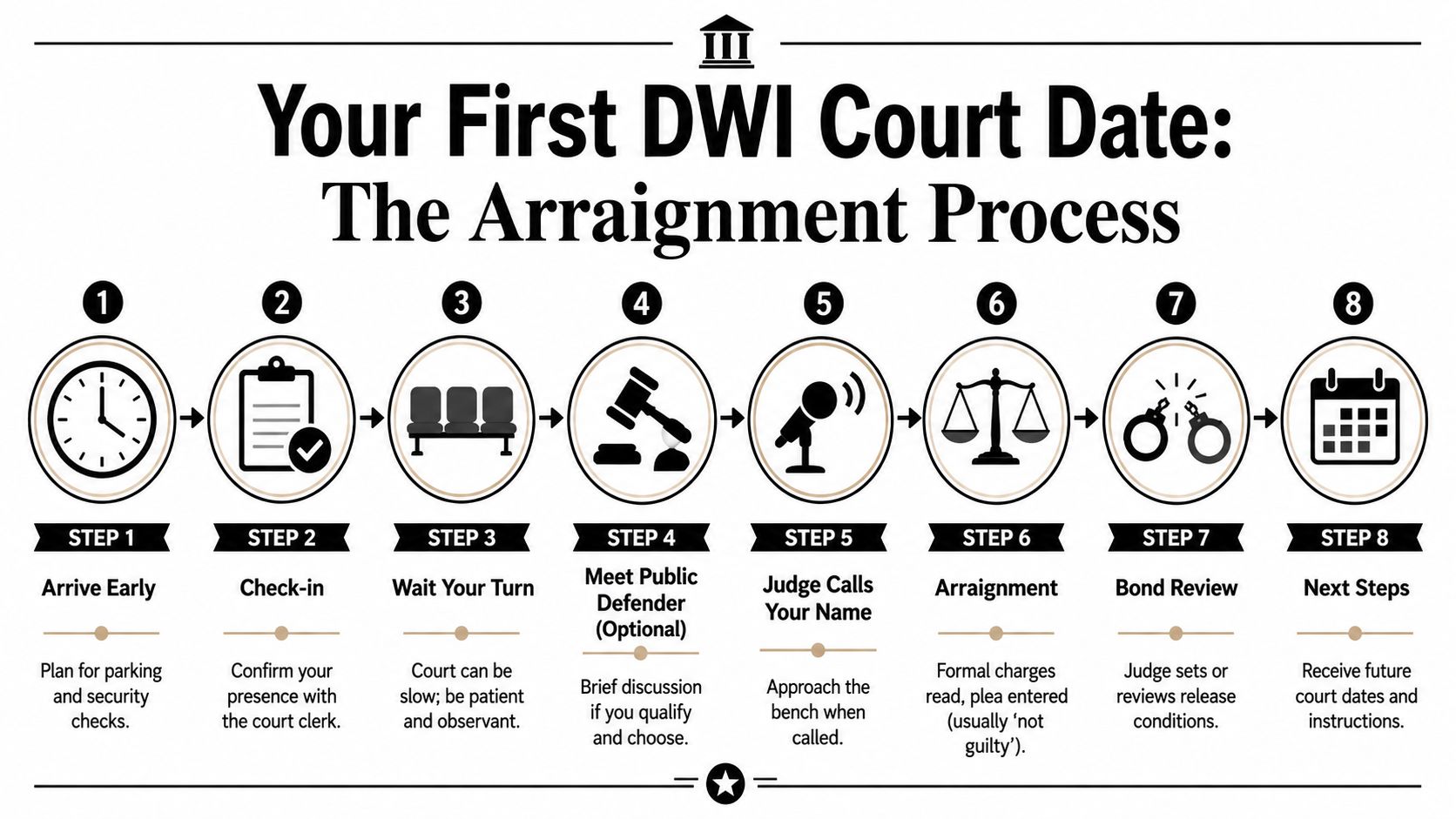
You arrive at the courthouse expecting something dramatic. In reality, the first setting in a Texas DWI case is usually brief, procedural, and far less eventful than clients fear. The court is getting the case formally on track. You are not there to prove innocence that morning, and the judge is not deciding the whole case.
At this stage, the setting is usually an arraignment rather than a trial-type hearing. The judge identifies the defendant, addresses the charge, advises the defendant of rights, and asks for a plea. Live testimony, cross-examination, and fights over suppression issues usually come later, after the defense has had a chance to review the evidence carefully.
What the morning often looks like
The first few minutes often feel more stressful than the hearing itself. You park, go through security, find the correct courtroom, and check in with the clerk or bailiff. Then you wait, sometimes longer than expected. That is normal in busy Texas courts.
Several people will be working in the room at once:
| Person | Role at the first setting |
|---|---|
| Judge | Runs the hearing and addresses the charge, plea, and court orders |
| Prosecutor | Represents the State of Texas |
| Defense lawyer | Protects your rights, enters the plea, and addresses issues that need immediate attention |
| Clerk or bailiff | Manages the docket and courtroom flow |
If you have counsel, a good part of the value is quiet and strategic. Your lawyer handles communication, keeps you from volunteering harmful facts, and makes sure simple mistakes do not create bigger problems later.
What usually happens when your case is called
When your name is called, you and your lawyer approach as directed. The judge will usually confirm your identity and make sure the record matches the person standing in court.
Next, the court states the charge. In a first-offense DWI case, that usually means the judge identifies the allegation and confirms that you understand what case is pending.
Then the plea is addressed. In many DWI cases, the practical choice at this point is a not guilty plea. That preserves room to review the police report, videos, test results, and the legality of the stop before making decisions that carry long-term consequences.
That is the fundamental trade-off at a first setting. Clients often want to explain themselves immediately because they know their side of the story. The problem is timing. Early statements can limit defense options, while a measured response gives your lawyer time to examine whether the stop was valid, whether field sobriety testing was administered correctly, and whether chemical testing can be challenged.
What clients fear will happen, versus what actually happens
Clients commonly worry that the officer will take the stand, the prosecutor will start arguing the facts, or the judge will decide guilt on the spot. That is usually not how this hearing works.
In most courts, the first setting is administrative in the ordinary sense of courtroom procedure. The judge is getting the case called, making sure rights are addressed, and setting the framework for later dates. If you want a more detailed explanation of the early hearing's purpose, this Texas arraignment hearing guide covers that process in plain terms.
A quiet first appearance is often a good one. If the plea is entered correctly, no unnecessary statements are made, and no avoidable problems are created, the case is in a better position than when the day started.
How to carry yourself in court
Small choices matter here.
- Arrive early: Parking, security, and docket delays can slow everything down.
- Dress respectfully: You do not need to look wealthy. You do need to look prepared and serious.
- Bring identification: Court staff may need it.
- Let your lawyer do the talking: Hallway conversations with prosecutors are rarely helpful.
- Pay attention to instructions: The court may announce dates or requirements you need to follow exactly.
For many people, the first court date feels like the moment everything will happen. Usually, it is the moment the case is formally organized. That distinction matters. Once clients understand the sequence, the hearing becomes far more manageable.
Decoding Your Bond Conditions and Responsibilities
A lot of clients leave the first court date relieved they were not taken into custody, then miss the next risk entirely. Bond conditions can control your daily routine long before the case is resolved.

What bond conditions really are
Bond conditions are court orders that apply while your DWI case is pending. If you are out of jail, you are out because the court allowed it under specific terms. In many Texas DWI cases, those terms may address alcohol use, travel, reporting, ignition interlock, testing, or other monitoring.
The exact conditions depend on the court, the facts of the arrest, your history, and sometimes the judge's standard practice. A first-time DWI with no accident may be treated differently from a case involving a high breath result, a child passenger, or an allegation that someone was hurt.
This is one place where clients often expect the wrong problem. They worry the first court date is when the judge will decide guilt. More often, the immediate issue is whether release conditions stay the same, get clarified, or become stricter.
Why these rules matter
Judges expect strict compliance. Prosecutors notice compliance too.
If your bond says no alcohol, that usually means no alcohol. If it says get permission before travel, ask before you leave. If pretrial services requires testing or check-ins, missing one can create a bond problem that is separate from whether the State can prove the DWI charge.
That trade-off is real. A person may have a defensible DWI case and still make it harder by violating release terms. Courts tend to give more room to someone who follows orders, shows up on time, and does not create side issues.
Common mistakes that cause trouble
Some bond violations start with carelessness. Others start with confusion. Both can put you back in front of the judge.
Watch for these problems:
- Assuming a condition is informal: If it appears in your paperwork or was ordered in court, treat it as binding.
- Traveling without approval: Even a short trip can become an issue if permission was required.
- Missing testing or monitoring appointments: Courts usually care more about the missed event than the excuse offered later.
- Relying on memory instead of the written order: Get a copy and read it carefully.
- Waiting too long to tell your lawyer about a problem: Early notice gives your lawyer a chance to fix or explain it before it gets worse.
What helps while the case is pending
The safest approach is disciplined and boring. That is not glamorous, but it works.
Keep every court paper. Save proof of classes, testing, or device compliance. Put deadlines in your phone. If a condition is unclear, ask your lawyer before making assumptions. I would much rather answer a cautious question on the front end than try to repair a preventable violation later.
It also helps to understand that bond conditions are only one part of the larger DWI process. Your criminal court case and your license case can move on separate tracks, which is why it helps to understand the difference between an ALR hearing and the criminal DWI case in Texas.
A manageable case can become harder if bond problems pile up. A stressful case can stay manageable if you follow the orders exactly and let your lawyer address the legal issues.
The Critical Two-Track DWI Process Criminal Court vs ALR
A lot of drivers walk into the first court date believing the judge will address everything at once. That is not how a Texas DWI usually works.
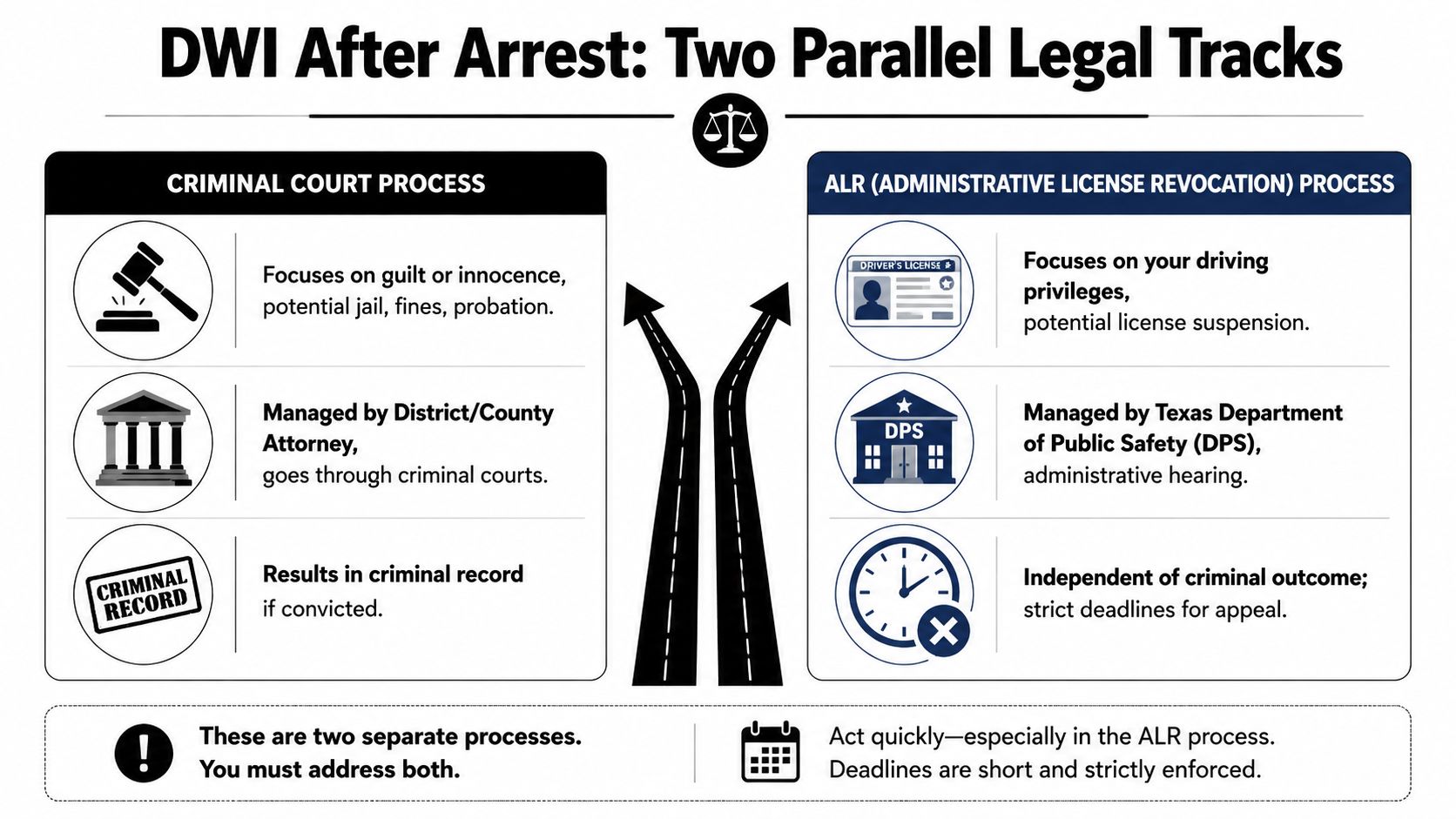
After an arrest, two separate processes often start at nearly the same time. One is the criminal case, where the State tries to prove the DWI charge. The other is the Administrative License Revocation process, usually shortened to ALR, which deals with your driving privileges. Those tracks can overlap, but one does not automatically control the other.
Texas law requires a prompt magistration after arrest, where bond is set and initial warnings are given. The license side also starts early, and the deadline to request an ALR hearing can arrive long before anything meaningful happens in criminal court, according to this overview of the DWI court process and ALR deadlines.
Two tracks with different jobs
Here is the practical difference:
| Track | Main issue | Who handles it |
|---|---|---|
| Criminal case | Whether the State can prove the DWI charge and what criminal penalties may follow | Criminal court |
| ALR case | Whether your driver's license will be suspended | Administrative process connected to DPS |
Clients often fear the first court date is the moment they will lose everything at once. In reality, the first court appearance is usually procedural. The more immediate risk is often quieter. A driver focuses on the court date listed on the paperwork and misses the separate deadline to protect the license.
For a clearer explanation of how those proceedings differ, see our guide on the difference between the ALR hearing and the criminal DWI case in Texas.
Why timing matters so much
The criminal case often feels more serious, so it gets more attention. That is understandable. It is also how people lose the chance to contest a license suspension.
If the officer served a notice of suspension, the ALR request deadline usually arrives fast. Waiting for the first court date can be a mistake because the license process may already be advancing while the criminal case is still at a very early stage. In practice, I tell clients to treat the court setting and the license deadline as two separate calendar problems from day one.
This video gives a useful visual overview of the process:
Terms that make this easier to follow
A few definitions help clear up the confusion:
- Administrative license suspension: A civil process that affects your ability to drive. It is separate from the criminal prosecution.
- Implied consent: The legal rule tied to chemical testing after a DWI arrest. A refusal or a test result over the legal limit can trigger license consequences.
- ALR hearing: The administrative hearing used to challenge the proposed suspension.
The judge in your criminal case does not stop the ALR clock for you.
What this means in real life
The best approach is simple and disciplined. Treat the arrest as two matters immediately. One concerns the charge itself. The other concerns your license.
That does not mean panic is useful. It means early organization is useful. With the right strategy, this part of the process is manageable, but only if both tracks get attention at the start.
How a DWI Lawyer Changes Your First Court Appearance
The difference between going alone and going with counsel shows up immediately. Early DWI settings are procedural, but procedure is where rights are preserved or lost.
In Texas, the first criminal court date after a DWI arrest is usually an arraignment, while the separate administrative license process must be triggered within 15 days of arrest to preserve the right to challenge suspension. An attorney can manage both critical initial steps, as noted in this summary of the Texas DWI court process.
What a lawyer is doing before the hearing
A good Texas DUI attorney doesn't just stand beside you when your name is called. The work starts earlier.
That often includes:
- Checking the setting details: Wrong courtroom, wrong time, or missed appearance problems can snowball quickly.
- Entering a formal appearance: This tells the court and prosecutor who represents you.
- Handling the plea carefully: Early decisions should preserve defenses, not close them off.
- Managing the ALR side promptly: The license issue has its own timeline and shouldn't be treated as an afterthought.
For many people, the presence of a lawyer lowers stress the fastest. The process becomes organized instead of reactive.
Practical advantages at the first setting
Lawyers help in ways that clients often don't see until later:
| Without counsel | With counsel |
|---|---|
| You may not know what the court expects | The process is usually explained in advance |
| You may talk when silence is safer | Your lawyer handles communication strategically |
| You may miss a related deadline | Counsel tracks both court and license issues |
| You may agree to terms you don't understand | Counsel can address unfair or unclear conditions |
Some courts may also allow an attorney to appear for certain early settings. That depends on the court and the circumstances, but it can make a practical difference for work, childcare, and stress management.
Why this changes the whole case, not just one day
The first appearance is not where most DWI cases are won. But it is where the tone gets set.
Counsel helps you avoid common early mistakes such as talking too much, ignoring the license track, or treating bond conditions casually. A lawyer also starts evaluating the actual defense issues. Was the stop lawful? Were field sobriety tests administered correctly? Was the breath or blood evidence handled properly?
If you're deciding whether to get help early, this resource on whether to call a lawyer after a DWI arrest in Texas addresses that timing question directly.
The Law Office of Bryan Fagan, PLLC handles both the criminal court side and ALR matters for Texas DWI clients, which is the kind of dual-track coordination many people need right after arrest.
Your Next Steps for Building a Strong Texas DWI Defense
After the first court date, the case enters the stage where preparation matters more than courtroom drama. This is usually when the defense starts collecting the material that will shape negotiations, motions, and trial decisions: police reports, body camera or dash camera footage, breath or blood testing records, dispatch logs, and witness information.
In a first-offense case, the charge often starts as a misdemeanor, but the facts can still change the risk level, the pressure from the prosecution, and the strategy that makes sense. Early settings rarely force final decisions. What they do is create a window to get organized before the State has fully framed the case on its terms.
That window matters.
What often comes after the first court date
A strong defense usually develops in a few parts:
- Evidence review: Examining the stop, arrest, officer observations, video, testing records, and any gaps or inconsistencies.
- Legal motions: Raising issues about the traffic stop, probable cause, statements, or the way breath or blood evidence was obtained and handled.
- Negotiation: Using weaknesses in the evidence to push for a better result, whether that means reduction, dismissal, or a more favorable resolution.
- Trial preparation: Preparing the case seriously enough that the prosecution knows quick pressure will not decide the outcome.
Clients sometimes expect the hardest part to be over after that first appearance. In practice, this is often the point where the actual defense work begins.
What you should do right now
A few steps help immediately:
- Keep every document related to the arrest, bond, license notice, and court settings.
- Follow bond conditions exactly while the case is pending.
- Stop discussing the facts casually with friends, coworkers, or online.
- Write down your own timeline while the details are still fresh, including where you were, what you drank if anything, when the stop happened, and what officers said and did.
- Get legal advice quickly if you have not already done so.
A first DWI in Texas is serious, but the first court date usually marks the beginning of your defense work, not the end of your options.
The practical answer is reassuring. Your first court date is usually a procedural setting, and the next phase is where careful case-building can change the result. Clear advice, steady follow-through, and attention to both the court case and the license case put you in a much stronger position.
If you're facing a DWI charge, the next step is to get clear advice about both the court case and the license issue before deadlines pass. The attorneys at Law Office of Bryan Fagan, PLLC offer free consultations and case evaluations for Texans dealing with a first DWI in Texas, DWI license suspension concerns, and broader fight DWI Texas defense strategy. If you need a Houston DWI lawyer or a Texas DUI attorney to help you understand what happens next and protect your rights, reach out for a confidential review of your case.