 Skip to content
You get out of jail at 3:00 a.m., your car may still be impounded, your paperwork is a mess, and one question keeps coming up. Should you call a lawyer after a DWI arrest in Texas?
Yes. Call one now.
A Texas DWI starts two legal problems at once. One can threaten your record, your money, and your freedom. The other can take your driver's license fast if nobody acts in time. You cannot afford to sit on the paperwork and wait for a court date.
Texas treats driving while intoxicated as a serious criminal offense. For many first-time cases, the charge can expose you to jail time, fines, and license consequences. Texas law also generally treats a BAC of 0.08% or higher as intoxication. National crash data from the National Highway Traffic Safety Administration's drunk driving page shows why these cases are prosecuted aggressively. Texas-specific fatality figures should be tied to TxDOT, not NHTSA, so the only point you need here is the practical one. Prosecutors and police take these arrests seriously, and you should too.
The first 24 to 72 hours matter more than people realize. A lawyer can review the notice you were handed, determine whether the clock is already running on your license case, request the right hearing, identify video and witness evidence that may disappear, and keep you from making statements that make the criminal case harder to defend. Those are not tasks to put off until your first court setting.
Start with a clear plan. Read this guide on the first 24 hours after a Texas DWI arrest and get counsel involved before you miss a deadline that cannot be fixed later.
The Answer Is Yes Here Is Why It Matters Right Now
You get out of jail, look at the paperwork, and see a court date weeks away. That is the trap. People assume nothing serious happens until they stand in front of a judge. In Texas, a DWI arrest starts two cases right away, and one of them can start costing you your license before the criminal case gets traction.
Call a lawyer now.
A DWI lawyer is not there just to appear in court later. In the first 24 to 72 hours, your lawyer identifies which deadlines are already running, whether you received notice that affects your license, what bond conditions you must follow, and what evidence needs to be preserved before it disappears. Patrol car video, body camera footage, jail video, dispatch records, receipts, and witness information do not wait for your first setting.
You are already dealing with two separate cases
The criminal case is the charge itself. The state will try to prove you were intoxicated while driving.
The other case is administrative. It deals with your driver's license and moves on its own track. If you wait because your court date feels far away, you can lose options you had the day you were released.
That is why early legal help matters. A lawyer can step in before deadlines pass and before the state's version of events hardens into the only version on paper.
What a lawyer does immediately that you cannot realistically do alone
A good lawyer starts with the file in your hand and the facts that are still fresh.
That means reviewing the notice of suspension or refusal paperwork, checking the temporary driving permit, confirming the arresting agency, spotting issues with the stop and arrest, and preserving evidence that may later expose weak police work or bad testing procedures. It also means telling you what not to say, who not to talk to, and how to avoid making the criminal case worse with one careless explanation.
A lawyer also begins evaluating the issues that often decide whether the case can be reduced, suppressed, or beaten:
- Whether the officer had a lawful reason to stop you
- Whether the arrest was supported by probable cause
- Whether field sobriety tests were given and scored properly
- Whether breath or blood testing procedures were handled correctly
- Whether video, witnesses, or records contradict the offense report
If you want a practical checklist of what to do right away, read this guide on the first 24 hours after a Texas DWI arrest.
Waiting helps the state
Texas treats DWI as a serious charge. A conviction can affect your freedom, your license, your insurance, your job, and any professional reputation you have built. The early window is where a defense lawyer can still protect evidence, control deadlines, and stop avoidable damage.
Do not sit on the paperwork and hope the first court date is when your case starts. It already started.
Your First 15 Days Protecting Your Texas Driver's License
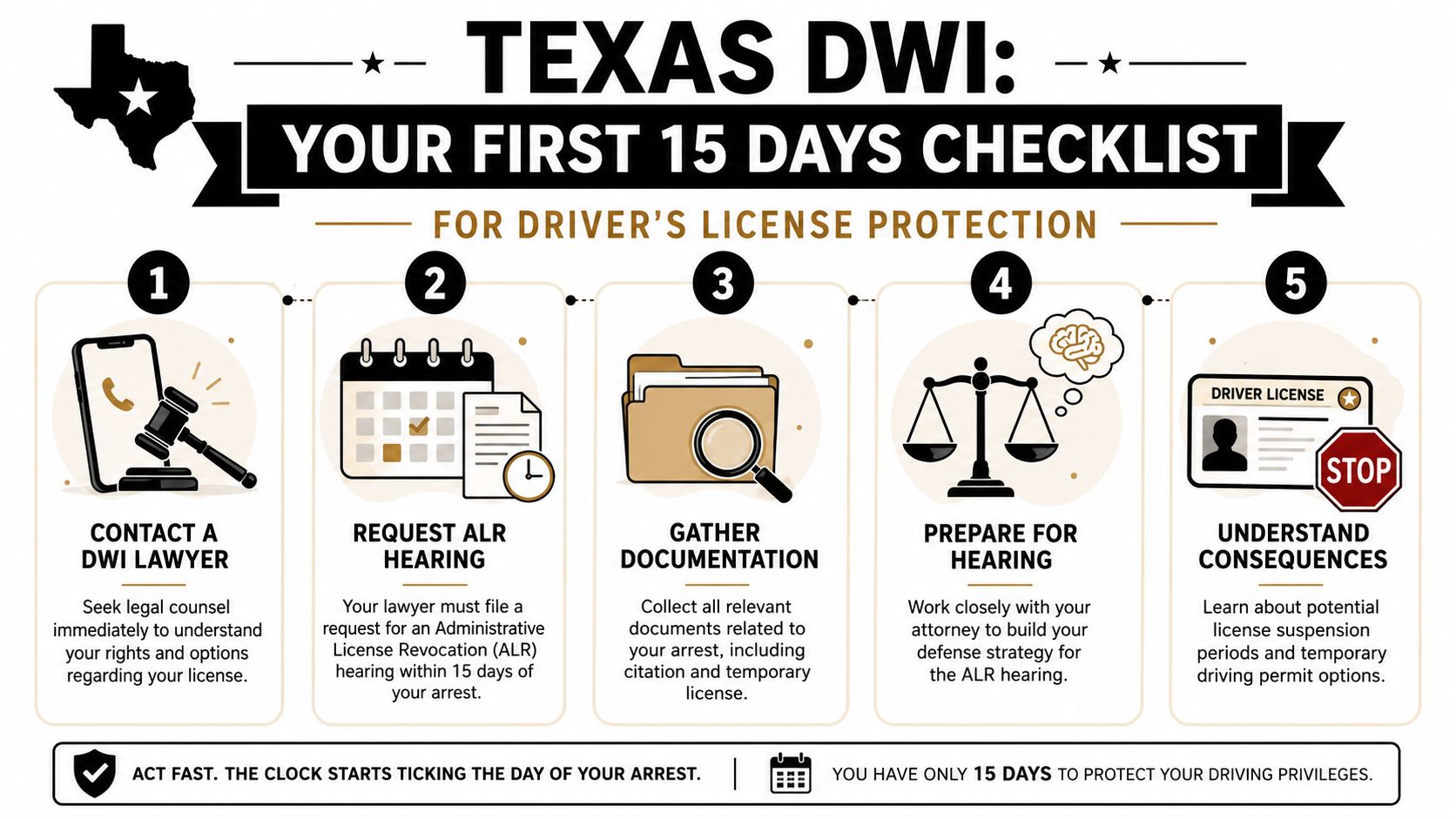
The most urgent deadline in many Texas DWI cases isn't your court date. It's the deadline to request an Administrative License Revocation, or ALR, hearing.
An administrative license suspension is the state's separate effort to suspend your driving privilege apart from the criminal prosecution. It is handled outside the criminal court process. If you miss the deadline to request the hearing, the suspension can become automatic.
What the ALR deadline means
Texas drivers generally have 15 days after arrest or notice to request an ALR hearing, according to this explanation of the Texas ALR deadline. When the request is filed on time, it can preserve your driving privileges while the case is pending.
That alone is a strong reason to call a lawyer immediately.
What your lawyer does in those first days
A good lawyer doesn't just tell you to “show up in court.” Your lawyer should be handling concrete tasks right away.
Review the paperwork
Look for the notice tied to your license, temporary permit, citation, bond paperwork, and any test-related forms.Confirm the deadline
The service date matters. Don't guess. Don't assume.Request the ALR hearing
This is the move that can stop you from losing your license by default.Start preserving evidence
Surveillance footage, body cam issues, receipts, text timestamps, rideshare records, and witness contact information can matter early.Plan for driving if a suspension issue arises
If your license is at risk, ask about how to get an occupational license.
Why the ALR hearing matters beyond driving
Many people think the ALR process is just about transportation. That is too narrow.
The ALR hearing can also become an early testing ground for the state's evidence. It may reveal weaknesses in the stop, arrest sequence, or testing process before the criminal case is fully developed. That gives your lawyer information to use later.
Missing the ALR deadline is one of the easiest ways to make a DWI case harder than it needs to be.
If you do nothing else today, protect the license side of the case. Then build the criminal defense from there.
The Two Battles of a Texas DWI Criminal vs Administrative
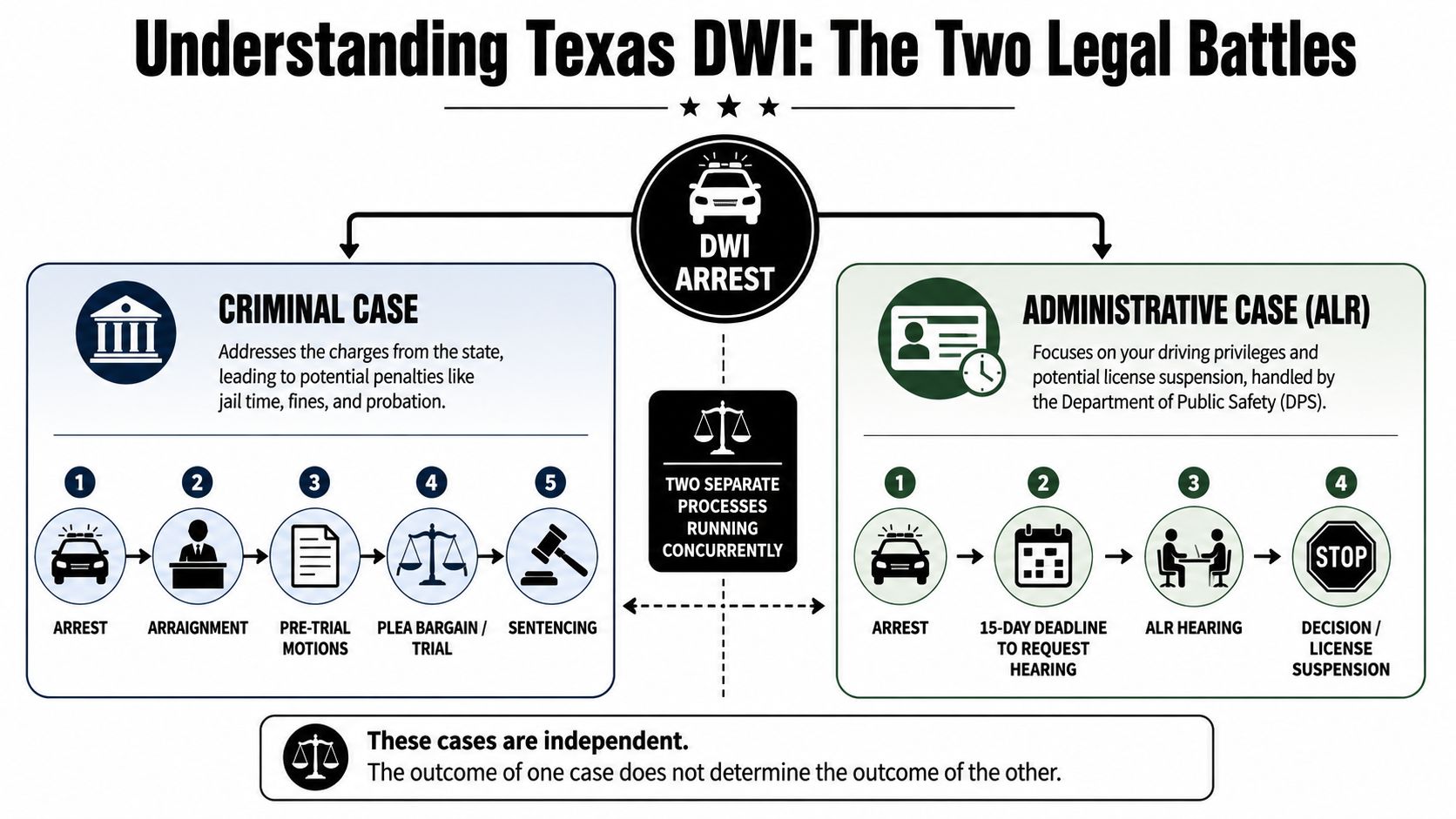
A Texas DWI puts you in two legal fights at the same time. Think of it as fighting on two fronts.
One front is about punishment. The other is about driving privileges. They run at the same time, but they are not the same case.
The criminal case
The criminal case is the prosecution for DWI itself. That case can involve court appearances, motions, plea negotiations, and trial preparation. The stakes can include jail exposure, fines, probation terms, and a permanent criminal record if the case ends badly.
The administrative case
The administrative side is the ALR case. That is the driver's-license fight. It focuses on whether the state can suspend your license after the arrest.
These cases are related, but they are separate. A result in one doesn't automatically decide the other.
Key terms you need to understand
Here are the terms that matter most right now:
- BAC means blood alcohol concentration. In Texas, 0.08% is the general threshold at which the law treats a driver as intoxicated.
- Field sobriety test means the roadside tasks officers use to claim they observed impairment. These are not the same thing as a chemical test.
- Implied consent means that by driving in Texas, you are considered to have consented to certain chemical testing procedures after a lawful DWI arrest under state law.
- Administrative license suspension means the separate state action against your driver's license, outside the criminal prosecution.
Why this split matters strategically
People often assume the court case is everything. It isn't.
A lawyer handling your case has to think in parallel. One part of the strategy deals with preserving your ability to drive. The other part attacks the prosecution's proof. If your lawyer ignores either side, you're exposed.
A DWI defense is not one file and one hearing. It is a coordinated response to two different problems that started on the same night.
That is why the answer to “should I call a lawyer after a DWI arrest Texas” is yes. Not because every case ends the same way, but because every case starts with deadlines and decisions you should not handle casually.
How a Houston DWI Lawyer Fights to Protect Your Future
You are home after the arrest. Your car may still be impounded. Your license issue is already in motion. The prosecutor has not filed everything yet, but the case has started. The first job of a Houston DWI lawyer is to get control fast, before the record hardens against you.
A good lawyer does not wait for a court date and then react. In the first 24 to 72 hours, your lawyer should start gathering the evidence that tends to disappear first: dash cam video, body cam footage, 911 calls, dispatch logs, booking records, intoxilyzer records, blood draw paperwork, and witness names. Delay hurts. Videos get overwritten. Officers finish reports. The State's version becomes the default unless someone challenges it early.
Texas sees a high volume of DWI enforcement. One Texas-focused review reported about 90,000 DWI arrests per year on average, with roughly 63% of defendants pleading guilty and about 70% of those who pleaded not guilty still being convicted of the original charge. The same review also reported 83,088 DWI charges in 2020, along with 6,771 dismissals and 3,275 releases with no charge, showing that arrest does not automatically equal conviction. That review also notes the 0.08% BAC threshold, that a BAC above 0.15% can raise a first-offense DWI to a Class A misdemeanor, and that NHTSA says drivers at 0.08 are about 4 times more likely to crash than sober drivers, while drivers at 0.15 are at least 12 times more likely. All of that appears in this Texas DWI statistics review.

Strong DWI defense starts with the state's weak points
A serious defense starts with the parts of the case the State must prove, not with excuses. The stop matters. The officer's observations matter. The arrest decision matters. The testing process matters.
Your lawyer should press on questions like these: Why did the officer stop you? Is that reason clear on video? Did the officer give field sobriety test instructions correctly? Were lighting, footing, traffic, weather, anxiety, fatigue, age, injury, or medical conditions affecting what looked like "clues"? Did the officer have probable cause to arrest, or did the report jump from suspicion to arrest without enough support?
Then the chemical test gets the same close review. Breath and blood cases turn on procedure. Machine maintenance, operator steps, observation periods, blood draw protocols, lab handling, storage, and chain of custody all matter. If the State cut corners, your lawyer needs to find it early and preserve the issue for hearings and trial.
The first days after arrest can shape the whole case
This is also the period when your lawyer can protect you from making the case worse.
Clients often want to explain themselves to police, call the prosecutor's office, or post about the arrest online. That is a mistake. Your lawyer should shut that down, control communication, and make sure every next step serves the defense.
A Houston DWI lawyer should also start mapping the case file immediately. That includes the offense report, probable cause affidavit, notice of suspension, bond conditions, tow records, jail records, and any test refusal or test result paperwork. Small inconsistencies matter. A bad time stamp, a missing warning, a thin probable cause narrative, or a mismatch between video and report can become a suppression issue or a strong negotiation point later.
Law Office of Bryan Fagan, PLLC handles both the criminal defense side and the ALR side of Texas DWI cases, including stop analysis, field sobriety challenges, and chemical test review.
Your lawyer is creating a stronger position
A DWI lawyer's job is to put pressure on the State where the case is weakest.
That can mean demanding records early, filing motions to suppress, challenging the basis for the stop, attacking the arrest decision, contesting breath or blood evidence, and forcing the prosecution to prove each step instead of coasting on the arrest report. Sometimes that produces a better plea option. Sometimes it supports a dismissal argument. Sometimes it builds a trial defense.
The right lawyer is preparing for all three from day one.
For a broader look at defense strategy, this video gives useful context.
If you want to fight DWI Texas charges effectively, hire someone who starts working before the case settles into the State's version of events.
Special Circumstances First Time DWI Felony CDL and More
Not every DWI case carries the same risk. Your job, license status, prior history, and alleged test result can change how urgent and complex the case becomes.
First DWI in Texas is still serious
A first DWI in Texas is often a misdemeanor, but that does not mean it is minor. Even on a first arrest, the case can affect your license, your insurance, your job prospects, and your criminal record.
If the state alleges a higher BAC, the exposure can increase. If there are aggravating facts, the consequences can become much more severe.
Some situations need immediate extra planning
A few examples:
- BAC allegation above 0.15: Texas law can enhance a first-offense DWI to a Class A misdemeanor.
- Repeat DWI allegations: Prior cases can raise both punishment risk and strategic complexity.
- CDL holders: A DWI license suspension issue can threaten your livelihood quickly. Commercial drivers should treat the licensing side as an emergency.
- Felony-level situations: Cases involving factors such as a child passenger or serious harm are in a different category entirely. These require fast, disciplined defense work.
- Out-of-state drivers or licensed professionals: Your Texas case can spill into home-state licensing or employment problems.
If your ability to drive is tied to your income, delay is expensive even before the case reaches court.
Texas DWI Penalties at a Glance 2026
| Offense Level | Jail Time | Fine | License Suspension |
|---|---|---|---|
| First DWI in Texas | Up to 180 days in jail | Fines may apply | License suspension may apply |
| First DWI with BAC above 0.15% | Exposure increases because the case can be charged as a Class A misdemeanor | Fines may apply | License suspension may apply |
| Repeat DWI | Penalties increase compared with a first offense | Fines may increase | License consequences can become more severe |
| Felony DWI | Exposure is substantially higher than misdemeanor DWI | Fines may apply | License consequences can be severe |
| CDL-related DWI issues | Criminal penalties depend on the underlying charge | Fines may apply | Driving privilege consequences can threaten commercial work |
This table stays qualitative where no verified number was provided. That is the right way to look at it. If your case involves anything beyond a straightforward first allegation, you need a Texas DUI attorney who sees those complications early.
Questions to Ask When Choosing Your DWI Attorney
Do not hire a lawyer just because the office answers the phone first. Ask direct questions and listen for direct answers.
The right consultation should leave you clearer, not more confused.
Ask about the first week, not just the final result
Start with these:
- Who will handle my case
- How do you deal with the ALR hearing
- What do you need from me in the next 24 to 72 hours
- What issues do you look for in the stop, arrest, and testing
- What should I stop doing right now
A serious lawyer will talk about deadlines, evidence, and process. A weak one will talk mostly about outcomes they can't guarantee.
Ask how they communicate
You also need to know how the relationship will work.
- Will I speak with the lawyer or only staff
- How will updates be given
- What happens if my court date changes
- What documents should I send today
If you want a stronger checklist before making calls, review these questions to ask a criminal defense attorney.
Watch for clear thinking
A good consultation usually includes three things:
- A focused review of what happened.
- A realistic explanation of the license issue and criminal issue.
- A plan for the next few days.
You are not looking for someone to promise magic. You are looking for someone who spots problems early and knows what to do next.
That is the standard. Hold every lawyer you speak with to it.
Take the First Step to Protect Your Rights and Future
You leave jail, get your phone back, and start thinking about work, your car, and who already knows. That is exactly when people lose ground. In Texas, a DWI arrest triggers two separate problems fast. Your driver's license issue starts on one track. Your criminal case moves on another. Both start moving before you feel ready.
Call a lawyer now.
Not tomorrow night. Not after you “see what happens.” The first days matter because evidence is still available, deadlines are still open, and your memory is still sharp enough to help your defense. Once that window closes, you do not get it back.
Here is what you should do today. Save every paper you received. Write down the timeline from the traffic stop to release. Include what you ate, what you drank, what the officer said, whether field tests were given, and whether you gave breath or blood. Then stop discussing the case with friends, coworkers, or on social media.
A lawyer can take over the parts you cannot handle alone in the first 24 to 72 hours. That includes protecting your position on the license suspension issue, identifying video and testing evidence that may disappear, reviewing the basis for the stop and arrest, and making sure you do not miss an early mistake that follows you through the rest of the case.
Early action changes cases.
Some DWI cases get reduced. Some get dismissed. Some are won because the officer lacked a valid reason to stop the car, the testing had problems, or the State cannot prove what it needs to prove. Those results usually start with quick, disciplined work right after the arrest, not delay.
If you need help after a Texas DWI arrest, request a free consultation with Law Office of Bryan Fagan, PLLC. A confidential case evaluation can help you address the ALR deadline, understand your criminal case, and decide your next step with a clear plan.

