
A DWI arrest in Texas can be overwhelming, but you don't have to face it alone. Your arraignment hearing is the critical first step in the court process, and having a strategic defense lawyer by your side makes all the difference. This hearing is your first formal appearance in court, where the judge will officially read the charges against you, your attorney will enter a plea on your behalf, and your release conditions will be set. Think of it as the formal start of the legal process.
Your First Court Date After a DWI Arrest
After a DWI arrest in Texas, the legal system can feel like a maze of confusing and intimidating procedures. The very first major event you’ll encounter is the arraignment hearing. This isn't a trial where guilt or innocence is decided. Instead, it's a procedural hearing that officially kicks off the criminal court process. Understanding its purpose can go a long way in reducing your anxiety and helping you feel more in control.
The arraignment is designed to accomplish three main things. First, it ensures you are formally notified of the specific DWI charges the state has filed against you. Second, it's where you, through your attorney, will enter an initial plea. Finally, the judge reviews and sets the conditions for your release while the case is pending, which is known as your bond.
The Purpose of a DWI Arraignment
This initial hearing is foundational; it sets the stage for every single step that follows in your defense. Many people mistakenly believe they need to defend themselves or explain their side of the story at this point—that's a mistake. Your only job is to be present and let your attorney handle all communication with the court.
This hearing is less about evidence and more about administration. Its primary functions are straightforward:
- Formal Reading of Charges: The judge or prosecutor will state the exact offense you are being charged with, such as a first-time DWI, which is typically a Class B Misdemeanor in Texas.
- Entering a Plea: Your Houston DWI lawyer will enter a plea of “not guilty” on your behalf. This is a standard and strategic move that preserves all your legal rights and allows your defense team to begin fighting the charges.
- Setting Bond Conditions: The judge will establish the terms of your pretrial release. This might involve a cash bond, a surety bond, or a Personal Recognizance (PR) bond, along with potential requirements like reporting to a pretrial services officer.
Having an experienced attorney at this hearing is not just helpful—it's essential. A skilled lawyer ensures the correct plea is entered, argues for the least restrictive bond conditions possible, and protects you from accidentally saying something that could harm your case.
When you feel overwhelmed by the process, it's useful to understand what to do after a DWI arrest to stay proactive. To demystify the courtroom environment, the table below breaks down the key individuals you will see during your hearing and what they do.
Key People in the Courtroom During Your Arraignment
Walking into a courtroom for the first time can be intimidating. Here’s a quick rundown of who’s who so you know what to expect.
| Courtroom Role | Who They Are | What They Do |
|---|---|---|
| The Judge | An elected or appointed official | Presides over the courtroom, informs you of your rights, reads the charges, and sets bond conditions. |
| The Prosecutor | An attorney representing the State of Texas | Formally presents the charges against you and may argue for specific bond conditions. |
| Your Defense Attorney | Your legal advocate from The Law Office of Bryan Fagan | Represents your interests, speaks on your behalf, enters your plea, and argues for favorable release terms. |
| The Bailiff | A law enforcement officer | Maintains order and security in the courtroom. |
| The Court Clerk | A court administrator | Manages the official court records, documents, and scheduling for your case. |
Knowing these roles can help make the arraignment process feel less like a mystery and more like a structured, manageable step.
Navigating the Arraignment Process Step by Step
Walking into your first court date for a DWI can feel incredibly intimidating. The good news is that knowing what to expect can take a lot of the anxiety out of the process. While every courtroom has a slightly different rhythm, the arraignment hearing itself follows a standard script. Let’s walk through it so you can picture exactly what will happen.
First, you’ll find that the courtroom is a busy place, usually with many other people whose cases are also on the docket for that day. You and your attorney will take a seat and wait until the clerk or bailiff calls your name and case number. That’s your signal to approach the front of the courtroom.
Approaching the Judge’s Bench
Once your case is called, you’ll walk up to the judge's bench with your Houston DWI lawyer. You'll stand right beside your attorney, but remember this key point: you are not expected to say anything to the judge. Your lawyer is there to be your voice, handling all the legal communication to ensure everything said on your behalf is precise and protects your rights.
The entire hearing is designed to accomplish three main things in just a few minutes.
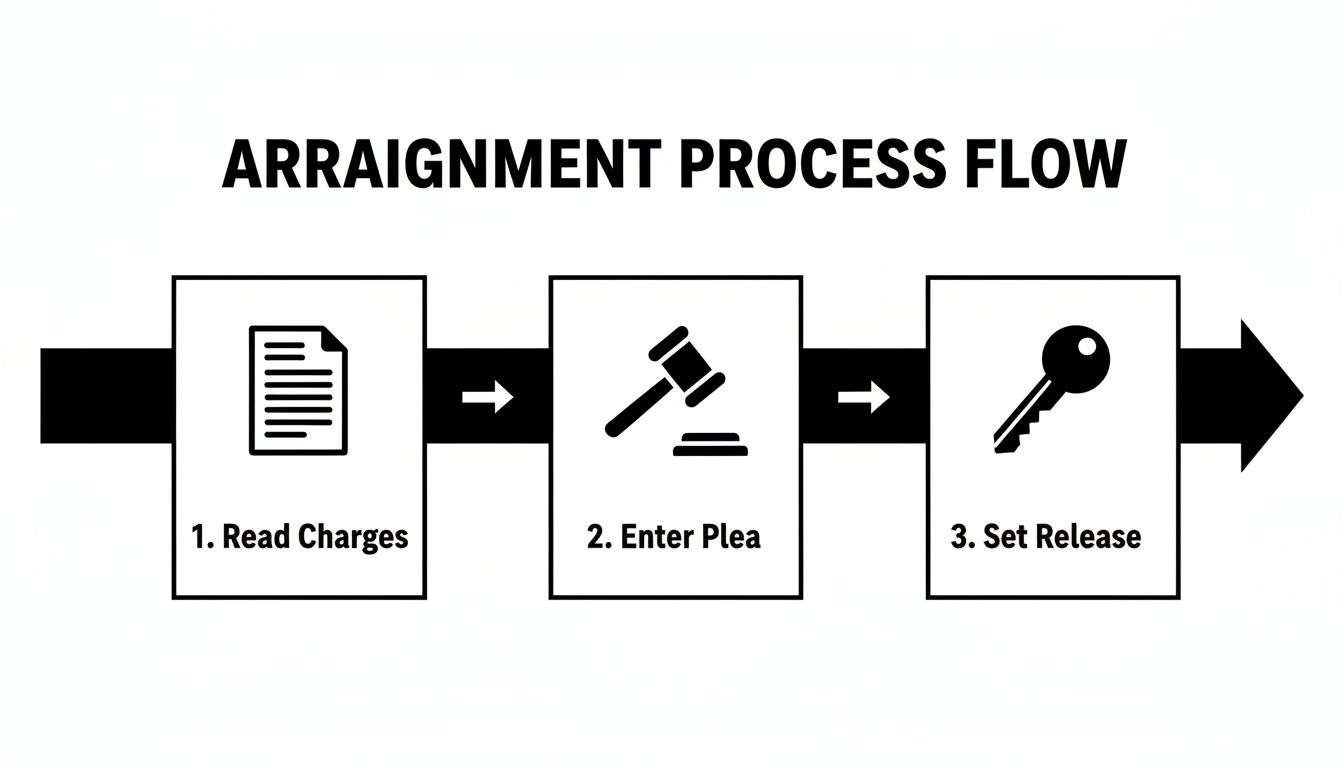
This flowchart breaks it down perfectly: the court will read the charge, your lawyer will enter a plea, and the judge will confirm your release conditions.
The Formal Reading of the Charges
The hearing kicks off when the judge formally states the charge against you. They will read from an official court document—either an "information" or an "indictment"—that spells out the specific Texas law the prosecution claims you violated. It will sound something like, "You are charged with Driving While Intoxicated, a Class B Misdemeanor."
This part isn't a debate; it’s a constitutional formality to ensure you're officially on notice about the accusation. Your lawyer will simply confirm that you've received a copy of the charging document and understand the charge.
Entering Your Initial Plea
Next, the judge will ask how you plead. This is where your lawyer steps in. They will immediately enter a plea of "not guilty" for you. This is the standard, correct, and strategic move in nearly every DWI case in Texas.
Pleading "not guilty" isn't about claiming factual innocence at this stage. It's a critical legal procedure that preserves all of your rights—the right to see the evidence against you, to challenge the state's case, and to negotiate for a better outcome down the road.
By pleading not guilty, you are essentially telling the court, "Prove it." You are forcing the prosecutor to meet their burden of proving the charge beyond a reasonable doubt. This action is what officially moves your case forward and gives your defense team the time and opportunity to begin building a powerful strategy to fight your DWI in Texas.
Receiving Final Instructions
After your plea is entered, the judge will briefly cover your bond and release conditions. If you're already out on bond, the judge will likely just confirm that those same conditions remain in effect. If there are any new rules—like having to report to a pretrial services officer or getting an ignition interlock device installed—the judge will state them clearly.
Your attorney might also take this moment to handle administrative matters, like setting the next court date or ensuring the prosecutor has handed over the initial evidence (called "discovery"). Once the judge gives you the date for your next appearance, the hearing is over. For your specific case, the whole thing often lasts only a couple of minutes. After that, you're free to leave with your attorney.
The Two Most Critical Decisions: Your Plea and Bond

In the few minutes you stand before the judge, two things happen that set the entire tone for your DWI case: your plea and your bond conditions. These aren't just minor formalities; they are the strategic first moves that can either open doors for your defense or slam them shut.
Understanding these two elements helps you see the arraignment for what it truly is—the starting line, not the finish line. How your Texas DUI attorney handles both the plea and the bond argument is critical to protecting your freedom from day one.
The Only Plea to Enter: Not Guilty
When the judge asks how you plead, your attorney will confidently and clearly state, “Not guilty.” This is, without a doubt, the single most important thing that happens at your arraignment. Many people worry this sounds dishonest, but it’s a necessary legal step to protect your rights.
Pleading "not guilty" is the procedural key that unlocks all of your constitutional protections. It forces the State of Texas to prove its case against you beyond a reasonable doubt and gives your legal team the time we need to dig into every piece of evidence, from the traffic stop to the breath or blood test.
Entering a “not guilty” plea is how we officially begin to fight your DWI charge in Texas. It preserves our ability to file motions, challenge evidence like breath test results, and negotiate for a dismissal or reduction of the charges.
Put it this way: a "guilty" plea slams the door on your defense before it even starts. A "not guilty" plea swings it wide open, allowing us to build the strongest possible case for you.
Understanding Bond and Pretrial Release
The second critical issue at your arraignment is your bond. A bond is a promise to the court that you'll show up for all future court dates, secured either by money or by agreeing to certain conditions. A common concern is the fear of an impossibly high bond that could leave you in jail while your case moves forward.
This is where a skilled DWI attorney makes a huge difference. We argue for the least restrictive and most affordable release conditions possible. In Texas, the main types of bonds include:
- Cash Bond: This means you or your family has to pay the full bond amount directly to the court.
- Surety Bond: You pay a fee (usually 10-15%) to a bail bondsman, who then posts the full amount on your behalf.
- Personal Recognizance (PR) Bond: This is the best-case scenario. The judge releases you on your written promise to appear in court, with no money required upfront.
Our goal is always to get you released without creating a financial burden. We do this by painting a clear picture for the judge of your ties to the community—your job, your family, your stability—to show you are not a flight risk. Unfortunately, many judges don't give this proper consideration. In observed hearings across the U.S., a staggering 68% of people had a cash bond set, while only 21% were released on recognizance. Even more shocking, in 77% of the cases where cash bonds were set, the judge never considered the person's ability to pay.
At The Law Office of Bryan Fagan, we fight this trend every day to protect our clients. We know what it takes to argue for a fair bond, and you can learn more in our detailed guide on DWI bond amounts in Texas.
Your Rights and the Role of Your DWI Attorney
Getting arrested for a DWI can make you feel like you’ve lost all control. But walking into that arraignment hearing, you need to remember one thing: you are protected by the Constitution. You have the right to an attorney, the right to know exactly what you're being charged with, and the absolute right to remain silent. This hearing is where those rights stop being abstract concepts and become your first line of defense.
A dedicated Houston DWI lawyer does more than just show up and stand next to you. They act as your shield and your voice, making sure your constitutional protections are honored from the second your name is called. You're not just a bystander in this process; you're an active partner in your own defense, and your attorney is there to lead the charge.
An Advocate Who Speaks for You
From the moment you hire our firm, your job is to stay quiet. You no longer have to speak directly to the judge or the prosecutor—we handle all of that for you. This isn't just for convenience; it's a critical part of a strong defense strategy. We take care of all the legal formalities, from filing the right paperwork to officially entering your "not guilty" plea on the record.
This is essential because the courtroom has its own language, and it's easy to say something that can be twisted or used against you later on. By speaking on your behalf, we eliminate that risk entirely. Your only job is to be present while we navigate the legal minefield for you.
Defending Against Restrictive Bond Conditions
One of the most immediate battles at an arraignment is over the conditions of your release. The prosecutor will often push for strict, life-disrupting requirements that can feel like you're being punished before you've been proven guilty. These can include:
- Ignition Interlock Device (IID): A breathalyzer you have to blow into just to start your car. This is often mandatory for a second DWI or cases with a high Blood Alcohol Concentration (BAC).
- Frequent Reporting: Mandated check-ins with a pretrial services officer, which can interfere with work and family life.
- Substance Abuse Evaluations: Court-ordered assessments that are both costly and time-consuming.
Your attorney’s job is to fight back against any conditions that are overly restrictive or unnecessary. We'll argue for your release on fair and reasonable terms, presenting a clear picture of your ties to the community to prove you aren't a flight risk and can be trusted to show up for your future court dates.
Laying the Groundwork for Your Defense
The arraignment may feel like a formality, but it's where the strategic foundation for your entire DWI defense is laid. While it's not a trial, it's the official kickoff to the legal fight ahead, and we use this opportunity to get your case on the right track from day one.
This goes beyond just entering a plea. We ensure the prosecution hands over the initial evidence, known as discovery, which we will later analyze for weaknesses. We also establish a professional and firm presence with the judge and prosecutor, sending a clear signal that we are ready to challenge every piece of the state’s case. To get a better sense of everything your lawyer does, you can learn more about the role of a DUI attorney in our detailed guide.
With the right lawyer by your side, the arraignment hearing is transformed from an intimidating procedure into the first strategic move in your defense. You are not alone in this fight; we are here to protect your rights, your freedom, and your future.
Common and Costly Mistakes to Avoid at Your Hearing

Your arraignment hearing is the first real opportunity you have to start building a strong defense against a DWI charge. But it’s also a minefield where simple errors can cause lasting damage to your case. Knowing what these common mistakes are is the first step toward dodging them and keeping your defense on solid ground.
The single biggest misstep is trying to handle this hearing alone. Without an experienced Houston DWI lawyer by your side, you are at the mercy of the court and the prosecutor. You might feel cornered into answering questions or accidentally say something that hurts your case. An attorney is your shield, ensuring your rights are protected.
Another huge mistake is pleading guilty just to "get it over with." A DWI conviction in Texas carries severe, lifelong consequences, including potential jail time, a permanent criminal record, and a DWI license suspension. Pleading guilty at your arraignment means throwing away every chance you have to fight the charge. A “not guilty” plea is the only strategic move.
The Dangers of Failing to Appear
By far, the most catastrophic mistake you can make is not showing up for your arraignment. A no-show, known legally as a Failure to Appear (FTA), triggers immediate and severe consequences. The moment the court calls your name and you aren’t there, the judge will issue a warrant for your arrest.
This means you could be picked up at any time—during a routine traffic stop, at your job, or even at home. Once you’re taken back into custody, getting a reasonable bond becomes much harder. The court now sees you as a flight risk, and the prosecutor will argue for a much higher bond amount, potentially keeping you in jail while your case moves forward.
Failing to appear for your arraignment hearing doesn't make the problem go away—it multiplies it. An arrest warrant and a higher bond are just the start of the new legal troubles you will face.
The stakes are incredibly high. Data shows that failure-to-appear rates at arraignments can hover between 10-20% per court date. A missed hearing instantly turns a manageable situation into a much deeper legal crisis.
However, research also shows that simple interventions can make a huge difference. One study found that SMS text reminders cut FTAs by over 8 percentage points and even led to a small but meaningful increase in cases ending with dismissals or not-guilty findings. You can read the full research about these arraignment findings and see how small steps can have a big impact.
Why Professional Representation Is Non-Negotiable
Walking into your arraignment without a seasoned DWI attorney is like walking into a legal battle unarmed. Your lawyer’s entire job is to prevent these costly mistakes before they can happen. We make sure you know exactly when and where to be, handle all the talking in the courtroom, and start building your defense from the second your case is called.
Here’s what a good Texas DUI attorney guarantees you avoid:
- Saying the Wrong Thing: We speak for you. You don't have to worry about accidentally incriminating yourself under pressure.
- Accepting a Bad Deal: We know a guilty plea at this stage is a strategic disaster and will enter a "not guilty" plea to protect all your future options.
- Missing Your Court Date: Our team manages your court schedule, sends you reminders, and makes sure you are fully prepared for every single appearance.
Your freedom and your future are on the line. Showing up prepared, on time, and with an experienced legal advocate by your side isn't just a good idea—it's an absolute necessity for protecting your rights and fighting for the best possible outcome in your Texas DWI case.
What Comes After the Arraignment Hearing?
Walking out of the courtroom after your arraignment can bring a mix of relief and anxiety. That first formal step is over, but now you’re left wondering, "What's next?" The arraignment isn't the end of your DWI case; it's the official starting line for the legal fight to protect your future. Now, the real work begins.
Your case moves into a crucial phase called discovery. This is the evidence-gathering stage, where your attorney formally demands that the prosecutor turn over every single piece of evidence they have against you. This isn't a friendly request—it's a legal requirement, and it’s where we start looking for the cracks in the state's case.
Building Your Defense from the Ground Up
The discovery process is where we start to fight for you. We don't just glance at the police report; we scrutinize every detail. The evidence we demand and review typically includes:
- Police Reports and Officer Notes: We hunt for inconsistencies, procedural mistakes, and any violations of your constitutional rights during the traffic stop or arrest.
- Body Cam and Dash Cam Footage: Video evidence often tells a different story than the written report. It can reveal issues with the initial traffic stop or how field sobriety tests were administered.
- Breath or Blood Test Results: We dig into the maintenance logs for the Intoxilyzer machine, the qualifications of the person who administered the test, and the entire chain of custody for the sample to find grounds for a challenge.
- Witness Statements: Any statements from witnesses are carefully picked apart for contradictions or inaccuracies.
This is how we find the weaknesses and legal openings necessary to build a powerful defense strategy tailored to your specific case.
The discovery phase is where your defense transforms from an idea into a concrete plan of action. It's about turning over every stone to find the evidence that can lead to a dismissal, a reduction in charges, or a not-guilty verdict at trial.
While we're working on your criminal case, we are also fighting to save your driver's license in a totally separate civil proceeding—the Administrative License Revocation (ALR) hearing. You only have 15 days from the date of your arrest to request this hearing, so moving fast is absolutely critical. Our firm handles both of these legal battles for you, ensuring a coordinated and comprehensive defense.
Pre-Trial Motions and Negotiations
Armed with the evidence we’ve gathered during discovery, we move on to the next strategic steps. This often involves filing pre-trial motions. These are formal legal arguments asking the judge to take specific actions, like suppressing evidence that was obtained illegally. For example, if the traffic stop was made without reasonable suspicion, we can file a motion to have all evidence that followed thrown out of court.
At the same time, we may engage in plea negotiations with the prosecutor. Our detailed investigation and preparation give us the leverage to argue for a favorable outcome, whether that's getting the charge reduced to a non-DWI offense like Obstruction of a Highway or a complete dismissal. We prepare every single case as if it's going to trial, which sends a clear message to the prosecutor: we are ready to fight every step of the way to protect your future.
Questions About Your DWI Arraignment Hearing
A DWI arrest can be overwhelming, and it’s natural to have questions as you prepare for court. Knowing what to expect at your arraignment can make a world of difference. Here are straightforward answers to the questions we hear most often from our clients.
Do I Have to Speak at My Arraignment Hearing?
Absolutely not. In fact, you shouldn’t say a word to the judge or prosecutor.
Your constitutional right to remain silent is your most important protection. Your Houston DWI lawyer is there to do all the talking for you, handling every interaction with the court. This is a critical strategy to prevent you from accidentally saying something that could be used against you later. Your only job is to be present and let your attorney be your voice.
What Should I Wear to My Arraignment?
How you dress sends a clear message of respect to the court. Think of it like a job interview—business casual is always a safe bet.
- For men: Slacks and a button-down shirt or a polo are appropriate.
- For women: A modest dress, skirt, or slacks with a blouse works well.
Avoid casual clothing like shorts, graphic t-shirts, flip-flops, or hats. Showing the court you take this seriously is a small but important detail that can only help your case.
A professional appearance reinforces that you are treating the legal process with the gravity it deserves. It’s a simple way to show respect for the judge and the courtroom.
Can My DWI Case Be Dismissed at the Arraignment?
It's extremely rare for a DWI case to get thrown out at the arraignment. This hearing is almost entirely procedural—it's about formally reading the charges, entering a "not guilty" plea, and setting bond conditions.
However, the arraignment is the first real chance for your defense attorney to get the state's initial charging documents. If there are immediate, glaring legal flaws in how the case was filed, it sets the stage for filing a powerful motion to dismiss later on. So, while a dismissal right then and there is a long shot, the groundwork for a future win often starts here.
How Long Does an Arraignment Hearing Usually Last?
The time you’ll actually spend standing in front of the judge is surprisingly short—often just a few minutes.
However, you should plan on being at the courthouse for a good portion of the day. Courts handle a massive docket of cases, and you’ll likely have to wait for your case to be called. Bringing a book and clearing your schedule for at least half the day is a smart move.
A DWI charge in Texas is a serious matter, but a strategic, aggressive defense can protect your future. At The Law Office of Bryan Fagan, PLLC, our team of experienced Houston DWI lawyers is ready to stand with you from the arraignment all the way to the final resolution of your case. You don’t have to face the court system alone—contact us today for a free, confidential case evaluation to understand your rights and start building your defense.