
A DWI arrest can be overwhelming—but you don’t have to face it alone. The first step toward taking back control is understanding what comes next, and that first step is the arraignment hearing.
This is your first formal court appearance, where a judge officially reads the charges against you, you enter an initial plea, and the conditions of your release are set. It's not a trial to determine guilt or innocence—think of it as setting the stage for the legal fight ahead. A skilled Houston DWI lawyer can guide you through this process, protecting your rights from the very start.
Your First Court Appearance After a DWI Arrest

Facing a DWI charge in Texas means stepping into a complex legal system, and your arraignment is the official kickoff. An arrest can leave you feeling lost and worried about your future, your freedom, and your driver's license. But this first hearing is a structured, predictable event. Its main purpose is to ensure you are formally aware of the charges and that you understand your constitutional rights.
Don't mistake this for a casual procedural step; it’s one of the most critical moments in your case. In Texas, this hearing usually happens within 24 to 48 hours of your arrest. That’s an incredibly tight window where important decisions are made, which is why having a plan—and a strategic attorney—is so urgent.
What Is the Purpose of the Hearing?
The arraignment serves a few key functions in a Texas DWI case, and it's important to know what they are.
- Formal Notice of Charges: The judge will read the official DWI complaint against you. This ensures there's no confusion about what the state is accusing you of.
- Entering an Initial Plea: You'll be asked to plead "guilty," "not guilty," or "no contest." Pleading not guilty is almost always the right move at this stage. It preserves all of your rights and gives your attorney the time needed to review the evidence and build your defense.
- Establishing Legal Representation: The court needs to know if you have a lawyer. If you cannot afford one, this is where the process of appointing a public defender for you begins.
- Setting Bail and Release Conditions: The judge will either set or review the terms of your release. This includes the bail amount and any conditions you must follow, like installing an ignition interlock device.
To give you a clearer picture, here’s a quick rundown of what to expect.
Key Events During Your DWI Arraignment Hearing
| Event | What It Means for You |
|---|---|
| Case is Called | Your name and case number are read aloud, and you (or your lawyer) will approach the judge. |
| Charges Are Read | The judge formally states the DWI charge filed against you by the prosecutor. |
| Rights Are Explained | You will be informed of your constitutional rights, like the right to an attorney and the right to remain silent. |
| Plea is Entered | You will be asked for your plea. Pleading "not guilty" is standard practice to keep your legal options open. |
| Bail/Bond is Set | The judge sets the amount of money needed to secure your release and any conditions you must follow. |
| Next Court Date is Scheduled | The court will set the date for your next appearance, which is typically a pretrial hearing. |
Each of these steps is a building block for your defense strategy.
Having an experienced Houston DWI lawyer by your side from this very first appearance is vital. An attorney can handle the proceedings for you, protect your rights from the get-go, and start laying the groundwork needed to fight your DWI charges. For more on what to do right after an arrest, check out our guide on what to do immediately after a DWI arrest.
Navigating the Courtroom Step by Step

Walking into a courtroom for the first time can feel intimidating, but the good news is that the arraignment process follows a predictable script.
Knowing what happens at an arraignment hearing ahead of time can demystify the experience and replace anxiety with confidence. The entire event is a series of procedural steps designed to get your case officially started.
First, you’ll wait in the courtroom until a clerk or bailiff calls your name and case number. When it’s your turn, you’ll walk to the front of the room and stand before the judge, ideally with your attorney beside you. This part is purely administrative and usually moves quickly.
The Formal Reading of Charges
Once you're at the bench, the judge will get to the main event: formally reading the DWI charge that the prosecutor has filed against you. The judge will state the specific offense, saying something like, "You are charged with Driving While Intoxicated, a Class B Misdemeanor."
The court will then ask if you understand the charge. This isn't a trick question; it’s a procedural checkpoint to make sure you've been officially notified. Your attorney will be there to confirm you understand and handle any immediate questions.
Entering Your Initial Plea
After reading the charge, the judge will ask you to enter a plea. In a Texas DWI case, you have three options:
- Guilty: An admission that you committed the crime.
- Not Guilty: A formal denial of the charge, which forces the state to prove its case against you.
- Nolo Contendere (No Contest): You aren’t admitting guilt, but you are accepting the punishment as if you were guilty.
At this early stage, pleading "not guilty" is almost always the right move. Think of this plea not as a declaration of innocence, but as a procedural key. It preserves every single one of your constitutional rights and gives your defense attorney the crucial time they need to launch a full investigation.
Pleading "not guilty" is your signal to the court that you intend to hold the prosecution to its burden of proof. It unlocks the door for your attorney to review police reports, challenge breath or blood test results, and build a strong defense to fight your DWI in Texas.
By pleading not guilty, you are not lying to the court. You are simply activating your right to a fair legal process. This single step allows your attorney to gather all the evidence through discovery, find the weaknesses in the state’s case, and start negotiating from a position of strength. It is the essential first move in protecting your future.
Understanding Your Constitutional Rights
The arraignment isn’t just a formality; it’s the moment your most fundamental constitutional rights step into the spotlight. Both the U.S. and Texas Constitutions act as a shield to protect you during the criminal justice process, and this first court appearance is a critical checkpoint to make sure that shield is firmly in place from day one.
Understanding these rights is the first step in building a solid defense. They are rock-solid guarantees that the process will be fair and that you cannot be forced to help the prosecution build a case against you. A skilled Texas DUI attorney’s job is to ensure these rights are fiercely defended at every turn.
Your Right to an Attorney
Perhaps the most important right at this stage is your right to have a lawyer. The judge will ask if you’ve hired an attorney. If you can’t afford one, the court is legally required to appoint a public defender to represent you.
This is crucial because a lawyer does more than just speak on your behalf; they are the guardian of every other right you have. They prevent you from making common mistakes, like answering a question that seems harmless but could damage your case. Having a skilled Houston DWI lawyer by your side from the very start is the single best way to protect your freedom and your future.
Your Right to Remain Silent
You have the absolute right to remain silent, often called the privilege against self-incrimination. This means you can’t be forced to answer any questions about the DWI, either in the courtroom or before you got there.
The judge will ask you to state your name and confirm you understand the charges, but that's where your talking ends. Your attorney will do all the communicating from that point on, including entering your plea. Anything you say can and will be used against you, which makes silence one of the most powerful tools in your defense.
The Right to Be Formally Informed of the Charges
The entire point of what happens at an arraignment hearing is to ensure you are officially told exactly what criminal charges the state has filed against you. The judge will read the official complaint so there’s no confusion about the accusation. This formal notice is a cornerstone of due process—you can't defend yourself against charges you don’t officially know exist.
Having your defense attorney there guarantees that these rights are not just mentioned but are actively enforced, setting a strong, proactive tone for the rest of your case.
How Bail and Release Conditions Are Decided
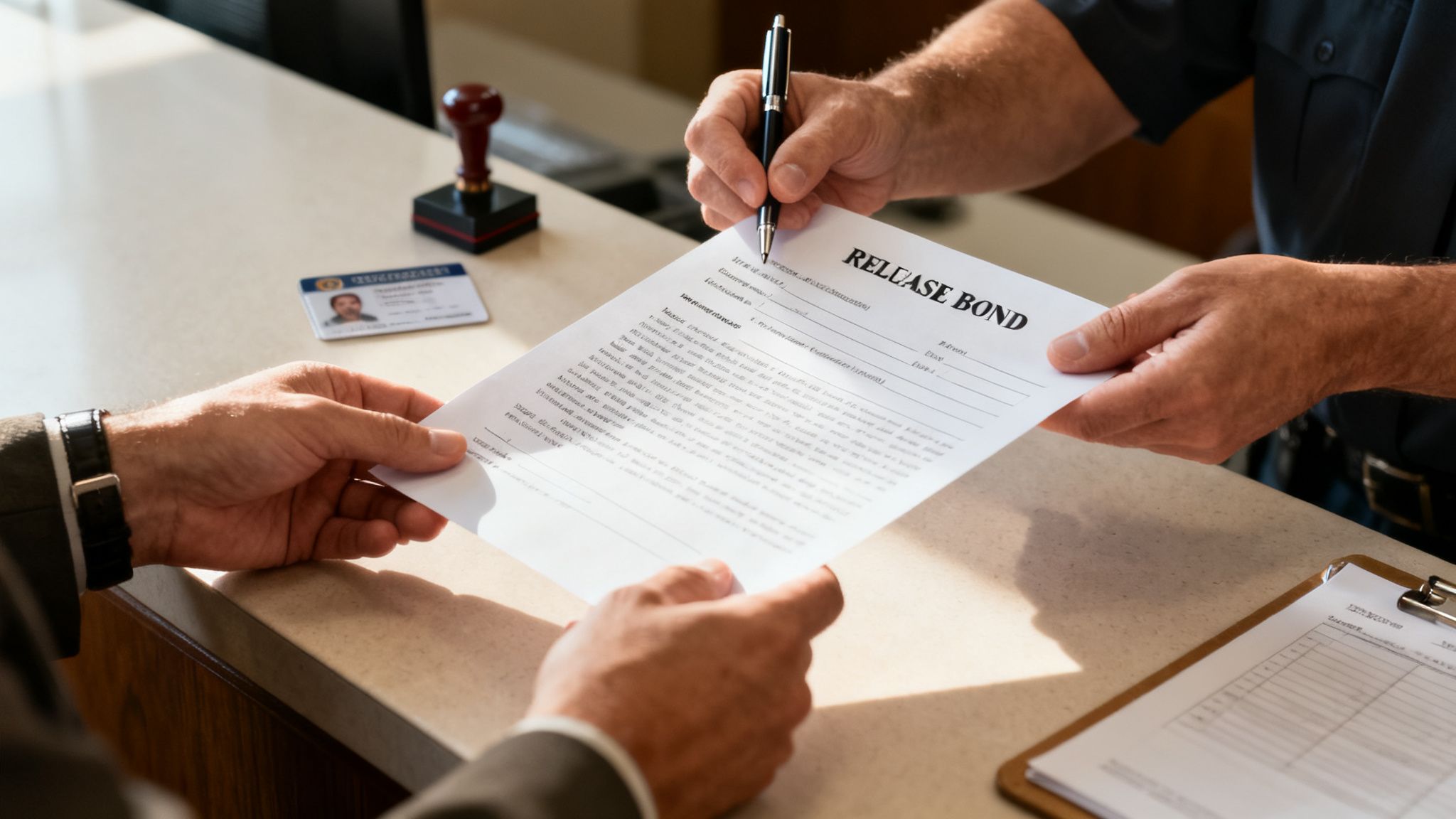
After a DWI arrest, your first thought is almost always, "How do I get out of jail?" The arraignment is where that question gets answered. The judge will decide whether to release you and what strings will be attached.
This decision is based on a specific set of factors designed to ensure you show up for future court dates and to protect the community. This is one of the first moments where having an experienced Houston DWI lawyer in your corner can make a monumental difference. Your attorney’s ability to frame you as a responsible person who isn't a flight risk can directly influence the judge, potentially leading to a lower bond and less restrictive conditions.
Factors Influencing the Judge’s Decision
When setting bail, the judge performs a risk assessment, weighing several key elements:
- Ties to the Community: Do you have a steady job? Own a home? Have deep family roots in the area? Strong community connections signal to the judge that you’re not likely to disappear.
- Criminal History: The judge will review your record. Any prior arrests or convictions, especially for a first DWI in Texas or similar offenses, will be a major factor. A clean slate speaks volumes.
- The Nature of the Offense: The specific details of your arrest matter. Was your Blood Alcohol Concentration (BAC) extremely high? Was there an accident that caused injuries? These aggravating factors can increase the bail amount.
Your attorney’s job is to paint the most positive picture possible, highlighting your stability and arguing for the least restrictive release conditions.
Understanding Different Types of Bonds
The judge has a few options to secure your release, ranging from a simple promise to a financial obligation. To get a better handle on the potential price tag, you can learn more about the factors that influence DWI bail costs.
- Personal Recognizance (PR) Bond: This is the best-case scenario. The court releases you based on your written promise to appear at all future hearings. No money is required.
- Cash Bond: You must pay the full bail amount directly to the court. You get this money back at the end of your case, assuming you make all your court dates.
- Surety Bond: This is the most common route. You'll pay a fee, typically 10% of the total bond, to a bail bondsman who then posts the full amount for you. This 10% fee is non-refundable.
Studies have shown that having a lawyer advocating for you this early has a real impact. In one county, when defense attorneys made bond recommendations, judges set the bond at or below that recommended level in 89% of cases.
Common Release Conditions
Getting out of jail usually comes with rules. In addition to setting a bond, the judge will almost certainly impose specific conditions you must follow while your case is active.
These conditions are not suggestions—they are direct court orders. If you violate any of them, your bond can be revoked, and you’ll find yourself back in jail waiting for your trial.
Some of the most common conditions include:
- Installing an ignition interlock device (IID) on any vehicle you drive.
- Attending substance abuse counseling or programs like AA.
- Submitting to random drug and alcohol tests.
- A strict order not to consume any alcohol whatsoever.
An experienced DWI attorney can negotiate these terms, fighting to make sure they are reasonable and don’t completely disrupt your ability to work and live your life.
The Strategic Role Your Attorney Plays
Having an attorney at your arraignment hearing is a critical strategic move that lays the groundwork for your entire DWI defense. While you’re focused on getting through a stressful day, your attorney is already taking proactive steps to protect your rights and shape the outcome of your case from the very first move.
Their presence alone sends a powerful message to the prosecutor and the judge: you are taking these charges seriously and intend to fight them. An experienced Texas DUI attorney becomes your voice, your shield, and your strategist, handling the complex legal process so you don't have to. This early intervention is essential.
More Than Just a Courtroom Presence
One of the most immediate benefits of hiring an attorney is that, in many misdemeanor DWI cases, they can often appear in court for you. This means you may not have to take time off work or endure the anxiety of standing before the judge yourself.
Your lawyer will handle the key procedural steps with precision:
- Waiving Your Appearance: If the court allows it, your attorney can file the right paperwork to waive your physical presence at the arraignment.
- Entering a "Not Guilty" Plea: They will formally enter a plea of "not guilty" on your behalf. This is the standard move at this stage, as it preserves all of your legal options.
- Initiating Discovery: Your lawyer will immediately file a request for discovery. This is a formal legal demand that forces the prosecution to hand over all its evidence—police reports, breath or blood test results, and any dashcam or bodycam video.
This allows your defense team to get a running start, immediately digging into the state's case to find weaknesses.
Your attorney’s most crucial job at the arraignment is to advocate for reasonable bail and release conditions. They will present you as a responsible member of the community, arguing against an excessive bond amount and overly restrictive rules that could interfere with your job, family life, and ability to get back on your feet.
Ultimately, hiring an attorney early transforms the arraignment from something that happens to you into a proactive opportunity. It sends a clear signal that you are prepared to defend your rights. If you're preparing for what happens at an arraignment hearing, you can learn more about how to find a skilled DUI attorney in Texas to protect your interests.
What Comes Next in Your DWI Case
Your arraignment is a critical first step, but it’s really just the opening bell. Once you enter that "not guilty" plea, the real fight begins. The case shifts from procedural formalities to a strategic phase where your attorney starts building your defense.
This is where the heavy lifting happens. It’s no longer about simply showing up to court; it’s about digging deep into the prosecution's case, hunting for weaknesses, and preparing to challenge every piece of evidence.
The Discovery and Pretrial Phase
Right after your arraignment, your case moves into the discovery phase. Think of this as your attorney formally demanding the prosecution lay all its cards on the table. This isn't a polite request—it's a legal obligation for them to hand over everything they’ve collected.
This evidence usually includes:
- The official police report from the arresting officer.
- The results from any breath or blood tests (BAC).
- Dashcam and bodycam video footage capturing the stop and arrest.
- Any statements taken from witnesses.
Your lawyer will meticulously comb through every document and second of video, looking for inconsistencies, procedural errors, and violations of your constitutional rights. This detailed review is the bedrock for filing pretrial motions—powerful legal arguments asking the judge to throw out certain evidence or, in some cases, dismiss the entire case. For example, if the video shows the officer had no legal reason to pull you over, your lawyer will file a motion to suppress all evidence from that illegal stop.
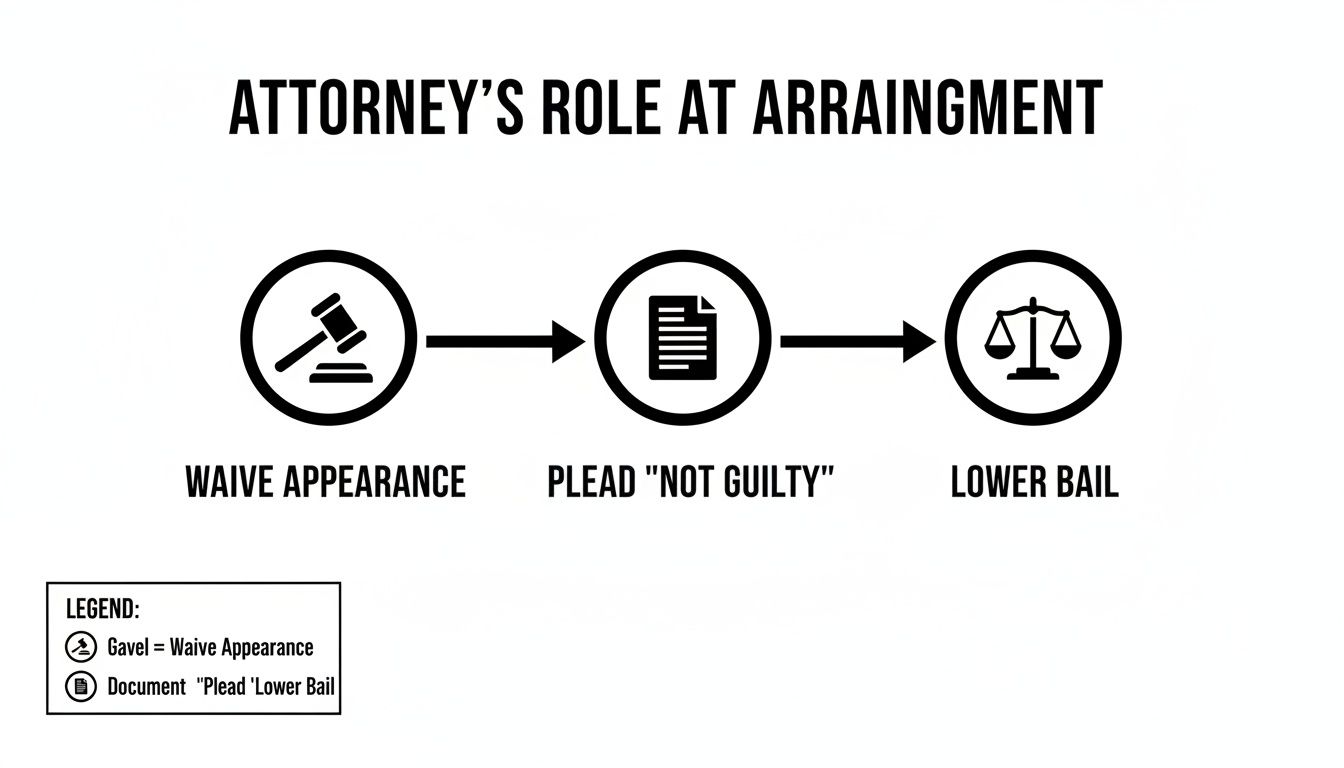
These initial strategic moves—waiving your appearance, pleading not guilty, and fighting for better bail conditions—are all about positioning your case for the best possible outcome down the road.
Your Parallel License Battle
While the criminal case is getting underway, another battle is already raging on a separate front—the fight for your driver's license. This process, known as an Administrative License Revocation (ALR) hearing, is incredibly time-sensitive. After a DWI arrest in Texas, you have just 15 days to request this hearing to prevent a DWI license suspension.
This is a civil proceeding, completely separate from your criminal court case, that determines whether the Texas Department of Public Safety (DPS) will suspend your license. If you fail to request this hearing in time, your license will be automatically suspended.
It's also crucial to attend all your court dates. One study found that nearly 18% of people released on their own recognizance missed at least one court date. Explore more research on court appearance patterns to see how common this pitfall is.
An experienced Houston DWI lawyer knows how to manage both the criminal case and the ALR hearing, ensuring no deadline is missed and that your rights are fully protected on both fronts.
Common Questions About DWI Arraignment Hearings
It's natural to have questions, and getting clear answers can help you feel prepared instead of panicked. Let's tackle some of the most common concerns about a DWI arraignment.
Do I Have to Speak at My Arraignment?
Absolutely not. In fact, you shouldn't. Beyond stating your name for the record, you have a constitutional right to remain silent, and this is the time to use it. Your Houston DWI lawyer will do all the talking for you, including entering your plea of "not guilty."
Never discuss the details of your case in open court. Everything you say is on the record and can be used against you. Your attorney is your shield; their job is to handle all communication with the judge and prosecutor to protect you.
What Should I Wear to the Arraignment Hearing?
First impressions matter in a courtroom. You should dress as if you're going to a serious job interview. Business casual is the perfect standard—think slacks and a collared shirt or a conservative blouse and skirt.
Avoid anything too casual, like shorts, t-shirts with graphics, hats, or flip-flops. Showing respect for the court is always the smart play. Also, make sure your phone is completely off before you enter the courtroom.
What Happens If I Miss My Arraignment Date?
This is one of the worst mistakes you can make. If you fail to appear for your arraignment, the judge will immediately issue a bench warrant for your arrest. This means a police officer can take you into custody at any time.
Additionally, you will likely forfeit any bond you've posted. The court will see you as a flight risk, which makes getting released again on reasonable terms incredibly difficult. If you have any doubt about making your court date, call your attorney immediately.
A DWI charge is a serious roadblock, but it doesn’t have to define your future. At The Law Office of Bryan Fagan, PLLC, our team is dedicated to defending your rights and fighting for the best possible outcome. We understand what you’re up against and are here to guide you through every step. Contact us today for a free, confidential case evaluation to learn how we can help you fight DWI Texas charges.
Request a Free Consultation With The Law Office of Bryan Fagan, PLLC