
A DWI arrest can be overwhelming, but you don't have to face it alone.
Upon contacting a Houston DWI lawyer after an arrest, individuals often ask the same question within the first few minutes. What are the chances of beating a DWI in Texas? They want a straight answer, and that's understandable. Your license may be at risk. Your court date is coming. You may be worrying about work, family, insurance, and your record all at once.
The honest answer is that this isn't a coin flip. It's a legal case. Outcomes depend on what the officer did, what the video shows, how the tests were handled, whether deadlines are met, and how quickly the defense starts working. In Texas, “winning” also doesn't mean only one thing. In some cases, it means dismissal. In others, it means a reduction, avoiding a license suspension, or blocking damaging evidence from ever being used.
That distinction matters. A strategic defense focuses on the result that protects your future the most, not just the label people use when they say “beat the case.”
Your First Question After a DWI Arrest
If you were arrested last night or over the weekend, you may still be replaying the stop in your head. Maybe the officer said you failed field sobriety tests. Maybe you refused a breath test. Maybe you gave a blood sample and now you're waiting for results. In that moment, it's easy to assume the state already has everything it needs.
That assumption hurts people.
A DWI charge in Texas is serious, but the arrest is only the start of the process. Police reports can be challenged. Body camera footage can contradict an officer's memory. Breath or blood evidence can raise legal and procedural issues. A defense lawyer doesn't start by asking whether the arrest looks bad. The right lawyer starts by asking whether the state can prove the case lawfully and reliably.
Practical rule: Don't judge your case by the handcuffs, the officer's confidence, or the wording on the citation. Judge it by the evidence, the procedure, and the timeline.
Some people define “beating” a DWI as walking out with a full dismissal. That can happen. Others need a different kind of win. Keeping a professional license intact, avoiding a DWI conviction, preserving the ability to drive, or reducing the charge can all change the long-term impact of an arrest.
Here's the better way to consider it:
- A full win can mean the charge is dismissed or you're acquitted.
- A practical win can mean the charge is reduced or key evidence is thrown out.
- An early win can mean protecting your driver's license while the criminal case is still pending.
- A damage-control win can mean avoiding the worst penalties and protecting your record as much as possible.
When people ask what are the chances of beating a DWI in Texas, they're really asking something broader. They want to know whether this situation can still be turned around. In many cases, the answer is yes, but only if the defense treats the case as a series of opportunities, not a single all-or-nothing event.
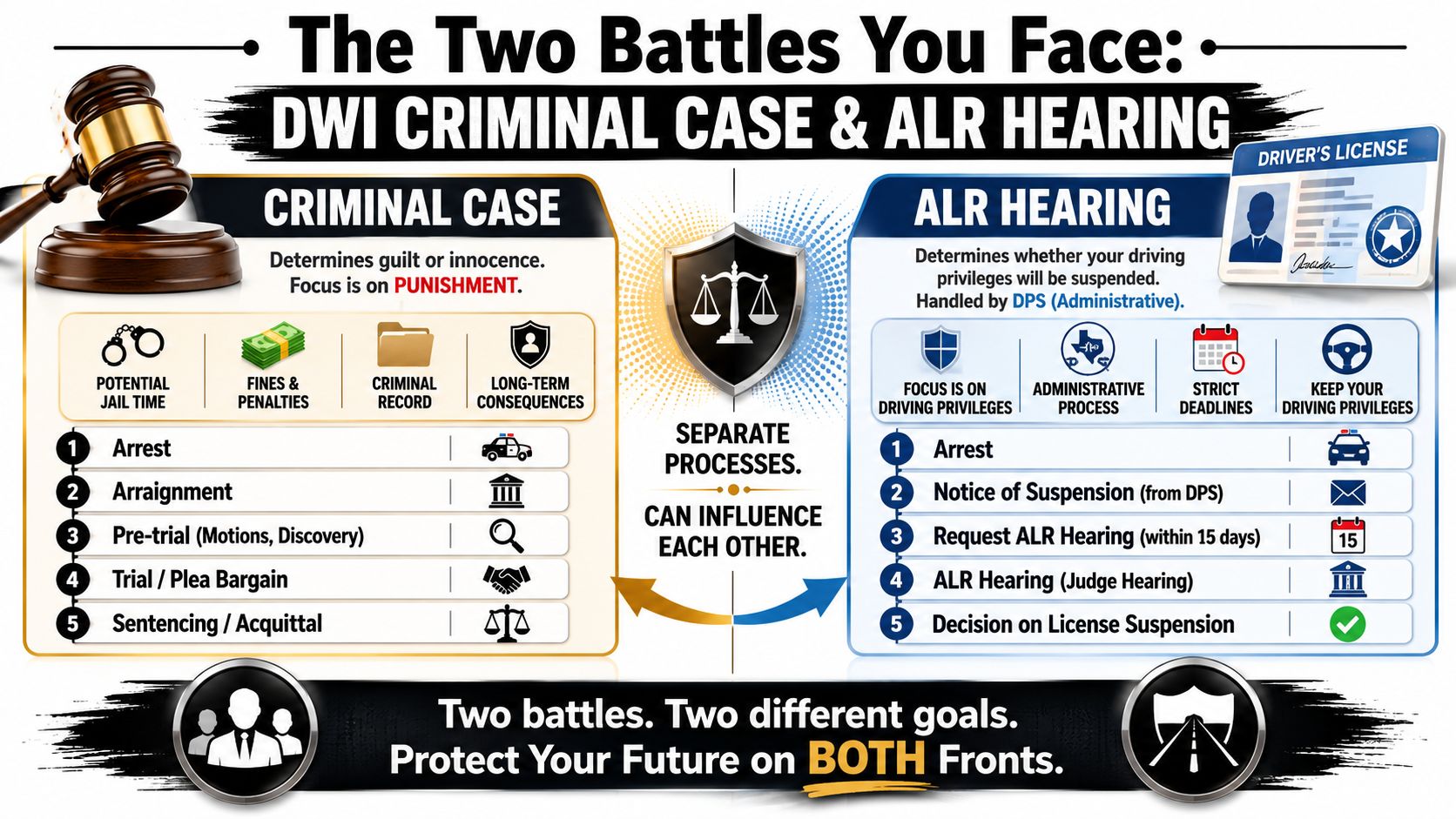
The Two Battles You Face A DWI Criminal Case and ALR Hearing
After a Texas DWI arrest, you're usually dealing with two separate cases at the same time. One is the criminal charge in court. The other is the Administrative License Revocation, often called an ALR hearing, which deals with your driving privileges.
That separation is one of the most important parts of a DWI case, and many people don't realize it until they're already close to losing their license.
What the criminal case decides
The criminal case is where the state tries to prove you committed driving while intoxicated, meaning the normal use of your mental or physical faculties was impaired by alcohol, drugs, or a combination of substances, or that your BAC, short for blood alcohol concentration, was at or above the legal limit. BAC refers to the amount of alcohol measured in your breath or blood.
This case can affect:
| Issue | Criminal case |
|---|---|
| Record | Possible criminal conviction |
| Penalties | Possible jail, probation, fines, classes, interlock |
| Outcome focus | Guilt, innocence, reduction, dismissal |
A first DWI in Texas is often charged as a misdemeanor, but the consequences can still be life-changing. If there's an accident, a prior record, or other aggravating facts, the stakes go up quickly.
What the ALR hearing decides
The ALR case is different. It's not about guilt or innocence in the criminal sense. It focuses on whether the Texas Department of Public Safety can suspend your driver's license based on the arrest, a test refusal, or a test result.
You must act fast. In many Texas cases, you have a 15-day deadline after arrest to request the hearing. If that deadline is missed, the suspension process usually moves forward without that challenge.
For a practical overview of the immediate post-arrest process, see this guide on being arrested for DWI in Texas.
The ALR hearing is often your first chance to challenge the officer's version of events under oath, before the criminal case gets much traction.
That early hearing matters because the odds of protecting your license can be better than the odds of winning the criminal case outright. Since 2022, summarized SOAH records report that 34% of ALR cases were dismissed and 42% avoided suspension entirely, with no-suspension outcomes as high as 74% in Harris County, according to this Texas ALR outcome summary.
Why this distinction changes your strategy
If you only focus on the courtroom charge, you can miss an immediate and valuable opportunity. An ALR hearing can help you keep driving, test the officer's testimony early, and expose weaknesses that may later help in the criminal defense.
That's why a good Texas DUI attorney doesn't treat the license case as a side issue. It's one of the first places where preparation can produce a real result.
What a Winning DWI Defense Looks Like in Texas
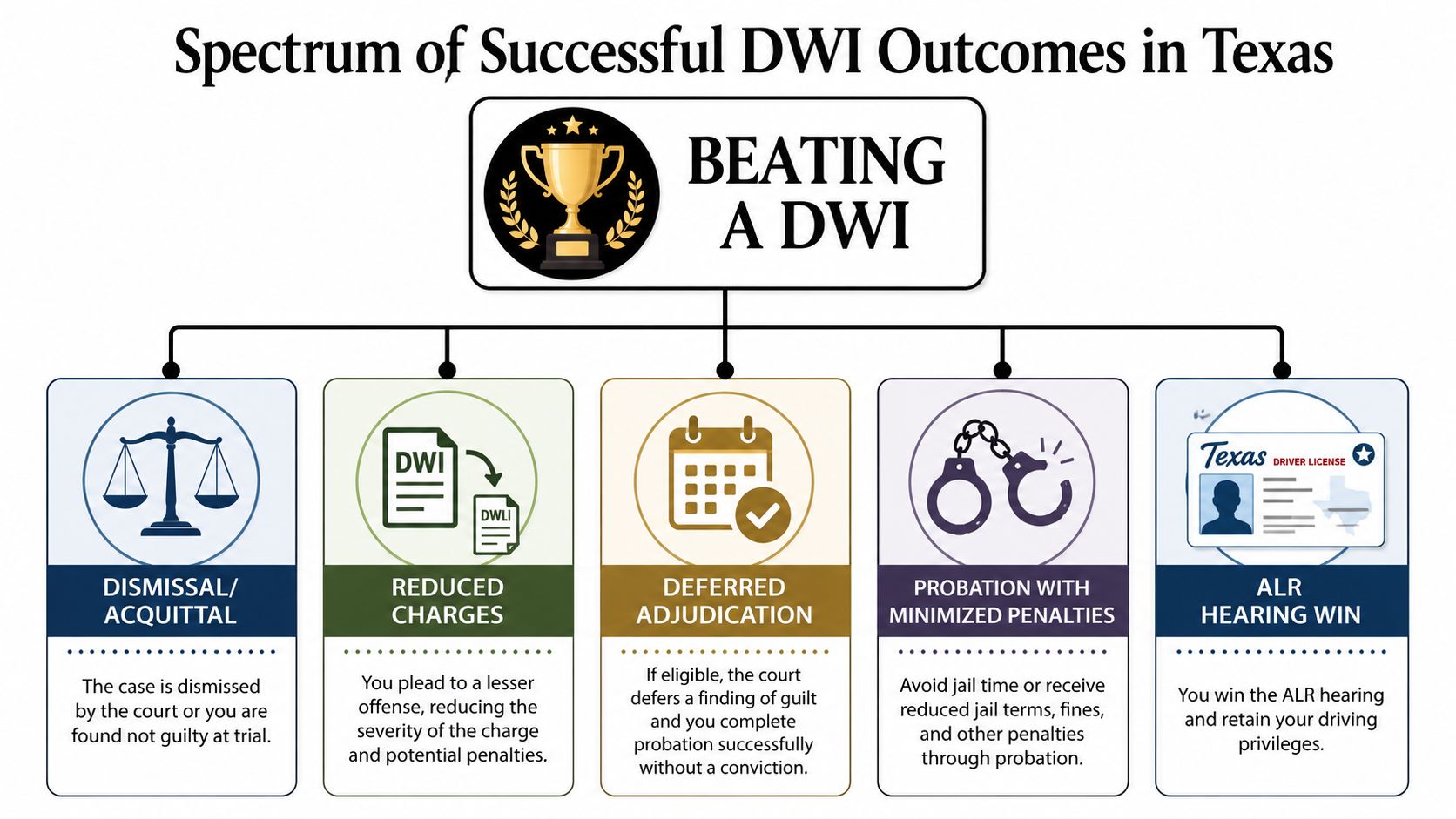
A winning result in a DWI case isn't always a dramatic not guilty verdict. In practice, success often falls on a spectrum. The strongest defense strategy aims for the best available outcome based on the facts, the evidence, and the county where the case is pending.
The best-case outcomes
At the top of the list are the outcomes that often come to mind:
- Dismissal means the charge is dropped.
- Acquittal means you went to trial and were found not guilty.
- Reduction means the case ends with a lesser charge instead of a DWI conviction.
Publicly cited Texas outcome data show that when defendants fight a DWI instead of pleading guilty, about 10% to 15% of cases are dismissed and about 30% end in conviction on a lesser charge, creating a combined chance of roughly 45% for a dismissal or reduction, based on this Texas DWI outcome summary.
That doesn't mean every contested case has the same odds. It means fighting the case creates room for better outcomes that don't exist when someone gives up at the start.
Outcomes that still count as beating the case in a practical sense
A smart defense also looks for results that reduce damage even if the case doesn't end with a complete dismissal.
Here are common examples:
| Outcome | Why it matters |
|---|---|
| Suppression of evidence | Weakens the prosecution's case by removing key proof |
| Deferred adjudication when available | May help avoid a final conviction, depending on the charge and county practice |
| Negotiated plea to a lesser offense | Often protects against the long-term impact of a DWI conviction |
| Probation with targeted conditions | Can help avoid jail and limit disruption to work and family life |
| ALR victory | Preserves your license while the criminal case continues |
What not to misunderstand
A bad starting point doesn't always mean a bad ending. A strong chemical test can still be challenged if the state can't lay the right foundation. An officer's report can sound convincing on paper and fall apart on video. On the other hand, a case that looks weak at first can become harder if the defense waits too long and loses access to evidence or misses deadlines.
Bottom line: “Winning” a Texas DWI case means reaching the best defensible outcome available, not chasing one narrow result while ignoring every other opportunity.
This is why the question what are the chances of beating a DWI in Texas has to be answered carefully. Your true chances depend less on hope and more on whether the defense identifies where the state's case is vulnerable, then uses those weaknesses at the right stage of the process.
Key Factors That Determine Your DWI Case Outcome
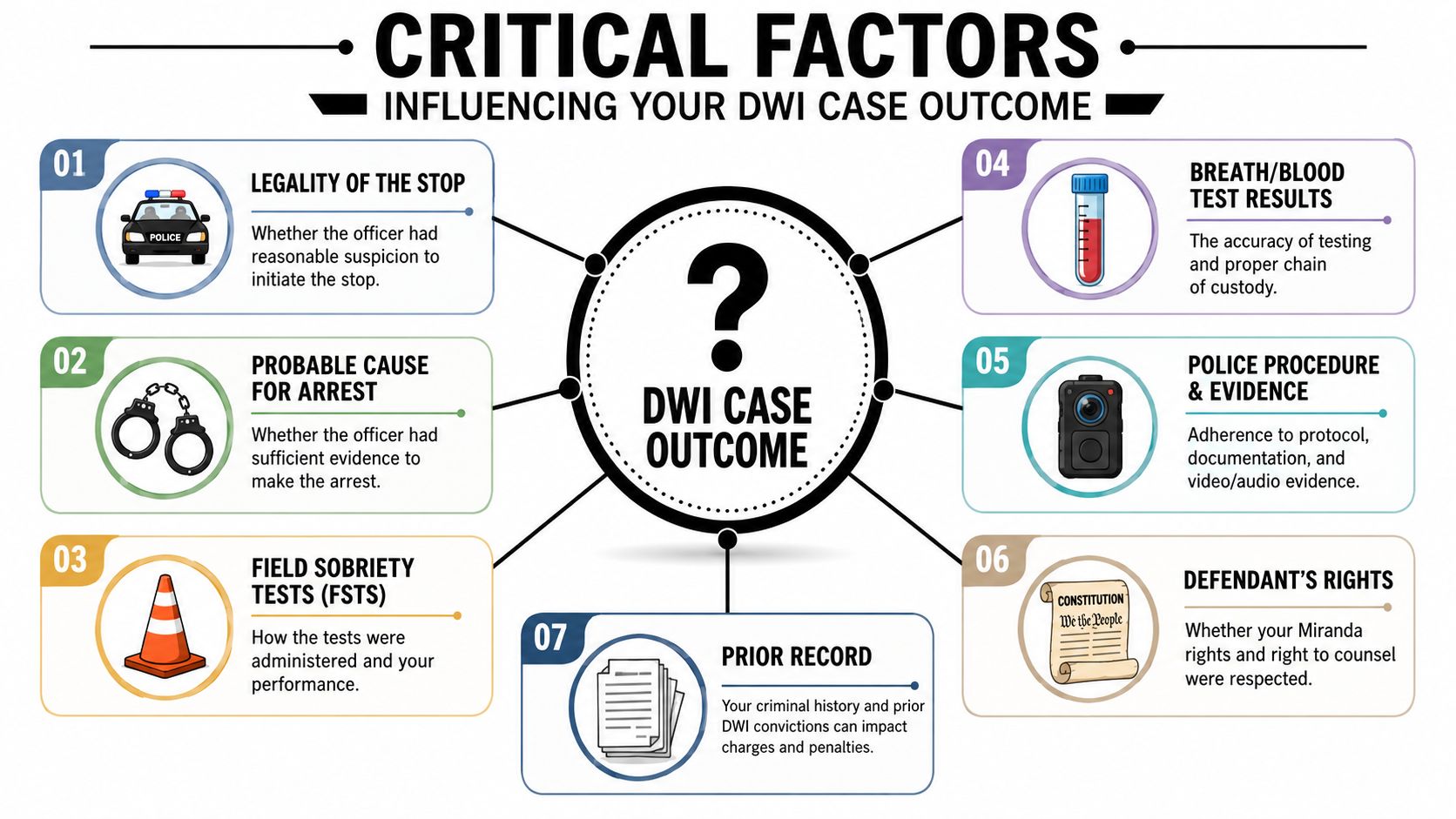
Every Texas DWI case turns on a few core questions. Was the stop legal? Did the officer have enough facts to arrest you? Were the tests reliable? Did law enforcement follow the rules when collecting and preserving evidence?
When lawyers talk about the strength of a DWI case, these are the pressure points they mean.
The stop and the arrest
Police need a lawful reason to stop your vehicle. That usually means reasonable suspicion, which is a specific, explainable basis for believing a traffic violation or criminal offense occurred. A vague hunch isn't enough.
After the stop, the officer must develop probable cause to arrest you for DWI. Probable cause means enough facts and observations exist to support the arrest. That can include driving behavior, statements, odor of alcohol, performance on tests, and other observations. If the stop or arrest wasn't legally supported, the defense may seek to suppress the evidence that followed.
A useful primer on these issues is this page about what makes a DWI case weak in Texas.
Field sobriety tests and BAC evidence
Field sobriety tests are roadside tasks officers use to look for signs of impairment. They are often called FSTs. These tests can be challenged because they depend heavily on instructions, conditions, and officer interpretation. Medical issues, fatigue, anxiety, footwear, lighting, roadside slope, and weather can all matter.
BAC stands for blood alcohol concentration. In Texas, chemical evidence usually comes from a breath test or a blood test. The state still has to show the result is reliable and tied to proper procedures.
That means the defense looks at things like:
- Breath testing procedure to see whether the machine and the operator followed required protocol
- Blood draw timing to examine whether the sample accurately reflects the time of driving
- Chain of custody to check whether the sample was properly tracked and handled
- Documentation gaps that create doubt about accuracy or admissibility
Success in these cases often comes from excluding evidence, not merely arguing over it in front of a jury. A reported dataset from the five largest Texas counties showed a 34.2% dismissal rate, indicating that roughly one in three cases in that set ended before conviction when the defense identified weaknesses in the stop, arrest, or testing process, according to this Texas county dismissal discussion.
Here's a helpful overview of how lawyers analyze those weak points:
Procedure matters more than many people think
Texas DWI cases are full of deadlines, notices, reports, recordings, and lab records. Small mistakes can have big consequences.
One term people often hear after an arrest is implied consent. In plain English, that means Texas drivers are considered to have agreed in advance to provide a breath or blood specimen under certain circumstances after a lawful DWI arrest. Refusing can trigger separate license consequences, and giving a sample doesn't prevent the defense from challenging how it was obtained or tested.
Another term is administrative license suspension, which is the license consequence handled through the ALR process rather than the criminal court.
Missing footage, delayed reports, warrant issues, and timing errors don't automatically win a case. But they often create leverage, especially when the defense finds them early and ties them to a legal motion.
Other facts that can shape the result
Some case details don't decide guilt by themselves, but they affect strategy:
| Factor | Why it matters |
|---|---|
| Prior history | Can change charging decisions, negotiations, and sentencing risk |
| Accident allegations | Often make prosecutors less flexible |
| Passenger issues or child presence | May raise exposure and complicate resolution |
| Commercial driver status | Makes license consequences more serious |
| Professional licensing concerns | Can change what outcome matters most |
The right defense starts by sorting these issues into two categories. First, what can be attacked. Second, what must be managed.
Common Defense Strategies to Fight a DWI in Texas
A good DWI defense is methodical. It isn't built on one dramatic argument. It's built by taking the facts apart piece by piece and testing whether the state can prove each part of the case.
When the stop is the problem
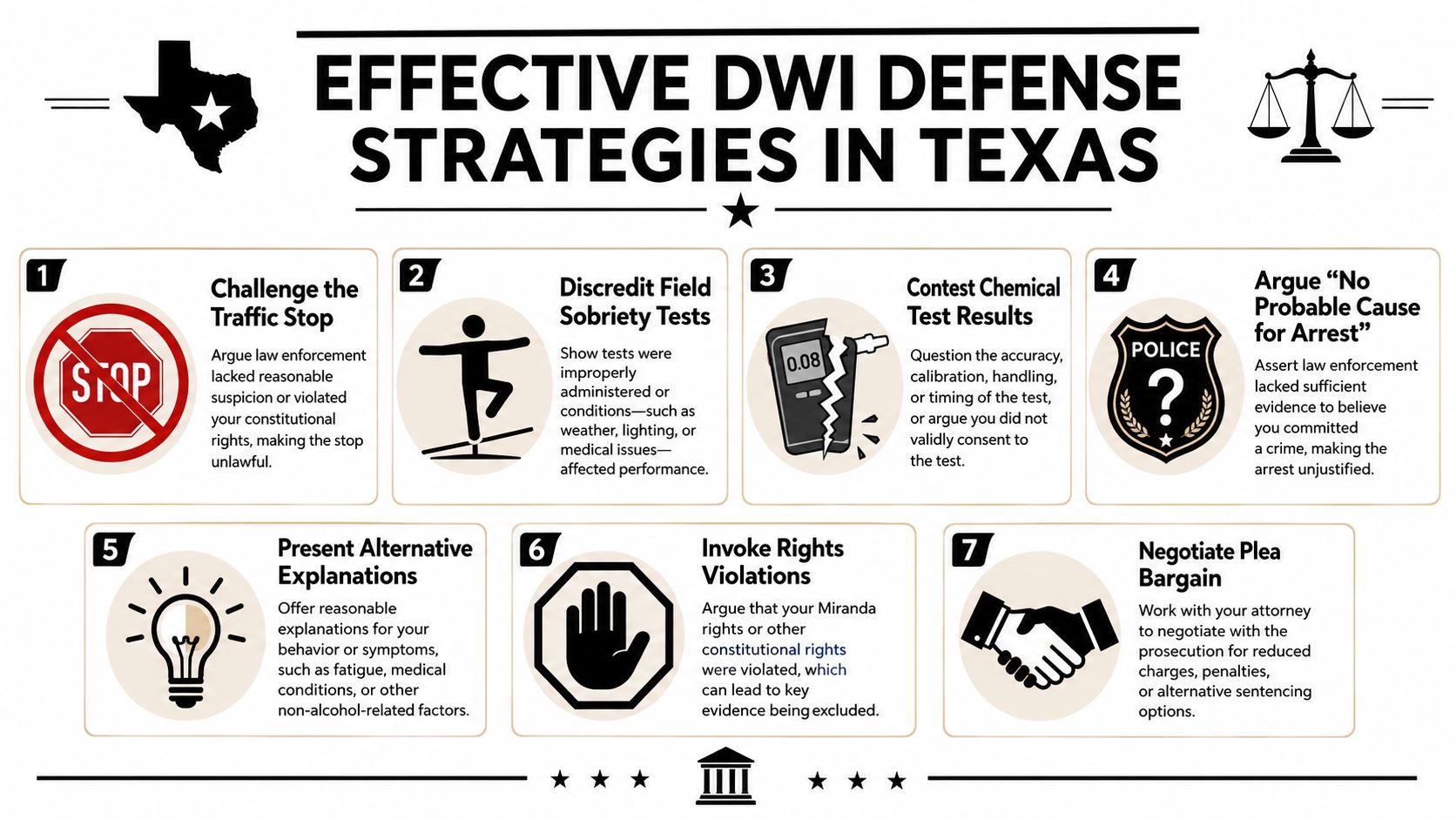
If the officer lacked a valid basis to pull you over, the defense may file a motion to suppress the stop and everything that came after it. For example, an officer might describe drifting within a lane as suspicious, but the video may not support that claim. If the stop falls, the rest of the case can weaken fast.
When the roadside investigation is shaky
Field sobriety tests often carry more weight in reports than they deserve in court. A person can appear unsteady for many reasons unrelated to alcohol. Poor instructions, a sloped shoulder, flashing lights, traffic noise, and medical limitations all matter.
That leads to a common defense theme. The officer may have interpreted nervousness or imperfect balance as intoxication when the facts support a more ordinary explanation.
When the chemical evidence looks stronger than it is
Breath and blood results can be challenged from several angles. The issue may be the machine, the operator, the timing, the paperwork, the sample handling, or the legal basis for getting the sample in the first place.
A few examples show how this works:
- Late blood draw can raise questions about whether the result reflects the time of driving rather than some later point.
- Missing records can make it harder for the state to prove the testing process was reliable.
- Warrant defects or consent issues can affect whether the sample should be admitted at all.
Some of the strongest DWI defenses don't argue that nothing happened. They argue that the state can't prove what happened with legally reliable evidence.
When negotiation is the right move
Not every case should be tried, and not every strong defense ends with a trial. Sometimes a lawyer uses weaknesses in the evidence to push for a reduction, a more manageable resolution, or a result that better protects a client's job, license, or future record.
That's often where an experienced Houston DWI lawyer or Texas DUI attorney adds real value. The job isn't only to cross-examine at trial. It's also to know when to press for suppression, when to challenge a witness, when to negotiate, and when to protect the client by avoiding a needless gamble.
One option Texas drivers consider is retaining counsel that handles both criminal DWI defense and license-related issues. For example, Law Office of Bryan Fagan, PLLC represents people in DWI court matters as well as ALR proceedings.
What usually doesn't work
Some approaches waste time or make the case worse:
- Hoping the officer won't appear instead of preparing a real defense
- Telling your story repeatedly to police, friends, or online, which creates statements the state may use
- Waiting for test results before hiring counsel and losing early opportunities
- Assuming a first DWI in Texas will automatically be forgiven because you've never been in trouble before
A strong defense uses facts, procedure, and timing. Wishful thinking doesn't hold up in court.
Immediate Actions That Can Improve Your Chances
The first days after a DWI arrest matter. Delay can cost you evidence, deadlines, and advantage. In 2021, Texas recorded over 100,000 DWI arrests in one reported summary, while fewer than 3% of cases were dismissed statewide in that same overview, underscoring how important early action is if you want to improve the outcome, according to this Texas DWI arrest and dismissal discussion.
If you want to fight DWI Texas charges effectively, start with actions that preserve options.
Do these right away
- Request legal help immediately. A defense lawyer can move on the ALR deadline, preservation requests, and early evidence review before the state gets too far ahead.
- Write down the timeline. Include where you were, what you ate or drank, when you were stopped, what the officer said, whether tests were offered, and whether cameras were visible.
- Preserve useful records. Receipts, rideshare history, GPS logs, text timestamps, and medical information can all become relevant.
- Protect the license issue early. The DWI license suspension process moves fast, and the hearing request window doesn't wait for you to feel ready.
For a practical checklist, review these steps for the first 24 hours after a DWI arrest in Texas.
Avoid these mistakes
A lot of damage happens outside court because people try to explain themselves in the wrong place.
| Don't do this | Why it hurts |
|---|---|
| Post about the arrest online | Creates evidence and admissions |
| Call the officer to explain | Rarely helps, often adds statements |
| Talk freely with friends about details | Those conversations may not stay private |
| Ignore mail from DPS or the court | Deadlines and notices keep moving |
Early action doesn't guarantee a dismissal. It does give your lawyer more to work with, and in DWI cases that can change everything.
You Don't Have to Face This Alone Your Next Step
A DWI charge can feel personal, urgent, and isolating. It's also manageable when you approach it the right way. The key is to stop thinking of your case as one yes-or-no question and start treating it as a series of legal decisions that can improve the outcome.
If you're asking what are the chances of beating a DWI in Texas, the most useful next step is to get your case reviewed quickly, including the criminal charge and the license issue. The sooner a defense starts, the more options you usually have.
If you're facing a DWI arrest in Texas, contact Law Office of Bryan Fagan, PLLC to request a free consultation and case evaluation. You can get clear answers about your charge, your ALR deadline, your license risk, and the defense strategies that may apply to your case.