
A DWI arrest can be overwhelming—but you don’t have to face it alone. The legal system can feel like it's coming at you from all sides. Then, an official notice for a hearing arrives in the mail, piling on even more confusion and stress. That notice is your introduction to the Texas State Office of Administrative Hearings (SOAH), a neutral, independent state agency that resolves disputes. For DWI cases, it’s the first battleground where your driving privileges hang in the balance, and our firm is here to defend you every step of the way.
What to Expect at Your First Texas SOAH DWI Hearing
After a DWI arrest, you are facing two completely separate legal processes in Texas. First, there's the criminal case, which will eventually determine your guilt or innocence for the crime itself. But running on a much faster track is the second process: an administrative case that decides the fate of your driver's license.
The notice you received is for the administrative side of things—specifically, a hearing called an Administrative License Revocation (ALR) hearing. This isn't a criminal trial. It’s a civil proceeding held before an Administrative Law Judge at SOAH.
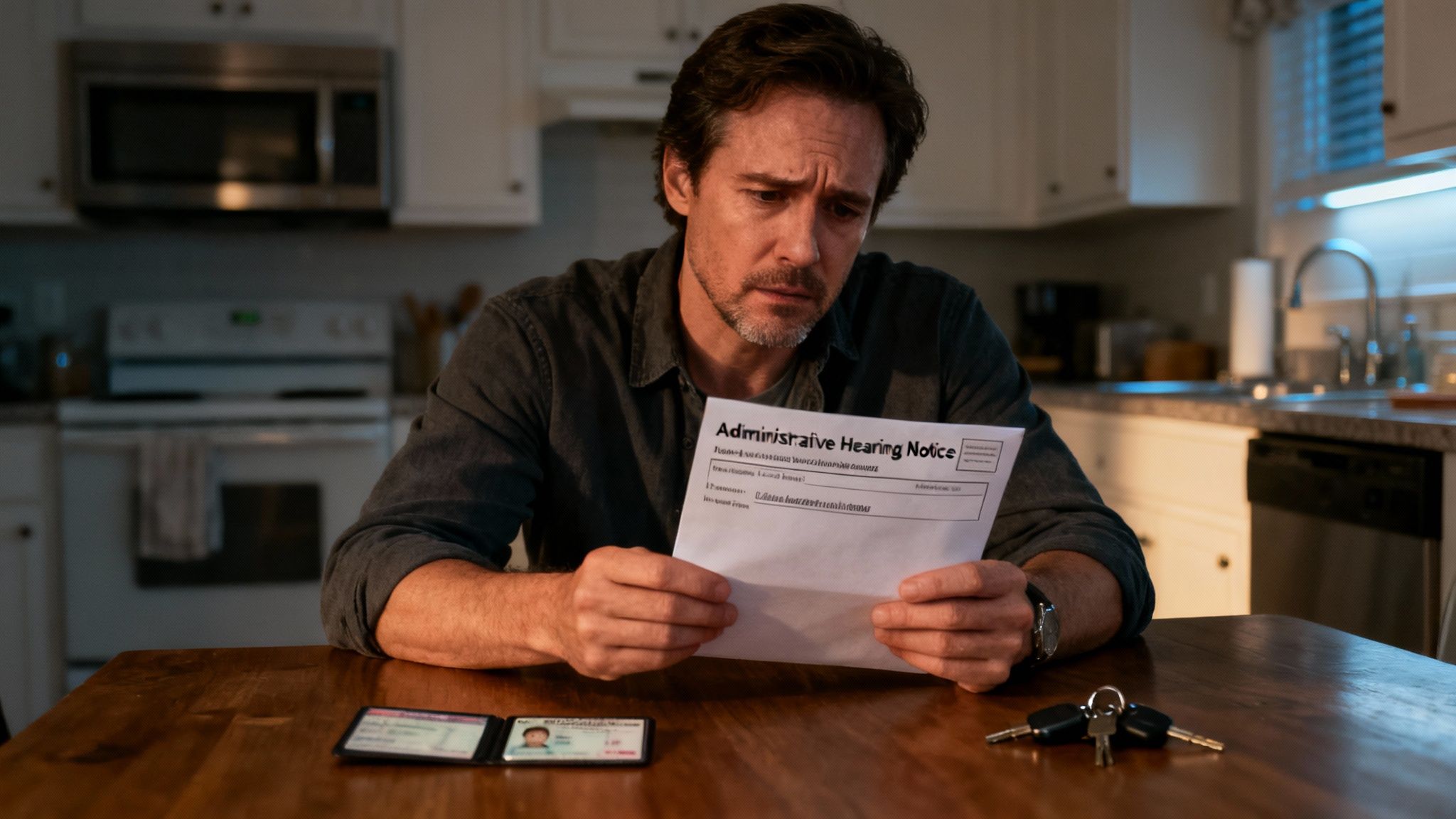
The sole purpose here isn't to convict you of a crime but to determine if the Texas Department of Public Safety (DPS) has enough reason to suspend your license. This all happens much quicker than your criminal case.
The Critical 15-Day Deadline
After a DWI arrest, a clock starts ticking immediately. You have only 15 days from the date of your arrest to formally request an ALR hearing.
This is not a suggestion; it's a hard-and-fast, non-negotiable deadline. If you miss this 15-day window, you automatically lose your right to challenge the suspension. Your license will then be suspended, usually starting 40 days after your arrest.
Acting quickly is the single most important first step you can take. Contacting a Houston DWI lawyer right away ensures this crucial deadline is met, preserving your ability to fight for your license. We handle this filing for our clients, getting the process started to protect their driving privileges from day one.
Why This Hearing Is So Important
The ALR hearing at SOAH is much more than just a fight to keep your license—it’s a powerful strategic opportunity. It gives your attorney the first chance to challenge the evidence against you and question the arresting officer under oath. Think of it as a preview of the state's entire case.
Here’s why it’s a critical first step in your defense:
- Evidence Preview: We can subpoena everything from police reports and dashcam footage to breathalyzer maintenance and calibration records.
- Officer Testimony: We get to cross-examine the arresting officer, locking them into their story. This is often where we find inconsistencies or weaknesses in the state's case.
- Strategic Advantage: The information we gather here is often invaluable for building a much stronger defense for your criminal case down the road.
Understanding the ALR process is crucial. You can learn more about the Administrative License Revocation process in Texas in our detailed guide. Protecting your license is our first priority, and navigating the Texas State Office of Administrative Hearings is where that fight begins.
What Is SOAH and Why It Matters for Your DWI
After a DWI arrest, you're suddenly fighting on two fronts. The criminal case is the one everyone knows about, but there's another, more immediate battle over your driver's license. This fight takes place at the Texas State Office of Administrative Hearings, or SOAH, and understanding its unique role is the first step toward keeping your license.
Think of SOAH as a neutral, third-party referee. Its entire job is to settle disputes between everyday Texans and state agencies, like the Department of Public Safety (DPS). In a DWI case, SOAH is where your Administrative License Revocation (ALR) hearing happens. This is not a criminal trial. It's a civil proceeding with a single, laser-focused purpose: deciding whether the DPS has the legal right to suspend your license.
This separation is critical. The SOAH hearing is a completely separate legal action from your criminal DWI case, and the outcome here has no bearing on whether you're found guilty or innocent of the criminal charge.
An Independent Court for a Fair Fight
It wasn't always this way. Before SOAH was created, the same state agency trying to take your license was also the one making the final decision. This created an unfair conflict of interest. To fix this, the Texas Legislature created SOAH to ensure impartiality.
Your hearing is overseen by an Administrative Law Judge (ALJ), who is a neutral, independent judge. The ALJ's only job is to listen to the evidence presented by your lawyer and the lawyer for the DPS and make a ruling based on the facts and the law.
This structure is a fundamental protection of your rights. It forces the DPS to prove its case to an impartial decision-maker.
The core idea behind SOAH is simple: separate the prosecutor from the judge. It guarantees that the agency trying to penalize you isn't also the one calling the shots. This impartiality is the bedrock of a fair administrative process.
The Texas State Office of Administrative Hearings was officially established in 1991 to serve exactly this purpose. Though it’s a relatively young institution, it now handles between 28,000 and 30,000 contested hearings every single year, making it a cornerstone of Texas's legal system. Its jurisdiction has grown from just a few agencies to over 50, providing a vital check on government power. You can learn more about the history and scope of SOAH on Wikipedia.
Why Your SOAH Hearing Is a Strategic Advantage
While the immediate goal is to stop a DWI license suspension, the ALR hearing offers so much more. For a skilled Houston DWI lawyer, this hearing is the first real chance to gain a major advantage in your entire DWI defense.
Here’s how we turn the SOAH hearing into a powerful strategic tool:
- Get an Early Look at the Evidence: We can issue subpoenas to get our hands on everything the state has—the full police report, the officer's handwritten notes, and every second of dashcam or bodycam video. This gives us a complete blueprint of their case against you, long before we'd ever see it in the criminal court.
- Question the Officer Under Oath: This is perhaps the single most valuable part of the process. We get to put the arresting officer on the stand and cross-examine them. We'll pick apart their reasons for the traffic stop, challenge how they administered the field sobriety tests, and scrutinize every step of the arrest procedure.
- Lock in Their Testimony: Everything the officer says is recorded and transcribed. If their story changes even slightly when they testify in the criminal trial months later, we can use their sworn statements from the SOAH hearing to challenge their credibility in front of a jury. Inconsistencies like that can cripple the prosecution's case.
- Map Out a Winning Defense: Based on the evidence we gather and the officer's testimony, we can spot the strengths and weaknesses in the state's case early on. This intelligence is priceless, allowing us to build a tailored, effective defense strategy for your much more serious criminal charge.
At the end of the day, the hearing at the Texas State Office of Administrative Hearings is far more than a bureaucratic hurdle. It's the first battleground—a crucial opportunity to challenge the state's evidence, protect your freedom to drive, and start laying the foundation to win your DWI criminal case.
Navigating Your SOAH Hearing Process Step-by-Step
After a DWI arrest, the path to an Administrative License Revocation (ALR) hearing can feel like a maze. But think of it less like a maze and more like a roadmap. Understanding what comes next makes the whole ordeal feel far less intimidating. Each step isn't just a procedural hurdle; it's a strategic opportunity to build your defense.
The Texas State Office of Administrative Hearings (SOAH) is the neutral ground where this fight happens. It’s an independent agency designed to make sure you get a fair hearing against the state.
This flow chart gives you a simple visual of how SOAH fits into the picture, acting as the impartial referee between you and the state agency trying to take your license.
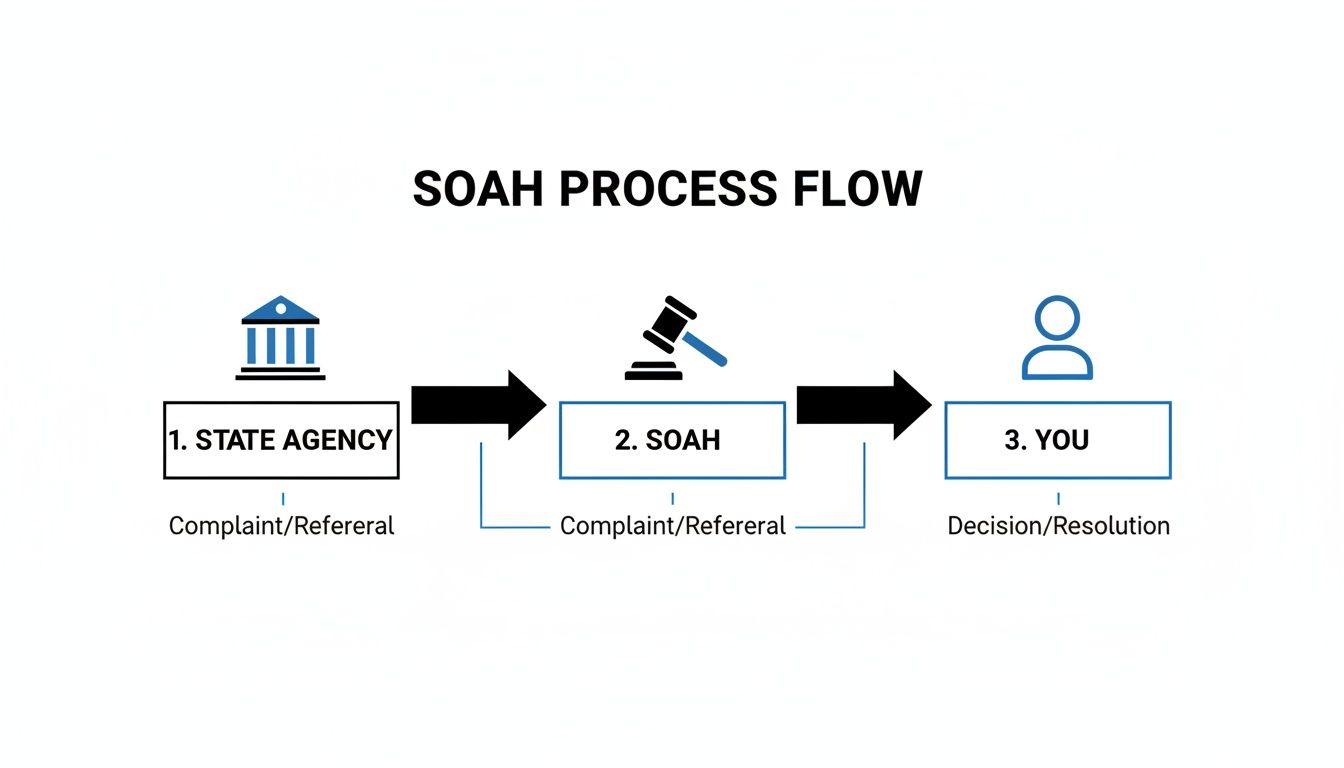
From the moment you hire our firm, we take control. We navigate this process for you, guiding your case through every critical stage with one goal: protecting your driver’s license. Here’s how it usually unfolds.
Stage 1: Requesting the Hearing and Stopping the Suspension
This first step is a race against the clock. You have only 15 days from the date of your arrest to formally request an ALR hearing. Miss that deadline, and your license is automatically suspended.
The second we’re on your case, we file this request. It does two critical things: first, it officially challenges the suspension. Second, and just as important, it puts a freeze on that automatic suspension. This means you can keep driving legally while we get to work building your defense.
Stage 2: The Discovery Phase
This is where the real investigative work begins. The discovery phase is our chance to demand and review every piece of evidence the Texas Department of Public Safety (DPS) has against you. We use legal tools called subpoenas to actively pursue all relevant information.
During this stage, we’re digging into everything:
- The Arresting Officer’s Report: We analyze this document for inconsistencies, procedural errors, and weaknesses in the officer’s account.
- Dashcam and Bodycam Video: Video evidence often tells a different story than the written report, exposing issues with the initial traffic stop or the field sobriety tests.
- Breath or Blood Test Records: This isn’t just about the final number. We look at the breathalyzer’s maintenance logs, the technician’s qualifications, and the chain of custody for any blood samples.
This is about finding the cracks in the state's case. You can get a deeper look at the kinds of evidence we use in our guide to ALR hearing evidence in Texas. Getting this information early lets us build a powerful, custom strategy for your specific situation.
Stage 3: The Hearing Before the Administrative Law Judge
The ALR hearing itself is a formal legal proceeding run by an Administrative Law Judge (ALJ), who serves as a neutral decision-maker.
Here’s who is in the room:
- Your Attorney: We are there to present evidence, make legal arguments, and cross-examine the state’s witnesses on your behalf.
- The DPS Attorney: This lawyer represents the state and will try to prove they have the right to suspend your license.
- The Arresting Officer: The state’s key witness. We get to question them under oath, which is often where cases are won or lost.
- The ALJ: The independent judge who listens to both sides and makes the final decision.
A key point: You typically don’t have to attend or testify. Our job is to represent you, so you can continue with your daily life while we handle the fight.
The Texas State Office of Administrative Hearings handles a high volume of cases, around 28,000–30,000 hearings every year. They use regional dockets and remote technology, making hearings more accessible for drivers in Houston and across Texas, which reduces the need for travel.
For a clearer picture, here's a simplified breakdown of the timeline you can generally expect for a SOAH ALR hearing.
SOAH ALR Hearing Timeline: What to Expect
The process from your arrest to a final decision follows a structured path. While every case is unique, this table outlines the typical stages and timeframes.
| Stage | What Happens | Typical Timeframe |
|---|---|---|
| Arrest & Request | You are arrested, and we file the ALR hearing request to stop the automatic suspension. | Within 15 days of arrest |
| Case Filed at SOAH | DPS files the case with SOAH, and a docket number is assigned. | 2-4 weeks after the request |
| Discovery | We request and review all evidence, including police reports, videos, and test records. | 30-90 days |
| Hearing Scheduled | SOAH schedules the hearing date and notifies all parties. | Hearing set for 90-120 days out |
| The ALR Hearing | We present your case, cross-examine the officer, and argue against the suspension. | Hearing lasts 1-2 hours |
| Judge's Decision | The Administrative Law Judge issues a written decision on whether to suspend your license. | 1-2 weeks after the hearing |
This timeline gives you a roadmap, but keep in mind that our goal is to use every bit of this time to strengthen your defense for the best possible outcome.
Stage 4: The Final Decision and Next Steps
Once all the evidence and arguments have been heard, the ALJ will issue a formal written decision.
If we win, the proposed license suspension is defeated, and you keep your driving privileges without interruption. If the judge sides with DPS, the suspension will go into effect.
But even if the ruling isn’t in our favor, this is not the end of the road. We can immediately begin the process of getting you an Occupational Driver's License (ODL) to ensure you can still drive to work, school, and for other essential needs. More importantly, all the evidence, testimony, and insights we gathered become a powerful head start for fighting your separate criminal DWI case.
SOAH vs Criminal Court: Key Differences You Need to Know
One of the most confusing parts of a DWI arrest is realizing you’re fighting two separate legal battles at the same time. On one side, you have the criminal court case. On the other, you have an administrative case at the Texas State Office of Administrative Hearings (SOAH), and it moves on a much faster track with its own rules.
It’s critical to understand that these two proceedings are completely separate. They have different goals, different standards of proof, and different consequences. Winning one does not mean you automatically win the other.
This split system can be disorienting, but it also creates a significant strategic opportunity for your defense. Understanding these key differences is the first step toward building a comprehensive strategy that protects both your driver's license and your freedom.
Purpose And Stakes
The biggest difference between your SOAH hearing and your criminal trial comes down to what's at stake. Each case is designed to answer a completely different question.
-
SOAH Hearing: The only issue here is your driving privilege. This is a civil matter focused squarely on whether the Texas Department of Public Safety (DPS) had sufficient cause to initiate the suspension of your license. The outcome is simple: your license is either suspended, or it isn’t.
-
Criminal Court Trial: This is where your liberty is on the line. The purpose of the criminal case is to determine if you are guilty of the crime of Driving While Intoxicated. The potential penalties are far more severe, including hefty fines, probation, and even jail time.
Think of it this way: SOAH is focused on your license, while the criminal court is focused on your record and your freedom.
Burden Of Proof
Another major distinction is the burden of proof—how much evidence the state needs to win its case. The standard at SOAH is much lower than in a criminal courtroom, making it easier for the state to succeed.
In your SOAH hearing, DPS only has to prove its case by a preponderance of the evidence. This legal standard simply means "more likely than not." If the judge believes there's just a 51% chance that what DPS is claiming is true, the state wins.
But in your criminal case, the prosecutor must prove your guilt beyond a reasonable doubt. This is the highest standard of proof in our legal system, meaning the jury has to be virtually certain of your guilt to convict.
This difference in proof is enormous. It's why fighting to protect your license at SOAH requires an attorney who knows how to analyze evidence and create doubt, even when the state’s bar is low.
The Strategic Opportunity In Your SOAH Hearing
While the lower burden of proof at SOAH may seem like a disadvantage, we see it as a powerful strategic weapon. Your ALR hearing is our first—and often our only—chance to get the arresting officer on the record, under oath, before the criminal case gets going.
We use this hearing as a fact-finding mission. It's an opportunity to cross-examine the officer on every detail of the traffic stop, the field sobriety tests, and the arrest itself. This testimony is recorded and locks the officer into their story. If their testimony changes later in the criminal trial, we can use their previous statements from the SOAH hearing to challenge their credibility in front of a jury.
This early look at the state's case is invaluable. It helps us find weaknesses, develop defense strategies, and prepare for the much tougher fight in criminal court. It’s not just about trying to save your license; it’s about gathering the intelligence we need to protect your future.
To make these differences perfectly clear, here’s a side-by-side comparison.
SOAH Administrative Hearing vs Criminal Court Trial
This table breaks down the fundamental distinctions between the two legal proceedings you face after a DWI arrest in Texas. Understanding this is key to navigating what comes next.
| Aspect | SOAH ALR Hearing | Criminal Court Case |
|---|---|---|
| Primary Goal | To determine the fate of your driver's license. | To determine guilt or innocence for the DWI charge. |
| Type of Case | Civil Proceeding | Criminal Proceeding |
| Decision-Maker | Administrative Law Judge (ALJ) | Judge and/or Jury |
| Burden of Proof | Preponderance of the Evidence (more likely than not) | Beyond a Reasonable Doubt (highest legal standard) |
| Potential Outcome | License suspension or no suspension. | Fines, probation, jail time, and a criminal record. |
| Rules Followed | Texas Rules of Civil Procedure | Texas Rules of Criminal Procedure |
| Key Consequence | Loss of driving privileges. | Loss of liberty and a permanent criminal conviction. |
Grasping this dual-track system is crucial. With a strategic Houston DWI lawyer on your side, we can navigate both the administrative and criminal processes, using every tool available to fight for the best possible outcome in both arenas.
How a Strategic Defense Can Win Your SOAH Hearing
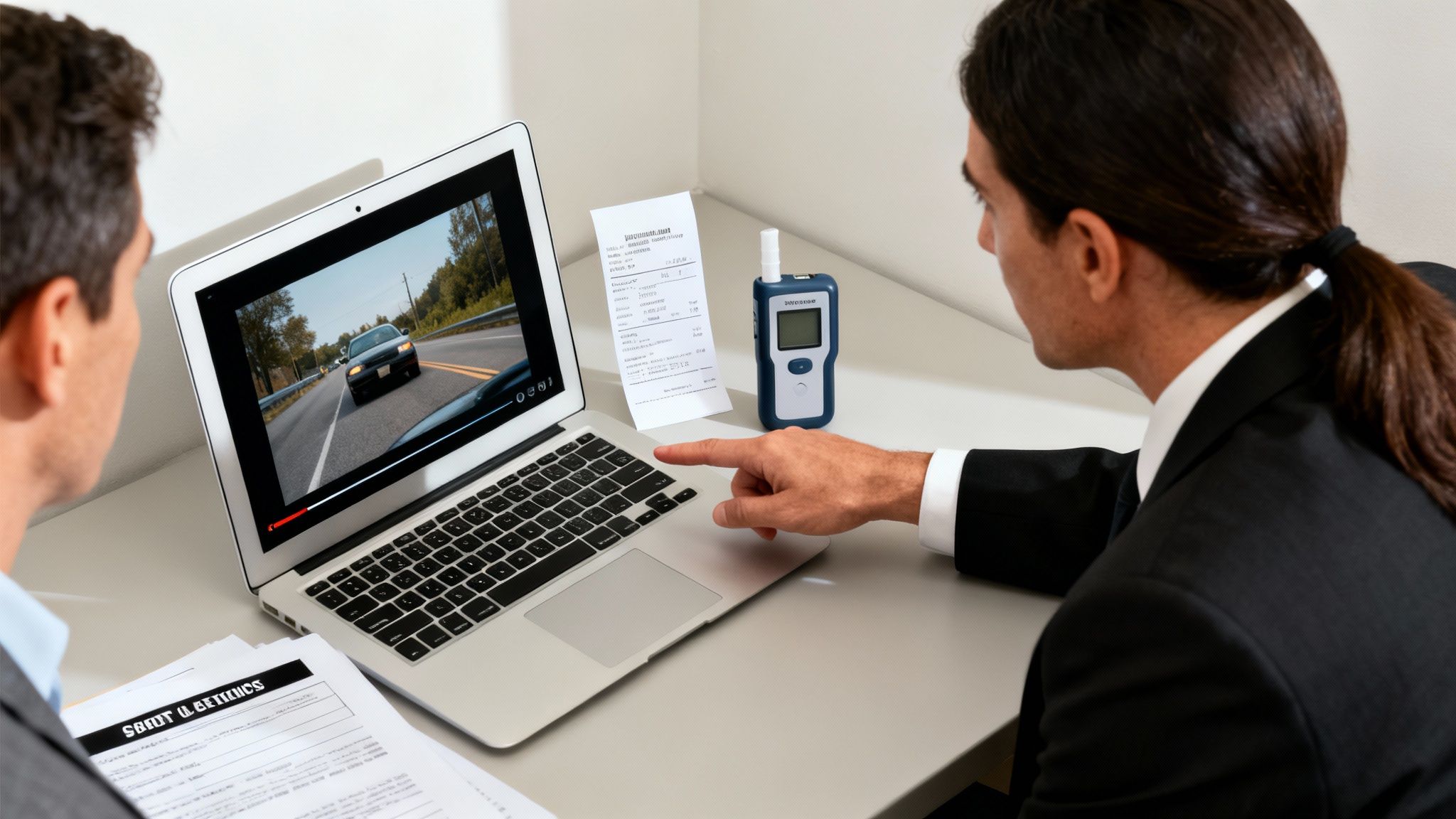
Winning at the Texas State Office of Administrative Hearings isn't about luck—it’s about strategy. A seasoned Houston DWI lawyer doesn’t just show up to your ALR hearing; they come armed with a game plan designed to dismantle the state's case, piece by piece. This isn’t just about protecting your driver's license. It’s about creating a powerful advantage for your entire DWI defense.
Our approach is aggressive from the start. We see the SOAH hearing as the first and best chance to challenge the state’s evidence, cross-examine the arresting officer, and expose the weak spots that can lead to a win. A victory here not only saves your license but can seriously strengthen your position in the separate criminal case.
Scrutinizing the Traffic Stop
Every DWI case starts with a traffic stop, and that’s often where our defense begins. The Fourth Amendment protects you from unreasonable searches and seizures, meaning the officer must have had a valid reasonable suspicion to pull you over. A vague reason like "driving in a high-crime area" simply doesn't cut it.
We investigate every detail of the stop:
- Did the officer have a legitimate, specific reason to pull you over?
- Does the dashcam footage support what the officer wrote in their report?
- Was the stop prolonged unnecessarily, violating your rights?
If we can show the initial stop was illegal, any evidence they collected afterward—field sobriety tests, breath or blood results—can be challenged. This often leads to a win at SOAH and can cripple the prosecution’s criminal case.
Challenging Field Sobriety and Chemical Tests
Standardized Field Sobriety Tests (SFSTs) are subjective and frequently administered incorrectly. We question whether the officer followed the strict protocols from the National Highway Traffic Safety Administration (NHTSA). Was the test done on a level surface? Were the instructions given correctly? Could your medical conditions or even your footwear have affected your performance?
Breath and blood tests are also not foolproof. A breathalyzer is a machine that requires proper maintenance and calibration. We subpoena the device’s service logs to look for a history of errors or missed inspections. For blood tests, we scrutinize the entire chain of custody to ensure the sample was handled correctly.
Any mistake in procedure, no matter how small, can be used to challenge the validity of the test results. Our job is to find those mistakes and use them to your advantage.
Exposing Procedural and Statutory Errors
Police officers must follow a strict protocol during a DWI arrest. A crucial part of that is reading the Statutory Warnings (DIC-24) correctly. This form is supposed to explain the consequences of refusing or failing a chemical test. If the officer misreads the warnings, fails to provide them, or cannot prove you understood them, the entire legal basis for suspending your license can be invalidated.
Fighting a state agency at SOAH is a tough battle, which is why a detailed, strategic defense is critical. For instance, a review of over 2,800 tax cases at SOAH showed the state won about 85% of the time, while individuals won their cases outright less than 5% of the time. While these numbers are from a different area of law, they highlight the uphill climb you face against state agencies and prove why a meticulous, evidence-based defense is essential to protect your driving privileges. You can read more about these findings in the TTARA Research Foundation Report.
By using these defense strategies, we transform the SOAH hearing from a procedural formality into a powerful weapon. A victory here is about more than just keeping your license—it sends a strong message to the prosecutor that you're ready to fight every part of the case against you. Don't face this alone; let us build the strategic defense your case deserves.
Protect Your License, Protect Your Future
A DWI charge and a hearing at the Texas State Office of Administrative Hearings can feel like an uphill battle, but it’s a fight you don't have to face alone. The administrative process is complex, moves incredibly fast, and can feel unforgiving. But it's also your first and best chance to protect your driving privileges and gain a tactical advantage for your criminal case.
Trying to navigate this on your own is a significant risk. With an experienced legal advocate in your corner, the SOAH hearing becomes your first line of defense, not just another threat. Remember, the clock started ticking the second you were arrested.
Don't Miss Your Window—Take the First Step Now
That 15-day deadline to request your ALR hearing isn't a suggestion; it's a hard stop. Once that window closes, you lose your right to challenge the suspension, and your license will likely be suspended automatically. Don't let this critical opportunity slip away.
Even if the hearing doesn't go your way, you still have options. Our team can help you get an occupational driver's license in Texas, which can keep you on the road for work, school, and essential family needs while we continue to build the strongest possible defense for your criminal charges.
A DWI arrest is overwhelming. It can feel like your whole world is on the line. But you don't have to go through this alone. The decisions you make in the next few days will impact your license, your job, and your future.
The single most important decision you can make right now is to secure experienced legal help.
Contact The Law Office of Bryan Fagan, PLLC for a free, no-obligation consultation. Our team of dedicated Houston DWI lawyers knows the administrative and criminal systems inside and out. Let us put our experience fighting for Texans to work for you today.
Answering Your Top Questions About SOAH and DWI Hearings
When you’re arrested for a DWI, a wave of questions hits you all at once. The legal system is a maze, especially since you’re suddenly juggling a criminal case and a separate administrative battle at the Texas State Office of Administrative Hearings (SOAH). Let's provide the clear, direct answers you need right now.
What Happens if I Miss the 15-Day Deadline?
This one is simple: if you miss the 15-day deadline to request your Administrative License Revocation (ALR) hearing, your driver's license will be suspended automatically. That suspension typically begins 40 days after your arrest.
There are no extensions. Missing this deadline means you forfeit your right to challenge the administrative suspension. This is why one of the first calls you should make after a DWI arrest is to an experienced Texas DUI attorney who can file that request immediately and protect your rights.
Do I Have to Show Up for the SOAH Hearing?
In most cases, no. Your attorney will appear on your behalf to handle everything—presenting evidence, cross-examining the arresting officer, and making legal arguments to the Administrative Law Judge.
This allows you to focus on your job and family without the added stress of a court date. We handle the legal fight for your license. Of course, if a situation ever arises where your testimony might be helpful, we would discuss that strategy with you well in advance.
If I Win My SOAH Hearing, Is My DWI Case Dismissed?
No, but it's a huge step in the right direction. A win at your SOAH hearing is a major victory because it stops the administrative suspension of your license. However, it does not automatically dismiss your separate criminal DWI charge. The administrative and criminal proceedings are completely independent.
Here’s the upside: a win at SOAH gives your criminal defense a massive boost. The testimony we get from the arresting officer during the SOAH hearing can uncover critical weaknesses in the state’s criminal case. This can give us the leverage needed to negotiate a better outcome or fight for a complete dismissal of the charges.
Can I Get an Occupational License if I Lose?
Yes. Even if the judge rules against you at the SOAH hearing and your license is suspended, you will almost certainly be eligible for an Occupational Driver's License (ODL). An ODL is a special, restricted license that lets you drive for essential reasons like getting to work, school, and handling necessary household duties.
Our firm can petition the court for an ODL for you right away. We move quickly to get this essential license in your hands so you can keep your life moving forward during the suspension period.
Facing a DWI arrest feels like being caught in a storm, but you don't have to navigate the Texas State Office of Administrative Hearings on your own. The choices you make in the next few days are absolutely critical. Contact The Law Office of Bryan Fagan, PLLC today for a free, confidential case evaluation to start protecting your license and your future. Let our experience fighting to fight DWI Texas cases go to work for you. Learn more at our DWI defense website.