
A DWI arrest can be overwhelming — but you don’t have to face it alone. The single most important deadline you're facing right now is the 15-day window to request an Administrative License Revocation (ALR) hearing.
This isn't just a suggestion; it's a critical deadline. Missing it means you forfeit your best and earliest chance to prevent an automatic license suspension. A skilled Houston DWI lawyer can handle this for you, ensuring your rights are protected from day one.
Your First Move After a DWI Arrest

It’s easy to feel overwhelmed after a DWI arrest, but you need to act fast. From the minute you're arrested, two parallel legal battles begin: a criminal case that could lead to fines and jail time, and an administrative case that directly threatens your driver's license. The administrative side moves with lightning speed, and it has to be your top priority.
Texas has what’s known as an "implied consent" law. In simple terms, by driving on Texas roads, you've already agreed to give a breath or blood sample if you're lawfully arrested for DWI. If you refuse that test, or if you take it and your Blood Alcohol Concentration (BAC) is 0.08% or higher, the Texas Department of Public Safety (DPS) immediately starts the process to suspend your license.
The Critical 15-Day Deadline
You have exactly 15 days from the date of your arrest to formally request an Administrative License Revocation (ALR) hearing. If you miss this window, your license will be automatically suspended on the 40th day after your arrest. No exceptions.
Requesting this hearing is a critical strategic move for two reasons:
- It stops the automatic suspension. Filing the request puts the suspension on hold. Your license remains valid while you await the hearing date.
- It gives your attorney a major advantage. The ALR hearing is our first opportunity to challenge the state's evidence. We can question the arresting officer under oath and look for weaknesses in their report—testimony that can be invaluable for weakening the criminal charges later.
Many people mistakenly think the ALR hearing is just a minor procedural step. In reality, it’s a goldmine of information and a crucial part of a strong DWI defense. It’s our chance to get a sneak peek at the prosecutor’s game plan and lock the officer into their testimony.
Understanding the Administrative License Revocation (ALR)
The ALR hearing is a civil proceeding, completely separate from your criminal DWI court case. The focus here isn't on proving your guilt or innocence for the DWI charge itself.
Instead, the administrative judge is only concerned with a few key questions:
- Did the officer have reasonable suspicion to pull you over and probable cause to arrest you for DWI?
- Did you either refuse a chemical test (like a breathalyzer) or provide a sample with a BAC of 0.08% or more?
If the state can prove both of those points, your license gets suspended. However, a skilled DWI lawyer often finds procedural errors or weaknesses in the officer's testimony that can lead to a win.
Even if the ALR hearing doesn't go your way, this guide will show you how to secure an occupational license to keep you on the road. We understand the pressure you're under. For a more detailed look at what to do right now, check out our guide on the essential steps to take after a DWI arrest. This is your roadmap to taking back control.
Figuring Out if You Qualify for an Occupational License
After a DWI arrest, the first question is usually, "Can I still drive?" For most people, the answer depends on getting an occupational driver's license (ODL). But before you can start the process, you have to determine if you're eligible. Texas law has specific rules, and knowing where you stand is the first step toward protecting your ability to get to work, school, and manage your life.
Not everyone can get an ODL right away. The state wants to ensure that only individuals who present a low risk to the public get this special driving privilege. The eligibility rules balance your genuine need to drive with the state's mission to keep the roads safe.
Who Is Typically Eligible for an ODL?
For many people, especially those facing a first DWI in Texas, the path to getting an ODL is fairly clear. If your license was suspended because of an Administrative License Revocation (ALR) for failing or refusing a breath or blood test, you can usually petition the court for an ODL.
The absolute must-have is proving you have an "essential need" to drive. This isn't just a casual term; it has a legal definition. It covers driving for:
- Your job, including getting to and from work and any driving required as part of your duties.
- School, such as attending college classes or a trade school program.
- Essential household duties, which includes everything from grocery shopping and doctor's appointments to caring for your children or other dependents.
A judge will look closely at your petition to make sure your need is real. Simply wanting to drive for convenience won’t be enough. You must show that not having a license would create a genuine hardship for you and your family.
Common Roadblocks and Mandatory Waiting Periods
While many people can apply for an ODL immediately, some situations trigger a mandatory waiting period, often called a "hard suspension." These periods are non-negotiable and are put in place as a penalty for more serious offenses or for repeat offenders.
You might be forced to wait if:
- You’ve had a previous DWI-related license suspension within the last five years.
- Your current license suspension is for a serious charge like Intoxication Assault or Intoxication Manslaughter.
- This is not your first alcohol-related law enforcement contact and you refused the chemical test.
These waiting periods can range from 90 days to a full year, depending on your specific situation. This is where having a sharp Houston DWI lawyer is crucial. We can analyze your driving record and the details of your arrest to pinpoint the exact date you become eligible, ensuring you don't waste a single day.
The Stakes for Licensed Professionals
For many Texans, a driver's license is directly tied to a professional license. A DWI can put the careers of nurses, real estate agents, pilots, and commercial drivers in jeopardy. The stakes couldn't be higher, as professional licensing now covers roughly 25% of the U.S. workforce. For these individuals, fighting the license suspension and getting an ODL isn't about convenience—it's about career survival. A DWI can trigger an investigation by a licensing board, and showing you've maintained your legal ability to drive is a huge factor in demonstrating responsibility. The American Economic Association has covered the significant rise of professional licensing and its impact on workers.
Trying to figure all this out on your own can be overwhelming. That’s why we’ve put together a comprehensive breakdown to help you understand where you fall. You can get into the nitty-gritty details in our guide to occupational license eligibility in Texas.
To give you a quick snapshot, here’s a table that breaks down the most common scenarios.
Texas Occupational License Eligibility at a Glance
This table simplifies the eligibility requirements based on your driving profile and DWI history, helping you quickly see where you might stand.
| Driver Profile | Eligibility Status | Key Considerations |
|---|---|---|
| First-Time DWI Offender | Generally Eligible | Can typically apply as soon as the suspension starts. You must prove an essential need. |
| Repeat DWI Offender | May Face Waiting Period | A 90-day to 1-year "hard suspension" might apply if you had a prior DWI suspension within 5 years. |
| CDL Holder | Ineligible for Occupational CDL | While you can get an ODL for a personal vehicle, federal law blocks you from getting one for commercial driving. |
| Under 21 Driver | Eligible with Conditions | Often face tougher rules, including a zero-tolerance policy and a mandatory ignition interlock device (IID). |
Knowing your eligibility status is the foundation for your entire strategy to stay on the road legally. A mistake in timing or a misunderstanding of the law can get your petition denied, leaving you stranded for months. By getting a clear picture of your situation right now, you can build a strong case and take the right steps to regain control over your life.
Assembling Your Application and Essential Paperwork
Filing for an occupational license isn't just asking a judge for a favor. It’s about building a rock-solid case file that leaves no room for questions. The court is extremely particular about the documents it requires, and even one small mistake—a missing signature, the wrong form—can get your application delayed.
Think of this part of the process as building the foundation for your argument. Let's walk through every piece of paper you'll need and how to get it right the first time.
The Petition for an Occupational Driver’s License
The heart of your application is the Petition for Occupational Driver’s License. This is the formal legal document you file with the court that officially begins the process. It tells the judge who you are, why your license is suspended, and most critically, why you have an "essential need" to be on the road.
This isn't a document you should draft on your own. It must be prepared with legal precision and include specific details, such as:
- The exact hours you need to drive each day (up to a 12-hour maximum).
- Which counties you need to travel in.
- The specific, non-negotiable reasons you need to drive (work, school, critical household duties).
A vague petition is a weak one. Simply writing "I need to drive for my job" won't cut it. You have to lay out your work schedule and duties in clear detail to justify every hour you're asking for.
Your Certified Driving Record (Type AR)
To assess your risk, the judge needs to see your entire driving history. That's where your certified driving record from the Texas Department of Public Safety (DPS) comes in. You need to order a very specific version: Type AR (Abstract Record). This one contains a complete history of every accident and moving violation on your record.
You can order it directly from the Texas DPS website. Make sure you request the certified version. A standard, uncertified printout will be rejected by the court. This record gives the judge the full picture, making it a non-negotiable part of your file.
A common mistake that stalls these cases is submitting the wrong type of driving record or a non-certified copy. Double-checking that you ordered 'Type AR – Certified' is a small step that prevents a huge headache.
Proof of Financial Responsibility (SR-22 Insurance)
Before any judge will consider granting you an occupational license, you must prove you have the right car insurance. After a DWI, your standard policy isn't enough. You'll need to get an SR-22 certificate.
An SR-22 isn't actually an insurance policy. It's a certificate that your insurance company files directly with the DPS, guaranteeing that you're carrying the state-mandated minimum liability coverage. You’ll need to call your insurance agent and ask them to add an SR-22 filing to your existing policy. They’ll then give you the certificate to include with your court paperwork. This is your proof to the court that you're financially responsible.
The Essential Need Letter
While the petition formally states why you need to drive, a personal letter explaining your situation can be incredibly persuasive. This is often called an "essential need letter," and it's your chance to speak directly to the judge in your own words. The key is to be respectful, concise, and compelling.
Your letter should paint a clear picture of the genuine hardship you'd face without a license. For example:
- For Work: "I am the sole provider for my family, and my job as a construction manager requires me to be on-site at various locations across Harris and Montgomery counties from 7 AM to 5 PM. Without the ability to drive, I will be unable to perform my duties and will lose my job."
- For School: "I am a full-time nursing student at Houston Community College. My classes are from 9 AM to 3 PM on Tuesdays and Thursdays, and my clinical rotations are at a hospital 20 miles from my home. Public transportation is not available for my 6 AM clinical shifts."
- For Household Duties: "I am a single parent responsible for taking my two young children to school and daycare each morning and picking them up each afternoon. I also need to drive for weekly grocery shopping and to take my elderly mother to her doctor's appointments."
This letter adds a human element to your file, transforming you from a case number into a real person with real responsibilities. A skilled Texas DUI attorney can help you frame this letter to be as effective as possible, ensuring it perfectly supports the legal arguments in your petition.
Navigating the Court and DPS Approval Process
Once you have all your documents in order, it's time to deal with the two main players in this process: the Texas court that hears your case and the Department of Public Safety (DPS) that issues the license. It can feel like a two-front battle, but think of it as two connected steps. Get through the first, and you're set up for success on the second.
Your first move is filing the Petition for Occupational Driver’s License with the right court. This is usually a Justice of the Peace, County, or District Court where you live or where the DWI happened. An experienced Houston DWI lawyer will know exactly where to file—a critical detail, as filing in the wrong court can get your case thrown out and set you back weeks.
Your Day in Court
After the petition is filed, the court schedules a hearing. This is where you make your case to the judge. It sounds intimidating, but if your paperwork is solid, it's usually a straightforward affair. The judge simply wants to confirm you have an "essential need" to drive and that you've met all legal requirements.
Expect the judge to ask a few questions to verify what's in your petition, such as:
- "Tell me about your job. What are your hours and why do you need to drive for work?"
- "What household duties, like taking kids to school or going to the doctor, require you to drive?"
- "If I grant this, do you understand the rules and restrictions that come with it?"
Be honest, respectful, and prepared. Your attorney will guide you through this process. If the judge is convinced, they will sign a court order that gives you the green light to get your occupational license.
This diagram breaks down the three core documents you'll need to get that court order signed.
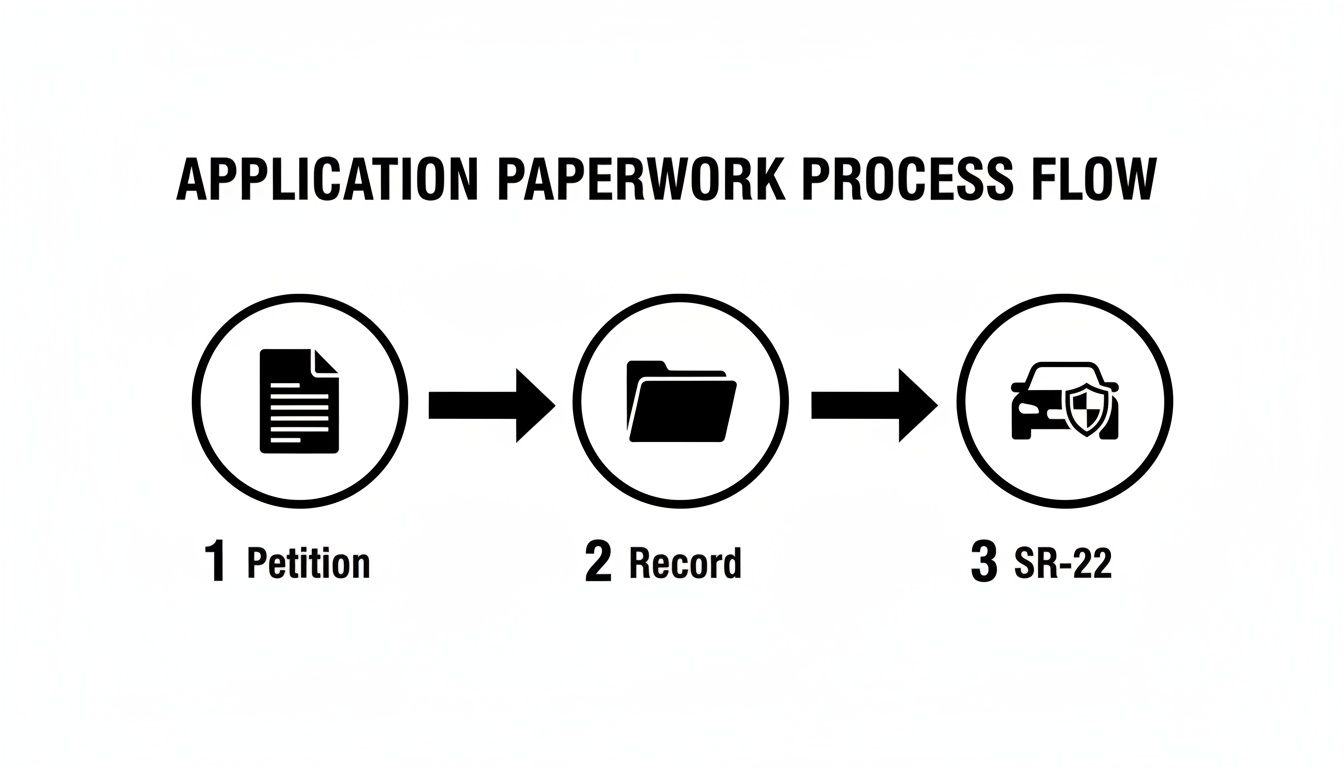
As you can see, a complete petition, your official driving record, and proof of SR-22 insurance are the three pillars of a successful court hearing.
The Final Step with the Texas DPS
Getting that signed court order is a huge win, but hold on—it is not a driver's license. You cannot legally drive with just the court order. Think of it as the court's permission slip that you now have to take to the DPS.
To get the actual plastic license in your wallet, you must mail a complete package to the DPS headquarters in Austin. This isn't the time for shortcuts; the package must include:
- A certified copy of the signed court order (not the original!).
- The SR-22 certificate from your insurance company.
- Payment for all the required reinstatement fees.
- Any other forms they require, like an application for a new license.
We can't stress this enough: send certified copies and keep your own copies of everything. DPS gets thousands of pieces of mail, and you need a paper trail.
One of the most common mistakes people make is thinking the court tells the DPS what happened. It doesn't work that way. It's 100% your responsibility to get that court order and all the other paperwork to the DPS to get your license issued.
Handling Delays and Following Up
After you mail your packet to Austin, the waiting begins. DPS administrative timelines can be slow, sometimes taking several weeks to process everything. If you haven't heard anything after a few weeks, it's time to follow up.
This is another area where an experienced DWI attorney can be invaluable. We know how to navigate the DPS bureaucracy, check on your application status, and resolve any hiccups that might be causing a delay. This entire process is completely separate from your criminal DWI case and the ALR hearing. Understanding the nuances of the Administrative License Revocation process in Texas shows just how many moving parts there are. Having a professional in your corner ensures nothing falls through the cracks, from filing the first form to getting confirmation that your occupational license is on its way.
Getting a Handle on SR-22 Insurance and Ignition Interlock Devices
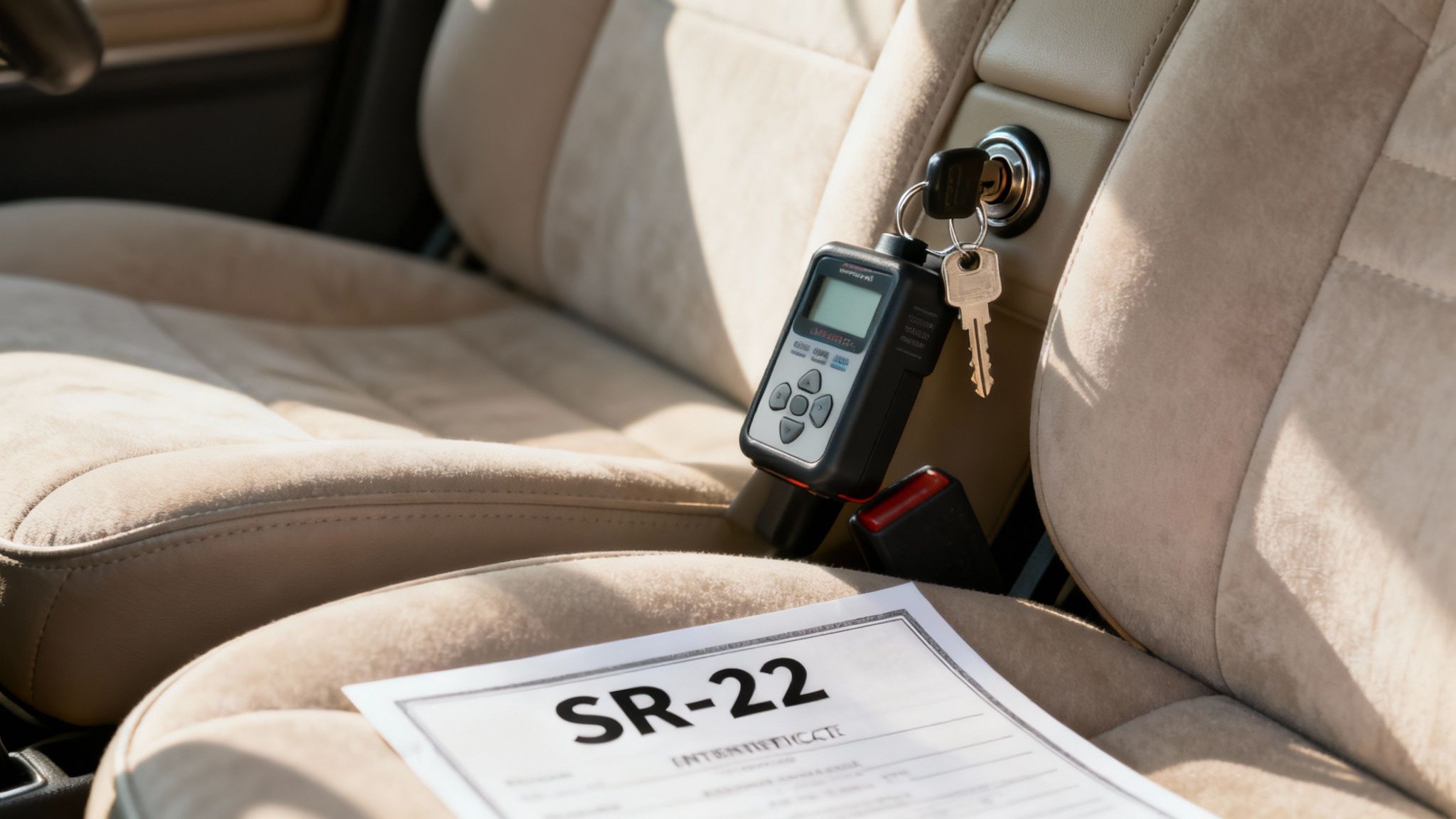
As you begin the process of getting an occupational license, you'll encounter two terms that can be confusing: SR-22 insurance and the Ignition Interlock Device (IID). These aren't just suggestions; in many Texas DWI cases, they are mandatory requirements. Think of them as the state's way of ensuring you take your driving responsibilities seriously after an arrest.
Let's clear up the biggest misconception about the SR-22. It is not an insurance policy. It's a certificate—a specific form your insurance company files directly with the Texas Department of Public Safety (DPS). This form simply proves you're carrying at least the state-mandated minimum liability coverage. It’s how the state keeps a closer watch on you, ensuring you don't let your insurance lapse.
You’ll have to keep that SR-22 on file, usually for two years starting from the date of your DWI conviction. If your coverage lapses for even a day during that period, your insurer is required to notify the DPS immediately, which will lead to another suspension.
What Is an Ignition Interlock Device?
If the SR-22 is about financial accountability, the Ignition Interlock Device (IID) is the state’s tool for ensuring public safety. An IID is a small breathalyzer professionally installed into your vehicle's ignition system. Before the car will start, you have to blow into the device to provide an alcohol-free breath sample.
The device also requires random "rolling re-tests" while you're driving to ensure you remain sober. Every test—pass or fail—is logged and reported directly to the court or your probation officer, and a failed test comes with serious consequences.
An IID can feel invasive, but in many DWI cases, it's the single factor that persuades a judge to grant an occupational license. It shows a real commitment to sober driving and gives the court the assurance it needs to let you back on the road.
When Are These Requirements Mandatory?
Not everyone who needs an occupational license will have to get an IID, but the rules are getting stricter. Whether it's required depends on the specifics of your case.
In Texas, an IID is almost always mandatory if:
- You have a prior DWI conviction.
- Your Blood Alcohol Concentration (BAC) was 0.15% or higher, even for a first offense.
- Your DWI involved an accident causing injury (Intoxication Assault).
- The judge orders it as a condition of your bond or probation, which is increasingly common.
For professionals, the stakes are incredibly high. A DWI can threaten the professional licenses many people need for their jobs, and licensing boards often look at whether you're able to drive legally. Failing to follow through with IID or SR-22 requirements can have disastrous career fallout, a topic explored in recent NBER research on licensing and earnings.
Finally, let's talk about the cost. Filing an SR-22 usually adds a small fee to your regular insurance premium. The IID is a bigger financial commitment. You can expect an installation fee of around $100 to $200, followed by monthly monitoring and calibration fees that typically run between $70 and $100. You are responsible for all of these costs. A good Houston DWI lawyer can walk you through these obligations so you can budget for the expenses and comply with every court order without any last-minute surprises.
Common Questions About Texas Occupational Licenses
When your license is suspended after a DWI, a million questions can race through your mind. It's a confusing and stressful time, but getting clear, straightforward answers makes all the difference. Here’s a breakdown of the most common concerns we hear from clients about getting an occupational license in Texas.
How Long Does It Take to Get an Occupational License?
This isn't an overnight fix. After we file the petition with the court, we have to wait for a hearing date, which can take a few weeks depending on the court's schedule.
Once a judge signs the order granting you the license, that's a huge step, but it's not the last one. We then have to send all the official paperwork to the DPS headquarters in Austin for final processing. It can easily take them another few weeks to issue and mail you the physical license. An experienced Texas DUI attorney can spot potential pitfalls and prevent common mistakes that cause frustrating delays.
Can I Drive Anywhere I Want with an Occupational License?
Absolutely not. This is a critical point to understand. An occupational driver's license (ODL) is not a free pass to drive whenever and wherever you please. It comes with very strict limitations.
The license only allows you to drive for essential needs, as defined by the judge in your court order.
This typically includes driving for things like:
- Getting to and from your job.
- Performing work-related duties during your shift.
- Attending classes for school or vocational training.
- Handling essential household duties, like going to the grocery store, doctor's appointments, or taking your kids to school.
The court order will spell out the exact hours you're allowed to drive (up to 12 per day) and the specific counties you can drive in. Straying outside of those rules is a serious violation.
What Happens If I Violate the Terms of My ODL?
The consequences are severe. If a police officer pulls you over while you’re driving outside the hours or locations specified in your court order, you’re facing serious legal trouble.
You are required to carry a certified copy of the court order and your SR-22 proof of insurance with you at all times when driving. Simply failing to have these documents on hand when you're pulled over is a violation in itself.
Getting caught driving outside your restrictions can lead to a new criminal charge for Driving While License Invalid (DWLI). A conviction for DWLI can mean more fines, potential jail time, and the immediate revocation of your occupational license. At that point, you would be left with no legal way to drive at all.
Is an Occupational License an Option for a Commercial Driver?
This is a make-or-break issue for professional drivers. If you hold a Commercial Driver's License (CDL), you cannot get an occupational CDL to drive a commercial truck or bus. Federal law strictly prohibits it.
However, all is not lost. You can still petition the court for a standard occupational license that allows you to operate a personal, non-commercial vehicle for essential needs, just like anyone else. This means you can still get to work, run errands, and handle family obligations. For CDL holders, this makes it paramount to fight DWI Texas charges to protect your career.
A DWI arrest doesn't just threaten your freedom—it puts your finances, your job, and your family's stability at risk. You shouldn't have to face this complex legal battle alone. At the Law Office of Bryan Fagan, PLLC, our experienced DWI defense attorneys are ready to defend your rights and fight for the best possible outcome. We have a deep understanding of Texas DWI laws and will build a strategic defense to challenge the state's case against you. Don't let a DWI license suspension derail your life. Request a free, confidential consultation today by visiting us at https://texasduilawfirm.com.