 Skip to content
A DWI arrest can be overwhelming, and the thought of losing your license is a major source of stress. Suddenly, your ability to drive to work, handle family responsibilities, or simply manage your life is on the line. But you don’t have to face it alone. In Texas, an Occupational Driver's License (ODL) is a critical tool that allows you to keep handling your essential needs while your primary license is suspended.
Securing an ODL is a structured legal process. It involves filing a formal petition with the court, proving you have a legitimate need to drive, and meeting key requirements like obtaining SR-22 insurance. It's a manageable challenge, but you have to know the steps to protect your ability to drive.
Your Guide to Driving Legally After a DWI Arrest
A DWI arrest in Texas puts your driving privileges in immediate jeopardy. The thought of a license suspension can send anyone into a panic, threatening your job, your income, and your ability to manage basic family responsibilities. Being stranded is a terrifying prospect, but here's the good news: a suspension isn't the final word. The Texas legal system provides a clear path forward.
This guide is designed to walk you through securing an Occupational Driver's License, a special, restricted license granted by a judge. Think of it as a lifeline that lets you drive legally for the things that truly matter—getting to work, attending school, and taking care of necessary household duties while your regular license is suspended.
Understanding the Purpose of an Occupational License
An ODL isn't a replacement for your standard license. It's a court-authorized permit to handle life's necessities. The court understands that while driving is a privilege, the ability to earn a living and care for your family is a fundamental need. A complete loss of transportation can cause an incredible amount of hardship, and the ODL is the solution to that problem.
To get one, you first have to navigate the legal hurdles. This includes understanding the Administrative License Revocation (ALR) hearing, which is a civil process completely separate from your criminal DWI case, and proving what the court considers an "essential need."
An ODL provides a lifeline, allowing you to maintain stability for yourself and your family. It demonstrates to the court that you are taking responsible steps to manage your obligations while respecting the terms of your suspension.
Key Terms You Need to Know
The process involves some specific legal terms. Don't let the jargon intimidate you; these concepts are pretty straightforward once you break them down.
- Essential Need: This is the legal standard you must meet. It's not about convenience; it's about necessity. This covers driving for work-related duties, commuting to your job or school, and performing essential household tasks like grocery shopping or taking a child to the doctor.
- SR-22 Insurance: This isn't an insurance policy. It's a certificate your insurance company files with the Texas Department of Public Safety (DPS). It serves as proof that you carry the state's minimum liability insurance, and it's mandatory for anyone seeking an ODL after a DWI-related suspension.
- Court Order: This is the official document signed by a judge that grants you the ODL. It will spell out exactly when and where you're allowed to drive—specifying the hours, days, and counties. You must carry a certified copy of this order with you every single time you get behind the wheel.
Our goal is to provide a clear, confident roadmap. This is a challenge you can manage with the right information and strategic legal support. If you need more help with your DWI case or the ODL process, our guide on license reinstatement in Texas offers even more valuable details.
Figuring Out if You Qualify for an Occupational License
Before petitioning a Texas court for driving privileges, you must answer the most important question first: do you qualify? Getting an occupational license isn't automatic. Your eligibility hinges on the specifics of your case, like why your license was suspended and your driving record.
The two most common reasons for a suspension are either failing or refusing a breath/blood test—which triggers an Administrative License Revocation (ALR)—or getting convicted of DWI. Each path has its own set of rules, and knowing which one applies to your case is the first step to moving forward with confidence.
How Prior DWI Convictions Affect Your Case
Your driving history is a huge factor. While a first-time DWI arrest often allows you to apply for an occupational license right away, a prior DWI conviction can significantly change the timeline. Texas law is designed to impose tougher consequences for repeat offenses.
This doesn't mean you're out of options. It just means there might be a mandatory waiting period before you can ask the court for permission to drive. An experienced Houston DWI lawyer can analyze your driving record and give you a straight, accurate answer on when you'll be eligible to apply.
Understanding the Mandatory Waiting Periods
In some cases, Texas imposes what’s known as a "hard suspension." This is a mandatory waiting period where you are completely ineligible for an occupational license. These waiting periods are set by law and are not negotiable.
- First DWI Arrest (No Prior Suspensions): In most cases, there is no waiting period. You can usually file for an ODL as soon as your suspension begins.
- Refusal of Breath/Blood Test (First Offense): If your license was suspended because you refused a chemical test under Texas implied consent law, you could face a 90-day waiting period before you can get an ODL.
- Prior DWI Conviction or Suspension: If you have a DWI conviction within the last five years, you might face a waiting period of up to one year.
These timelines are critical. Filing your petition too soon is a guaranteed denial, wasting your time and money. Our firm helps people navigate these tricky waiting periods to ensure your petition is filed at the earliest possible moment. To get a better handle on your specific case, you can learn more about occupational license eligibility in Texas in our detailed guide.
Special Rules for Commercial Driver's License (CDL) Holders
If you have a Commercial Driver's License, the rules are much tougher. A DWI arrest will trigger a CDL suspension of at least one year for a first offense, even if you were driving your personal vehicle.
Crucial Point for CDL Holders: Texas law flat-out prohibits issuing an occupational license to operate a commercial motor vehicle. While you might still get an ODL to drive a regular car for essential needs, your career as a commercial driver is on hold.
This rule shows just how badly a DWI can impact people whose entire livelihood depends on driving. In a broader sense, occupational licensing in Texas is a major hurdle for many workers. According to the Archbridge Institute's 2025 State Occupational Licensing Index, Texas regulations cover 148 different occupations, affecting over 20% of the state's workforce and creating barriers for entry-level and independent operators. You can read the full index findings here to see how deep these regulations go. For CDL holders, this regulatory landscape makes fighting the DWI charge itself even more vital.
Filing Your Petition With the Court
Once you've confirmed your eligibility, it's time to take formal legal action. This is where the process of getting an occupational license truly begins, and it all starts with a document called the Petition for Occupational Driver's License.
This isn't just another form. The petition is a formal, sworn legal request you submit to the court. It lays out your entire case for the judge—your personal details, why your license was suspended, and most importantly, a crystal-clear explanation of your "essential need" to drive. An error here could lead to an immediate rejection.
Which Court Handles Your Petition?
Knowing where to file is the first logistical hurdle. In Texas, you'll file your petition in a Justice, County, or District Court. The correct court depends on the specifics of your case and where the original offense occurred.
For instance, if your license was suspended because of an Administrative License Revocation (ALR) following a DWI arrest, you'll almost always file in the county where you were arrested. An experienced attorney who knows the local courts can pinpoint the right venue, ensuring your petition doesn't get lost in a bureaucratic shuffle.
What Your Petition Must Include
A successful petition is all about the details. It needs to give the judge a complete and accurate picture of your situation and why you absolutely need to be on the road. Missing even one required piece of information can cause major delays or even get your request denied outright.
This table breaks down the key documents and information you'll need to gather before filing.
| Key Documents for Your Occupational License Petition |
| :— | :— | :— |
| Document or Information | Purpose | Where to Obtain or Prepare |
| Personal Information | To identify you for the court and DPS. | Your driver's license, personal records. |
| Reason for Suspension | To inform the judge of the underlying cause (e.g., ALR, DWI conviction). | Court documents from your criminal case or ALR notice. |
| Proof of Financial Responsibility (SR-22) | To prove you have the state-mandated high-risk auto insurance. | Contact your auto insurance provider to purchase an SR-22 certificate. |
| Sworn Statement of Essential Need | To justify why you need to drive for work, school, or household duties. | You and your attorney will draft this based on your specific needs. |
| Certified Abstract of Your Driving Record | To provide the court with your official driving history. | Request this directly from the Texas Department of Public Safety (DPS). |
Having all these items ready is non-negotiable. The SR-22 certificate, in particular, is a common stumbling block—you must have it before you file, as a copy gets attached to the petition itself.
This flowchart maps out the key stages you’ll go through, from the initial suspension to figuring out the mandatory waiting periods based on your history.
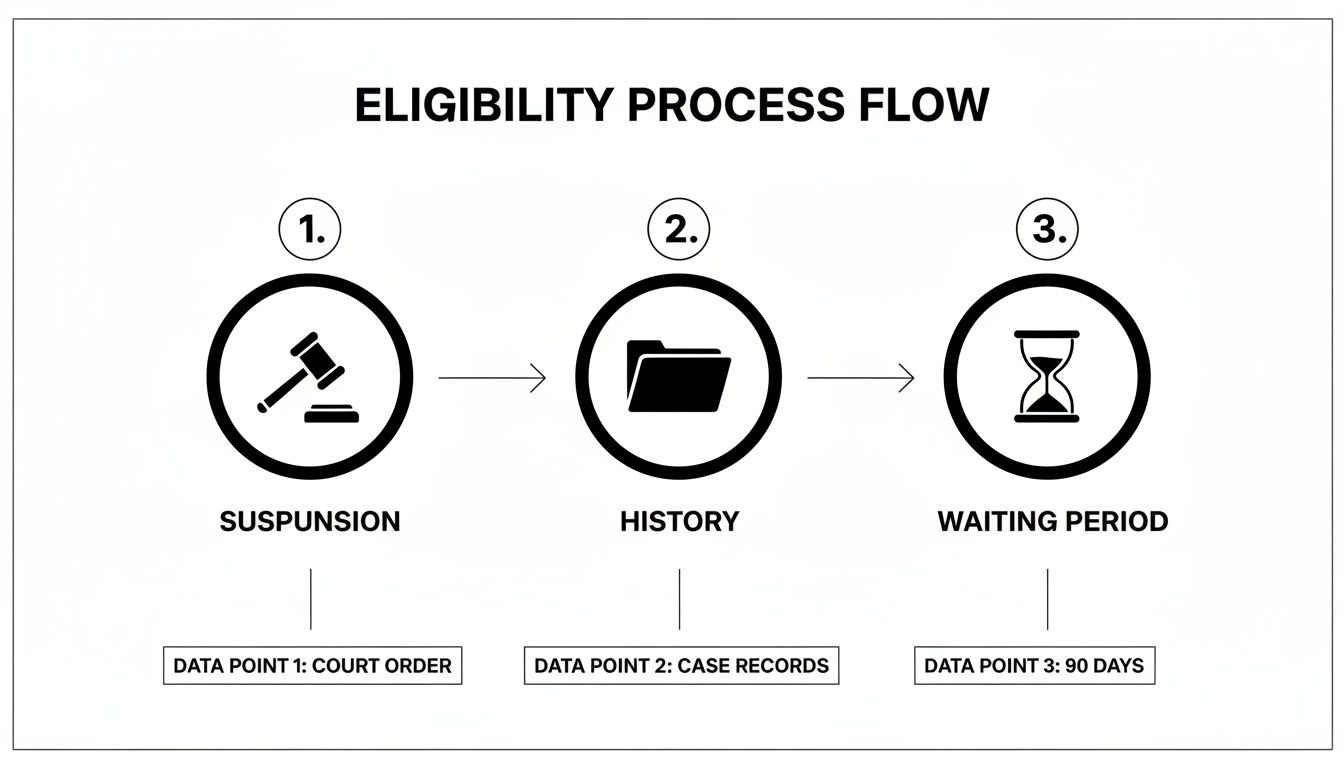
As you can see, the path requires a careful look at why your license was suspended, what's on your record, and whether you have to wait out a "hard suspension" period before a judge can help.
Preparing the Court Order for the Judge
Along with the petition, your attorney will draft a proposed court order. This is the actual document the judge signs if they approve your request. Think of it as the official rulebook for your occupational license. It spells out the exact hours, days, and counties where you are legally allowed to drive.
Preparing a clear, accurate, and legally sound order for the judge to sign is a strategic move. It makes the judge’s job easier and shows that you have a well-thought-out, reasonable request, which can significantly improve your chances of getting a swift approval.
A poorly written order might get rejected on the spot. Worse, a judge could sign one with vague terms that could land you in legal trouble later on. This is one of those areas where having a professional on your side is invaluable.
Notifying the Department of Public Safety
After your petition is filed with the court, a copy must be sent to the Texas DPS. This is a crucial procedural step that officially lets the state know you're seeking an occupational license.
The state's attorneys have the right to show up at your hearing and argue against your petition. While this is rare for most standard ODL requests, skipping this notification step is not an option.
Getting Ready for Your Court Hearing
Once everything is filed, the court will set a hearing date. If your petition is well-prepared and your request is reasonable, the hearing is often just a quick formality. But you still have to be ready to answer the judge's questions about your need to drive.
The judge's number one concern is public safety. They need to be convinced that your need is real and that letting you drive under strict limits won't create a danger to others. Your attorney will prepare you for any questions, helping you present your case with confidence.
This whole process is often tied to the outcome of an Administrative License Revocation (ALR) hearing. You can learn more about how we handle ALR hearings at the State Office of Administrative Hearings in Texas to see how the two legal tracks connect. In many situations, a skilled lawyer can get the occupational license approved without you ever having to step foot in the courtroom.
Proving Your Essential Need to Drive
The entire success of your occupational license petition boils down to one thing: proving you have an essential need to drive. A judge isn't going to grant an ODL just for your convenience—things like getting to the movies or visiting friends are off the table.
The court needs to see, in black and white, that without a restricted license, your ability to keep your job, stay in school, or run your household would be seriously jeopardized. Building this case is much more than just telling a judge you need to drive.
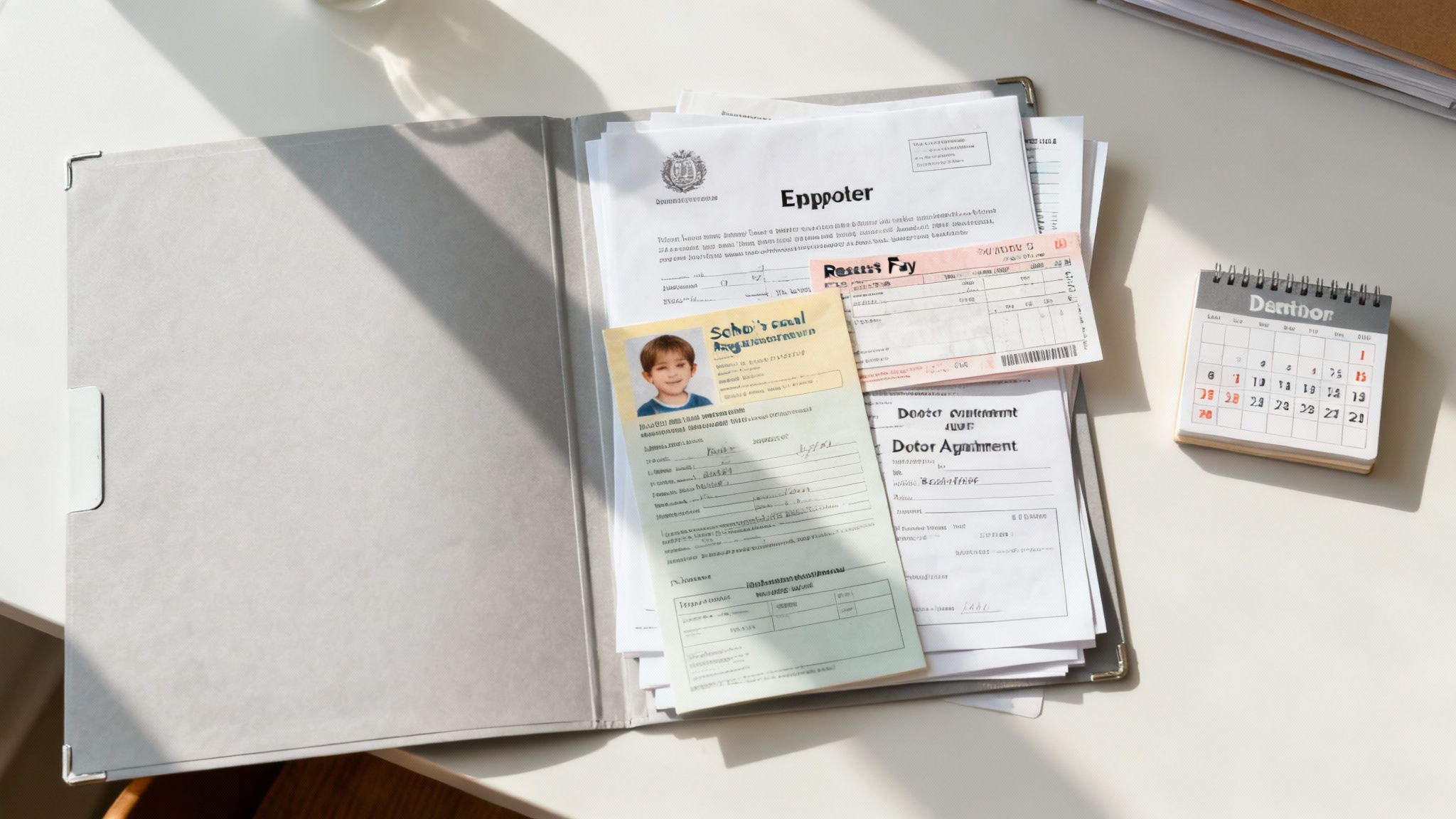
Your word alone won't cut it. You have to back up every claim with solid proof. The goal is to paint a clear, credible, and verifiable picture of your daily responsibilities for the court. This is where having an experienced Houston DWI lawyer guide your strategy can make all the difference.
What Qualifies as an Essential Need
So what does the court actually consider "essential"? Texas law is quite specific. It generally covers the activities necessary to earn a living and manage your household. Think of it in terms of your core, non-negotiable responsibilities.
Here are the most common reasons a judge will sign off on an ODL:
- Getting to and from work. This is the number one justification. It covers your direct commute and any driving required for your job duties (unless you're a CDL holder).
- Traveling for school. If you're a student, driving to and from classes at a college or vocational school is considered essential.
- Performing essential household duties. This is a broad but important category. It includes necessary tasks like grocery shopping, taking your kids to school or daycare, attending required medical appointments, or caring for an elderly parent.
It's absolutely vital to be realistic. If you go in asking for 24/7 driving privileges, you are almost guaranteed to be denied. Your petition must reflect genuine needs, not just wants.
Gathering Compelling Evidence for Your Case
To make a persuasive case, you need documents that validate every part of your request. This evidence is what turns your petition from a simple plea into a well-supported legal argument that a judge can confidently approve.
For instance, if you need to drive for work, don't just write, "I need to drive to my job." That's not enough. You need to prove it with documents like:
- A Letter from Your Employer: This needs to be on official company letterhead. It should clearly state your job title, work hours, and confirm that driving is a necessary part of your employment.
- Recent Pay Stubs: These are simple but powerful. They prove you're currently employed and rely on that income to support yourself and your family.
- A Detailed Work Schedule: This helps the judge understand why you're asking for the specific hours you've listed in your petition.
The same principle applies if your essential need is tied to family duties. To prove you need to drive your kids to school, bring their school registration forms and a copy of the official school calendar. For medical appointments, doctor's notes or appointment confirmations are exactly the kind of concrete evidence a judge wants to see.
The strength of your petition is in the details. The more specific and well-documented your essential need is, the more likely a judge is to view your request as reasonable and necessary.
Being Precise About Hours and Locations
Your petition can't be vague. It must state the exact hours of the day and the specific counties where you need to drive. A fuzzy request is a major red flag for judges. You can't just ask for permission to drive "during the day." You need to be specific, like "Monday through Friday, from 7:00 AM to 6:00 PM."
The court order, if the judge grants it, will mirror these precise details. You might be allowed to drive for up to four hours a day, but a judge has the discretion to extend that up to 12 hours—if you can prove it's truly necessary. For example, a salesperson who covers a huge territory might get a 12-hour window, while someone with a simple 15-minute commute to a local office might only get a couple of hours.
Be warned: driving outside the hours, days, or counties listed in your court order is a serious violation. It can lead to new criminal charges for Driving While License Invalid (DWLI) and the immediate revocation of your occupational license. This is exactly why getting these details right from the start is so critical. A good attorney will make sure your petition is precise, credible, and gives you the best possible shot at getting approved.
Getting Your Official License After the Hearing
Walking out of the courtroom with a signed order from the judge feels like a massive win—and it is. But you're not quite at the finish line yet.
Think of that court order as the key to getting back on the road. Now you have to take it to the Texas Department of Public Safety (DPS) to actually unlock your driving privileges. This final part is purely administrative, but every detail must be perfect, or you'll face frustrating delays.
You're now legally allowed to drive for up to 45 days using a certified copy of that court order. Don't wait, though. Getting your paperwork sent to Austin right away is the only way to make sure your official license arrives before that temporary permission runs out.
First Things First: Secure Your SR-22 Insurance
Before you can send your packet to the DPS, you need to prove you have high-risk auto insurance. This comes in the form of an SR-22 certificate.
An SR-22 isn't an insurance policy itself. It's a form your insurance provider files for you, basically telling the state, "Yes, this person has the minimum liability coverage we require."
Getting one is pretty straightforward:
- Call your insurance agent. Just tell them you need an SR-22 for an occupational license. They'll know exactly what to do.
- Pay the fee. There’s usually a small one-time filing fee, but be ready for your overall insurance premiums to go up. It's an unfortunate but unavoidable part of the process.
- Keep a copy for your records. Your insurance company will send the official proof to the DPS, but you absolutely need a copy to include in the packet you're mailing.
This is non-negotiable. Without proof of an SR-22, the DPS will flat-out reject your application, regardless of what the judge ordered.
Assembling and Submitting Your Packet to the DPS
With the SR-22 in hand, it's time to gather the rest of your documents. Your packet has to be 100% complete. A single missing item will bring the entire process to a screeching halt.
Here is exactly what you need to put in that envelope and mail to the DPS:
- A certified copy of the court order. This isn't a regular photocopy. It has to be a copy you get directly from the court clerk with an official stamp or seal.
- Your SR-22 certificate. Make sure you include the copy your insurance company gave you.
- All required state fees. This will include the occupational license issuance fee and any other reinstatement fees you might owe from the suspension.
- A completed application for an occupational license. This is a standard DPS form you'll need to fill out.
Many people mistakenly believe the court handles this part for them. It is entirely your responsibility to get these documents together and send them off. A good attorney makes sure this packet is assembled perfectly and mailed immediately to prevent any problems.
What If an Ignition Interlock Device (IID) Was Ordered?
If your license was suspended because of a DWI, it’s almost certain the judge ordered you to install an Ignition Interlock Device (IID). This is a small breathalyzer wired into your car’s ignition. You have to blow into it to start the car and at random times while you're driving.
When an IID is part of your order, you must also provide proof of its installation to the DPS. The company that installs the device will give you a certificate—this is another critical piece of the puzzle that has to go in your packet.
Getting an occupational license in Texas can feel like a real grind, and there's a reason for that. Texas actually ranks as the third-worst state in the nation for occupational licensing restrictions, with 178 occupational barriers on the books. As you can see from the Texas occupational licensing national comparison, navigating state requirements is often more complex here than anywhere else.
Getting through this final administrative step is your last hurdle. Do it right, and you'll be legally back on the road in no time.
Answering Your Top Questions About Texas Occupational Licenses
When your driver's license is on the line after a DWI arrest, your head is probably swimming with questions. It's a stressful, confusing time, and getting straight answers can make all the difference. Let's tackle some of the most common concerns we hear from clients every day, based on our experience helping Texans fight DWI charges and get back on the road.
How Long Does It Take to Get an Occupational License?
The timeline for getting an occupational license depends almost entirely on the court's schedule in the county where you file your petition. In some cases, we've filed a petition and had a signed court order in just a few days. In busier counties like Harris, it might take a couple of weeks.
The key to speeding up the process is preparation. Having every piece of paperwork—the petition, the proposed order for the judge to sign, your SR-22 insurance, and any supporting documents—ready from day one is essential. A small error can get your case kicked back, forcing you to start over. An experienced Texas DUI attorney knows how to file a flawless petition and can often get a hearing scheduled much faster.
What Are the Driving Restrictions?
It's critical to understand that an occupational license is not a regular license. It is a highly restrictive, court-ordered privilege. The judge's order will spell out exactly when, where, and why you are allowed to drive.
These restrictions are directly tied to the "essential need" you proved in your petition. For example, the order might say you can drive in Harris and Montgomery counties from 8 AM to 6 PM, Monday through Friday, for work. That’s it. Driving to a friend's house on a Saturday or running to the grocery store at 9 PM is a serious violation. If you're caught, you could face a new criminal charge for Driving While License Invalid (DWLI) and lose your occupational license on the spot.
What Happens if I Have a Commercial Driver's License (CDL)?
For truck drivers and other commercial operators, a DWI arrest is a potential career-ender. If you're convicted, your CDL will be suspended for at least one year for a first-time DWI—even if you were driving your personal pickup truck at the time of the arrest.
A Crucial Reality for CDL Holders: Texas law is crystal clear on this point. You cannot get an occupational license to operate a commercial motor vehicle. Period. While you can still get an ODL to drive a regular car for personal needs (like getting to the doctor), your ability to earn a living as a commercial driver is put on hold.
This harsh rule makes it absolutely essential to fight DWI Texas charges from the very beginning. The demand for commercial drivers is always changing, and a year-long suspension can set your career back significantly. In fact, a 2025 Report on Texas Growth Occupations from the Texas Workforce Commission showed just how much demand can fluctuate, with job postings requiring a CDL dropping from 14.3% in 2019 to just 5.7% by 2024. You can't afford to be sidelined.
How Much Does an Occupational License Actually Cost?
The total cost is a combination of several different fees you need to budget for. Here’s a typical breakdown:
- Court Filing Fees: These vary by county but usually fall somewhere between $250 and $350.
- DPS Fees: You’ll have to pay the Texas Department of Public Safety for license reinstatement and to issue the new restricted license.
- SR-22 Insurance: This high-risk insurance filing will definitely increase your monthly premium. The cost varies widely based on your driving history.
- Attorney Fees: This is what you pay for the legal expertise to get your petition drafted, filed, and argued correctly before a judge.
Trying to handle it yourself to save money can be a costly mistake. Any error in the paperwork can lead to the judge denying your petition. That means you're back to square one, paying all those court and DPS fees a second time. Investing in a knowledgeable Texas DWI attorney from the start ensures it's done right the first time, saving you a world of stress, time, and, ultimately, money.
A DWI arrest can throw your entire life into chaos, but you don’t have to go through it alone. The legal system is complicated, and your freedom to drive, work, and provide for your family is too important to risk. At the Law Office of Bryan Fagan, PLLC, we are here to defend your rights and guide you through every step with confidence.
If you’re facing a DWI license suspension, the clock is ticking. Request a free consultation with our experienced DWI defense attorneys today, and let's start building a strategy to protect your future.

