
A first-time Texas DWI defense lawyer cost typically falls between $3,000 and $10,000 in attorney fees. The total financial impact can climb to $17,000 or more once court issues, license problems, and related expenses pile in, especially when the case gets complicated.
A DWI arrest can be overwhelming, but you don't have to face it alone. If you're up late searching for a Houston DWI lawyer, a Texas DUI attorney, or trying to figure out whether a DWI license suspension is coming, the first thing to understand is simple: the lawyer's fee is only part of the overall bill. The bigger number comes from what happens after the arrest, not just what you pay on day one.
In Texas, BAC means blood alcohol concentration, and implied consent means the state treats driving on Texas roads as agreement to chemical testing rules after a lawful arrest. A field sobriety test is the roadside coordination test officers use to build probable cause, and an administrative license suspension is the civil consequence that can threaten your driving privileges apart from the criminal case. If you want to fight DWI Texas the right way, you need to think beyond the headline price and look at the whole case.
What a Texas DWI Really Costs Beyond the Headline Number
You're at the kitchen table after midnight, phone in hand, searching “Texas DWI defense lawyer cost” because you want a real number, not a sales pitch. Start with this: the fee depends on how hard the case has to be fought, and the lawyer's quote is only the first line item. A basic first-offense defense costs less than a case with a contested stop, a high BAC allegation, or an ALR fight, and that gap is where a lot of people get caught off guard. Published Texas fee guides put first-offense lawyer fees in a wide range, from $1,000 to $2,500 for basic plea work, $2,500 to $5,000 for pretrial work, and $5,000 to $10,000 or more for trial or aggravated defense, with a common first-DWI range landing between $3,000 and $10,000 (Texas DWI lawyer cost in Texas).
The bill is built by work. Every hearing, motion, expert review, and trial preparation session adds time, and that is where the money goes. One Texas estimate cited in the same source puts the attorney fee at up to $9,400 and the overall cost of a DWI at up to $17,000 once related expenses are included (Cost of a DWI in Texas).
Practical rule: If a quote sounds cheap but does not clearly include pretrial work, an ALR hearing, and trial preparation, it is not a true comparison.
The real question is what your case needs
A simple case and a contested case are different products. If the evidence is weak, your lawyer may spend more time on negotiation. If the stop was questionable, the work shifts toward suppression issues and evidence challenges. That is why flat “DWI lawyer cost” numbers mislead people unless the firm explains exactly what stage of the case is included.
A Texas estimate cited by a legal source places the total cost of a first-time DWI at $5,000 to $24,000 in 2019, showing that the lawyer's invoice is only one piece of the financial hit (Cost of a DWI in Texas). The financial damage also reaches beyond the courtroom, which is why you should read the long-term financial impact of a DUI in Texas before you decide how to handle the case. If you are budgeting your defense, treat the attorney fee as the starting point, not the finish line. Hire early, ask direct questions, and protect the parts of the case that can still be saved.
Hidden Costs That Drive Up Your DWI Defense Bill

A low quote looks good until the case stops being routine. Once the State presses harder, your defense has to do real work, and that is where the bill rises. The hidden costs usually come from ALR work, evidence review, suppression motions, expert consultation, and trial prep. Texas fee guides make that point clear, because the deeper the litigation goes, the more time the defense has to put into the case (Texas DWI lawyer cost in Texas).
Where the surprise charges come from
An ALR hearing is one of the first charges clients miss. Some flat-fee agreements include it, and some firms charge separately for the license fight. That hearing matters because it targets the administrative license suspension side of the case, which is separate from the criminal charge.
Forensic work drives up costs too. If the State relies on a breath or blood result, the defense may need to challenge the testing process, the chain of custody, or the reliability of the machine. Challenging Breath and Blood Tests in Texas DWI Cases points to the kind of evidence dispute that can justify more attorney time, because chemical-test evidence should not be treated as untouchable.
The cheapest fee is often the one that leaves out the work that changes outcomes.
What the published Texas ranges tell you
Texas fee guides separate simple cases from hard-fought ones for a reason. Published ranges commonly place first-offense misdemeanors around $2,500 to $5,000, deeper investigation and motion work around $5,000 to $7,500, and fully defended trial cases at $7,500 to $15,000+ (Texas DWI lawyer cost in Texas). Another Texas guide lists a first DWI at $5,000, a second DWI at $7,000, and a felony DWI at $10,000, with the ALR hearing and trial fee included in those amounts, plus financing options at $500, $700, or $1,000 per month over 10 months depending on the charge (DWI cost Texas).
For broader defense pricing, Texas guides also show complex felony cases reaching $30,000 to $75,000+ depending on the charge (Cost of hiring a criminal defense attorney in Texas). That is why you should ask one plain question in every consultation. Does this fee include the ALR hearing, or am I paying extra later?
If you are comparing fee structures, a clear breakdown of Texas DWI lawyer fee options helps you see what is included before you sign anything.
How Texas DWI Lawyers Structure Their Fees and Retainers
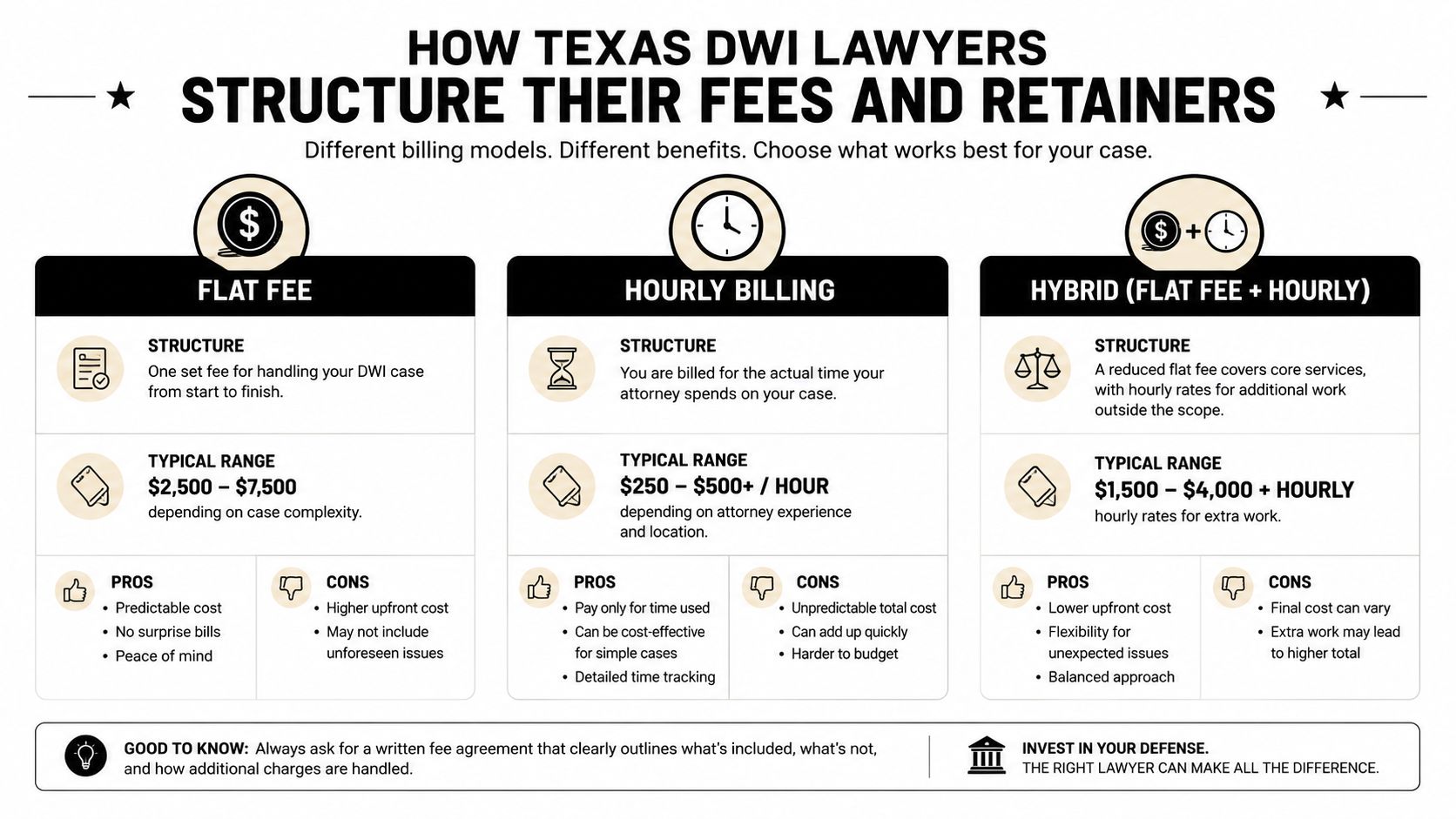
A Texas DWI lawyer should give you a fee structure you can understand before you sign anything. If the lawyer cannot tell you what the base fee covers, what happens if the case gets contested, and whether the ALR hearing is included, keep looking. A quote addressing the criminal case but leaving out license defense is not the full picture.
Flat fee, hourly, and hybrid
A flat fee is the setup most clients prefer because it gives you a known price for defined work. In a DWI case, that should mean the agreement spells out whether pretrial motions, negotiation, discovery review, and the ALR hearing are included. If those items are separate, the initial quote is not telling you much.
Hourly billing can make sense in some legal matters, but it is usually a poor fit for a DWI client who needs predictability. Every call, review, and court appearance can push the bill higher, which makes it hard to budget when your license, job, and transportation are already at risk. A hybrid model sits between the two, usually with a base fee for the core defense and added charges if the case turns into heavier litigation.
If you want a plain-language breakdown before you talk to a lawyer, a guide to Texas DWI lawyer fee options helps you compare what is included and what is left out.
Retainers and payment plans
A retainer is the money you pay up front so the lawyer can start work. Ask whether that money is earned immediately, held in trust, or refundable if the representation ends early. That answer tells you a lot about how the firm handles billing and how it treats clients who need structure, not surprises.
Payment plans matter because a DWI case often lands at the worst possible time. Some firms let you spread out the cost instead of forcing you to come up with everything at once. That can keep the defense moving while you protect your job, your driver's license, and your ability to handle the rest of your life.
One Texas firm publicly listed 10-month financing at $500, $700, or $1,000 per month depending on the charge, with the charge level tied to the fee amount. That kind of arrangement can make a serious defense manageable without pretending the case is cheap.
The right question is simple. What exactly is included in your fee, and what specific events make the price increase?
Texas DWI Defense Lawyer is the kind of defense page you should expect to see from a firm handling charges under Texas Penal Code 49.04, because the charge itself is only the beginning of the legal work.
Regional DWI Defense Costs Across Major Texas Markets

A Houston DWI lawyer may quote differently than a lawyer in San Antonio, and that's not random. Local court practice, courthouse workflow, and the amount of litigation a lawyer expects in a particular metro all affect the price you hear. In the major Texas markets, the practical baseline is shaped by how much time the attorney expects to spend inside that local system, not just by the label on the charge.
Why local knowledge changes the quote
Houston and Dallas–Fort Worth usually demand more logistical work because the court systems are large and the caseloads are heavy. Austin and San Antonio can price a little differently, but they bring their own court habits, scheduling issues, and prosecutor preferences. The point isn't that one city is “more expensive” in a vacuum, it's that the lawyer has to know the local terrain.
That's why a local attorney can be worth the fee. If your lawyer knows the courthouse, the usual motion practice, and the way local prosecutors handle breath and blood cases, your defense can move more efficiently. Out-of-area lawyers often charge less on paper, then spend more time learning the system while your case sits.
How to judge a regional quote
Don't ask only whether the price is high. Ask whether the quote reflects a real defense plan for your county and your facts. A lawyer who has handled first DWI cases, ALR hearings, and trial preparation in your city can often explain the price in a way that makes sense.
If you're comparing cities, look at what the fee includes instead of chasing the cheapest number. A quote that covers the criminal case but leaves out license defense is not a full comparison. A flat number that doesn't account for local court work can look appealing and still cost you more later.
Bottom line: regional pricing differences matter, but local experience matters more.
If you're in Houston, DFW, Austin, or San Antonio, the goal is not the lowest invoice. The goal is the fee that buys you the right amount of work in the right courthouse.
Why the Cheapest DWI Lawyer May Cost You More in the Long Run
The cheapest lawyer can be the most expensive mistake in a DWI case. If the defense doesn't push hard enough, you may lose the chance to challenge the stop, attack the chemical test, or expose weak police work. Once that happens, you're not just paying a lawyer, you're paying for the consequences of a missed defense.
What bargain defense usually leaves out
A low-fee approach often skips the hard work. That can mean no serious suppression motion, no meaningful review of bodycam, no real push on field sobriety issues, and no expert consultation when the facts call for it. In a first DWI in Texas, those omissions can change the whole case.
A strategic defense looks different. It starts with the arrest report, the stop, the testing method, and the timeline. It keeps pressure on the State instead of assuming a plea is the only path.
Value beats sticker price
You should judge value by what the lawyer can do for your case, not by the smallest number on the proposal. Ask whether the lawyer is willing to go to trial, whether they handle ALR work, and whether they have experience with cases like yours. That's more useful than asking who is cheapest.
The financial logic is simple. A little more spent on defense up front can protect your license, your job, and your record from larger downstream costs. That's not a sales pitch, it's just how Texas DWI cases work when the State keeps billing you through penalties, insurance, and lost opportunities.
Actionable Steps to Reduce Your DWI Costs and Protect Your Future
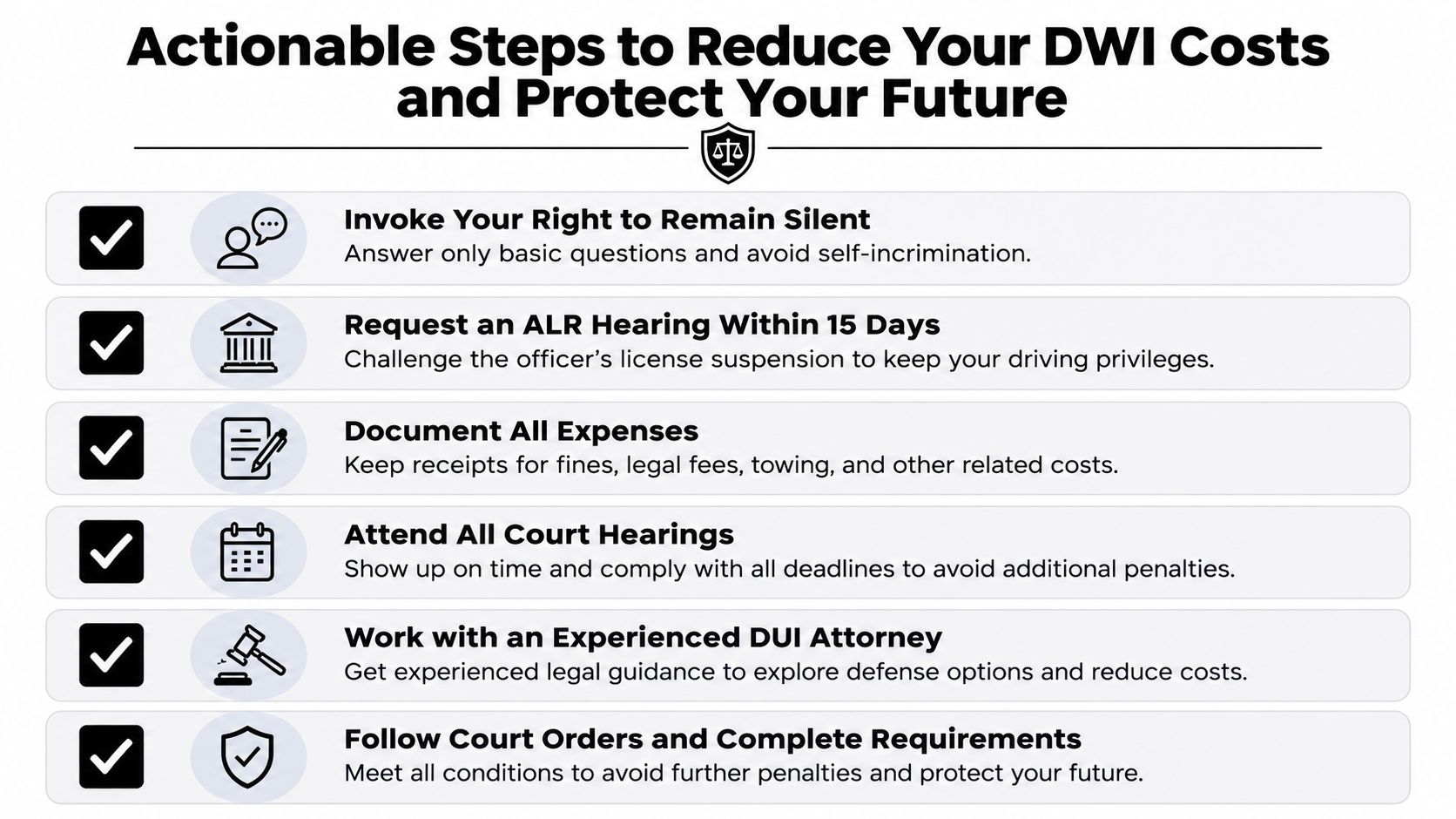
Start with the deadline that matters most. If your license is at risk, request the ALR hearing quickly so you don't give up your best chance to fight the suspension. Then gather your paperwork, court paperwork, citation, bond information, and anything you wrote down about the stop while the details are still fresh.
What to do before your first consultation
- Stay silent about the facts: Don't explain the arrest to friends, social media, or police beyond what's legally required.
- Request the ALR hearing fast: That's your first move if you want to fight the DWI license suspension side of the case.
- Save every document: Keep bond papers, tow records, court notices, and any testing paperwork in one place.
- Write down the timeline: Jot down where you were, who was present, and what the officer said while it's still fresh.
- Ask fee questions directly: Find out what the fee includes, what costs extra, and whether payment plans are available.
- Talk to a lawyer early: Earlier legal review usually means more options, because evidence is easier to preserve before deadlines pass.
If you want a clear breakdown of payment options, review Texas DUI lawyer payment plans before you sign anything. You should also ask about first-offense defense if this is your first case, because a first DWI in Texas needs a different strategy than a repeat case.
The same is true if you're trying to clean up the future after the case ends. Record clearing is a separate issue, and if your case qualifies, expunction or other relief may matter later. The right move now is to protect the case first, then protect your record later.
A smart defense is rarely the cheapest line item on the page. It is the one that keeps you from paying more later.
If you're facing a DWI in Houston, Dallas–Fort Worth, Austin, San Antonio, or a nearby county, the Law Office of Bryan Fagan, PLLC can review the stop, the testing, the ALR deadline, and the criminal court process with you. Visit Law Office of Bryan Fagan, PLLC to request a free consultation and get a straight answer about your options before you make a costly mistake.