
A DWI arrest can be overwhelming—but you don’t have to face it alone. Beyond the initial court case and legal proceedings, many people are blindsided by a separate, often staggering financial penalty known as the State of Texas surcharge. This isn't a fine from the court; it's an administrative bill from the Texas Department of Public Safety (DPS) that can cost you thousands and add a whole new layer of stress to your life. Understanding this penalty is the first step toward building a strong defense.
At The Law Office of Bryan Fagan, PLLC, we believe in empowering you with knowledge. Our goal is to explain Texas DWI laws in clear terms, protect your rights, and help you take control of your situation.

This guide will walk you through what the State of Texas surcharge is, how it works, and most importantly, how a strategic legal defense can help you avoid it altogether.
Texas DWI Penalties Explained: Surcharges vs. Court Fines
When you’re facing a DWI in Texas, you are fighting a battle on two fronts. First, there's the criminal case, which involves court appearances, potential jail time, and fines. Second, there’s an administrative battle waged by the Texas Department of Public Safety (DPS) to suspend your driver's license. The State of Texas surcharge is a key part of this administrative penalty system.
It's a frustrating scenario we see all too often: you resolve your criminal case, pay your court fines, and believe the ordeal is finally over. Then, months later, a bill arrives from the state. It's not a court document but a demand for payment just to keep your driver's license. It can feel like a surprise punishment you were never warned about.
What is the State of Texas Surcharge?
The surcharge is a mandatory administrative fee imposed under the Texas Driver Responsibility Program (DRP). This program was designed to add extra financial penalties for drivers convicted of certain offenses, including DWI.
It’s crucial to understand this key distinction:
- Court Fines: These are criminal penalties you pay at the courthouse as part of your sentence.
- Surcharges: These are administrative fees you pay directly to the DPS for three consecutive years after a DWI conviction. They are a fee to maintain your driving privileges.
If you fail to pay a surcharge, the DPS will automatically suspend your driver's license—even if you have completed every other requirement of your sentence. This is why a proactive defense is so critical. A dedicated Houston DWI lawyer can build a strategy aimed at preventing the conviction that triggers these fees in the first place.
Key Texas DWI Terms You Should Know
Navigating a DWI case means encountering specific legal terms. Here are a few clear definitions:
- Implied Consent: By driving on Texas roads, you have legally agreed to submit to a chemical test (breath or blood) if lawfully arrested for DWI. Refusing the test has its own consequences, including an automatic license suspension.
- BAC (Blood Alcohol Concentration): This is the percentage of alcohol in your bloodstream. The legal limit for adults in Texas is 0.08%.
- Field Sobriety Tests (FSTs): These are standardized roadside tests used by officers to assess impairment. They are often subjective and can be challenged in court.
- Administrative License Revocation (ALR): This is the civil process through which the DPS attempts to suspend your license after a DWI arrest. You only have 15 days from your arrest to request a hearing to fight it.
Understanding these terms is the first step. The next is having an experienced attorney who can use them to your advantage.
DWI Conviction Surcharges and Costs Explained
The financial nightmare of a DWI often begins after the court case is closed. That's when the Texas Department of Public Safety (DPS) steps in with surcharges—automatic, massive financial burdens designed to follow you for years.
The court penalizes you for the crime, but the DPS penalizes you for being a "high-risk" driver. If you don't pay the DPS, they will take away your license. Period. This catches so many people by surprise, sometimes a year or more after they thought everything was settled.
This flowchart breaks down how a single DWI conviction creates two separate financial headaches.
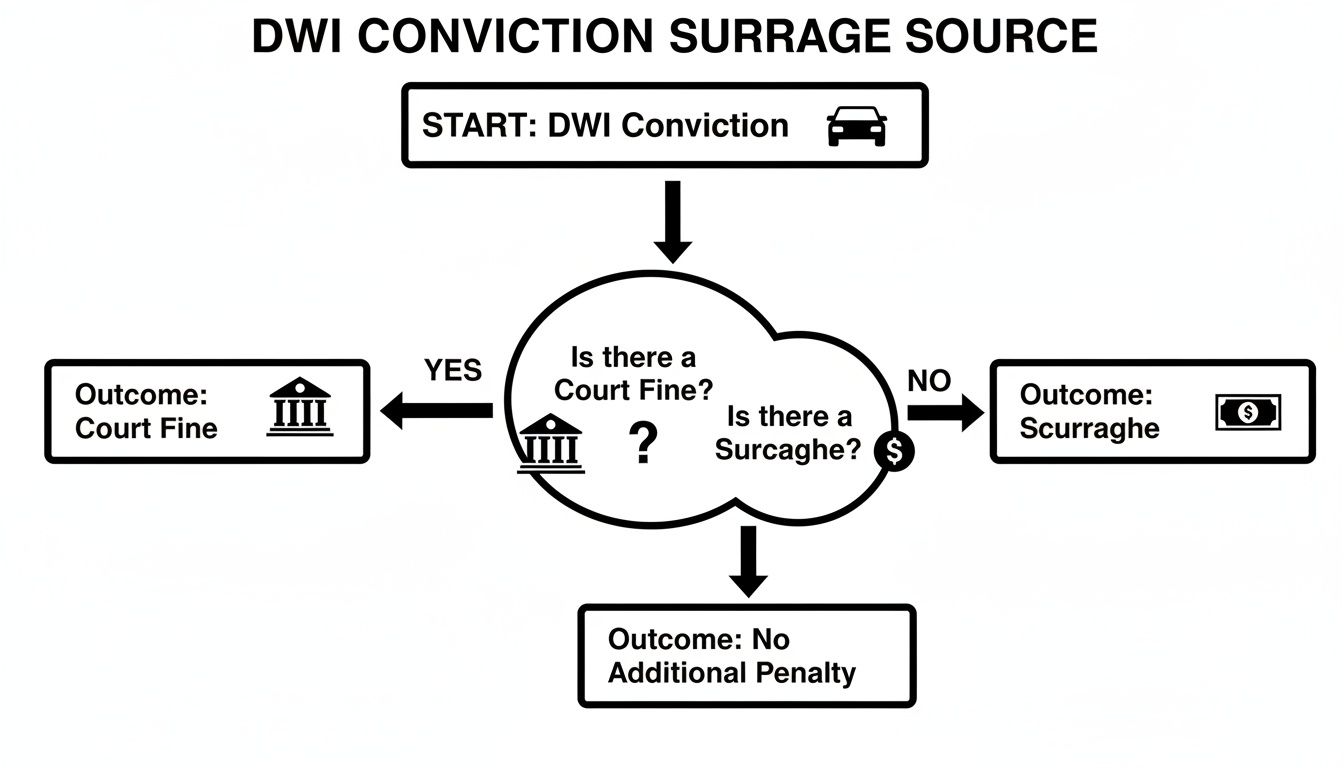
The key takeaway is that you're fighting on two fronts. You must pay the court to satisfy your criminal sentence, and you must pay the DPS just to keep your legal right to drive.
Surcharge Amounts for a First-Time DWI
So, how much are we talking about? The surcharge you’ll owe hinges on the specifics of your case, especially your Blood Alcohol Concentration (BAC).
For a standard first DWI in Texas, a conviction automatically triggers a $1,000 surcharge every year for three straight years. That's a $3,000 bill just to keep your license, completely separate from criminal fines, which can be up to $2,000 for a first offense.
But if your BAC was 0.15% or higher, the state considers this an "aggravated" DWI, and the surcharge doubles to $2,000 per year. That adds up to a staggering $6,000 over three years. You can find more on the distinction between fines and these administrative costs by reading up on Texas DWI fines and costs.
Comparing Surcharge Costs by BAC Level
The difference shows just how seriously the state punishes high-BAC offenses.
Texas DWI Surcharge Amounts at a Glance
This table breaks down the annual and total surcharge amounts for common DWI convictions.
| DWI Offense Type | Annual Surcharge | Total Surcharge (Over 3 Years) |
|---|---|---|
| First DWI (BAC < 0.15%) | $1,000 | $3,000 |
| First DWI (BAC ≥ 0.15%) | $2,000 | $6,000 |
As you can see, a DWI with a high BAC isn't just a more severe criminal charge—it's a financial catastrophe. A few decimal points on a breath or blood test can literally cost you an extra $3,000 in these administrative penalties alone.
This is exactly why it is critical to fight DWI Texas charges by challenging every piece of evidence. A skilled Houston DWI lawyer knows how to scrutinize the traffic stop, question the accuracy of BAC test results, and find weaknesses in the prosecution's case. Getting that BAC reading thrown out or reduced could save you thousands of dollars and protect your freedom to drive.
The Escalating Costs for Repeat DWI Offenses
If you thought the financial impact of a first DWI was severe, a second or third conviction brings a new level of financial pain. The state's approach to repeat offenses is incredibly aggressive, and the State of Texas surcharge is designed to be a powerful deterrent. At this point, the system no longer sees you as someone who made a one-time mistake; it views you as a high-risk driver, and the penalties skyrocket to match.
Think of it this way: a first offense is a warning. A subsequent one is treated as a pattern, and the state responds with penalties that can feel almost impossible to overcome.
The Financial Jump for a Second DWI
When you are convicted of a second DWI, the annual surcharge you owe the DPS jumps to $1,500 per year for three years. That’s a total of $4,500 in administrative fees alone.
This is on top of criminal fines that can now reach $4,000, plus a much longer potential license suspension. It's easy to get these state-mandated surcharges confused with other costs, like those from your insurer. You can learn more about how they differ in our guide on Texas insurance surcharges.
A second DWI conviction doesn't just mean higher fines; it means entering a new, more expensive tier of administrative penalties that can make getting your life back on track incredibly difficult.
The Life-Altering Consequences of a Third (Felony) DWI
A third DWI is where the consequences go from financially devastating to truly life-altering. In Texas, a third DWI is a felony. That single word changes everything. The penalties now extend far beyond your wallet. You could be facing prison time, and the criminal fine can climb as high as $10,000.
For a felony DWI, you are now in the highest penalty tier for the State of Texas surcharge. The state layers these administrative penalties on top of massive criminal fines, creating a financial hole that can be nearly impossible to dig out of. You can find more details on these escalating penalties from recent analysis on 2026 DWI laws.
Facing a repeat DWI charge can feel hopeless, but it's crucial to know that it is not. An experienced Houston DWI lawyer understands how to challenge the prosecution's evidence, even in what seems like an open-and-shut case. A tough, strategic defense can dramatically alter the outcome, potentially leading to reduced charges or saving your driving privileges when you thought all was lost.
How 2026 Laws Impact High-BAC DWI Surcharges
If you’re facing a DWI in Texas in 2026, you need to know the rules have gotten tougher, especially if your case involves a high Blood Alcohol Concentration (BAC). A major legal overhaul has raised the financial penalties for certain DWI offenses.Previously, a first-time DWI with a BAC of 0.15% or higher was generally a Class B misdemeanor. The laws in 2026 are a whole new ballgame. Understanding this shift is absolutely critical, as it directly impacts your case and the thousands of dollars you could owe the state.
The New Reality of a High-BAC DWI
Under current laws, a first-time DWI charge involving a BAC of 0.15% or more is automatically elevated to a Class A misdemeanor. This isn't just a reclassification; it has a direct and expensive impact on the State of Texas surcharge you'll face if convicted.
This change sends a clear signal from the legislature: they are cracking down hard on what they consider to be especially dangerous driving. Trying to navigate this stricter system without an experienced lawyer on your side has never been riskier.
As of 2026, a BAC of 0.15% or higher elevates a first-time DWI from a Class B to a Class A misdemeanor. This triggers fines up to $4,000 and, crucially, spikes the DPS surcharge to $2,000 annually for three years—a total of $6,000. You can discover more insights about these escalating costs and the true cost of a Texas DWI on zealousadvocate.com.
That’s right—a high-BAC case now pushes you into the highest surcharge bracket, effectively doubling what you would have owed for a standard first-time DWI. Going from a $3,000 total surcharge to a $6,000 one is a massive financial hit that can follow you for years.
This new legal reality raises the stakes of your case immensely. You need an experienced Texas DUI attorney who can meticulously analyze the evidence, challenge the validity of the BAC reading, and build a defense to protect you from these crushing penalties. It’s also important to know that these surcharge programs are always evolving. You can read more about the potential end of Texas DWI surcharges and what it could mean for your situation.
How to Fight Surcharges and Protect Your License

Seeing the staggering costs of a State of Texas surcharge can feel like a knockout punch. It’s easy to feel overwhelmed, but this is the moment to shift from defense to offense. The single most effective way to avoid these punishing annual fees is to prevent the DWI conviction from happening in the first place.
An arrest is not a conviction. It’s just the beginning of your defense. A skilled DWI defense attorney will investigate every detail, from the moment you saw flashing lights to the administration of the breath or blood test. We look for procedural errors, faulty equipment, and constitutional violations that can get the case thrown out.
What Happens After a DWI Arrest: The Two-Front Battle
A DWI arrest immediately throws you into two separate legal battles, and you must fight both to protect your future.
1. The Criminal Case: This is the fight against the DWI charge in court. A conviction here leads to fines, potential jail time, and a permanent criminal record.
2. The Administrative Case (ALR Hearing): This is the fight to save your driver's license. The DPS will try to suspend it through a process called an Administrative License Revocation (ALR) hearing. Here’s the catch: you only have 15 days from the date of your arrest to request this hearing. If you miss that deadline, your license gets suspended automatically.
A win at your ALR hearing can be a game-changer. It not only helps you keep your license but also gives your attorney a critical opportunity to question the arresting officer under oath. This is like a pre-trial deposition where we can expose weaknesses in the state’s criminal case against you.
Winning the ALR hearing is a critical first step. For a deeper look into this process, you can learn more about how to handle a DWI license suspension in Texas and what it takes to protect your driving privileges.
The Power of Strategic Negotiation
Even when the state’s evidence seems overwhelming, a good lawyer can create leverage. Through sharp negotiation with the prosecutor, it is often possible to get the charge reduced to a non-DWI offense, such as "Obstruction of a Highway" or certain types of reckless driving.
This accomplishes one monumental goal: avoiding a DWI conviction. Since the surcharges are tied directly to that conviction, a reduction in charges makes the surcharges vanish completely. This is the power of a strategic, proactive defense. It proves you have options and that a DWI arrest doesn't have to end with a conviction and thousands in fees owed to the state.
Your Top Questions About Texas Surcharges, Answered
When you're dealing with a DWI, the legal jargon can feel overwhelming. The term ‘State of Texas surcharge’ often causes the most confusion and anxiety. Let's cut through the noise and provide clear, straight answers to the questions we hear most often.
What Happens If I Don't Pay the State of Texas Surcharge?
The consequences are immediate and severe. If you fail to pay, the Texas Department of Public Safety (DPS) will automatically suspend your driver's license—indefinitely. Put simply, you cannot legally drive in Texas again until every penny of that surcharge is paid. There’s no grace period and no getting around it.
Can I Get a Payment Plan for My Surcharges?
Yes, in some cases. The DPS offers payment plans for those who qualify, which can make the financial burden more manageable. However, a payment plan does not reduce what you owe. If you default on even one payment, your license will be suspended immediately. It's a helpful tool, but it requires perfect compliance.
If My DWI Is Dismissed, Does the Surcharge Go Away?
Absolutely. This is a critical point to understand. Surcharges are only triggered by a final conviction. If your attorney gets your DWI charge dismissed, reduced to an offense that doesn't carry a surcharge, or you are found not guilty at trial, you will not owe the DWI-related surcharge. This is a primary goal when you decide to fight DWI Texas charges, as it saves you thousands of dollars and protects your license.
How Do I Check If I Owe a Surcharge in Texas?
You can find out your status directly from the source. The state has an online portal where you can check if you owe a surcharge, see the total amount, and make payments. Just visit the official Texas.gov website's Driver License section. You'll need your driver's license number and date of birth to log in and see your record.
A DWI charge can feel like it’s taking over your life, but you don't have to face it by yourself. The attorneys at the Law Office of Bryan Fagan, PLLC have the experience to protect your rights and fight for the best outcome possible. We are here to provide reassurance, confidence, and a strategic defense tailored to your case. Request your free consultation today and let us start building your defense.