
A DWI arrest can be overwhelming, but you don't have to face it alone. You may be sitting at home replaying the traffic stop, the flashing lights, the request to step out, and the officer's conclusion that you were impaired. The question many Texas drivers ask is simple: Can the field sobriety tests be challenged after the arrest?
Yes, sometimes. A strong defense doesn't rely on saying that every SFST is worthless. It examines whether the officer administered the Horizontal Gaze Nystagmus, Walk-and-Turn, and One-Leg Stand according to the NHTSA protocol, whether the conditions allowed a fair test, and whether the officer overstated what the results prove.
This is the practical core of an SFST NHTSA validation study challenge in a Texas DWI case. The NHTSA research matters, but its limits matter just as much. Those limits can support a suppression motion, a reliability challenge, careful cross-examination, or a broader attack on probable cause. You can also review the practical issues discussed in this Texas field sobriety test challenge guide.
What an SFST Challenge Looks Like in a Texas DWI Case
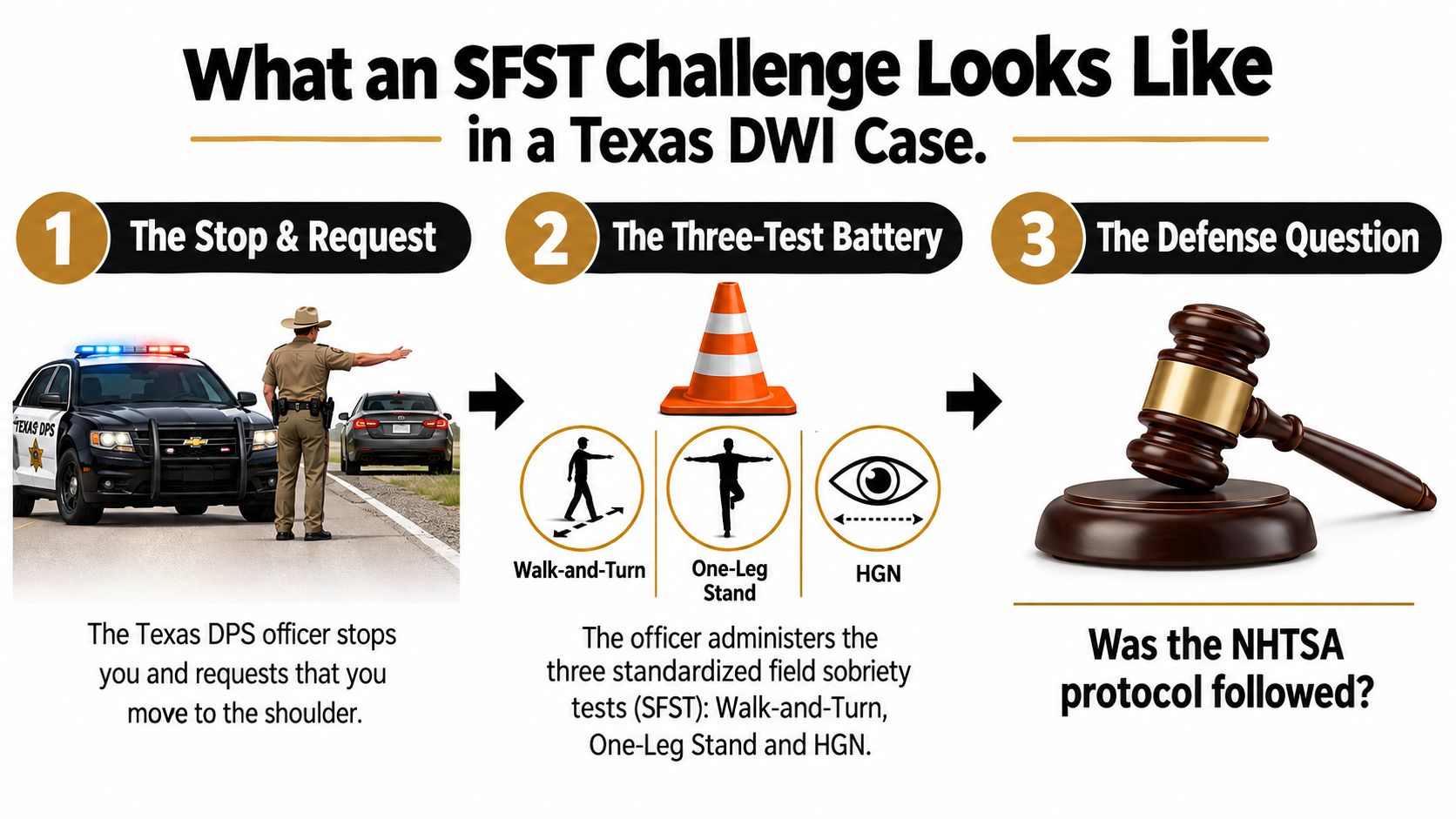
The typical scene is familiar. A Texas DPS trooper or local officer stops you after observing a traffic violation or driving pattern. The officer asks whether you've been drinking, directs you onto the shoulder, and asks you to perform three exercises. Later, the report may describe the officer as confident that you failed.
That report is not the end of the analysis. A field sobriety test, or SFST, is a standardized roadside exercise intended to help an officer evaluate possible impairment. BAC, or blood alcohol concentration, measures alcohol in a person's blood. The tests themselves don't measure BAC, and they don't directly prove that you lost the normal use of your mental or physical faculties.
Start with the video, not the conclusion
The first step is to compare the officer's report with body-camera, dash-camera, and roadside video. Look for the actual surface, lighting, traffic, weather, footwear, instructions, demonstrations, and the distance between the officer and the driver. A written conclusion can sound certain even when the recording shows hesitation, unclear directions, or a test performed under conditions outside the NHTSA research.
The second step is to identify each deviation. Did the officer give the standardized instructions? Did the officer record every clue accurately? Did a physical condition, injury, fatigue, anxiety, or medical history affect the performance? These details can change whether the results resemble the validated battery.
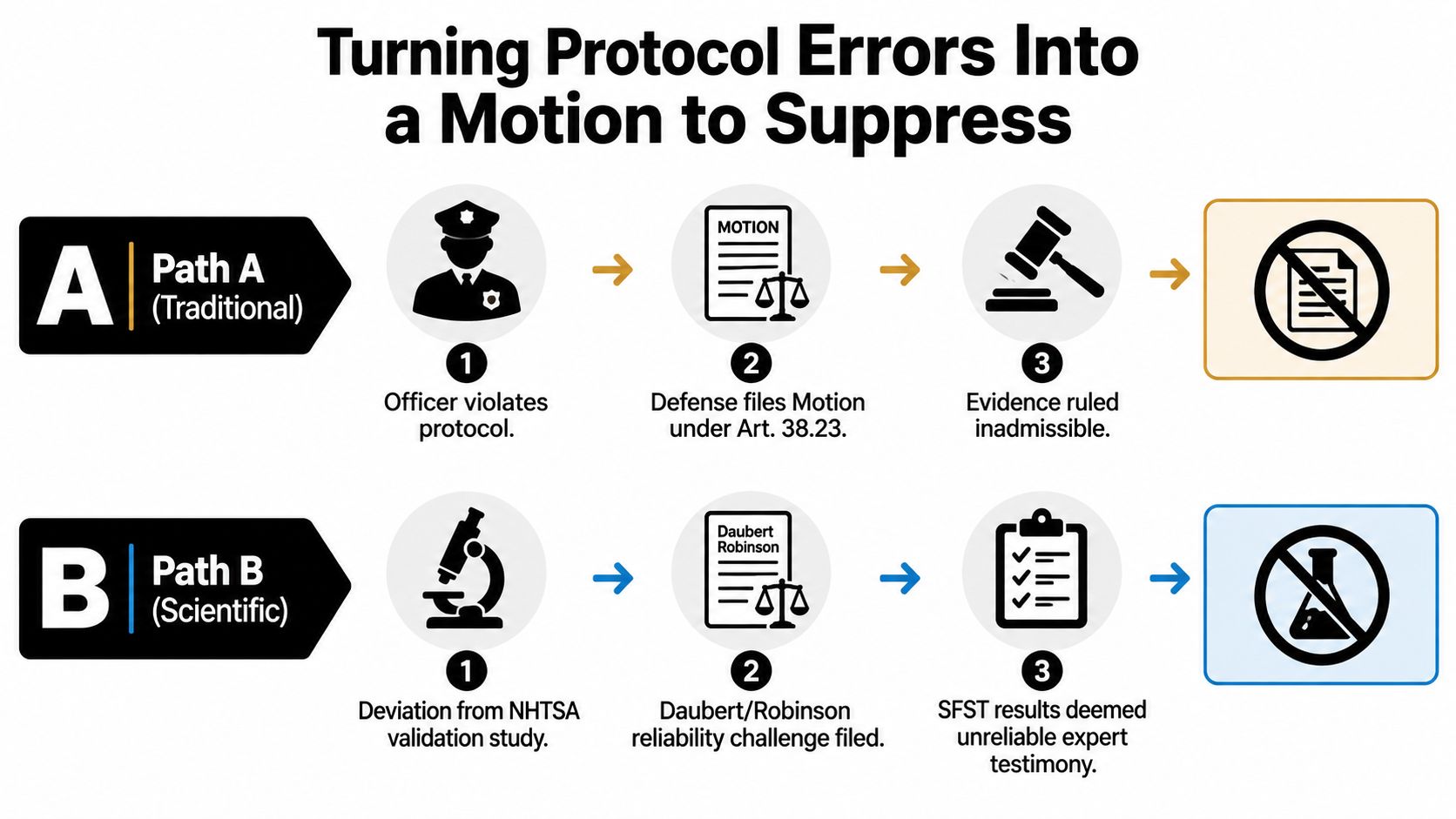
The third step is legal. Counsel may challenge the stop, the continued detention, the arrest decision, the admission of SFST observations, or the weight the jury should give those observations. In the right case, the defense can use Texas Code of Criminal Procedure article 38.23, a reliability challenge, and cross-examination together.
Practical rule: Don't argue that the officer's conclusion is wrong merely because you disagree with it. Show precisely how the observed test departed from the method used to produce the State's claimed accuracy.
How the NHTSA Validation Study Was Built
The SFST research developed in stages. NHTSA originally validated the three-test battery at a 0.10 BAC threshold in 1981, then sponsored field validation studies between 1995 and 1998 in Colorado, Florida, and San Diego under real-world enforcement conditions as standards moved toward 0.08. The foundational materials are collected in the NHTSA SFST participant manual.
The important question is what “validation” means. The research evaluated whether trained officers could classify people above or below a BAC cutoff using standardized clues and decision points. It did not establish that the exercises independently diagnose intoxication in every person, on every roadside, under every condition.
The early work used controlled subjects and trained officers. Later field studies examined people encountered during enforcement. That difference matters. Volunteers can be placed in conditions selected by researchers. Arrested motorists arrive with unknown medical histories, different footwear, uneven shoulders, poor lighting, traffic noise, fear, fatigue, and other factors that may influence performance.
The San Diego study evaluated 297 motorists. Their mean estimated BAC was 0.117, while their mean measured BAC was 0.122, a difference of 0.005 BAC that the study described as operationally irrelevant. The same line of research reported strong discrimination above and below 0.08 BAC, which explains why the battery remains common in DWI enforcement and courtroom disputes.
| Study | Year | Location | Subjects | BAC Range | Correct Classification at ≥0.08 |
|---|---|---|---|---|---|
| Foundational validation | 1981 | Controlled research | Not specified in the verified data | 0.10 threshold | Battery validated at 0.10 |
| Field validation | 1995 | Colorado | Arrested subjects and enforcement participants | Not specified in the verified data | Field accuracy reported in NHTSA materials |
| Field validation | 1997 | Florida | Enforcement participants | Not specified in the verified data | Field accuracy reported in NHTSA materials |
| Field validation | 1998 | San Diego | 297 motorists | Mean measured BAC 0.122 | Battery reported as highly accurate for classification above and below 0.08 |
The table also shows why courtroom language must be precise. An officer may say the tests are “accurate,” but the defense should ask, accurate for what task, under what conditions, and using what scoring rules? Classification around a threshold is narrower than proof of impairment.
Where the Validation Numbers Break Down
The NHTSA numbers are often presented as if they describe a standalone roadside diagnostic tool. They don't. NHTSA materials commonly cite detection rates at or above 0.08 BAC of about 88% for HGN, 79% for WAT, 83% for OLS, and 91% when all three are used together. Those figures come from standardized administration, proper clue scoring, and suitable conditions, as explained in the NHTSA SFST manual.
That qualification gives defense counsel a direct litigation point. The officer isn't entitled to borrow the research number while disregarding the protocol that produced it. A test conducted on a sloped shoulder, with unclear instructions, an unsuitable surface, or an altered stimulus is not the same test studied by NHTSA.
Independent academic analysis exposes another problem. One peer-reviewed analysis reported arrest accuracy of only 1% at BAC 0.30%, 34% at BAC 0.15%, and 100% at BAC 0.00%. Those figures don't mean every SFST result is wrong. They show that performance can deteriorate sharply when the target BAC isn't near the study threshold. The analysis is available in the peer-reviewed Law, Probability and Risk article.
The courtroom distinction
The studies classified people. Texas jurors decide whether the State proved intoxication under Texas law. Those aren't identical questions. A classification study can support an officer's investigation, but it doesn't transform physical coordination exercises into direct proof of intoxication.
The NHTSA refresher materials also cite field validation results showing 86% to 95% correct arrest or release decisions, while warning officers not to testify that a defendant “passed or failed” the SFSTs. The NHTSA refresher manual gives defense counsel a useful contrast: the published figures concern classification and decision-making, not a simple pass-or-fail diagnosis.
For a practical review of additional warning signs, see this guide to signs that a Texas DWI case may be weak. The strongest argument usually isn't broad rejection of SFST science. It's narrower and more persuasive: the State cannot claim validated accuracy when the officer didn't follow the validated method.
Inside the Three-Test Battery
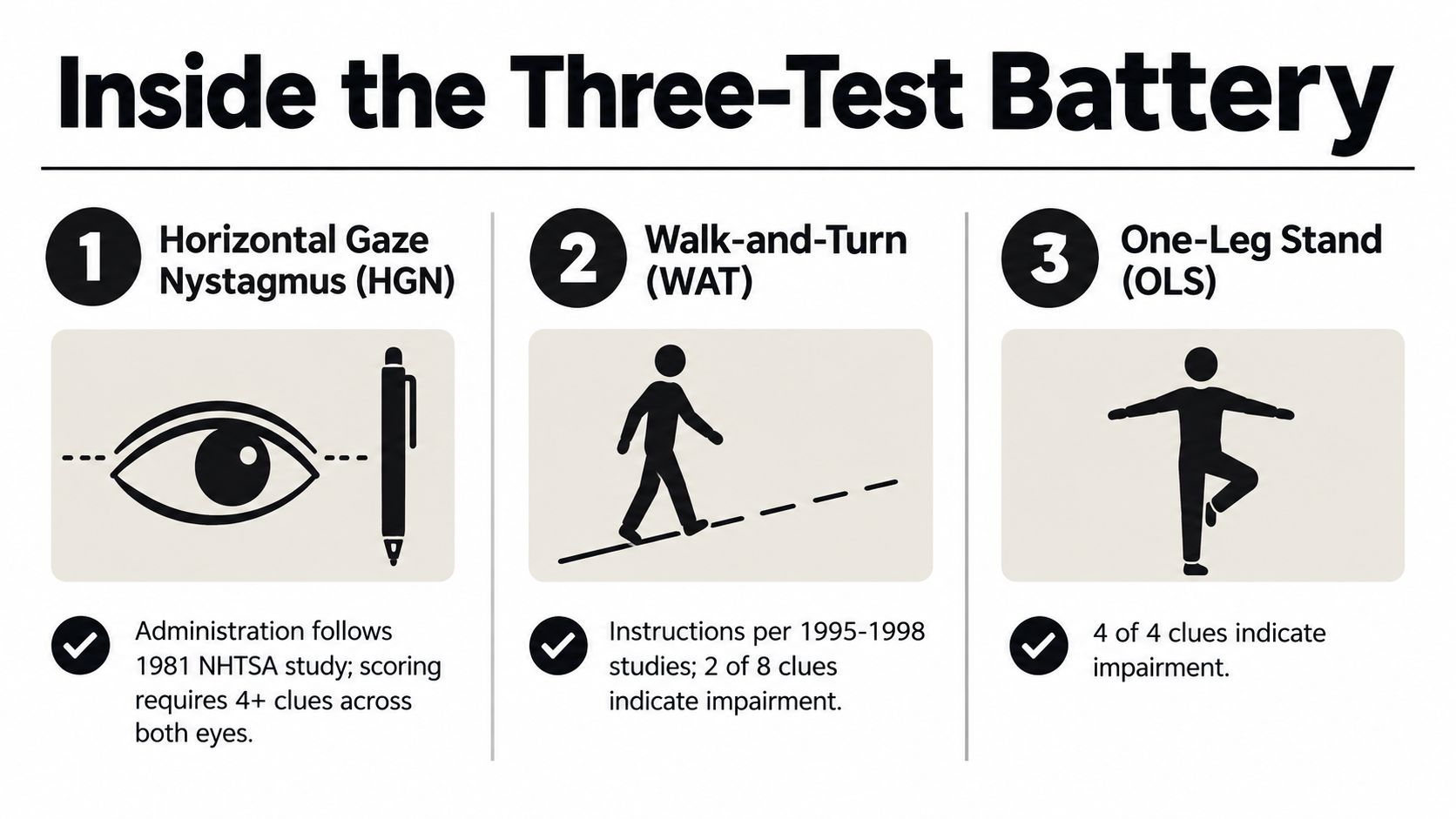
NHTSA recognizes only three scientifically validated roadside tests: HGN, WAT, and OLS. Each has a defined clue structure. The officer must administer and score the exercise consistently, then interpret the result within the limits of the training materials.
Horizontal Gaze Nystagmus
HGN examines involuntary eye movement as the eyes track a stimulus. The NHTSA scoring structure identifies six clues, with a commonly used arrest decision point of four clues. The officer must control the stimulus, maintain the proper distance, move it at the prescribed speed, and check for medical explanations that may affect eye movement.
A defense review should ask whether the officer moved the stimulus outside the prescribed 12-inch range, used an inconsistent speed, failed to keep the subject's head still, or skipped questions about head injury, inner-ear conditions, neurological issues, or medications. The HGN test resource explains why those details deserve close attention.
Walk-and-Turn
The WAT is a divided-attention exercise involving instructions, balance, counting, memory, and movement. It uses eight clues, with two clues commonly treated as the decision point in NHTSA training. The officer must explain and demonstrate the exercise, identify the starting position, and observe whether the subject begins correctly.
Small changes matter. Starting before the heels touch, using an unsuitable line or surface, failing to give uniform instructions, or interrupting the exercise can affect the result. A person who misunderstands the instruction may appear to show a clue without that clue reflecting alcohol impairment.
One-Leg Stand
The OLS also uses eight clues, with two clues commonly treated as the decision point in the validated scoring structure. The subject raises one foot, keeps the leg extended, and counts as instructed while maintaining position. The officer must document whether the foot touches down, the arms extend for balance, the body sways, or the subject hops.
The officer should also account for age, footwear, injury, fatigue, nervousness, and physical limitations. NHTSA's training materials emphasize standardized conditions, and the NHTSA instructor guide provides the framework for examining those conditions.
The practical lesson is straightforward. A test doesn't become reliable because an officer labels a movement a clue. The defense must ask whether the movement was observed, defined, and scored as the protocol requires.
Turning Protocol Errors Into a Motion to Suppress
A protocol error doesn't automatically win a Texas DWI case. It gives the defense a factual foundation for attacking the officer's conclusion and, depending on the circumstances, the legality or reliability of the evidence.
Build the record before arguing the law
A motion should begin with the court's jurisdiction and a clear factual narrative. Attach or identify the dash-camera and body-camera evidence, then list the deviations in the order they occurred. Avoid vague claims that the officer “did the tests wrong.” State exactly what the officer did, what NHTSA requires, and why the difference affects the claimed reliability.
A defense filing may use language such as:
Sample argument: “The State's probable-cause theory relies on SFST clues that were not observed under the standardized conditions used in the NHTSA validation research. Because the officer altered the instructions, failed to account for documented physical limitations, and scored movements outside the prescribed decision structure, the reported clues do not support the reliability or weight the State assigns to them.”
Article 38.23 of the Texas Code of Criminal Procedure can become relevant when the evidence resulted from a legal violation. The motion may challenge the stop, prolonged detention, or arrest if the officer lacked sufficient lawful grounds. The SFST errors can help show that the State's claimed basis for the arrest was weaker than the report suggests.
Add the scientific reliability argument
A separate Daubert and Robinson challenge focuses on whether the testimony rests on reliable scientific methods. The defense can rely on State v. Weller, State v. Neuzil, and Emerson v. State when framing the Texas law questions surrounding reliability, admissibility, and the use of scientific or specialized testimony.
The relief should be specific. Ask the court to limit or exclude testimony that presents SFSTs as direct proof of intoxication, prevents the officer from using unsupported “pass” or “fail” language, or bars conclusions that exceed the study's actual purpose. A fallback request can ask the court to hold a reliability hearing and exclude the SFST opinion if the State cannot establish a valid connection between the protocol and the administration in your case.
Use Article 39.14 early
Before the hearing, request the DWI arrest report, videos, dispatch records, photographs, written instructions, officer training materials, certification history, and records showing relevant updates. Article 39.14 discovery can reveal whether the report was prepared after the video, whether the officer omitted medical disclosures, and whether the written narrative matches what the camera records.
A Houston DWI lawyer should also examine whether the alleged clues support probable cause independently of the SFSTs. If the State's theory depends on a test administered outside the validation method, the defense has a concrete issue for the judge and a clear explanation for the jury.
Cross-Examining the Arresting Officer
Cross-examination should move from credentials to method, then from method to the video. The aim isn't to argue with the officer. It's to make the officer identify the protocol, accept its conditions, and explain every departure.
Foundational questions
Begin with training and memory:
- “When did you complete your NHTSA SFST training?”
- “When was your last SFST refresher?”
- “What manual governed your training at the time of this arrest?”
- “The three-test battery depends on standardized instructions and clue definitions, correct?”
- “The accuracy figures assume the officer follows those procedures?”
Then narrow the claim:
- “The tests don't produce a BAC reading, correct?”
- “They don't independently establish the loss of normal mental and physical faculties?”
- “The research concerns classification around a BAC threshold, not a medical diagnosis of intoxication?”
Administration questions
Use the video frame by frame:
- “What was the lighting at the testing location?”
- “Was the surface level, dry, and free from hazards?”
- “What shoes was the driver wearing?”
- “Did you ask about injury, balance problems, inner-ear issues, or head trauma?”
- “Did you observe the driver for the required period before testing?”
- “What exact instructions did you give?”
- “Did you demonstrate the entire exercise?”
- “Did you maintain the prescribed stimulus distance and speed for HGN?”
- “Did the driver begin the WAT only after the starting position was established?”
- “Did the raised foot touch the ground during OLS?”
- “Did you record the clues as they occurred, or reconstruct them later?”
The officer's report may say one thing while the video shows another. That contrast is often more effective than a long argument about scientific theory.
A strong cross-examination turns “I saw impairment” into separate questions about lighting, surface, instruction, observation, scoring, and alternative explanations.
When to consider an expert
Retain a forensic toxicologist or SFST instructor when:
- HGN matters: The case depends heavily on eye-movement observations or possible medical causes.
- The video is unclear: An expert can analyze timing, distance, instructions, and scoring.
- The subject has medical issues: Injury, neurological conditions, inner-ear problems, fatigue, or medication effects require careful interpretation.
- Chemical evidence conflicts: A toxicologist can connect the SFST limitations to the BAC evidence without overstating the defense.
- The officer claims scientific certainty: An SFST instructor can explain the difference between proper protocol and a roadside approximation.
Your Next Step Toward a Strong DWI Defense
Treat SFST evidence as evidence, not automatic proof. The State still must establish a lawful stop, sufficient grounds for detention and arrest, and admissible evidence supporting the DWI charge. A defense attorney can examine whether the officer followed the NHTSA method, whether alternative causes explain the clues, and whether the officer's testimony matches the recording.
Texas DWI law also creates separate consequences that require immediate attention. Implied consent means that a driver lawfully arrested for DWI is deemed to have consented to breath or blood testing. Refusing can trigger an administrative driver-license suspension of 180 days for a first refusal and two years for a second refusal within 10 years, as described in this Texas implied-consent overview. An administrative license suspension, or ALS, is a DPS license action that can proceed separately from the criminal DWI case.
For an adult driver, 0.08% BAC or higher is the legal threshold for a DWI charge. A first-offense conviction is generally a Class B misdemeanor carrying up to 180 days in jail, a fine of up to $2,000, and a license suspension that can last up to one year, according to this first DWI in Texas guide. A DWI arrest can also involve an ALR hearing, bond conditions, discovery, motions, plea negotiations, and trial.
What happens after arrest
- Request an ALR hearing promptly. The hearing concerns the license action, not guilt in the criminal case.
- Address bond and release conditions. Follow every court order and protect your driving privileges where possible.
- Obtain discovery. Request the arrest report, video, chemical-test records, dispatch material, and training records.
- Analyze the evidence. Compare the report, video, SFST protocol, medical history, and chemical testing.
- Choose the litigation path. Depending on the facts, counsel may pursue suppression, a reliability challenge, a negotiated resolution, expunction or record-sealing options, or trial.
The Law Office of Bryan Fagan, PLLC handles DWI defense issues including SFST reviews, chemical-test challenges, ALR hearings, first-time DWI cases, felony DWI matters, and related license concerns. A case evaluation should begin with the actual arrest materials, not a general assumption about what the officer's conclusion means.
The Law Office of Bryan Fagan, PLLC offers free consultations to review your arrest report, field video, chemical-test evidence, and possible SFST protocol deviations. Contact the firm to discuss your rights, your DWI license suspension risk, and a defense strategy designed for your Texas case.