
A DWI arrest can be overwhelming, but you don't have to face it alone. You may have been pulled over, taken to a station, asked to blow into an Intoxilyzer 9000, and given a result that doesn't match how you felt or behaved. If you're searching for a mouth alcohol defense involving an Intoxilyzer in Texas, the right question isn't whether the printed number is high. It's whether the entire testing process produced a reliable result.
Texas DWI cases involve two separate problems: the criminal charge and the possible DWI license suspension through the Administrative License Revocation process. Evidence about mouth alcohol, observation failures, medical conditions, dental work, operator training, and instrument records can matter in both proceedings. A careful defense treats the breath result as evidence to investigate, not as an unquestionable fact.
Mouth Alcohol and Your Texas Intoxilyzer Result
Mouth alcohol is residual ethanol remaining in the mouth, throat, or upper digestive tract when the Intoxilyzer takes a sample. It can come from a recent drink, regurgitation, vomiting, a burp, mouthwash, dental work, or other oral contamination. The concern is straightforward: the Intoxilyzer 9000 is intended to measure alcohol from deep-lung air, but it can't directly distinguish deep-lung alcohol from alcohol sitting in the mouth at the moment of sampling. Texas DPS explains the breath alcohol program and approved testing requirements.
That distinction can affect the result because alcohol in the mouth is more concentrated than the air expected from the lungs. A small amount of residual alcohol can therefore produce a breath reading that doesn't accurately represent your actual blood alcohol concentration, or BAC. BAC means the concentration of alcohol in a person's blood. In a breath case, the Intoxilyzer reports alcohol in grams per 210 liters of breath, rather than directly measuring blood.
Texas addresses this risk with a 15-minute continuous observation period immediately before the test. The certified operator is supposed to watch you and ensure that you don't place anything in your mouth. Drinking, smoking, chewing, vomiting, regurgitating, or another contamination event should cause the observation period to restart. The safeguard matters because research has found that mouth alcohol may dissipate to practical nonsignificance in roughly 10 to 19 minutes, while ethanol-containing mouthwash can still produce a false positive when tested within 15 minutes. The peer-reviewed breath-alcohol research is available through Springer.
The defense theory must be provable
Mouth alcohol isn't a magic phrase that automatically defeats a DWI. A credible defense identifies a possible contamination event, shows why the observation procedure failed to address it, and connects the failure to the machine's reported result.
Practical rule: Don't argue only that the number “looks wrong.” Build a record showing what happened before the sample, what the operator saw, what the video shows, and what the instrument records reveal.
Your attorney may examine the observation log, station video, breath-test printout, operator testimony, calibration records, and medical or dental history. That workflow-and-documentation attack can support a challenge at an ALR hearing and later help create reasonable doubt in the criminal case.
How the Intoxilyzer 9000 Reads a Breath Sample
The Intoxilyzer 9000 uses infrared analysis. During exhalation, the instrument examines how alcohol absorbs infrared light at specific wavelengths and converts that absorbance into a breath-alcohol measurement. The device is designed to target deep-lung, or alveolar, air because that air is expected to have a closer relationship to alcohol in the bloodstream than air from the mouth.
The sampling sequence matters. The machine requires a sufficient flow and volume and analyzes the breath curve during exhalation. The operator typically needs a continuous breath sample lasting at least 20 seconds, according to the Texas breath-testing description provided in the case research. A valid deep-lung sample should generally develop toward a plateau, while mouth alcohol may produce a rapidly declining curve.
Texas DPS describes the Intoxilyzer 9000 as using a slope-detection algorithm to look for a curve associated with mouth alcohol. The instrument also uses duplicate samples and checks whether they agree within the applicable tolerance. Texas DPS provides information about Texas breath-alcohol testing and the Intoxilyzer 9000.
Where safeguards can fail
Each safeguard addresses a different risk, but none replaces a careful review of the underlying record.
- Observation failure: The officer may be distracted, positioned poorly, or unable to see your mouth continuously.
- Undetected contamination: A burp, reflux episode, cough, or regurgitation may happen without the officer recognizing its significance.
- Dental retention: Dental work, dentures, bridges, or other structures may retain alcohol near the sampling path.
- Curve limitations: A slope algorithm may identify obvious contamination, but a high reading can still deserve scrutiny if the curve or surrounding records show irregularities.
- Duplicate agreement: Two similar samples don't prove that both samples came from uncontaminated deep-lung air.
The critical question is not whether the machine contains safeguards. It's whether those safeguards worked in your specific test.
A review of Intoxilyzer maintenance records can help determine whether the machine was properly maintained and whether the test sequence supports the State's interpretation. Chemical-test evidence can also be questioned through Challenging Breath and Blood Tests in Texas DWI Cases, which addresses how breath and blood evidence may be examined in a DWI defense.
Building Your Mouth Alcohol Defense File
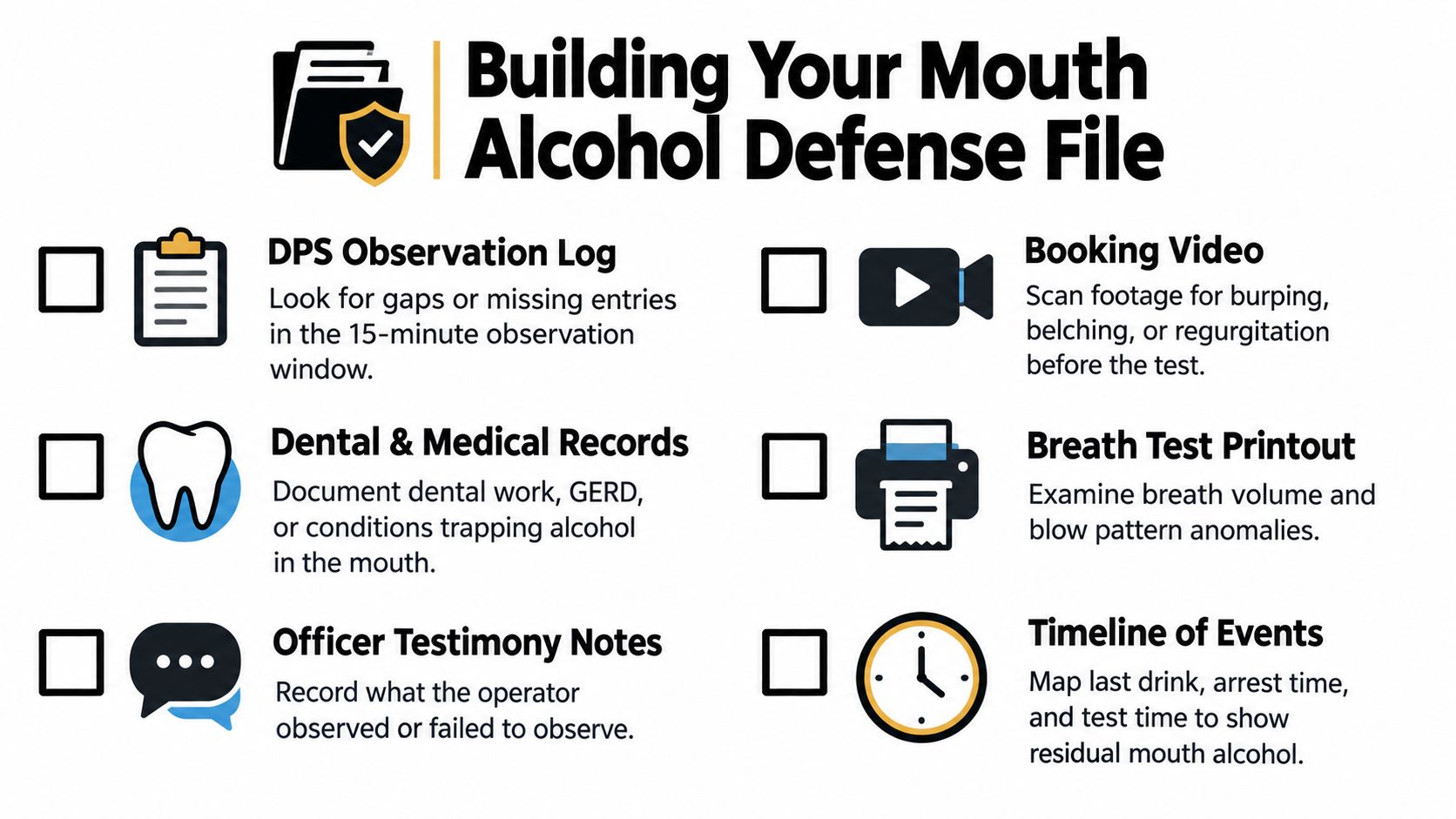
A strong file starts with the records created before and during the breath test. The DPS observation log should show when observation began, who watched you, and whether the period was continuous. Look for missing entries, unexplained gaps, changes in location, or testimony that conflicts with the written record.
Booking video can be more revealing than an officer's memory. Review the footage for burping, belching, coughing, vomiting, regurgitation, drinking, chewing, or any moment when the officer's attention moved away from you. Also determine whether a drink, mouthwash, breath spray, or other substance appeared in the vehicle or booking area.
Request the technical records
The Intoxilyzer file should include more than the final number. A Texas DWI attorney should seek the breath-test printout, calibration and diagnostic records, sequence-of-tests records, reference-standard information, and the operator's certification and proficiency records. The defense should compare those records with the officer's testimony and the timing shown on video.
The available case materials identify an instrument maintenance tolerance of 0.020. That number should be tied to the specific maintenance and calibration records in your case, not treated as a general conclusion that every test was reliable. A missing or incomplete record can create a meaningful question about whether the State can prove compliance.
Evidence is leverage only when someone preserves it, requests it, and connects it to a legal issue.
Your medical and dental history may supply the missing explanation. Gather records involving GERD, acid reflux, a hiatal hernia, recent oral surgery, dentures, bridges, mouthwash, breath spray, nicotine inhalers, or other oral products. Don't dismiss details because they seem minor. A brief reflux episode may matter if it occurred during the observation period.
Preserve the file for both proceedings
Counsel should send preservation requests for body-camera footage, dash-camera footage, booking video, observation video, dispatch records, and test records. The file should also include a written timeline covering your last drink, the traffic stop, arrest, arrival at the station, observation period, and breath test.
The same evidence can support both the ALR hearing and the criminal case. The deadlines and procedures differ, so the defense should organize the file early rather than waiting for the criminal case to approach trial. Standardized field sobriety evidence has its own weaknesses, which are addressed in Field Sobriety Tests and How They Are Challenged.
Using the Evidence at Your ALR Hearing
An Administrative License Revocation, or ALR, hearing is a civil proceeding that can suspend or disqualify your driver license after a DWI arrest. Texas DPS explains that an ALR consequence may follow a refusal, a failed test, or a BAC of 0.08% or higher in a non-commercial vehicle. The threshold for a commercial driver is 0.04% or higher. Texas DPS describes the ALR program and its consequences.
This is separate from the criminal DWI case. You can face the license proceeding while the criminal charge remains unresolved. That's why a Houston DWI lawyer should examine the breath-test workflow immediately, rather than treating the ALR hearing as a minor administrative matter.
Turn records into questions
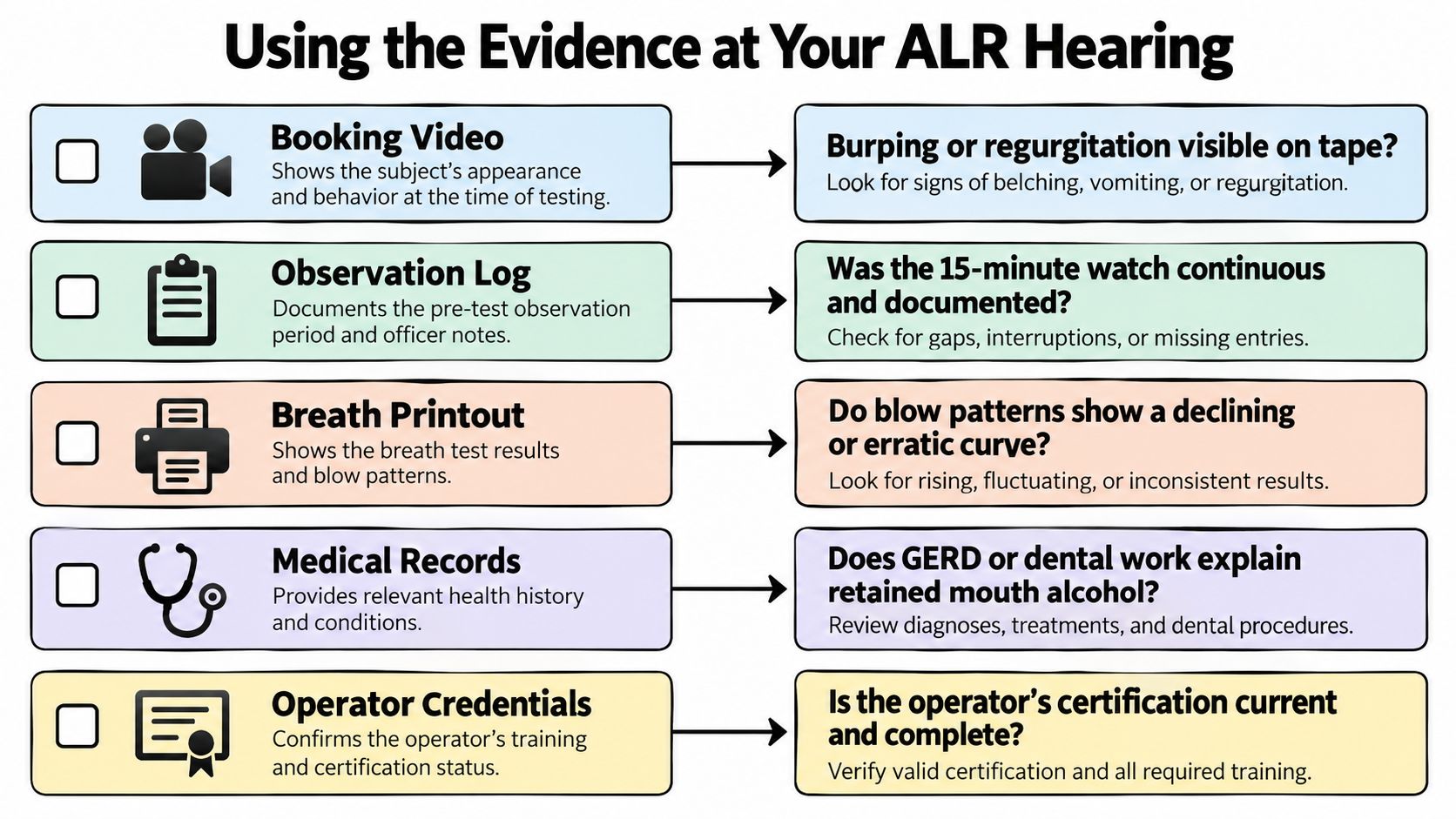
The defense should subpoena or request the records needed to test the State's proof. Questions for the breath-test operator may include:
- When did the observation period begin?
- Where was the operator standing?
- Could the operator see your mouth continuously?
- Did the operator observe coughing, burping, reflux, vomiting, or regurgitation?
- Did any interruption occur?
- Was the observation period restarted?
- Was the operator's certification current?
- Do the printout and logs match the operator's memory?
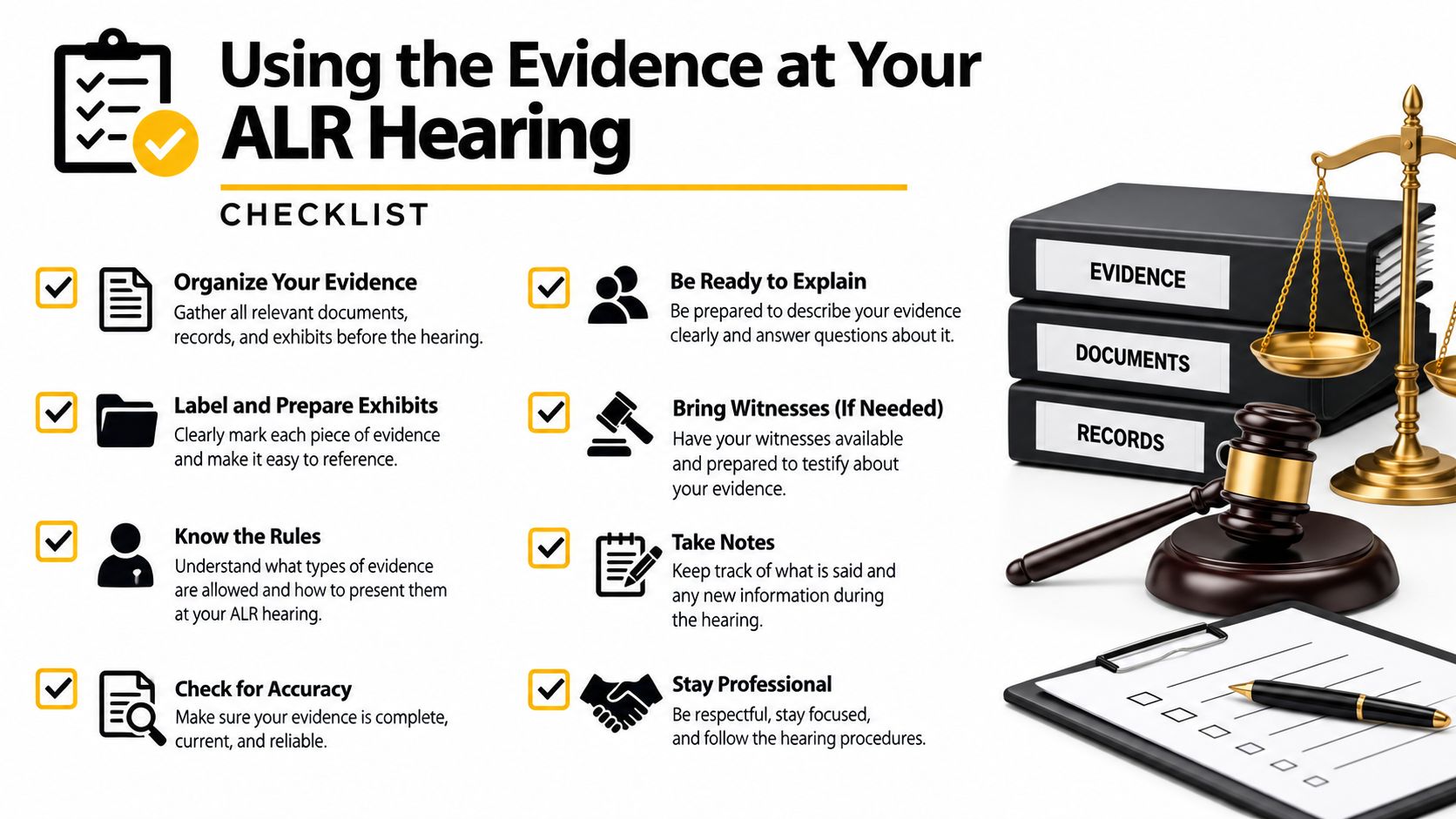
The video, log, printout, and certification records should be marked as exhibits when appropriate. If records are withheld, counsel can seek an order requiring production, request a continuance, or raise the evidentiary problem through the proper ALR procedure.
The hearing may also involve motions to suppress or a motion for directed verdict, depending on the evidence and the issues presented. Transportation Code Chapter 724 can affect timing and consent-related questions, so the lawyer must connect the procedural argument to the actual notice, test request, and records in your case.
An unfavorable ALR ruling doesn't decide guilt in the criminal court. The hearing can still preserve useful testimony, identify missing evidence, and expose weaknesses that later support trial litigation. Questions about future record relief also belong in a broader defense plan, including whether Clearing a Texas DWI: Expunction and Nondisclosure may be available after the case ends.
Fighting the Breath Test in Your Criminal Case
The criminal case requires a different presentation. The State must prove the DWI charge beyond a reasonable doubt, and the defense can challenge how officers obtained, handled, and interpreted the chemical evidence. A mouth alcohol theory should be developed through admissible records, testimony, video, and expert analysis, not offered as a bare possibility.
A lawyer may evaluate a motion to suppress under Texas Code of Criminal Procedure Article 38.23 when the evidence resulted from a legal violation. The analysis can include the traffic stop, probable cause, the request for testing, the observation period, consent, and whether the State complied with required procedures. Miranda issues may also arise depending on the circumstances of questioning and the evidence the prosecution wants to use.
Cross-examination follows the workflow
The breath-test operator should be questioned about the complete sequence, not just the final printed result. Relevant subjects include:
- Observation: What the operator saw, where the operator stood, and whether an interruption occurred.
- Operation: The operator's training, certification, proficiency, and familiarity with the instrument.
- Records: Calibration, diagnostics, reference standards, maintenance, air blanks, and sequence timing.
- Sample quality: Breath volume, blow duration, curve shape, slope detection, and agreement between samples.
- Chain of evidence: How the printout was created, stored, and connected to your test.
The arresting officer presents a separate set of issues. Counsel can examine the drinking timeline, field sobriety observations, medical conditions, speech and coordination, body-camera footage, and whether the officer saw any contamination event. A field sobriety test is not a direct alcohol measurement, and its interpretation depends on conditions such as footwear, lighting, road surface, health, and instructions.
Experts should answer specific questions
A forensic toxicologist or breath-test technician may help explain why the reported number doesn't necessarily establish the alcohol concentration in your bloodstream at the relevant time. The expert can evaluate mouth alcohol, slope detection, radio-frequency interference, calibration, simulator solution, sample quality, and the limits of the instrument's assumptions.
The defense shouldn't overstate the science. The trial-ready argument is narrower and stronger: the State's test may be unreliable because the required observation was incomplete, the records are deficient, the sample curve raises questions, or an oral or medical condition was not addressed. Those weaknesses can support reasonable doubt without claiming that every Intoxilyzer result is wrong.
Mouth Alcohol Without Recent Drinking
A mouth alcohol issue can exist even when you remember no recent drink. Mouthwash, breath spray, dental work, dentures, bridges, reflux, vomiting, or regurgitation may leave alcohol near the sampling path. GERD and acid reflux can also create a route for stomach contents to reach the mouth. Review acid reflux and its role in a Texas DWI defense to organize the medical questions without treating a diagnosis as an automatic defense.
Tell your lawyer about asthma inhalers, nicotine inhalers, recent oral surgery, and diabetes-related ketoacidosis concerns. These facts do not automatically prove an inaccurate result. They identify issues that require records, expert review, and comparison with the officer's observation timeline.
Build the timeline before drawing conclusions
Write down the events before testing while your memory is fresh. Record what you consumed, when you brushed your teeth, used mouthwash, chewed gum, took medication, experienced reflux, vomited, burped, or received dental treatment. Then compare your timeline with the officer's observation log and video.
Use the timing windows described earlier in this guide to test whether the observation period was continuous and whether it covered the contamination risk your timeline identifies. The question is not merely whether mouth alcohol was possible. The question is whether the State's records show that officers watched for, documented, and addressed the specific event that could affect your sample.
| Source | Typical Onset Window | Documentation to Gather |
|---|---|---|
| Recent mouthwash or breath spray | Close to the time of testing | Product receipt, container, statements, and video |
| Dental work, bridges, or dentures | During or after oral use | Dental records, treatment notes, and photographs |
| GERD or acid reflux | Around a reflux or regurgitation event | Medical records, prescriptions, and symptom history |
| Vomiting or regurgitation | Immediately after the event | Booking video, officer notes, medical records, and witness accounts |
| Inhalers or oral products | Near the time of use | Pharmacy records, prescriptions, and product information |
| Diabetes-related ketoacidosis concerns | Requires medical evaluation | Medical records and laboratory documentation |
Treat this as a workflow and documentation attack. Request the observation records, video, medical materials, and breath-test paperwork, then use the same timeline to prepare both the ALR hearing and the criminal case. A missing entry, unexplained gap, or failure to document a reported event may matter more than a general argument about mouth alcohol. The strongest presentation connects the suspected source to timing, observation, sampling, and the instrument record.
Next Steps After a Texas DWI Breath Test
Act quickly after the arrest. If you want to challenge the administrative suspension, request an ALR hearing within 15 days of receiving the suspension notice. Missing that deadline can cost you the opportunity to contest the license action, so don't wait for the criminal case to develop.
Texas implied consent means that, by driving on Texas roads, you generally agree to chemical testing under the conditions established by law. Refusing a breath or blood test can create separate license consequences. If you consent to a blood test, DPS states that the suspension notice isn't issued until the BAC results are received. Read about the separate refusal process in Texas Implied Consent and Refusing a Breath Test.
Protect the evidence immediately
Send written preservation requests for body-camera, dash-camera, booking, and observation footage. Gather dental and medical records, save the breath-test paperwork, and don't post about the stop on social media. Avoid discussing the facts with anyone except your lawyer, because casual statements can later become evidence.
A qualified breath-test expert may need time to review the records, so early retention can matter. Your attorney should also coordinate the ALR strategy with the criminal defense rather than treating them as unrelated matters.
At the first consultation, expect questions about:
- The timeline: When the stop, arrest, observation, and breath test occurred.
- The test: What you were told, what you did, and whether anything interrupted the process.
- Your health: Reflux, dental work, medications, inhalers, diabetes, and recent illness.
- The evidence: Videos, paperwork, witness names, medical records, and court notices.
- Your priorities: License protection, employment, commercial driving, family obligations, and the criminal charge.
A first DWI in Texas can create serious disruption, but an arrest isn't a conviction. A Texas DUI attorney can investigate the stop, challenge field sobriety and chemical-test evidence, protect the ALR deadline, and pursue a result that accounts for the weaknesses in the State's proof. If you're looking for a lawyer to fight DWI in Texas, choose counsel who will examine the workflow, not just repeat the number printed on the breath slip.
The Law Office of Bryan Fagan, PLLC reviews Intoxilyzer records, observation procedures, medical and dental evidence, ALR issues, and criminal DWI defenses for Texans facing breath-test charges. Visit Law Office of Bryan Fagan, PLLC to request a free consultation and discuss your license deadline and mouth alcohol defense with a Texas defense team.