
A DWI arrest can be overwhelming, but you don't have to face it alone.
You may have just looked at your phone, your paperwork, or your calendar and realized you missed probation. Now your mind is racing. Will your probation officer file a violation? Will the judge issue a warrant? Does one bad mistake mean your whole case is falling apart?
Take a breath. A missed probation appointment is serious, but it is still something you can address. What matters most now is how you respond in the next few hours and days. A calm, documented, lawyer-guided response can put you in a far better position than panic, silence, or trying to explain everything on your own.
That Sinking Feeling You Just Missed Your Probation Appointment
Missing probation is often not a deliberate act of defiance against the court. It happens because life gets messy. A work shift ran long. A child got sick. A car wouldn't start. You wrote the date down wrong. Or you thought a text reminder would come and it didn't.
That doesn't mean the court will automatically see it that way.
If your probation is tied to a Texas DWI case, the stakes feel even higher because you're already dealing with court conditions, reporting rules, alcohol education, testing, and license issues. You may be asking whether a single missed meeting means jail, whether your first DWI in Texas just became much more dangerous, or whether a Houston DWI lawyer can still fix this.
Often, the answer is yes. But the fix usually starts before a hearing is even scheduled.
Practical rule: Don't treat a missed probation appointment like a scheduling problem. Treat it like a legal event.
The strongest response usually has two parts. First, you stop the problem from growing. Second, you start building proof that this was an honest mistake, not a refusal to comply.
That distinction matters. Judges often react differently to a documented one-time error than they do to a pattern of shrugging off probation rules. If you move quickly, gather the right records, and avoid making unplanned statements, you may be able to protect your freedom and your future.
The Legal Fallout A Motion to Revoke and a Possible Warrant
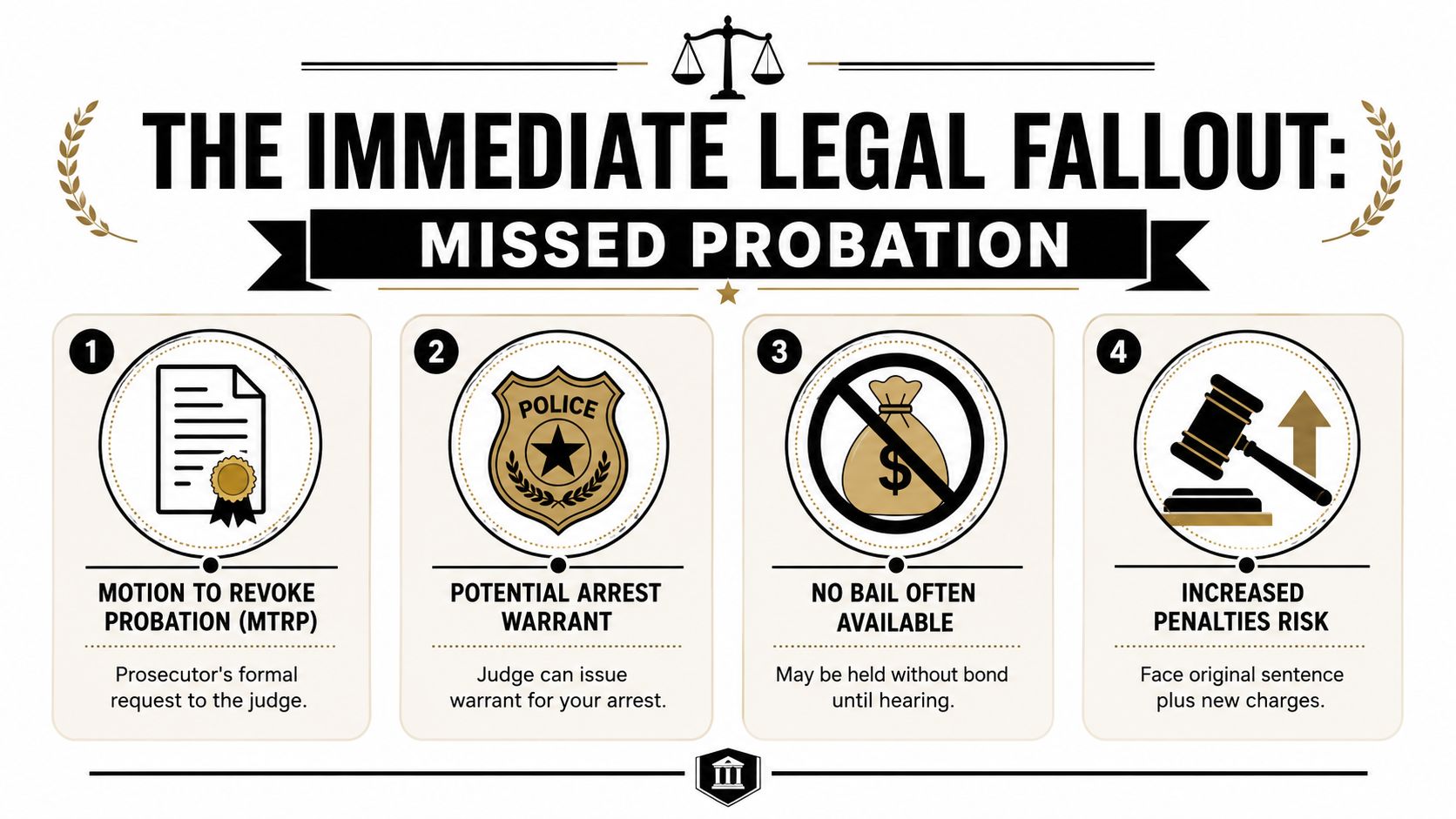
A missed probation appointment can trigger a chain reaction. Your probation officer may report the violation. A prosecutor may then ask the judge to act. In many Texas courts, that means a request to revoke, adjudicate, or modify probation depending on how your case was originally resolved.
A Motion to Revoke Probation is the formal request for the judge to take away your probation and impose consequences for the violation. If you were on deferred adjudication, the paperwork may be called a motion to adjudicate. If you want a plain-language overview of that process, review motion to adjudicate in Texas DWI cases.
What a judge may do next
A judge can issue a bench warrant, which is a court order for your arrest based on the alleged probation violation. In some cases, people learn about the warrant only after a traffic stop or when they appear in court on something else.
Another hard reality is that probation violation cases don't always work like a new arrest case. Bond options can be limited, and some people are held until the court addresses the violation.
Why courts take technical violations seriously
In 2023, over 110,000 people in the United States were incarcerated for technical probation violations, which frequently include missed appointments with probation officers, according to the Council of State Governments Justice Center findings on supervision violations and incarceration. That tells you something important. Courts do not treat reporting failures as harmless paperwork mistakes.
If your probation came from a DWI charge, keep the original case context in mind too. BAC means Blood Alcohol Concentration. In Texas, 0.08% or higher is legally defined as intoxicated for most adult drivers, 0.04% for CDL holders, and under Texas zero-tolerance rules, a driver under 21 can face penalties for any detectable amount, including 0.02%, under Texas Penal Code Section 49.01 as summarized here.
That original DWI evidence still matters. In some cases, probation problems sit alongside questions about the arrest itself, including chemical testing. Challenging Breath and Blood Tests in Texas DWI Cases addresses how chemical-test evidence can be questioned in a DWI defense.
The court may see the missed meeting as proof you're not following rules. Your job, and your lawyer's job, is to supply a better explanation backed by records.
Your First 24 Hours A Prioritized Action Plan
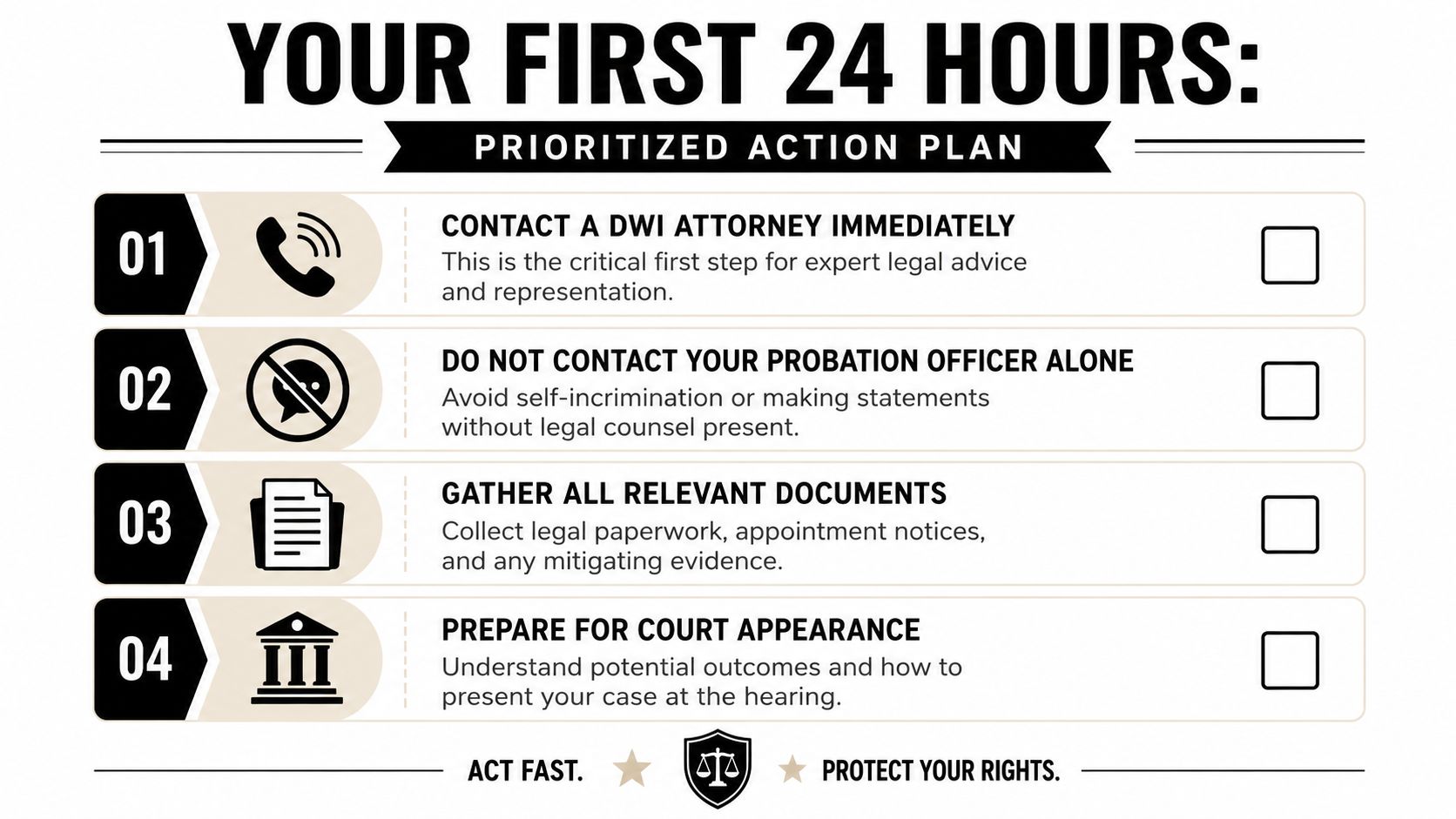
Start with the step often delayed. Talk to a lawyer before you start making cleanup calls.
If you're searching for a Texas DUI attorney or Houston DWI lawyer, this is the moment to get case-specific advice. The right strategy depends on your county, your judge, your probation terms, whether you're on regular probation or deferred adjudication, and whether there is already a violation report or warrant. For a focused overview, see this guide on Texas DUI probation violations.
A helpful visual can keep your next steps organized.
Step one is legal advice, not damage control
Many people think they should immediately call the probation officer and explain everything. Sometimes that works. Sometimes it gives the officer a clean admission they can place in a report.
That doesn't mean you should hide. It means you should be strategic.
- Call defense counsel first: You need to know whether to contact the officer immediately, how to phrase the contact, and what documents to gather before that conversation.
- Avoid casual explanations: Don't guess, ramble, or add facts you can't support.
- Ask about county practice: Some courts react differently to prompt outreach than others.
If this is tied to a first offense, First-Offense DWI in Texas: Penalties and Defenses explains what a first DWI charge means and how it can be challenged.
Build your file before someone else builds theirs
Start collecting every piece of paper or digital record that helps explain the miss.
Bring together:
- Appointment proof: Screenshot the date, time, notice, text, email, or voicemail if one exists.
- Your timeline: Write down exactly when you realized the appointment was missed and what happened that day.
- Mitigation records: Medical documents, work schedules, car repair receipts, rideshare logs, school records, childcare issues, or phone records.
- Probation paperwork: Conditions, prior reports, prior check-in history, and payment receipts if fees are involved.
Later in this section, watch this short video for additional context on handling a probation problem in a DWI case.
Be careful with DWI side issues
A missed appointment sometimes happens while other DWI deadlines are also running. If your case began with a Texas DWI arrest, an administrative license suspension issue may exist apart from the criminal case. In Texas, an Administrative License Revocation hearing, often called an ALR hearing, must be requested within 15 days of a DWI arrest to stop an automatic suspension, and if no hearing is requested, the license is suspended 40 days after arrest under Texas Transportation Code Section 521.342 as described here.
Also remember the meaning of implied consent. In Texas, by driving, you're considered to have agreed to provide a breath or blood sample if lawfully arrested for DWI. Refusing can trigger an automatic 180-day suspension for a first refusal and a 2-year suspension for a repeat refusal under Texas Transportation Code Section 724.015 as summarized here.
If you're trying to fight DWI Texas consequences, don't separate the probation problem from the license problem. They often move on different tracks at the same time.
Strategic Options for Mitigating the Violation
Once the first-day panic settles, the case becomes about positioning. You are no longer just reacting to a missed probation appointment. You are shaping how the court sees it.
Some people think the only strategy is to apologize and hope for mercy. That's incomplete. Courts respond better when the explanation is supported by documents, timing, and a practical compliance plan.
The difference between one mistake and a pattern
Judges look for a pattern of non-compliance before revoking probation. The key is to legally distinguish your situation as a one-time honest mistake. Preparing a Non-Compliance Mitigation Packet with records like medical documents or work schedules is a proactive way to document and excuse the absence before a hearing is even scheduled.
That packet should be built for persuasion, not just sympathy.
A strong packet may include:
| Item | Why it matters |
|---|---|
| Medical records or doctor note | Shows a concrete reason for the missed appointment |
| Work schedule or employer letter | Supports a conflict or sudden work demand |
| Transportation proof | Documents car trouble, towing, repair, or travel disruption |
| Communication log | Shows attempts to contact probation or clarify reporting |
| Personal timeline | Keeps the story consistent and specific |
Deciding how to handle a warrant risk
If a warrant has already issued, walking into custody without a plan can create unnecessary time in jail. In some cases, counsel can coordinate a managed surrender or court appearance that limits chaos and helps present mitigation early.
That decision is fact-specific. A person with otherwise clean compliance history may be in a different position than someone with prior warnings.
One reason timing matters so much in DWI cases is that deadlines are built into the system. The same urgency applies to license consequences. An ALR hearing is not the same as criminal court, but it can affect your ability to drive. That's why clients dealing with probation concerns often also need a plan for Texas implied consent and refusing a breath test, especially where breath or blood testing issues shaped the original arrest.
The Law Office of Bryan Fagan, PLLC handles Texas DWI defense matters that can include probation violations, ALR issues, and challenges to the evidence underlying the original arrest.
Preparing for Your Probation Revocation Hearing
A probation revocation hearing is not a new jury trial on the DWI itself. It is a hearing where the judge decides whether you violated a condition of probation and what to do about it.
That difference matters because the hearing is more focused, more procedural, and often moves faster than people expect. Your probation officer's report may play a major role. So can your own words, your documents, and your overall compliance history.
What the hearing usually looks like
The judge, prosecutor, defense attorney, and often the probation officer will be involved. The court reviews the alleged violation, hears arguments, and considers records or testimony.
Possible outcomes can include:
- Probation continues: The judge may reinstate probation, sometimes with a warning or extra conditions.
- Terms are modified: You may face stricter reporting, added classes, or other requirements.
- Probation is revoked: The judge can impose the original sentence that was suspended when probation was granted.
Bring order to the hearing before you ever walk into court. Judges notice when a client has records, dates, and a plan.
Key DWI terms still matter here
A few legal terms often confuse people during this stage.
- Implied consent: By driving in Texas, you're considered to have agreed to provide a breath or blood sample after a lawful DWI arrest.
- Field sobriety test: These are roadside coordination and attention tests officers use during a DWI investigation. They are not the same thing as a breath or blood test.
- Administrative license suspension: This is the DPS side of a DWI case involving your driving privileges. It is separate from the criminal court case.
If your arrest involved roadside testing, chemical testing, or a disputed stop, those facts may still affect the larger defense picture even while the probation hearing focuses on compliance.
Common Defenses and Preventing Future Violations
Not every missed probation appointment is willful. That's a central defense theme. The law and the court process make room for disputes about notice, intent, and reliability of the reporting system.
A missed meeting can sometimes be defended on the facts. Other times, the smarter path is mitigation plus a prevention plan that convinces the judge this won't happen again.
Defenses worth discussing with counsel
A few defenses come up often in Texas probation cases:
- Lack of willfulness: You didn't intend to ignore probation. Something specific prevented attendance.
- Insufficient notice: The appointment date, time, or reporting method was unclear or never properly delivered.
- Administrative mistake: Office error, clerical confusion, or conflicting instructions caused the problem.
A newer issue is digital notification failure. A 2025 report from the American Probation and Parole Association showed a 42% increase in claims of procedural errors related to missed digital notifications from automated systems. That creates a real defense question when an appointment notice was sent by an unreliable automated system or to the wrong number.
The digital notice problem is becoming real
More probation systems rely on texts, automated scheduling, and online reminders. That sounds efficient until the message is delayed, garbled, or sent to outdated contact information.
If your missed probation appointment involved a text you never got, a changed phone number, or an automated reminder that failed, preserve everything:
- Take screenshots
- Save call logs
- Don't delete messages
- Write down when you updated contact information
For broader rules that shape these cases, review Texas probation laws and violation issues.
Prevention is part of the defense
The best prevention plan is simple and repetitive.
- Use more than one reminder: Put appointments in your phone, on paper, and in a shared calendar if needed.
- Confirm in writing: If probation gives verbal instructions, follow up with a written confirmation when possible.
- Keep a compliance notebook: Track reporting dates, classes, fees, tests, and every communication.
- Talk to your lawyer early: If a conflict is coming, get advice before it turns into a violation.
For some clients, the long-term goal after resolving a DWI case may include record-cleanup options such as expunctions or related relief if the law allows. But the first step is finishing this phase without another avoidable problem.
Take Control with an Experienced Texas DWI Attorney
A missed probation appointment doesn't define your case. Your response does.
If you act quickly, document the reason for the miss, and avoid making unplanned statements, you give yourself a real chance to contain the damage. If you wait, guess, or hope the court won't notice, the problem usually gets harder to fix.
Texas DWI probation cases often involve several moving pieces at once. Court conditions. Reporting rules. A possible warrant. A DWI license suspension issue. Questions about the underlying stop, the field sobriety test, or the chemical test. A lawyer's job is to pull those pieces together and build a defense strategy that fits your county, your judge, and your record.
You don't have to handle this alone. If you're trying to protect your license, avoid jail, and fight DWI Texas consequences after a probation problem, get legal guidance before the situation escalates.
If you missed a probation appointment after a DWI arrest, contact Law Office of Bryan Fagan, PLLC for a free, confidential case evaluation. Our team works with clients across Houston and surrounding Texas courts to assess probation violations, license issues, and DWI defense options, then build a practical plan for the next step.