
A DWI arrest can be overwhelming, but you don’t have to face it alone.
If you’ve been told probation is the outcome that keeps you out of jail, that may sound like a win. Sometimes it is. But probation in Texas is not a light sentence, and it is not something you can handle casually. It is a court order with rules, deadlines, reporting duties, and enough traps to turn a manageable case into a revocation problem fast.
That’s why I tell clients to treat probation as part of the defense strategy, not just the sentence. The right approach can protect your license, your job, and your future record. The wrong approach can put you back in court before you realize how serious the issue is.
Understanding Probation in Texas
A lot of people first learn about probation laws texas when they’re standing in a courtroom, hearing terms like community supervision, deferred adjudication, reporting, classes, and testing. They nod along, then go home unsure what any of it really means.
Start with the basic point. Probation is court-ordered supervision in the community instead of serving your sentence in jail or prison. For many DWI defendants, that’s the outcome worth fighting for. But probation only helps you if you complete it successfully.
Texas uses probation heavily. Nearly 450,000 adults were under probation in Texas around 2018, including about 170,000 felony probationers, according to the Texas Public Policy Foundation report on adult probation. That tells you something important. Judges use probation every day, but they also expect strict compliance because the system is large and heavily supervised.
Why this matters in a DWI case
If your case involves a first DWI in Texas, probation may be the path that keeps you working and at home with your family. If your case involves a repeat allegation, the terms can be tighter and the risks higher.
You need to know three things right away:
- Probation is not freedom: You still answer to the court.
- Every condition matters: Missing even a small requirement can create a bigger legal problem.
- Early legal guidance helps: The conditions you accept at the start can affect how hard probation becomes later.
If you want a closer look at what day-to-day supervision can involve, review this guide on DUI probation supervision in Texas.
Practical rule: The best time to avoid a probation violation is before probation starts. Get clear on every condition, every deadline, and every reporting rule on day one.
Probation Types and Legal Foundations
Texas probation law usually comes down to two paths in a criminal case. Community supervision after a conviction, often called straight probation, and deferred adjudication, where the court delays a finding of guilt if you complete the terms successfully.
For a DWI defendant, the difference matters a lot.
Straight probation
With straight probation, the court enters a conviction and then suspends the jail sentence while you serve supervision in the community.
That means:
- you have a conviction on your record,
- you must follow the probation order,
- and if the court revokes probation, you can be ordered to serve the original sentence.
For some DWI cases, straight probation is a common outcome of a negotiated plea. It can still be a strong outcome compared with immediate jail time. But you need to understand the trade-off. You are avoiding confinement now by taking on strict obligations later.
Deferred adjudication
Deferred adjudication works differently. The judge accepts your plea, postpones a final finding of guilt, and places you on supervision. If you complete the terms, you avoid an adjudicated conviction in that case.
That’s why people often push hard for deferred adjudication when it’s legally available and strategically smart. It can leave you in a better position later when you’re dealing with background checks or possible record-sealing options.
But don’t misunderstand it. Deferred adjudication is still probation. If you violate it, the court can move forward with adjudication and impose punishment.
The legal framework that governs this
A lot of the nuts and bolts come from Article 42A of the Texas Code of Criminal Procedure. That part of Texas law governs community supervision, modifications, hearings, and termination issues. In DWI cases, the Texas Penal Code and Transportation Code also matter because they shape the charge, the conditions, and the license consequences tied to the case.
That same legal framework is why your probation strategy can’t be separated from your defense strategy. The criminal case, the supervision terms, and the DWI license suspension issues all connect.
Which option is better in a DWI case
There isn’t one answer for every client. I look at four things first:
| Issue | Straight probation | Deferred adjudication |
|---|---|---|
| Conviction status | Conviction entered | Final adjudication delayed |
| Risk if violated | Revocation and original sentence risk | Adjudication and sentencing risk |
| Record impact | Usually harsher record consequence | Often better long-term posture |
| Negotiation value | Sometimes more available | Sometimes harder to obtain |
If you’re choosing between the two, don’t focus only on the label. Focus on the full package:
- What classes and treatment are required?
- Will an ignition interlock be ordered?
- How strict is the reporting?
- How will the disposition affect your job and license?
- Is this the best setup for later relief?
Age and success rates matter
Younger clients often underestimate how demanding probation can be. That’s a mistake. Texas probation success rates vary sharply by age. Only 18% of people ages 17 to 21 completed probation successfully in one Texas-focused discussion of the issue, while the rate rose to over 40% for ages 22 to 25 and 60% for those 25 and older, as summarized in this Texas probation success rate article.
I don’t read that as a reason to give up. I read it as a warning. If you’re young, busy, impulsive, or juggling work and school, you need more structure, not less.
Terms every DWI client should understand
A few legal terms come up early and often:
- BAC means blood alcohol concentration.
- Implied consent means that by driving in Texas, you can face consequences for refusing a lawful breath or blood test request.
- Field sobriety test refers to roadside physical and attention tests officers use during a DWI investigation.
- Administrative license suspension means the separate DPS-related process that can suspend your license apart from the criminal case. You’ll often hear this called the ALR hearing process.
If you’re trying to fight DWI Texas charges, those terms aren’t side issues. They shape plea options, trial strategy, and probation conditions.
Deferred adjudication can be a smart result. It is not a free pass. If you treat it casually, the court won’t.
Probation Conditions for DWI Offenders
The biggest mistake people make is assuming probation just means “stay out of trouble.” That’s not enough. In a DWI case, your order will usually include a list of conditions, and every line matters.
Some conditions are standard. Others are specific to alcohol-related cases.
Common general conditions
Most probationers in Texas can expect requirements like these:
- Report as directed: You may need regular check-ins with your probation officer.
- Pay court-ordered money: This can include fines, court costs, supervision fees, or other financial obligations.
- Complete assigned service or programs: Community service and educational classes are common.
- Stay employed or stay in school: Courts often want to see stability and routine.
- Avoid new arrests or offenses: Any new criminal allegation can create immediate problems.
These conditions sound simple on paper. They aren’t always simple in real life. Work schedules change. Childcare falls apart. Transportation becomes a problem. If you wait until after a missed appointment to explain it, you’re already behind.
DWI-specific probation conditions
DWI probation usually adds alcohol-focused rules. Depending on the case, a judge may order:
- Alcohol education classes
- Counseling or treatment
- Random alcohol or drug testing
- Ignition interlock use
- No alcohol consumption
- Travel restrictions
- Curfew or location restrictions in some cases
For many clients, the no-alcohol condition is where trouble starts. They think a single drink at a wedding, dinner, or football game won’t matter if they don’t drive. That’s the wrong mindset. If your order says no alcohol, then no alcohol means no alcohol.
What compliance actually looks like
Good compliance is documented compliance.
Keep copies of everything:
- class completion certificates,
- payment receipts,
- interlock service records,
- testing records,
- counseling attendance logs,
- work schedules,
- and any written communication with probation.
If a dispute comes up, your memory won’t protect you. Your paperwork might.
A practical way to stay ahead
I tell clients to build one probation file and update it every week. Paper folder, phone folder, cloud folder. It doesn’t matter. Just keep it organized.
Use a short checklist:
- Did you complete every task due this month?
- Do you have proof of each completed task?
- Are your payments current or addressed?
- Do you need written permission for travel or schedule changes?
- Has anything happened that your lawyer should know immediately?
If a condition feels confusing, ask before you act. Probation officers and judges usually care more about a preventable mistake than an honest question.
For a Houston DWI lawyer or Texas DUI attorney, probation review is not paperwork cleanup. It’s risk control. If your order is too vague, too burdensome, or unrealistic for your job and family obligations, deal with that early.
Reporting Requirements and Compliance Strategies
Reporting is where many probation cases go sideways. Not because the client is trying to fail, but because daily life gets messy and probation doesn’t leave much room for sloppy follow-through.

What reporting usually involves
Your reporting terms depend on the court and the supervision office. Some people report in person. Some may have electronic or remote components. Some have more frequent contact early on and less later if they stay compliant.
Expect reporting to include some mix of:
- Scheduled check-ins: monthly or as directed by your officer
- Document review: pay stubs, class records, proof of residence, or treatment updates
- Testing instructions: alcohol or drug screening notices
- Field contacts: home or employment verification in some cases
If testing is part of your order, learn exactly how it works and what happens if you miss a date. This page on a drug test for probation helps explain why missing a test can be treated seriously.
How to avoid technical problems
A lot of probation violations aren’t new crimes. They’re admin failures. Late reporting. Missing paperwork. Not updating an address. Not bringing proof of payment.
That means your best strategy is boring, disciplined consistency.
Try this system:
- Use one calendar: Put every reporting date, class, payment due date, and interlock appointment in one place.
- Set two reminders: One a week before. One the day before.
- Keep a monthly compliance packet: Bring the same core documents every time unless your officer says otherwise.
- Report changes fast: New job, job loss, move, car trouble, medical issue. Tell your officer and your attorney early.
- Ask for adjustments before a problem develops: Work conflict and childcare conflict are easier to address in advance than after a missed obligation.
Fees and scheduling issues
People often ignore money issues until they become violation issues. Don’t do that. If payments are difficult, address the issue directly and document your efforts.
The same goes for scheduling. If you travel for work, care for children, or work night shifts, your officer needs to know your specific situation. Courts don’t expect perfection. They do expect communication.
When legal help fits in
If your conditions are causing recurring problems, legal counsel may need to step in before the issue becomes a formal violation. The Law Office of Bryan Fagan, PLLC handles probation-related DWI defense issues, including guidance on compliance and responses to violation allegations.
That kind of help is especially useful when reporting obligations collide with your employment or with a pending DWI license suspension matter.
Consequences of Violations and Revocation
Most probation trouble falls into one of two categories. Technical violations or substantive violations.
Technical and substantive violations
A technical violation means you broke a probation rule without being accused of a new crime. Missing a report date, missing a drug test, or failing to update your address are common examples.
A substantive violation usually means the state alleges a new criminal offense or another serious breach beyond routine noncompliance.
Technical violations are the most common in Texas probation law, including failures to report, missed tests, and address-update problems, as discussed in the Texas Judicial Council fact sheet on probation conditions.pdf).
What happens after an alleged violation
The state can file a motion asking the court to act. In straight probation, that is often called a motion to revoke. In deferred cases, it may be a motion to proceed with adjudication.
The process usually looks like this:
- Allegation filed
- Court setting or arrest on the violation matter
- Hearing before the judge
- Evidence presented
- Judge decides whether to continue, modify, sanction, or revoke
Many people are blindsided at this point. The burden on the prosecution in a probation violation setting is lower than the burden in a criminal trial. That changes the risk analysis immediately.
What the judge can do
Possible outcomes include:
- continuing probation as is,
- changing conditions,
- adding treatment or other sanctions,
- short jail sanctions in some situations,
- revoking probation and imposing the original sentence.
Your response matters. Silence, panic, and excuses usually don’t help. Records, context, and prompt action do.
Strong defense starts with proof
If you’re accused of a violation, gather every piece of evidence that supports your side:
- receipts,
- screenshots,
- attendance records,
- medical records,
- repair records for transportation or interlock issues,
- and witness statements if relevant.
A hearing often turns on whether your conduct looks careless, unavoidable, corrected, or ongoing.
Here’s a short video that helps explain the seriousness of probation violation issues in Texas.
Don’t wait for the hearing date to start defending yourself. Build your response the moment you learn a violation is being alleged.
Early Modification and Termination Options
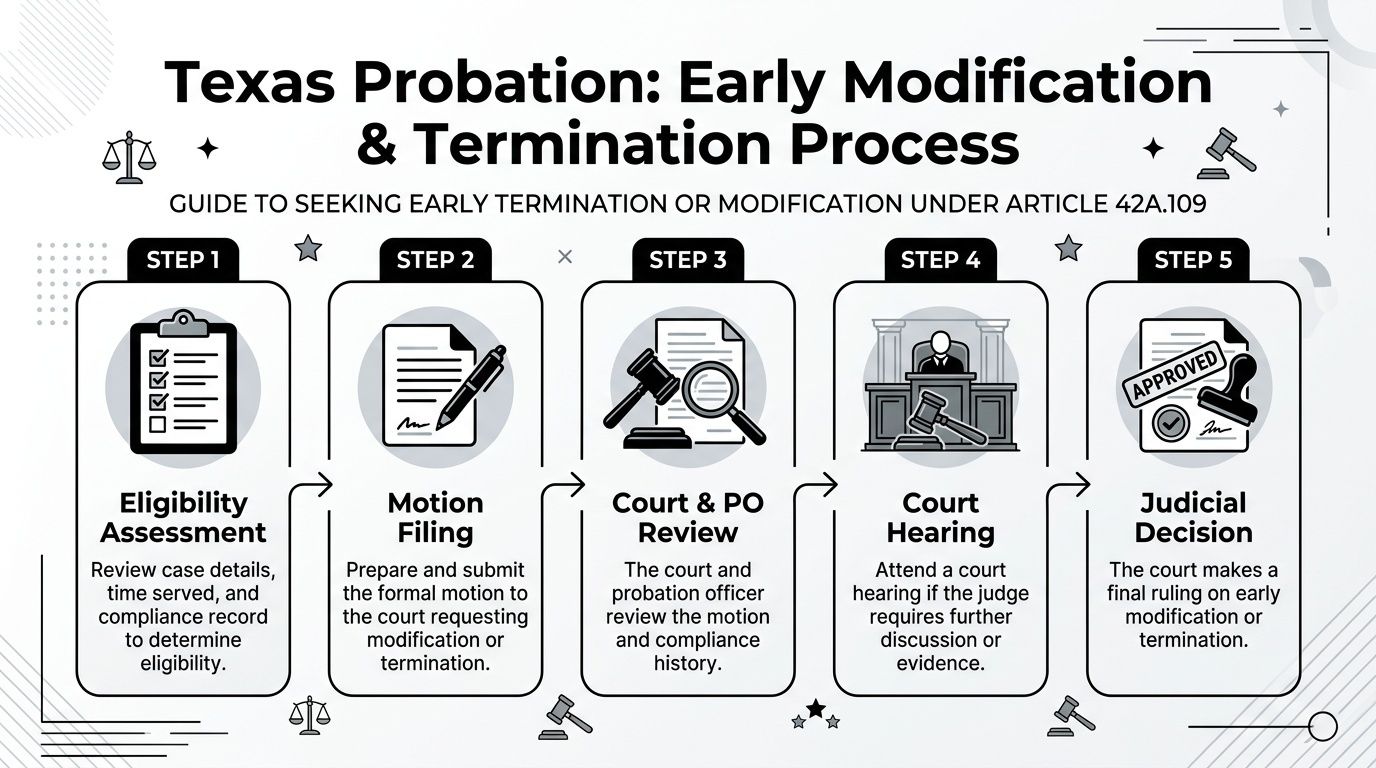
Probation doesn’t always have to last the full term. In some cases, Texas law allows you to ask for relief before the end. That can mean modifying conditions or seeking early termination.
When you may be eligible
Article 42A.109 allows discretionary early release after one-third of the term, or after two years for longer terms over six years, if the court finds it is in society’s best interest. The court must also conduct a judicial review at one-half of the term upon request, as summarized in this discussion of how probation works in Texas under Article 42A.109.
That does not mean early termination is automatic. It never is.
For DWI defendants, eligibility can be limited by the offense type and the specific facts of the case. That’s why you need a case-specific review before filing anything.
How to build a serious request
Judges want a reason to trust you. Give them one.
Bring substance, not just optimism:
- Proof of completed conditions: classes, counseling, service hours, treatment
- Payment records: fines, costs, and any required fees
- Negative testing history: when available and relevant
- Work and family stability: employment records, scheduling demands, caregiving obligations
- A clean compliance history: or a documented explanation for any issue that came up
If you want practical guidance on the filing process, review this page on DUI early probation termination in Texas.
Modification can help before termination
Sometimes early termination isn’t the first move. Modification is.
If a condition is interfering with work, treatment progress, transportation, or family responsibilities, your lawyer may be able to ask the court to adjust it. That can be the smarter play when a full release isn’t realistic yet.
Examples include requests related to:
- reporting logistics,
- travel permission,
- treatment scheduling,
- or conditions that no longer fit your circumstances.
Five steps that work better than guesswork
- Review the judgment and probation order carefully.
- Confirm that enough time has passed for a valid request.
- Gather proof before filing, not after.
- Address any weak points.
- Present a clear reason why modification or termination serves both you and the public interest.
A weak early termination motion can hurt more than it helps. File when your record supports the request.
Impact on License and Criminal Records
Probation is only part of the problem in a DWI case. Your driver’s license and your criminal record create a second set of consequences, and they don’t always move on the same timeline as the court case.
License issues and the ALR process
After a DWI arrest, you may face an administrative license suspension through the DPS process. That is separate from the criminal prosecution. This process is often called an ALR hearing, which stands for Administrative License Revocation.
Here’s the simple version:
- the criminal case decides guilt, punishment, and probation terms,
- the ALR case deals with your driving privileges,
- and you can win one fight and still lose ground in the other if you ignore it.
That’s why a Texas DUI attorney looks at both tracks immediately. If you miss the deadline to challenge the license action, you can lose your advantage quickly.
Terms that often confuse drivers
A few points need to stay clear:
- Implied consent means Texas can impose consequences for refusing a lawful breath or blood test request.
- Field sobriety test means roadside balancing and divided-attention tests the officer uses during the investigation.
- BAC means blood alcohol concentration, which may become a key issue in both negotiations and trial preparation.
- DWI license suspension can arise from the administrative process, from the criminal court result, or from both.
These aren’t just vocabulary words. They affect whether you can drive to work, how your case is defended, and what probation conditions make sense.
Criminal records and future relief
Whether probation helps or hurts your record depends heavily on the type of disposition. A conviction generally creates a harder record problem than a successful deferred outcome. But either way, you need realistic advice about what can and cannot be cleaned up later.
That matters for:
- licensed professionals,
- job applicants,
- parents in custody disputes,
- and anyone with security-sensitive employment.
CDL drivers face a harder reality
Commercial drivers get hit from two directions at once. Federal CDL disqualification rules under 49 CFR § 383.51 impose a mandatory one-year disqualification for a first alcohol-related offense, a consequence many general probation guides miss, as noted in this discussion of Texas probation law and CDL consequences.
If you hold a CDL, don’t assume probation saves your livelihood. It may help in the criminal case, but the licensing fallout can still be severe. That makes early strategy even more important for a Houston DWI lawyer handling a commercial driver’s case.
Practical Next Steps and FAQs
If you’re on probation already, or you think probation is the likely outcome, act like details matter. They do.
Your immediate checklist
- Get the written order: Don’t rely on memory from court.
- Calendar every deadline: Reporting, classes, testing, fees, interlock appointments.
- Create a compliance folder: Digital, paper, or both.
- Ask questions early: If a term is unclear, get clarification before you guess.
- Address license issues separately: Don’t assume the criminal court handles everything with DPS.
- Talk to a lawyer fast if anything goes wrong: Missed test, failed test, interlock problem, new arrest, job conflict, travel issue.
Common questions clients ask
Can I travel while on probation
Maybe, but don’t assume you can. Travel usually depends on your court order and probation officer approval. Get permission in advance and keep proof.
Do I have to tell my employer
Sometimes yes, sometimes no. It depends on your job, your licensing status, your contract, and whether driving is part of your work. If you hold a CDL or a professional license, get legal advice before you make that call.
What if I miss a payment
Don’t ignore it. Document the reason, communicate quickly, and look for a lawful way to address it before it turns into a violation allegation.
Can I still fight the DWI if probation is offered
Yes. A probation offer is not the same thing as the best outcome. In some cases, the right move is to challenge the stop, the testing, the field sobriety evidence, or the license suspension process instead of rushing into a plea.
What should I do after a DWI arrest in Texas
Handle it in order:
- deal with bond conditions,
- request help on the ALR hearing if needed,
- review the evidence,
- assess defenses,
- evaluate plea options only after you understand the consequences.
If you want to fight DWI Texas charges intelligently, don’t treat probation as the whole answer. Treat it as one option inside a broader defense plan.
If you’re dealing with probation, a first DWI in Texas, a DWI license suspension, or a possible violation, get legal guidance before a small problem becomes a bigger one. The Law Office of Bryan Fagan, PLLC offers free consultations for Texans who need a clear plan after a DWI arrest. You can request a case evaluation, get answers about probation terms, ALR hearings, deferred adjudication, expunction-related options, and what it will take to protect your record, your license, and your future.