
A DWI arrest can turn an ordinary night into a mess by morning. Your car may be impounded. Your phone is full of missed calls. You're trying to remember what the officer said about court, your license, and a breath or blood test. In that moment, you likely aren't thinking about “long term consequences of a DWI conviction in Texas.” You're thinking, “How bad is this, and what do I do first?”
That reaction is normal.
Panic, however, is not a strategy. A DWI case in Texas moves fast, and some of the damage starts before you ever step into a courtroom. If you wait, you lose options. If you act early, you can protect far more than your court date. You can protect your driver's license, your job, your record, and your ability to move forward.
A DWI Arrest Is Overwhelming but You Are Not Alone
I've spoken with plenty of people right after an arrest, and most say the same thing. They feel embarrassed, angry, confused, and scared all at once. Some are convinced their life is over. Others think it's “just a first DWI in Texas” and that they can deal with it later. Both reactions can lead to bad decisions.
What matters now is control.
A Texas DWI case isn't just about whether you pay a fine or show up in court. It can create a chain reaction. One missed deadline can lead to a license suspension. A suspended license can affect work. Trouble at work can strain your finances. A criminal record can keep showing up when you apply for housing, renew a license, or try to change jobs.
That's why I want you to think about this the right way. You are not just reacting to an arrest. You are managing risk across the next several months and, in some cases, years.
Practical rule: Treat the first days after a DWI arrest like a legal emergency, not a paperwork issue.
Here's the good news. A charge is not a conviction. Police reports can be challenged. Traffic stops can be challenged. Field sobriety testing can be challenged. Breath and blood evidence can be challenged. Administrative deadlines can still be met if you move quickly.
If you're searching for a Houston DWI lawyer or a Texas DUI attorney, you probably want a straight answer. Mine is simple. Don't try to “wait and see.” Start building your defense now, while the evidence is fresh and the deadlines haven't closed.
The Two Battles You Must Fight The ALR and The Criminal Case
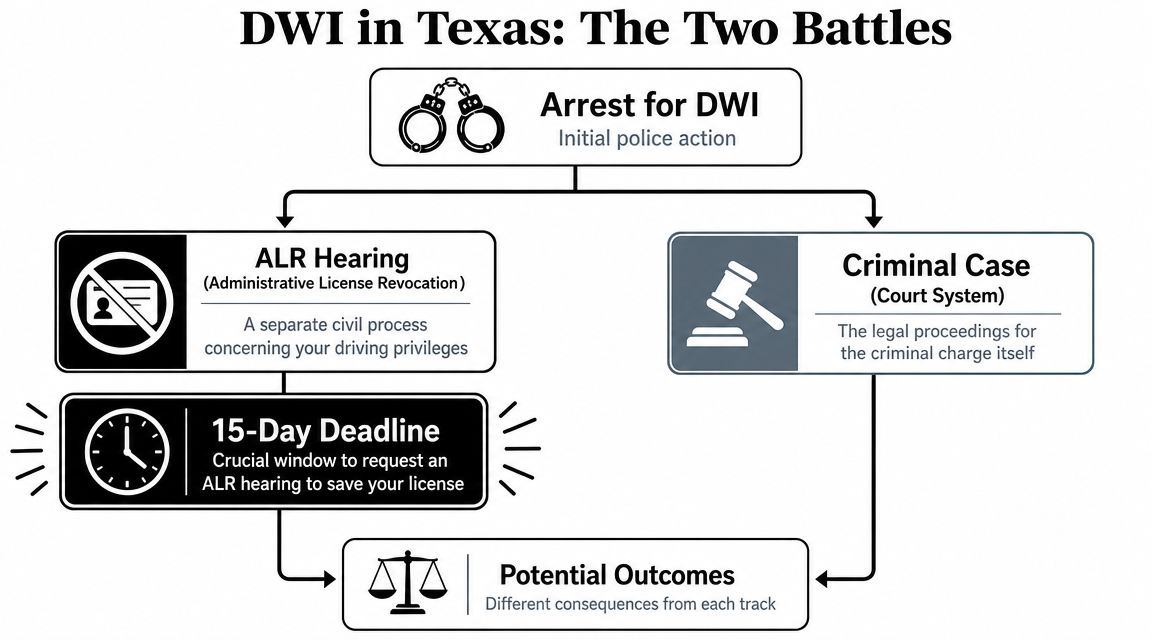
A Texas DWI arrest usually creates two separate cases. Many individuals only focus on the criminal charge and overlook the other. That mistake can cost you your license even if the court case ends better than expected.
The criminal case
This is the part typically recognized. The state accuses you of driving while intoxicated, and the case moves through the court system. That process can involve bond conditions, court appearances, evidence review, negotiations, motions, and possibly trial.
A few basic terms matter here:
- BAC means blood alcohol concentration. Texas law treats a person as legally intoxicated at 0.08%, and penalties can still apply even below that if alcohol or drugs affected driving ability, according to the Texas Department of Transportation impaired driving page.
- Field sobriety test usually refers to roadside tasks officers use to claim impairment, such as balance, divided attention, and eye-movement testing.
- Implied consent means that by driving in Texas, you've already agreed to provide a breath or blood specimen under the rules that apply after a lawful DWI arrest. Refusing can trigger administrative consequences even before the criminal case is finished.
The ALR case
The second battle is the Administrative License Revocation, or ALR, process. This is separate from criminal court. It focuses on your driving privileges.
Under Texas materials summarized by the Texas Impaired Driving Task Force, a first-offense chemical test failure can lead to a 90-day ALR suspension, and a first-offense refusal can lead to a 180-day suspension. You have 15 days to request a hearing, and if you don't act, the suspension can move forward on its own. You can review that rule on the Texas Impaired Driving Task Force DWI laws and consequences page.
That 15-day deadline is one of the most important deadlines in your whole case.
What happens right after arrest
A simple roadmap is beneficial. Here it is:
Release from jail or booking
You may be given bond conditions and paperwork with court information.Notice about license suspension risk
The ALR issue begins. The clock may already be running.Request the ALR hearing quickly
If you want to fight DWI Texas cases intelligently, this is one of the first moves.Start evidence review
Your lawyer should look at the stop, arrest, bodycam, dashcam, statements, test procedures, and whether the officer had legal grounds.Prepare for court and defense strategy
Sometimes the strongest early move is attacking probable cause. Sometimes it's preserving your ability to drive. Often it's both.
Missing the ALR deadline doesn't just hurt your driving privileges. It can also hand the state an early strategic advantage.
Why this two-track system matters long term
The criminal case and the ALR case can affect each other in practical ways, even though they are separate. If your license is suspended, commuting gets harder. If commuting gets harder, work gets harder. If work gets harder, money gets tighter. That pressure pushes people into rushed plea decisions.
That's why a smart defense starts early. You don't wait for the problem to grow roots. You challenge the suspension risk, preserve testimony and records, and make the state prove every part of the case.
Beyond the Courtroom The Financial and Driving Consequences
A lot of clients expect the hard part to be the court date. Then real life starts hitting all at once. The license problem affects work. Work problems strain your budget. Money pressure pushes bad decisions. That timeline is why you need a strategy early, not after the system has already boxed you in.
A DWI record can keep creating new problems
A Texas DWI conviction can stay visible long after the case ends, and that matters because future employers, landlords, lenders, and licensing agencies may keep seeing it. The Texas Criminal Defense Group discussion of long-term DWI consequences explains how a single conviction can keep resurfacing during job changes, housing applications, and credential reviews.
That repeated exposure is what makes this charge so disruptive.
You are not dealing with one bad month. You may be dealing with a record that keeps costing you opportunities years later. A smart defense looks at that risk from day one and asks a harder question than “How do we get through court?” It asks, “How do we protect your future options?”
Driving consequences can rearrange your daily life
License trouble is rarely just a transportation issue. If you drive to work, take children to school, care for a parent, or travel for your job, a suspension can throw your whole routine off balance.
Some terms sound technical, but the ideas are straightforward:
| Term | Plain-English meaning | Why it matters |
|---|---|---|
| Administrative license suspension | A separate process that can restrict your license after arrest | It can affect your ability to drive before the criminal case is resolved |
| Ignition interlock device | A device in your vehicle that requires a breath sample before the car starts | It adds cost, monitoring, and daily compliance rules |
| License reinstatement | The process of restoring full driving privileges | It usually requires more than waiting out the suspension |
An administrative license suspension is separate from the criminal case. That separation matters because an early setback with your license can create missed shifts, attendance problems, and extra expense before your court case is even finished.
An ignition interlock device also changes day-to-day life more than people expect. It can affect every trip to work, every school pickup, every errand, and every schedule in your household.
The financial hit spreads fast
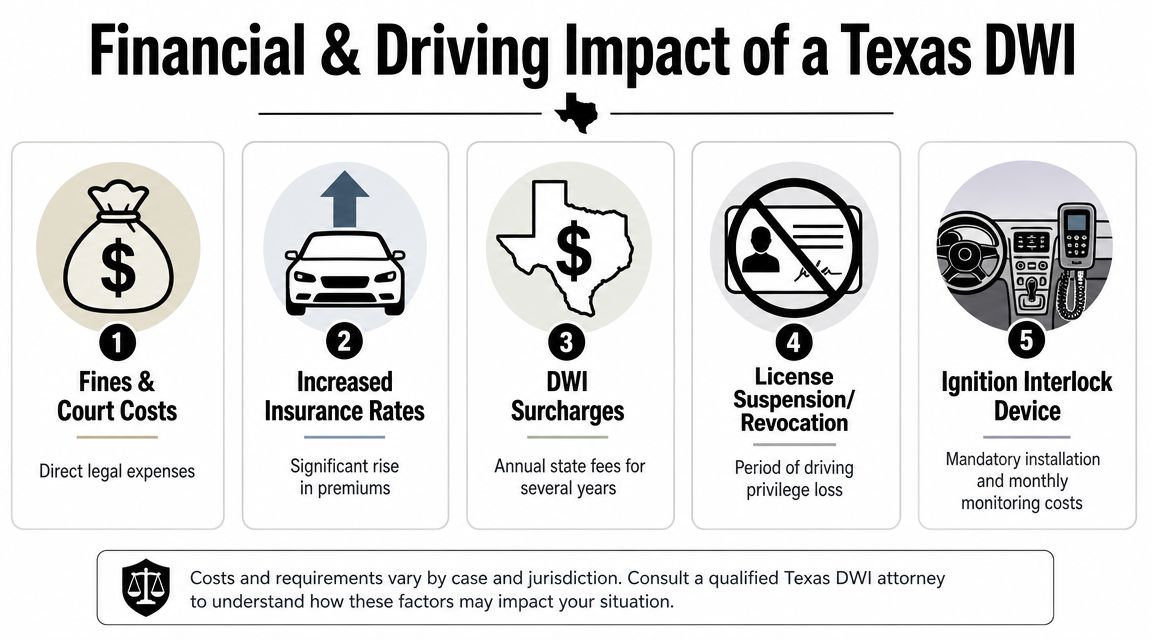
Court costs are only the beginning. A DWI can lead to fines, reinstatement fees, interlock costs, higher insurance premiums, towing and impound charges, alcohol education expenses, and lost income if you miss work or lose a job that depends on driving.
That pileup is the primary problem. One administrative issue leads to transportation trouble. Transportation trouble leads to work trouble. Work trouble leads to late bills, strained savings, and pressure to resolve the case quickly instead of wisely.
If you want a fuller breakdown of how those costs can build over time, review this guide to the long-term financial impact of a Texas DUI.
The people who come out of a DWI in the best position are usually the ones who treat the case as a long-term financial and licensing problem immediately.
Getting your license back usually takes more effort than people expect
Many drivers assume full reinstatement happens automatically once the suspension period ends. It usually does not. The Texas Department of Public Safety license eligibility and reinstatement page explains that drivers may need to satisfy suspension requirements, pay fees, and complete required steps before they can lawfully return to normal driving.
That process can drag on. Paperwork errors, missed requirements, and compliance issues can keep the problem alive longer than it should be.
If you hold a commercial driver's license, the risk gets even more serious. Your ability to earn a living may depend on protecting your driving privileges from the start. That is why I treat the license side of a DWI case as part of the main defense plan, not a side issue to clean up later.
How a DWI Conviction Can Impact Your Career and Family
The personal fallout from a DWI is often worse than the courtroom part. You can survive a hearing date. It's harder to shrug off a failed job application, a licensing board inquiry, or an accusation in family court that you're irresponsible.

Work and professional licenses
If you work in a regulated profession, a DWI conviction can create trouble beyond your criminal case. Nurses, teachers, lawyers, financial professionals, and other licensed workers may have to disclose a conviction or answer questions from a board or employer. Even when a license isn't automatically revoked, the review itself can threaten your income and your reputation.
Background checks make the problem recurring. A DWI can affect an application, a promotion, a transfer, a contract renewal, or a professional credential review. The trouble is not always immediate. Sometimes it appears the next time you try to improve your position.
That's why I tell clients to stop thinking only about “beating the ticket.” The primary question is broader. How do you protect your future earning power?
Family and custody issues
Family courts care about stability, judgment, and child safety. A DWI conviction can become part of that conversation, especially during a contested custody or visitation dispute. The other side may try to use it to question your decision-making, even if the arrest had nothing to do with your children.
This issue deserves careful planning, not excuses. If you're dealing with parenting concerns alongside a criminal case, read this guide on how a DWI affects child custody battles in Texas.
Judges and employers don't usually see the full story. They see the record first. Your defense needs to account for that reality.
There's also a housing angle people overlook. When a conviction appears on a background check, landlords may view you as a risk. That can narrow your options at exactly the time you need stability.
Immigration and travel concerns
For non-citizens, a DWI case can raise immigration questions that go beyond local court. The right answer depends on your exact status, history, and the facts alleged in the case, so this is not an area for guesswork.
If immigration is part of your life, your criminal defense lawyer should coordinate carefully with immigration counsel before any plea is entered. A fast plea that seems convenient can create consequences you didn't expect.
A short explanation from our team may help clarify what's at stake:
Why these consequences feel so long-lasting
A DWI conviction changes how institutions evaluate you. Employers ask whether you are reliable. Licensing boards ask whether you exercised judgment. Family courts ask whether the issue affects child safety. Landlords ask whether you create risk.
None of those systems care that you've “already paid” for the mistake in court. They apply their own standards. That's why the long term consequences of a DWI conviction in Texas can feel bigger than the sentence itself.
The Escalating Stakes of Repeat and Felony DWI Charges
If this is not your first case, the stakes rise fast. Texas does not treat repeat DWI charges like a simple rerun of the first one. Penalties increase, bargaining power diminishes, and the long-term fallout gets much harder to contain.
According to the Martinez Law summary of modern DWI statistics and Texas penalties, a second DWI can bring up to a $4,000 fine and one year in jail, while a third offense becomes a third-degree felony with a potential 2 to 10 years in prison and a $10,000 fine.
What that means in practical terms
A second charge usually brings a tougher prosecutor response and less patience from the court. Conditions can tighten. Negotiations can become more difficult. Your ability to explain the case away as a one-time lapse gets weaker.
A third DWI is a different category of problem because you are no longer just dealing with misdemeanor exposure. A felony record can change housing options, employment prospects, and professional opportunities in a much deeper way.
Why early intervention matters more on a repeat case
Repeat cases demand immediate damage control. You need to know:
- What prior convictions count
- Whether the stop and arrest can be challenged
- How testing evidence was handled
- Whether enhancement allegations are legally sound
- What can be done now to protect work, family, and license issues
If you're facing a repeat charge, this is not the moment for a casual approach. A Houston DWI lawyer handling a second or felony case should be building both a courtroom defense and a long-range mitigation plan from the start.
Strategic Defense How to Mitigate Long-Term Consequences
Monday morning is often when the real fear hits. You are trying to figure out how to get to work, what to say at home, whether your license is still safe, and how one arrest could keep affecting you months or years from now. That is exactly why your defense cannot be limited to the next court date. It has to be built around the timeline of consequences that starts immediately and keeps spreading if nobody steps in early.
You cannot change the arrest. You can change what follows.
Start with the pressure point that can trigger everything else
The first strategic question is simple. What is most likely to cause immediate damage to your daily life?
For many clients, that answer is the driver's license issue. If you lose the ability to drive, the problem rarely stays limited to transportation. It can affect work attendance, child pickup, probation compliance, medical appointments, and how a prosecutor views your stability. Early action matters because one administrative setback can create a chain reaction that makes the criminal case harder to manage.
Do this right away:
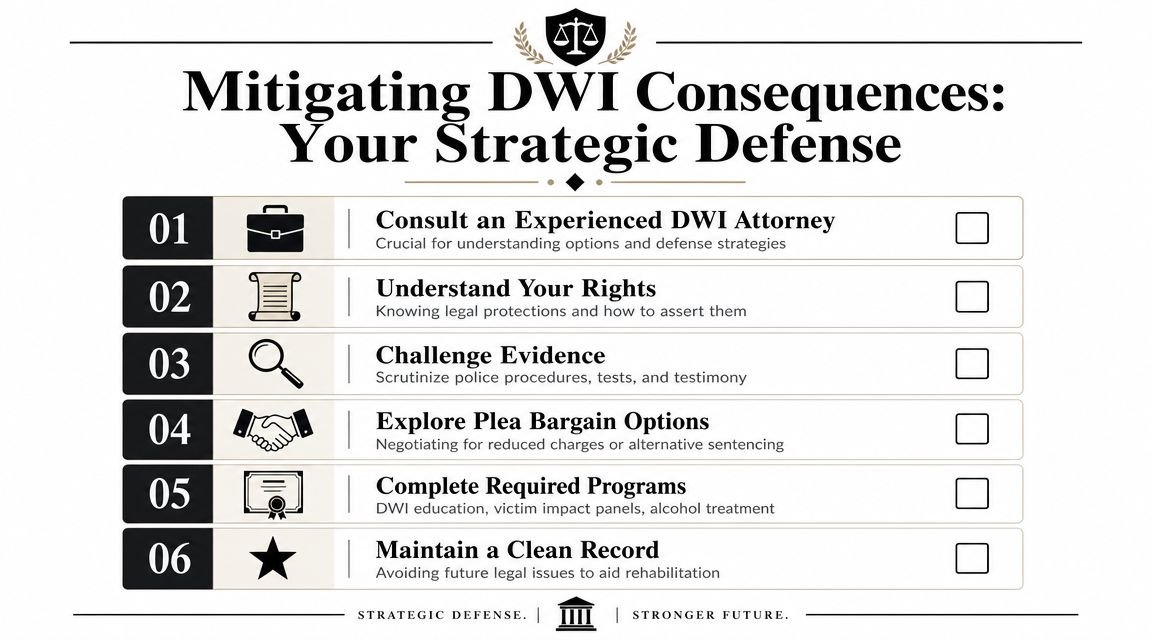
Request the ALR hearing before the deadline
That preserves your chance to challenge the suspension and gives your lawyer an early look at the officer's version of events.Save every document
Keep the notice of suspension, bond paperwork, towing records, testing paperwork, and anything tied to your work schedule or medical needs.Write out your timeline
Record where you were, why you were stopped, what you said, what the officer said, and what testing was requested. Small details often become the details that matter.Stop talking about the case casually
Do not explain it to coworkers, post about it online, or try to talk your way out of it with anyone connected to the case.
Build the defense around long-term exposure, not just guilt or innocence
A smart defense looks at more than whether the state filed a charge. It asks which parts of the case can do lasting damage and how to cut those off early.
That starts with a close look at the evidence:
The traffic stop
Was there a legal reason to pull you over in the first place?The officer's observations
Do the report and video match?The field sobriety tests
Were the instructions clear and the testing conditions fair?The chemical test
Was the sample obtained, handled, and analyzed the right way?The timeline
Are there gaps, inconsistencies, or shortcuts that weaken the state's proof?
This kind of review does more than prepare for trial. It shapes negotiations, affects license strategy, and can change how much risk the prosecutor sees in pushing the case.
Choose outcomes that protect your future options
The best result is not always the loudest result. Sometimes the smartest win is the one that limits what follows you into job applications, licensing reviews, custody disputes, or future background checks.
Depending on the facts, that may mean pursuing:
| Strategy | Why it matters |
|---|---|
| Charge reduction | A different outcome on paper can reduce damage to employment, housing, and reputation |
| Deferred adjudication if it fits the case | It may leave you in a better long-term position than a straight conviction |
| Early mitigation work | Treatment, counseling, or other documented steps can improve how the case is resolved |
| Record strategy after the case | Cleanup later can matter almost as much as the result in court |
I tell clients to think two moves ahead. If a resolution today creates a cleaner record path later, that matters. If you want to see how post-case record protection may work, review this Texas guide to DWI nondisclosure.
Do not treat the license problem as an afterthought
Many people focus on court and assume driving privileges will sort themselves out later. That is a mistake. Reinstatement usually requires specific action, and delays can keep the disruption going long after the criminal case feels settled.
Your lawyer should be tracking the full sequence from the start. That includes the ALR hearing, the evidence issues, possible court resolutions, reinstatement steps, and the record consequences that may show up later. A DWI case is not one event. It is a series of connected problems, and the defense has to address them in that order.
The Law Office of Bryan Fagan, PLLC handles DWI defense, ALR hearings, evidence challenges, and record-related strategy for Texas clients dealing with first-time, repeat, and license-sensitive cases.
What I recommend you do now
Take these steps immediately:
Get a DWI lawyer involved early
Early review protects deadlines, preserves evidence, and gives you better options.Follow every bond condition exactly
Judges and prosecutors notice carelessness fast.Protect your work situation carefully
Share only what is necessary. Extra explanations usually create extra problems.Keep proof that you are stable and responsible
Save work records, class records, treatment records, and anything else that shows consistency.Ask future-focused questions
Do not stop at “What happens in court?” Ask how this case could affect your license, record, income, insurance, and family life next year too.
That is how you limit long-term damage. A good defense is not reactive. It is early, deliberate, and built to protect your future at every stage.
Take Control of Your Future After a Texas DWI Arrest
A DWI arrest can leave you feeling like everything is moving against you at once. Court dates, license risk, work pressure, family stress, and money problems can hit in a very short window. That's exactly why you need a plan, not guesswork.
The long term consequences of a DWI conviction in Texas are serious. They can affect your ability to drive, your professional path, your finances, your reputation, and your options years down the road. But serious does not mean hopeless. It means the case needs immediate, strategic attention.
You don't have to solve the whole problem today. You do need to make the right first move today.
That first move is getting clear advice about the ALR deadline, the criminal charge, the evidence against you, and effective ways to reduce the damage. A careful defense can protect more than your court file. It can protect your future.
If you're dealing with a first DWI in Texas, a repeat charge, a DWI license suspension issue, or you need a Houston DWI lawyer who understands how these cases affect real life, act now. Waiting helps the state. Preparation helps you.
If you're ready to protect your license, your record, and your future, contact Law Office of Bryan Fagan, PLLC for a free, confidential case evaluation. We can review the stop, the testing, the ALR timeline, and the criminal case with you, then help you decide the smartest next step.
