
A DWI arrest in Texas can be overwhelming, throwing your life into chaos. Suddenly, you're facing a suspended license, and it's easy to feel like you've lost all control. But you don’t have to face it alone. There is a clear path to getting your license back, and our goal is to help you understand your rights and take the first step toward your legal defense.
A DWI Arrest Is Overwhelming, But You're Not Alone
After a DWI arrest, you're actually fighting on two separate fronts. There's the criminal case that goes through the courts, and then there's the administrative case with the Texas Department of Public Safety (DPS). This second part is what triggers an Administrative License Revocation (ALR)—an automatic suspension that can happen long before you are ever found guilty of a crime.
Why does this happen so fast? It all comes down to Texas's "implied consent" law. The moment you get behind the wheel on a Texas road, you've legally agreed to provide a breath or blood sample if an officer lawfully arrests you for DWI.

The entire process can feel like a bureaucratic nightmare, but it becomes manageable once you break it down into smaller pieces. Remember, the actions you take in the first few days are critical to protecting your driving privileges.
Understanding Key DWI Terms
To get your license back, you first need to understand the language of a Texas DWI case. Here are the key terms you need to know:
- Administrative License Revocation (ALR): This is not a criminal penalty. It's a civil suspension of your license handled by the Texas DPS. It is triggered if you refuse a chemical test or if you provide a sample showing a Blood Alcohol Concentration (BAC) of 0.08% or higher.
- Implied Consent: This is the legal rule that says by driving on Texas roads, you have already consented to a breath or blood test if you are lawfully arrested for DWI. Refusing the test comes with its own automatic penalty: a 180-day license suspension for a first-time refusal.
- Blood Alcohol Concentration (BAC): This is the percentage of alcohol in your bloodstream. For most drivers in Texas, the legal limit is 0.08%. If you're a commercial driver, that limit drops to 0.04%.
A DWI arrest doesn’t have to mean the end of your driving privileges. With a knowledgeable Houston DWI lawyer on your side, you can challenge the administrative suspension and build a strong defense for your criminal case.
Knowing these terms is your foundation for what comes next. The ALR process is completely separate from any criminal penalties you might face, which is why you have to deal with it right away to protect your ability to drive. The moves you make in the first 15 days after your arrest are the most critical.
Find Out Exactly Why Your Texas License Is Suspended
Before you can get back on the road, you must determine precisely why your license was taken away. A license suspension in Texas is rarely a single issue; it’s often a combination of different holds and requirements that must be addressed.
Your journey starts at the source: the Texas Department of Public Safety (DPS). Their online portal allows you to check your driver's license status. This isn’t just about seeing the word "suspended"—it's about digging into the details to find every single flag DPS has on your record.
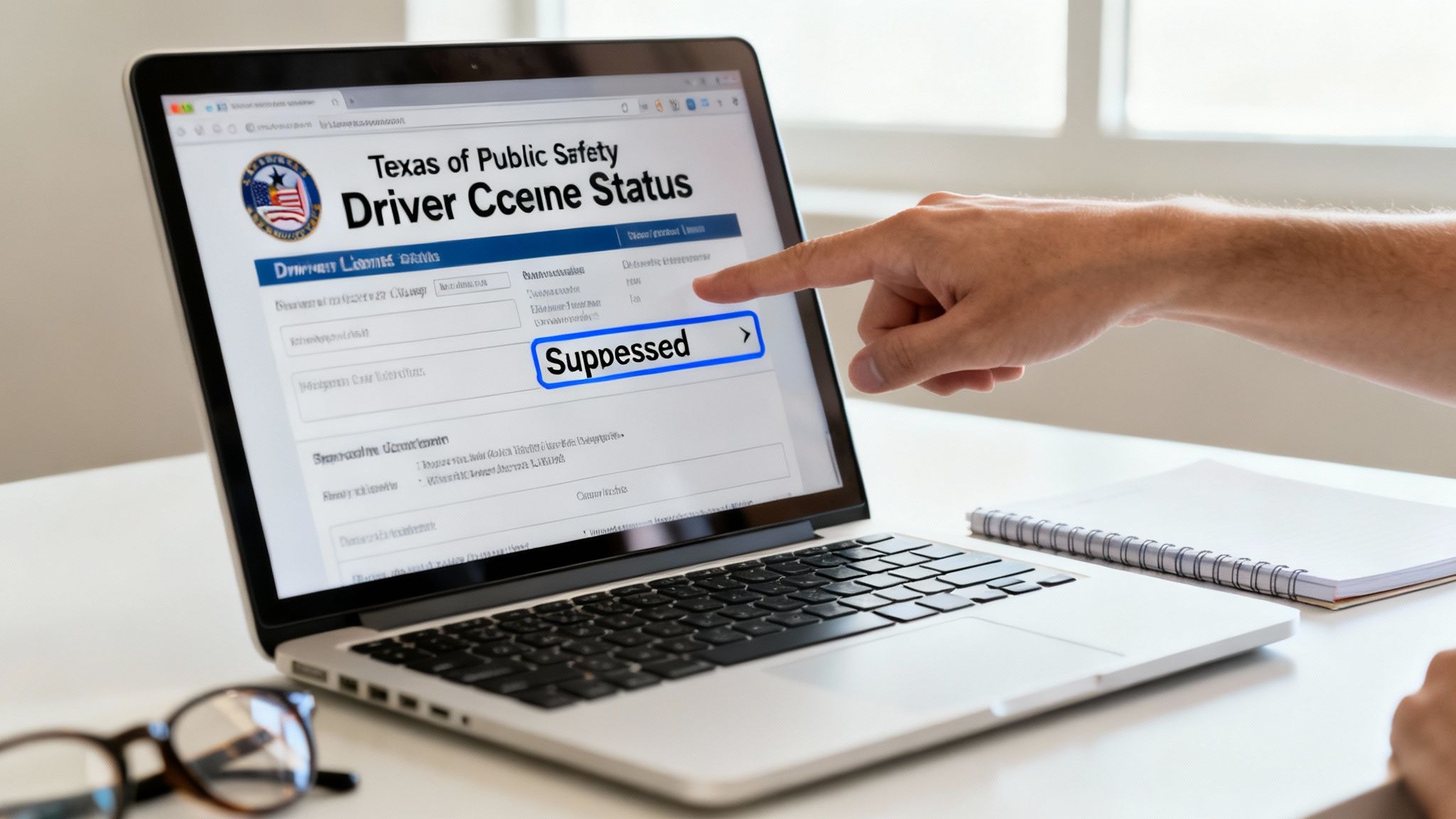
This step is non-negotiable. You could waste significant time and money trying to fix the wrong problem. For example, paying a reinstatement fee for a DWI suspension does you no good if there's still an unresolved hold from an old traffic ticket.
Decoding the Reasons on Your Record
When you check your license status, you may find multiple issues. Each one has its own set of rules, fees, and paperwork for clearance. A successful reinstatement plan must tackle every single one of them.
Here are some of the most common reasons you might see for a DWI license suspension and other holds:
- Administrative License Revocation (ALR): This is the automatic suspension that follows a DWI arrest for either refusing a breath or blood test or failing one (blowing 0.08% BAC or higher). This is a civil penalty and happens completely separately from your criminal case.
- Court-Ordered Suspension: If you're ultimately convicted of DWI, the judge will hand down a separate suspension as part of your criminal sentence. This suspension often has different start dates and a different length than the ALR.
- Unpaid Surcharges or Fines: While the old Driver Responsibility Program (DRP) is gone, you might still have lingering surcharges or unpaid court fines from old traffic tickets that are blocking your license.
- Failure to Appear: Ignoring a traffic ticket or missing a court date can trigger a hold that stops you from renewing or reinstating your license until you address the original ticket.
It's also important to know the difference between a license revocation vs suspension, as the paths to getting your driving privileges back can vary. For a deeper dive, check out our guide explaining revocation vs suspension in our article.
Common Reasons for License Suspension in Texas
To make it clearer, here's a breakdown of the most frequent causes of a Texas driver's license suspension, how long they typically last, and the first thing you need to do to start fixing it.
| Suspension Reason | Typical Suspension Period | First Reinstatement Action |
|---|---|---|
| DWI – ALR (Test Failure) | 90 days – 1 year | Pay a $125 reinstatement fee and provide an SR-22. |
| DWI – ALR (Test Refusal) | 180 days – 2 years | Pay a $125 reinstatement fee and provide an SR-22. |
| Court-Ordered DWI Conviction | 90 days – 2 years | Complete court-ordered terms (classes, fines, interlock). |
| Unpaid Tickets / Surcharges | Indefinite (until paid) | Pay all outstanding fines and fees with the relevant court. |
| Driving Without Insurance | Indefinite (until compliance) | Provide proof of valid insurance (SR-22). |
| Habitual Violator (Points) | 1 year | Complete a defensive driving course and pay reinstatement fees. |
This table is just a starting point. Your DPS record will have the specifics for your situation, which is why it's so important to get a copy of it.
The Lingering Impact of Old Programs and Fines
Many Texas drivers are surprised by suspensions that have nothing to do with a recent DWI. The now-defunct Driver Responsibility Program (DRP), for instance, created financial burdens that led to countless suspensions. When the state repealed it in 2019, more than 600,000 drivers whose only issue was DRP surcharges were suddenly eligible for reinstatement.
However, another 400,000 still had other unresolved holds, and 300,000 more were stuck because of holds from the Omni program for unpaid tickets. You can learn more about how the DRP repeal's impact on Texas drivers at texastribune.org.
Your DPS record is your roadmap. It tells you every single obstacle you need to clear before you can get your license back. A Houston DWI lawyer can help you read that map and build a step-by-step plan to address each hold, one by one.
Getting this diagnostic phase right is the foundation of your entire effort. By carefully reviewing your official DPS record, you can create a clear checklist of everything you need to do. This clarity prevents frustration and ensures that when you finish the process, your license is truly and legally valid again.
Tackling the Reinstatement Checklist: SR-22, Fees, and Courses
Once you know exactly what’s holding up your driver’s license, you can begin taking action. This is the part where you methodically check off every box on the Texas Department of Public Safety’s (DPS) list. Think of it as your game plan for getting back on the road.
Getting it right the first time is key to avoiding frustrating delays. For most DWI-related suspensions, this boils down to three core tasks: proving you have the right insurance, paying your fees, and finishing the required classes.
What Exactly Is SR-22 Insurance?
Let's clear up one of the biggest points of confusion: the SR-22. It’s not a type of insurance policy. An SR-22 is a certificate of financial responsibility. It’s a form your insurance company files with the DPS that says, "We're covering this driver, and we'll notify you if their policy lapses."
If you’re dealing with a DWI suspension in Texas, you are almost guaranteed to need an SR-22. This requirement usually lasts for two years from the date of your conviction. Letting your coverage lapse is a critical mistake—your insurer is legally required to notify the DPS, which will suspend your license all over again.
To obtain an SR-22, contact your current insurance provider or shop for one that handles these policies. Be prepared for higher rates; a DWI on your record makes you more expensive to insure. For a deeper dive, you can learn about the impact of a Texas DUI on SR-22 insurance costs in our guide.
Paying the DPS Reinstatement Fees
Next up are the fees. You’ll need to pay a standard reinstatement fee of $125 directly to the DPS to finalize the process. This is completely separate from any court costs, fines, or probation fees tied to your criminal case.
You can handle this payment online, by mail, or at some driver's license offices. However, do not pay this fee until you've cleared every other hold on your license. If you still have outstanding traffic tickets, that $125 won't resolve your suspension. The eligibility page on the DPS website is your guide—it lists everything you need to take care of first.
The $125 reinstatement fee is the final step in clearing the suspension. Paying it early, before finishing your DWI classes or getting your SR-22 filed, won't speed anything up.
Completing the Mandatory DWI Education Courses
The last piece of the puzzle is education. Texas requires anyone with a DWI-related suspension to complete a state-approved program. The course you need depends entirely on your DWI history.
DWI Education Program (12-Hour Course): This is the standard for a first-time DWI offense. It’s a 12-hour class covering Texas laws, how alcohol affects your judgment, and ways to avoid repeating the mistake. Upon completion, you’ll get a certificate to submit to the DPS.
DWI Intervention Program (32-Hour Program): If you have two or more DWI convictions, you’ll be required to take a much more intensive course. This is a 32-hour program for "repeat offenders" that goes deeper into the root causes of substance abuse.
Signing up for the right class is non-negotiable. If you take the 12-hour course when you were ordered to complete the 32-hour one, the DPS will reject your certificate, and you’ll be right back at square one. By carefully knocking out these three requirements—SR-22, fees, and education—you create a direct path to getting your license back.
Protecting Your Driving Privileges with ALR Hearings and Occupational Licenses
When you're arrested for a DWI, it's easy to feel like losing your license is a foregone conclusion. It’s not. In fact, you have a critical—and very short—window of opportunity to fight the suspension before it even starts. Taking proactive steps right away is the single best move to stay on the road.
The clock starts ticking the moment you're arrested. The state of Texas gives you only 15 days from that date to request an Administrative License Revocation (ALR) hearing. If you miss this deadline, you automatically forfeit your right to challenge the suspension, and it will take effect on the 40th day after your arrest.
Requesting an ALR hearing is a strategic legal move where a skilled DWI lawyer can start dismantling the state's case against your driving privileges.
The ALR Hearing: Your First Line of Defense
An ALR hearing is a civil proceeding, completely separate from your criminal DWI case. It takes place before an administrative law judge, and its only purpose is to decide if the Texas Department of Public Safety (DPS) has the legal grounds to suspend your license.
This is where your attorney gets the first chance to challenge the evidence. They can question key parts of the traffic stop and arrest, asking:
- Did the officer have reasonable suspicion to pull you over in the first place?
- Was there probable cause to justify a DWI arrest?
- Were you correctly informed of the consequences of refusing or failing a breath or blood test?
If your attorney wins the ALR hearing, the judge rules against the DPS, and your license is not suspended. That’s a huge win that protects your freedom to drive while you deal with the separate criminal charges.
What Happens If You Miss the ALR Deadline?
If you don't request the hearing in time, or if the judge rules for the DPS, the administrative suspension begins. For most people, this is when the real challenges start. Simple things like getting to work, taking kids to school, or making it to a doctor's appointment become logistical hurdles.
Once a suspension is in effect, you're also required to complete specific educational programs to get your license back, as the flowchart below illustrates.
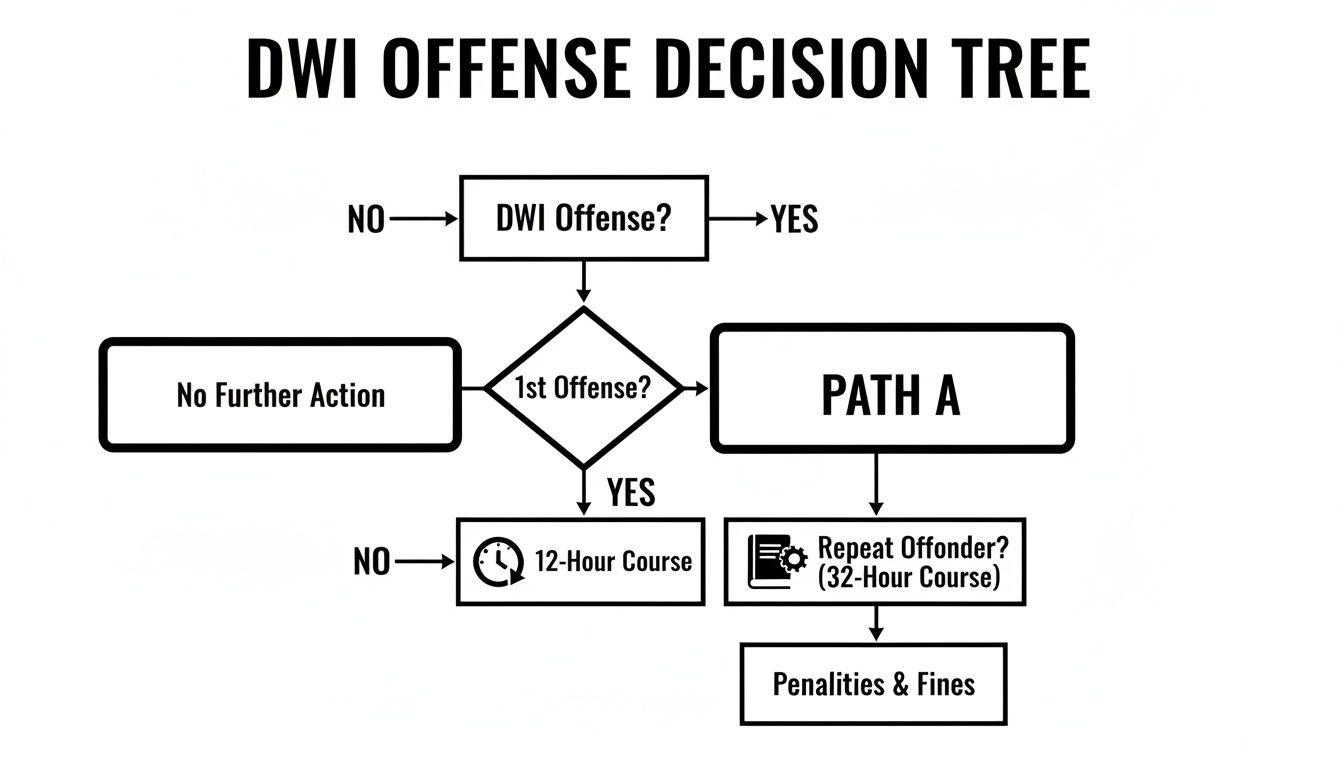
This decision tree shows how the consequences escalate quickly. The state mandates a 12-hour course for a first offense but ramps it up to a much more intensive 32-hour program for repeat offenses, underscoring why fighting the suspension from day one is so important.
Securing an Occupational Driver's License
Even if your license does get suspended, you may not be completely stranded. Texas law allows you to petition the court for an Occupational Driver’s License (ODL), also known as an essential need license. This isn't a full reinstatement; it's a special court order that lets you drive for specific, necessary reasons.
An ODL puts strict limits on your driving but allows you to handle essential life activities, such as:
- Driving to and from your job
- Performing duties required for your work
- Attending school or college classes
- Getting to medical appointments for yourself or a family member
- Running essential household errands, like buying groceries
An Occupational Driver's License can be the lifeline that keeps your life on track during a suspension period. It allows you to maintain your job and fulfill your family obligations while you work toward full reinstatement.
Getting an ODL involves filing a formal petition with the court, getting SR-22 insurance, and proving to a judge that you have an essential need to drive. If the judge approves, you’ll receive a court order that you must carry with you anytime you're behind the wheel. You can learn more about the specific steps in our guide on how to get an occupational license.
Whether you're fighting an impending suspension at an ALR hearing or need an ODL to manage an existing one, acting quickly with the right legal guidance is everything. A proactive approach, guided by an experienced attorney, can dramatically reduce the disruption to your life.
Special Cases: CDL Holders, Felony Charges, and Repeat Offenses
Not all license suspensions are created equal. For some drivers, a DWI arrest triggers a cascade of consequences that are far more severe and life-altering.
If you drive for a living, have prior offenses, or are facing a felony charge, the standard playbook for getting your license back just won't cut it. The stakes are much higher, and you need a defense strategy tailored to your unique situation.
The Career-Ending Threat to Commercial Drivers
For a professional driver, a DWI can be a career-ending event. Anyone holding a Commercial Driver's License (CDL) is immediately subject to strict federal regulations the moment they're arrested for DWI.
A first-time DWI conviction will result in a one-year disqualification of your CDL. That’s a year without work or income. If it happens a second time, you’re looking at a lifetime ban—a devastating outcome for any professional driver.
Protecting your CDL isn't just about getting back on the road; it's about saving your livelihood. This requires an aggressive defense from day one to challenge every aspect of the arrest—the stop, the sobriety tests, and the chemical results—to fight both the criminal charges and the automatic disqualification.
When DWI Becomes a Felony or Repeat Offense
For non-commercial drivers, the situation becomes exponentially more serious with each DWI arrest. A second or third conviction pushes you into a different tier of penalties, where the state's focus shifts from education to long-term monitoring and significant license revocations. The road to getting your license back becomes much longer and more complicated.
If you find yourself in this situation, you can expect:
- Lengthy License Revocations: Suspensions are measured in years, not months.
- Mandatory Ignition Interlock Devices (IID): A judge will almost certainly order an IID on your vehicle for an extended period, sometimes for years after your license is reinstated. This device requires a clean breath sample before your car will start.
- Intensive Intervention Programs: The standard 12-hour DWI class is off the table. Instead, you'll be required to complete a 32-hour DWI Intervention Program designed for repeat offenders.
The legal system is built to penalize those with prior offenses. Data from Texas enforcement actions shows that while first offenses often result in 180-day suspensions, repeat offenses can easily trigger two-year suspensions, with even longer revocations for charges like intoxication assault.
The state’s tough stance is clear from the sheer volume of enforcement actions. In a recent fiscal year, the DPS Regulatory Services Division alone managed 1,125 suspensions and 110 revocations in related fields. You can get a sense of the scale of these enforcement actions in the DPS's 2025 regulatory report.
Why a Specialized Defense Is Not Optional
In these high-stakes cases, there is no room for error. A one-size-fits-all defense won't address the nuances of a felony charge or the federal laws that govern CDLs.
You need a Houston DWI lawyer who specializes in these complex cases—someone who knows how to build a defense tailored to mitigate these severe consequences. This means scrutinizing every piece of evidence, from the initial traffic stop to the final breath or blood test result, to find weaknesses in the prosecution's case. The goal is to protect your career, your freedom, and your future.
Take Control of Your Future with a Houston DWI Lawyer
Trying to figure out how to reinstate a suspended license in Texas on your own feels like navigating a maze blindfolded. The Texas Department of Public Safety (DPS) has a specific, and often unforgiving, process. One small mistake on a form or a single missed deadline can send you right back to square one, adding weeks or even months to your suspension.
This is where having an experienced legal partner makes all the difference. At The Law Office of Bryan Fagan, PLLC, our job doesn’t stop in the courtroom. We are here to guide you through every administrative hurdle, from fighting for you at the ALR hearing to ensuring every piece of reinstatement paperwork is filed correctly the first time.
A Clear Path Forward
We know the complex web of requirements that can keep you off the road, and more importantly, we know how to untangle it. Getting your license back demands absolute precision.
This often means filing for an SR-22, paying the $125 reinstatement fee, and in many cases, installing an ignition interlock device for 6-12 months after a first DWI. Our experience shows that while the state has provided some relief for certain drivers, those facing a DWI still have to clear layered obstacles. For example, thousands of Texans are stuck because of holds from the Failure to Appear database. You can discover more insights in the DPS's 2025 regulatory report.
You don't have to face the DPS alone. A skilled Houston DWI lawyer can build a comprehensive strategy aimed at protecting your rights and restoring your freedom to drive as efficiently as possible.
Don't let the administrative bureaucracy overwhelm you. Take the first step toward clarity and taking back control. Our team is ready to review your case and build a plan tailored to your specific situation. Contact The Law Office of Bryan Fagan, PLLC today to request a free, no-obligation consultation and start your journey back to the road.
Questions We Hear All the Time About Reinstating a Texas License
Even with a step-by-step guide, you’re bound to have questions about your specific situation. Getting your license back after a DWI can feel like trying to hit a moving target. Here are direct answers to the most common concerns we hear from clients.
Can I Get My License Back Sooner?
In most cases, you must wait out the full suspension period handed down by the DPS or the court. There is no shortcut around that. However, you can often get back on the road for essential trips much sooner by applying for an Occupational Driver's License (ODL).
An ODL is a restricted license. It won't let you drive freely, but it will allow you to drive for critical needs like work, school, and doctor's appointments while the clock runs out on your full suspension.
What if I Have Holds From Old Tickets?
This is a common roadblock. Your license is going nowhere if you have any outstanding holds, especially from the state's Failure to Appear/Failure to Pay program. Before the DPS will consider your reinstatement, you have to clear these issues directly with the court that issued the original ticket. Sometimes, paying a forgotten fine is all it takes to remove a barrier that's been holding up your license for years.
How Long Do I Really Need SR-22 Insurance?
For a DWI-related suspension, the standard requirement is to maintain an SR-22 for two years starting from the date of your conviction. This is non-negotiable. It is critical that you do not let this insurance lapse, not even for a day. If you do, your insurance provider is legally required to notify the DPS, your license will be suspended again, and you'll have to start this process over.
The Bottom Line: For a first DWI, the reinstatement formula is pretty consistent: resolve your criminal case, pay the $125 reinstatement fee to the DPS, get your SR-22 filed, and finish the mandatory 12-hour DWI education course.
The state's stance on license holds is only getting stricter. Recent legislation, for example, gives the DPS the power to place an indefinite hold on a license for all sorts of unpaid fines, not just those related to DWI. You can get a better sense of how legislative changes impact license suspensions by reviewing recent laws like Texas Senate Bill 2205 (2025).
Can Filing for Bankruptcy Help With My License?
In very specific situations, it might. While bankruptcy generally can't wipe out government fines owed for a DWI, it can eliminate other unsecured debts like credit card bills or medical debt. This could free up the cash you need to pay the court costs and reinstatement fees that are blocking you from getting your license back.
Trying to navigate the DPS reinstatement process on your own is a real headache, but you don't have to go it alone. The Law Office of Bryan Fagan, PLLC has the experience to guide you through every administrative hurdle and get you back behind the wheel. We know the system inside and out and can create a clear, actionable plan to restore your driving privileges. Contact us today for a free consultation to talk about your case.